Driving your vehicle
36
5
E120000AUN-UK The onset of winter conditions subject
motor vehicles to greater operating
demands. Therefore, the following sug-gestions will assist in maintaining peak
performance and reliability during these
periods: E120100AUN-UK
Snowy or Icy conditions
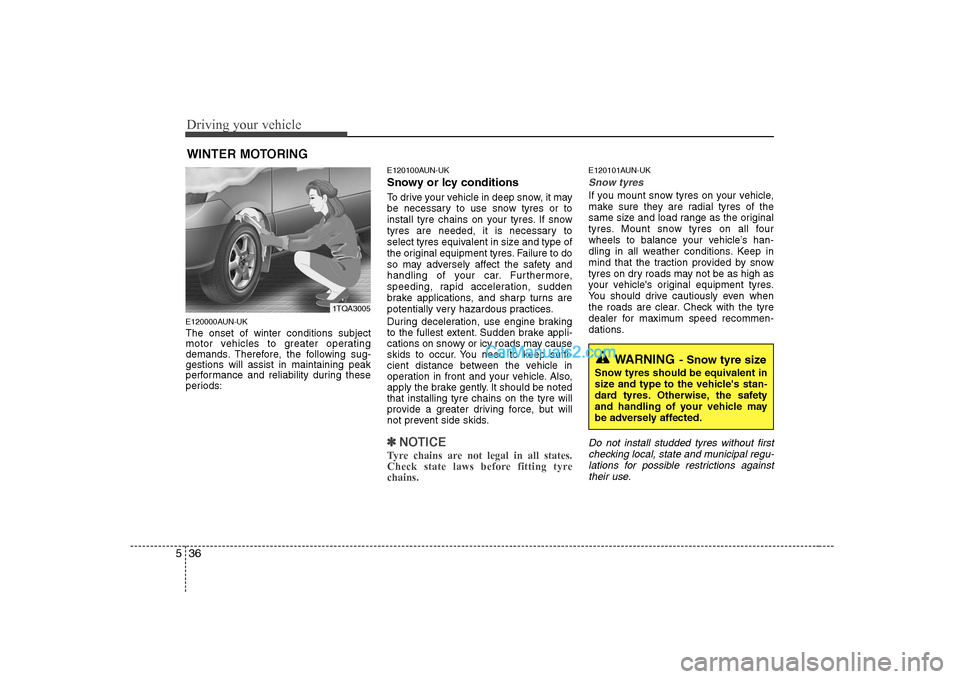
To drive your vehicle in deep snow, it may
be necessary to use snow tyres or to
install tyre chains on your tyres. If snow
tyres are needed, it is necessary to
select tyres equivalent in size and type of
the original equipment tyres. Failure to do
so may adversely affect the safety and
handling of your car. Furthermore,
speeding, rapid acceleration, sudden
brake applications, and sharp turns are
potentially very hazardous practices.
During deceleration, use engine braking
to the fullest extent. Sudden brake appli-
cations on snowy or icy roads may cause
skids to occur. You need to keep suffi-
cient distance between the vehicle in
operation in front and your vehicle. Also,
apply the brake gently. It should be notedthat installing tyre chains on the tyre will
provide a greater driving force, but will
not prevent side skids.
✽✽
NOTICE
Tyre chains are not legal in all states.
Check state laws before fitting tyrechains.
E120101AUN-UK
Snow tyres
If you mount snow tyres on your vehicle,
make sure they are radial tyres of the
same size and load range as the original
tyres. Mount snow tyres on all four
wheels to balance your vehicle’s han-
dling in all weather conditions. Keep in
mind that the traction provided by snow
tyres on dry roads may not be as high as
your vehicle's original equipment tyres.
You should drive cautiously even when
the roads are clear. Check with the tyre
dealer for maximum speed recommen-
dations.
Do not install studded tyres without first checking local, state and municipal regu-
lations for possible restrictions against their use.
WINTER MOTORING
WARNING - Snow tyre size
Snow tyres should be equivalent in
size and type to the vehicle's stan-
dard tyres. Otherwise, the safety
and handling of your vehicle may
be adversely affected.
1TQA3005
617
What to do in an emergency
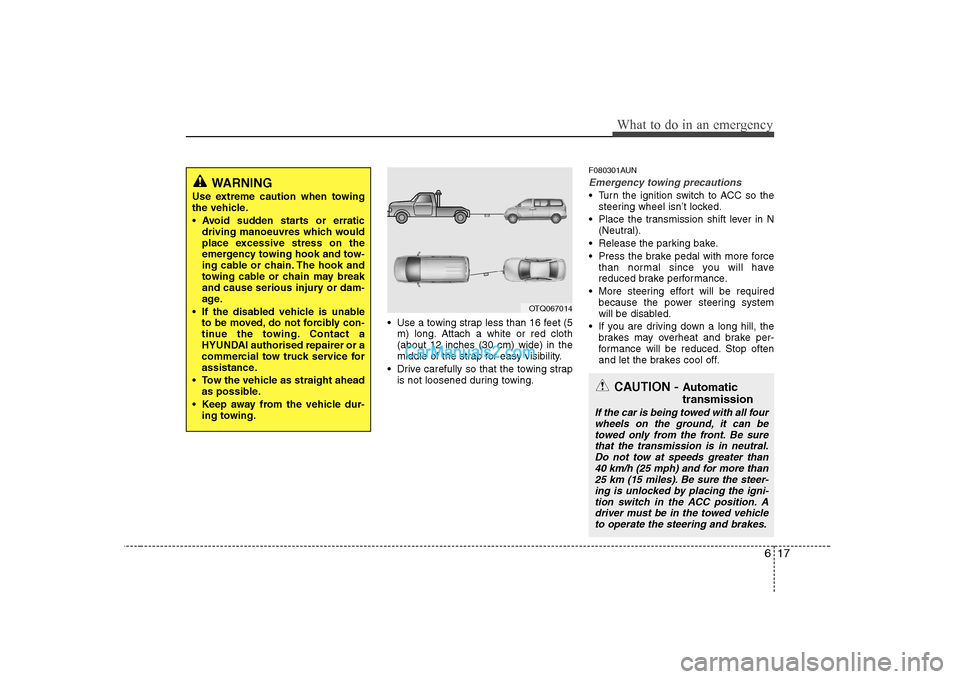
Use a towing strap less than 16 feet (5m) long. Attach a white or red cloth (about 12 inches (30 cm) wide) in the
middle of the strap for easy visibility.
Drive carefully so that the towing strap is not loosened during towing. F080301AUN
Emergency towing precautions
Turn the ignition switch to ACC so the
steering wheel isn’t locked.
Place the transmission shift lever in N (Neutral).
Release the parking bake.
Press the brake pedal with more force than normal since you will have
reduced brake performance.
More steering effort will be required because the power steering system
will be disabled.
If you are driving down a long hill, the brakes may overheat and brake per-
formance will be reduced. Stop often
and let the brakes cool off.
WARNING
Use extreme caution when towing
the vehicle.
driving manoeuvres which would
place excessive stress on the
emergency towing hook and tow-
ing cable or chain. The hook and
towing cable or chain may break
and cause serious injury or dam-
age.
If the disabled vehicle is unable to be moved, do not forcibly con-
tinue the towing. Contact a
HYUNDAI authorised repairer or a
commercial tow truck service for
assistance.
Tow the vehicle as straight ahead as possible.
Keep away from the vehicle dur- ing towing.
OTQ067014
CAUTION - Automatic transmission
If the car is being towed with all four
wheels on the ground, it can be towed only from the front. Be surethat the transmission is in neutral. Do not tow at speeds greater than
40 km/h (25 mph) and for more than 25 km (15 miles). Be sure the steer-ing is unlocked by placing the igni- tion switch in the ACC position. A
driver must be in the towed vehicle to operate the steering and brakes.