2009 Hyundai Elantra ESP
[x] Cancel search: ESPPage 202 of 308
Driving your vehicle
40
5
Driving with a trailer
Towing a trailer requires a certain
amount of experience. Before setting out
for the open road, you must get to know
your trailer. Acquaint yourself with the
feel of handling and braking with the
added weight of the trailer. And always
keep in mind that the vehicle you are
driving is now a good deal longer and not
nearly so responsive as your vehicle is
by itself.
Before you start, check the trailer towbar
and platform, safety chains, electrical
connector(s), lights, tyres and mirror
adjustment. If the trailer has electric
brakes, start your vehicle and trailer mov-
ing and then apply the trailer brake con-
troller by hand to be sure the brakes are
working. This lets you check your electri-
cal connection at the same time.
During your trip, check occasionally to be
sure that the load is secure, and that the
lights and any trailer brakes are still work-ing.Following distance
Stay at least twice as far behind the vehi-
cle ahead as you would when driving
your vehicle without a trailer. This can
help you avoid situations that require
heavy braking and sudden turns.
Passing
You’ll need more passing distance up
ahead when you’re towing a trailer. Due
to the increased vehicle length, you’ll
need to go much farther beyond the
passed vehicle before you can return to
your lane.
Backing up
Hold the bottom of the steering wheel
with one hand. Then, to move the trailer
to the left, just move your hand to the left.
To move the trailer to the right, move your
hand to the right. Always back up slowly
and, if possible, have someone guide
you.
Making turns
When you’re turning with a trailer, make
wider turns than normal. Do this so your
trailer won’t strike soft shoulders, curbs,
road signs, trees, or other objects. Avoid
jerky or sudden manoeuvres. Signal well
in advance.
Turn signals when towing a trailer
When you tow a trailer, your vehicle has
to have a different turn signal flasher and
extra wiring. The green arrows on your
instrument panel will flash whenever you
signal a turn or lane change. Properly
connected, the trailer lights will also flash
to alert other drivers you’re about to turn,
change lanes, or stop.
When towing a trailer, the green arrows
on your instrument panel will flash for
turns even if the bulbs on the trailer are
burned out. Thus, you may think drivers
behind you are seeing your signals
when, in fact, they are not. It’s important
to check occasionally to be sure the trail-
er bulbs are still working. You must also
check the lights every time you discon-
nect and then reconnect the wires.
Do not connect a trailer lighting system
directly to your vehicle’s lighting system.
Use only an approved trailer wiring har-
ness.
An authorised Hyundai dealer can assist
you in installing the wiring harness.
WARNING
Failure to use an approved trailer wiring harness could result in dam-
age to the vehicle electrical system
and/or personal injury.
Page 221 of 308
613
What to do in an emergency
The compact spare should be inflated to
420 kPa (60 psi).
✽✽NOTICE
Check the inflation pressure after
installing the spare tire. Adjust it to the
specified pressure, as necessary.
When using a compact spare tire,
observe the following precautions:
Under no circumstances should you exceed 80 km/h (50 mph); a higher
speed could damage the tire.
Ensure that you drive slowly enough for the road conditions to avoid all haz-
ards. Any road hazard, such as a pot-
hole or debris, could seriously damage
the compact spare.
Any continuous road use of this tire could result in tire failure, loss of vehi-
cle control, and possible personal
injury.
Do not exceed the vehicle’s maximum load rating or the load-carrying capaci-
ty shown on the sidewall of the com-
pact spare tire.
Avoid driving over obstacles. The com- pact spare tire diameter is smaller than
the diameter of a conventional tire and
reduces the ground clearance approxi-mately 25 mm (1 inch), which could
result in damage to the vehicle.
Do not take this vehicle through an automatic car wash while the compactspare tire is installed.
Do not use tire chains on the compact spare tire. Because of the smaller size,
a tire chain will not fit properly. This
could damage the vehicle and result inloss of the chain. The compact spare tire should not be
installed on the front axle if the vehicle
must be driven in snow or on ice.
Do not use the compact spare tire on any other vehicle because this tire has
been designed especially for your vehi-
cle.
The compact spare tire’s tread life is shorter than a regular tire. Inspect your
compact spare tire regularly and
replace worn compact spare tires with
the same size and design, mounted onthe same wheel.
The temporary spare tire should not be used on any other wheels, nor should
standard tires, snow tires, wheel cov-
ers or trim rings be used with the tem-
porary spare wheel. If such use isattempted, damage to these items or
other car components may occur.
Do not use more than one temporary spare tire at a time.
Do not tow a trailer while the temporary spare tire is installed.
WARNING
This spare tire should be used only
for VERY short distances. Compact
spares should NEVER be used for
long drives or extended distances.
Page 228 of 308
73
Maintenance
MAINTENANCE SERVICES
You should exercise the utmost care to
prevent damage to your vehicle and
injury to yourself whenever performing
any maintenance or inspection proce-
dures.
Should you have any doubts concerning
the inspection or servicing of your vehi-
cle, we strongly recommend that you
have an authorised Hyundai dealer per-
form this work.
An authorised Hyundai dealer has facto-
ry-trained technicians and genuine
Hyundai parts to service your vehicle
properly. For expert advice and quality
service, see an authorised Hyundai deal-
er.
Inadequate, incomplete or insufficient
servicing may result in operational prob-
lems with your vehicle that could lead to
vehicle damage, an accident, or person-
al injury. Owner’s responsibility
✽✽
NOTICE
Maintenance Service and Record
Retention are the owner's responsibility.
You should retain documents that show
proper maintenance has been performed
on your vehicle in accordance with the
scheduled maintenance service charts
shown on the following pages. You need
this information to establish your compli-
ance with the servicing and maintenance
requirements of your vehicle warranties.
Detailed warranty information is provided
in your Service Passport. Repairs and adjustments required as a
result of improper maintenance or a lack
of required maintenance are not covered.
We recommend you have your vehicle
maintained and repaired by an autho-
rised Hyundai dealer. An authorised
Hyundai dealer meets Hyundai’s high
service quality standards and receives
technical support from Hyundai in order
to provide you with a high level of service
satisfaction.
Page 231 of 308
Maintenance
6
7
Owner maintenance precautions
Improper or incomplete service may
result in problems. This section gives
instructions only for the maintenance
items that are easy to perform.
As explained earlier in this section, sev-
eral procedures can be done only by an
authorised Hyundai dealer with special
tools.
✽✽
NOTICE
Improper owner maintenance during the warranty period may affect warran-
ty coverage. For details, read the sepa-
rate Service Passport provided with the
vehicle. If you're unsure about any serv-
icing or maintenance procedure, have it
done by an authorised Hyundai dealer.
SCHEDULED MAINTENANCE
SERVICE
Follow Normal Maintenance Schedule
if the vehicle is usually operated where
none of the following conditions apply. If
any of the following conditions apply, fol-
low Maintenance Under Severe Usage
Conditions.
Repeated short distance driving.
Driving in dusty conditions or sandy areas.
Extensive use of brakes.
Driving in areas where salt or other corrosive materials are being used.
Driving on rough or muddy roads.
Driving in mountainous areas.
Extended periods of idling or low speed operation.
Driving for a prolonged period in cold temperatures and/or extremely humid
climates.
More than 50% driving in heavy city traffic during hot weather above 32°C.
If your vehicle is operated under the
above conditions, you should inspect,replace or refill more frequently than the following Normal Maintenance Schedule.After 96 month or 120,000 km continue
to follow the prescribed maintenance intervals.
WARNING - Maintenance
work
Performing maintenance work on a vehicle can be dangerous. You
can be seriously injured while
performing some maintenance
procedures. If you lack sufficient
knowledge and experience or the
proper tools and equipment to do
the work, have it done by an
authorised Hyundai dealer.
Working under the bonnet with the engine running is dangerous.
It becomes even more dangerous
when you wear jewelry or loose
clothing. These can become
entangled in moving parts and
result in injury. Therefore, if you
must run the engine while work-
ing under the bonnet, make cer-
tain that you remove all jewelry
(especially rings, bracelets,
watches, and necklaces) and all
neckties, scarves, and similar
loose clothing before gettingnear the engine or cooling fans.
Page 261 of 308
Maintenance
36
7
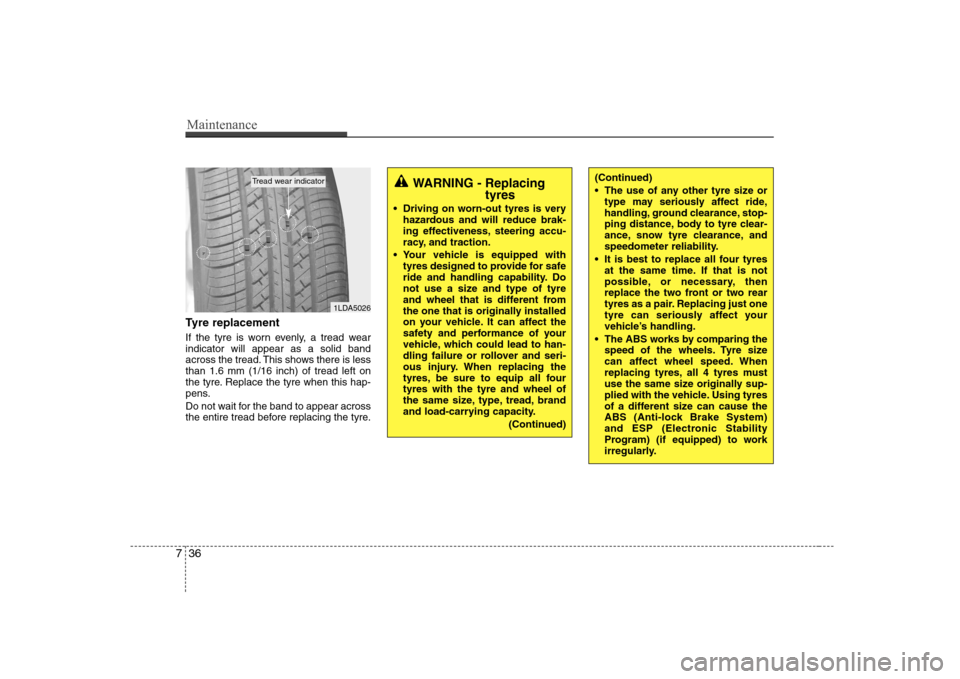
Tyre replacement
If the tyre is worn evenly, a tread wear indicator will appear as a solid band
across the tread. This shows there is lessthan 1.6 mm (1/16 inch) of tread left on
the tyre. Replace the tyre when this hap-
pens.
Do not wait for the band to appear across
the entire tread before replacing the tyre.
WARNING - Replacing
tyres
Driving on worn-out tyres is very hazardous and will reduce brak-
ing effectiveness, steering accu-
racy, and traction.
Your vehicle is equipped with tyres designed to provide for safe
ride and handling capability. Do
not use a size and type of tyre
and wheel that is different from
the one that is originally installed
on your vehicle. It can affect the
safety and performance of your
vehicle, which could lead to han-
dling failure or rollover and seri-
ous injury. When replacing the
tyres, be sure to equip all fourtyres with the tyre and wheel of
the same size, type, tread, brand
and load-carrying capacity.
(Continued)
1LDA5026
Tread wear indicator(Continued)
The use of any other tyre size ortype may seriously affect ride,
handling, ground clearance, stop-
ping distance, body to tyre clear-
ance, snow tyre clearance, and
speedometer reliability.
It is best to replace all four tyres at the same time. If that is not
possible, or necessary, then
replace the two front or two rear
tyres as a pair. Replacing just one
tyre can seriously affect your
vehicle’s handling.
The ABS works by comparing the speed of the wheels. Tyre size
can affect wheel speed. When
replacing tyres, all 4 tyres must
use the same size originally sup-
plied with the vehicle. Using tyres
of a different size can cause the
ABS (Anti-lock Brake System)
and ESP (Electronic Stability
Program) (if equipped) to work
irregularly.
Page 265 of 308
Maintenance
40
7
7. Uniform tyre quality grading
Quality grades can be found where
applicable on the tyre sidewall
between tread shoulder and maxi-
mum section width.
For example:
TREADWEAR 200
TRACTION AA
TEMPERATURE A
Tread wear
The tread wear grade is a comparative
rating based on the wear rate of the tyrewhen tested under controlled conditions
on a specified government test course.
For example, a tyre graded 150 would
wear one-and-a-half times as well on the
government course as a tyre graded 100.
The relative performance of tyres depends upon the actual conditions of
their use. However, performance may dif-
fer from the norm because of variations
in driving habits, service practices and
differences in road characteristics and
climate.
These grades are moulded on the side-
walls of passenger vehicle tyres. The
tyres available as standard or optional
equipment on your vehicles may vary
with respect to grade. Traction - AA, A, B & C
The traction grades, from highest to low-
est, are AA, A, B and C. The grades rep-
resent the tyres ability to stop on wet
pavement as measured under controlled
conditions on specified government test
surfaces of asphalt and concrete. A tyre
marked C may have poor traction per-
formance.
Temperature -A, B & C
The temperature grades are A (the high-
est), B and C. The grades represent the
tyre’s resistance to the generation of heatand its ability to dissipate heat when test-ed under controlled conditions on a spec-
ified indoor laboratory test wheel.
Sustained high temperature can cause
the material of the tyre to degenerate and
reduce tyre life, and excessive tempera-
ture can lead to sudden tyre failure.
Grades A and B represent higher levels
of performance on the laboratory test
wheel than the minimum required by the
law.WARNING - Tyre
temperature
The temperature grade for this tyre
is established for a tyre that is
properly inflated and not over-
loaded. Excessive speed, underin-
flation, or excessive loading, either
separately or in combination, can
cause heat build-up and possible
sudden tyre failure. This can cause
loss of vehicle control and serious
injury or death.
Page 272 of 308
747
Maintenance
Description Fuse ratingProtected component
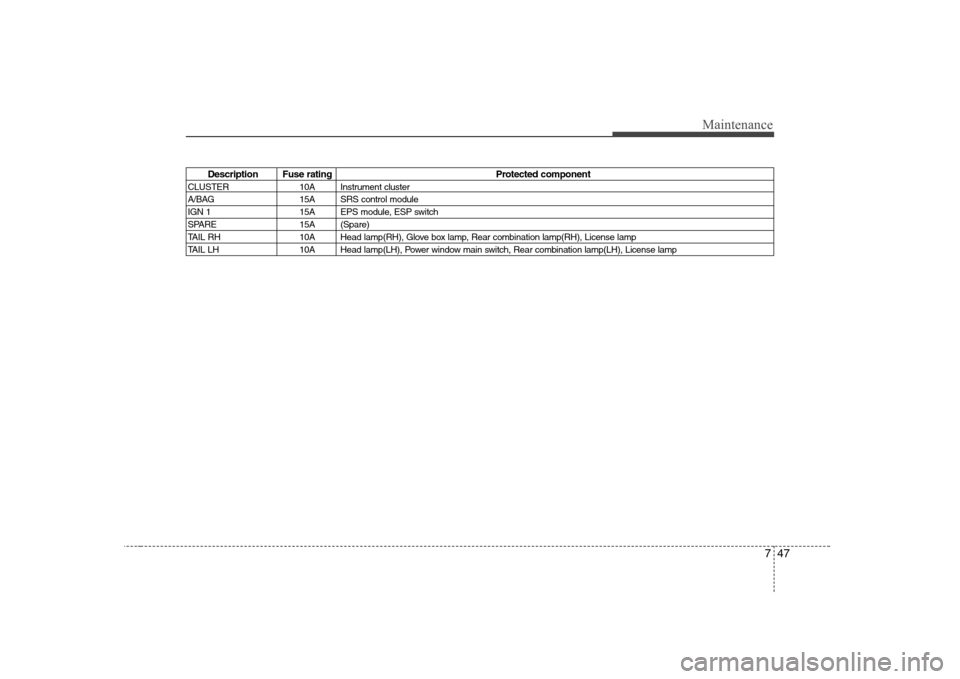
CLUSTER 10A Instrument cluster
A/BAG 15A SRS control module
IGN 1 15A EPS module, ESP switch
SPARE 15A (Spare)
TAIL RH 10A Head lamp(RH), Glove box lamp, Rear combination lamp(RH), License lamp
TAIL LH 10A Head lamp(LH), Power window main switch, Rear combination lamp(LH), License lamp
Page 273 of 308
Maintenance
48
7
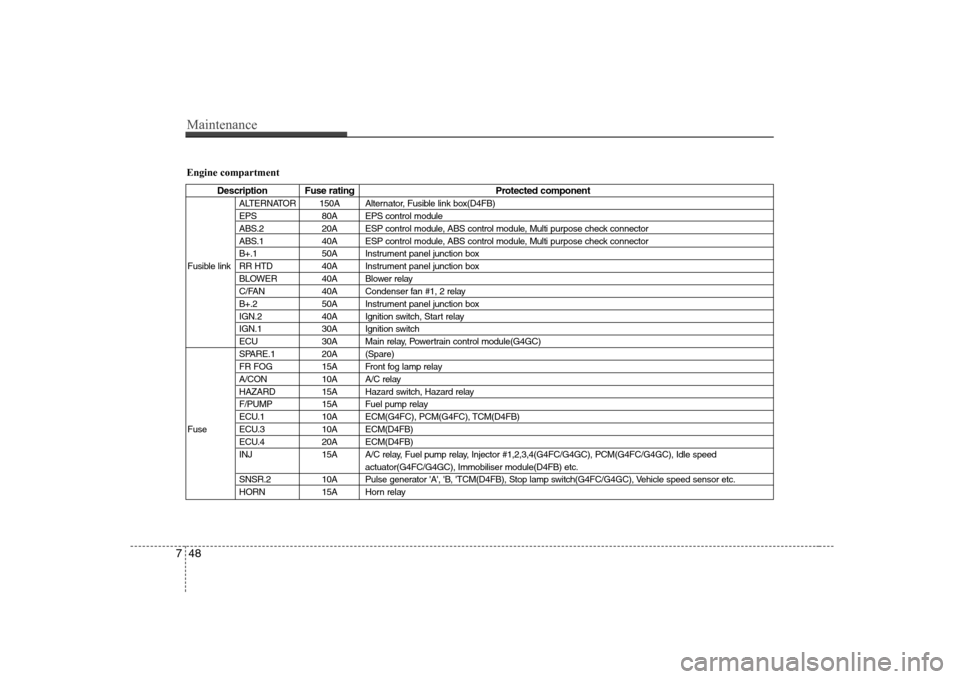
Engine compartment
Description Fuse rating Protected component
ALTERNATOR 150A Alternator, Fusible link box(D4FB)
EPS 80A EPS control module
ABS.2 20A ESP control module, ABS control module, Multi purpose check connector
ABS.1 40A ESP control module, ABS control module, Multi purpose check connector
B+.1 50A Instrument panel junction box
Fusible link RR HTD 40A Instrument panel junction box BLOWER 40A Blower relay
C/FAN 40A Condenser fan #1, 2 relay
B+.2 50A Instrument panel junction box
IGN.2 40A Ignition switch, Start relay
IGN.1 30A Ignition switch
ECU 30A Main relay, Powertrain control module(G4GC)
SPARE.1 20A (Spare)
FR FOG 15A Front fog lamp relay
A/CON 10A A/C relay
HAZARD 15A Hazard switch, Hazard relay
F/PUMP 15A Fuel pump relay
ECU.1 10A ECM(G4FC), PCM(G4FC), TCM(D4FB)
Fuse ECU.3 10A ECM(D4FB) ECU.4 20A ECM(D4FB)
INJ 15A A/C relay, Fuel pump relay, Injector #1,2,3,4(G4FC/G4GC), PCM(G4FC/G4GC), Idle speed actuator(G4FC/G4GC), Immobiliser module(D4FB) etc.
SNSR.2 10A Pulse generator 'A', 'B, 'TCM(D4FB), Stop lamp switch(G4FC/G4GC), Vehicle speed sensor etc.
HORN 15A Horn relay