Page 29 of 266

1
FEATURES OF YOUR HYUNDAI
191
FEATURES OF YOUR HYUNDAI
19
Adjusting the height up and down
(If Installed)To raise the headrest, pull it up to the
desired position (1). To lower the head-
rest, push and hold the release button (2)
on the headrest support and lower the
headrest to the desired position (3).
Removal (If Installed)To remove the headrest, raise it as far as
it can go then press the release button (1)
while pulling upward (2).
To reinstall the headrest, put the headrest
poles (3) into the holes while pressing the
release button (1). Then adjust it to the
appropriate height.
OMC029045
OMC029046
!
WARNING:
Make sure the headrest locks in position
after adjusting it to properly protect the
occupants.
!
B110A02MC-AATFolding Rear SeatbacksThe rear seatbacks may be folded to
facilitate carrying long items or to increase
the luggage capacity of the vehicle.
WARNING:
The purpose of the fold-down rear
seatbacks is to allow you to carry longer
objects than could otherwise be accom-
modated.
Never allow passengers to sit on top of
the folded down seatback or cargo area
while the car is moving as this is not a
proper seating position and no seat belts
are available for use. This could result in
serious injury or death in case of an
accident or sudden stop. Objects car-
ried on the folded down seatback should
not extend higher than the top of the front
seats. This could allow cargo to slide
forward and cause injury or damage
during sudden stops.
Page 80 of 266
1FEATURES OF YOUR HYUNDAI70
B330A03A-AATTACHOMETERThe tachometer registers the speed of
your engine in revolutions per minute
(rpm).
CAUTION:
The engine should not be increased to
such a speed that the needle enters the
red zone on the tachometer face. This
can cause severe engine damage and
may void your warranty.
!
INSTRUMENT CLUSTERB280A01TG-AATFUEL GAUGEThe needle on the gauge indicates the
approximate fuel level in the fuel tank.
The fuel capacity is given in Section 9.NOTE:The "
" symbol means the fuel filler
lid is placed on the left side of the vehicle.
OMC029420
Type A
Type B
OMC029424B330A02MC-D
Type A
Type B
Page 164 of 266

DRIVING YOUR HYUNDAI
212
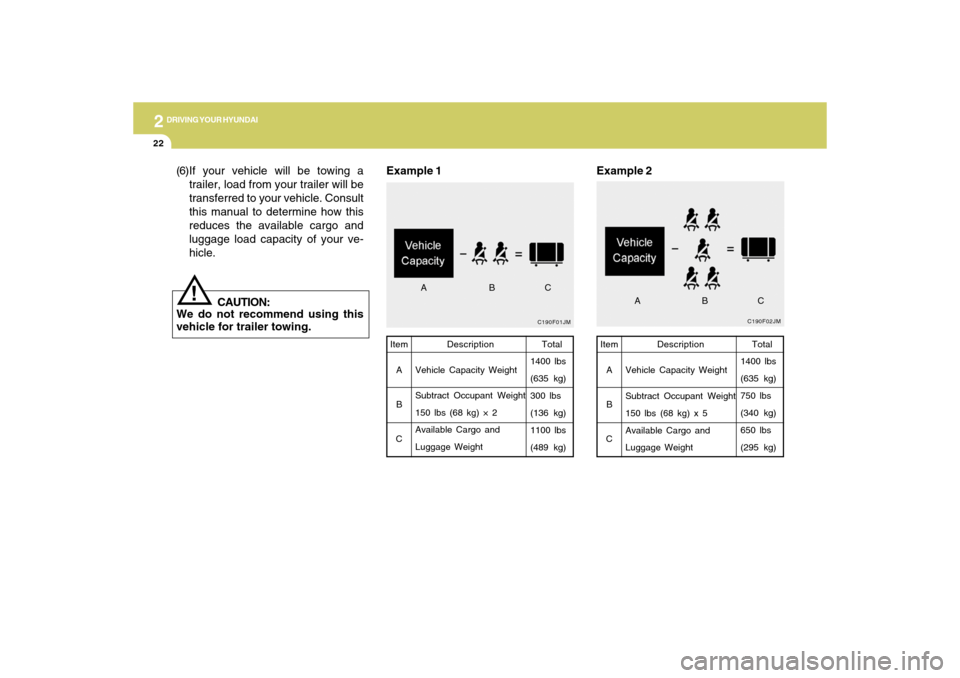
Steps for Determining Correct Load
Limit
(1)Locate the statement "The com-
bined weight of occupants and cargo
should never exceed XXX pounds''
on your vehicle's placard.
(2)Determine the combined weight of
the driver and passengers that will
be riding in your vehicle.
(3)Subtract the combined weight of the
driver and passengers from XXX
kilograms or XXX pounds.
(4)The resulting figure equals the avail-
able amount of cargo and luggage
load capacity. For example, if the
"XXX" amount equals 1400 lbs, and
there will be five 150 lb. passengers
in your vehicle, the amount of avail-
able cargo and luggage load capac-
ity is 650 lbs. (1400-750 (5 x 150) =
650 lbs.)
(5)Determine the combined weight of
luggage and cargo being loaded on
the vehicle. That weight may not
safely exceed the available cargo
and luggage load capacity calcu-
lated in Step 4. The tire label located on the driver's
side of the center pillar outer panel
gives the original tire size, cold tire
pressures recommended for your ve-
hicle, the number of people that can be
in your vehicle and vehicle capacity
weight.
Vehicle capacity weight:
849 lbs (385 kg)
Vehicle capacity weight is the maxi-
mum combined weight of occupants
and cargo. If your vehicle is equipped
with a trailer, the combined weight
includes the tongue load.
Seating capacity:
Total: 5 persons
(Front seat: 2 persons,
Rear seat: 3 persons)
Seating capacity is the maximum num-
ber of occupants including a driver,
your vehicle may carry.However the seating capacity may be
reduced based upon the weight of all
of the occupants, and the weight of the
cargo being carried or towed. Do not
overload the vehicle as there is a limit
to the total weight, or load limit includ-
ing occupants and cargo, the vehicle
can carry.
Towing capacity:
We do not recommend using this ve-
hicle for trailer towing.
Cargo capacity:
The cargo capacity of your vehicle will
increase or decrease depending on the
weight and the number of occupants
and the tongue load, if your vehicle is
equipped with a trailer.
Page 165 of 266
2
DRIVING YOUR HYUNDAI
22
C190F01JMTotal
1400 lbs
(635 kg)
300 lbs
(136 kg)
1100 lbs
(489 kg)
Example 1Item
A
B
CDescription
Vehicle Capacity Weight
Subtract Occupant Weight
150 lbs (68 kg) × 2
Available Cargo and
Luggage Weight
ABC
(6)If your vehicle will be towing a
trailer, load from your trailer will be
transferred to your vehicle. Consult
this manual to determine how this
reduces the available cargo and
luggage load capacity of your ve-
hicle.
!
C190F02JM
Example 2
Total
1400 lbs
(635 kg)
750 lbs
(340 kg)
650 lbs
(295 kg) Item
A
B
CDescription
Vehicle Capacity Weight
Subtract Occupant Weight
150 lbs (68 kg) x 5
Available Cargo and
Luggage Weight
AB
C
CAUTION:
We do not recommend using this
vehicle for trailer towing.
Page 166 of 266
DRIVING YOUR HYUNDAI
232
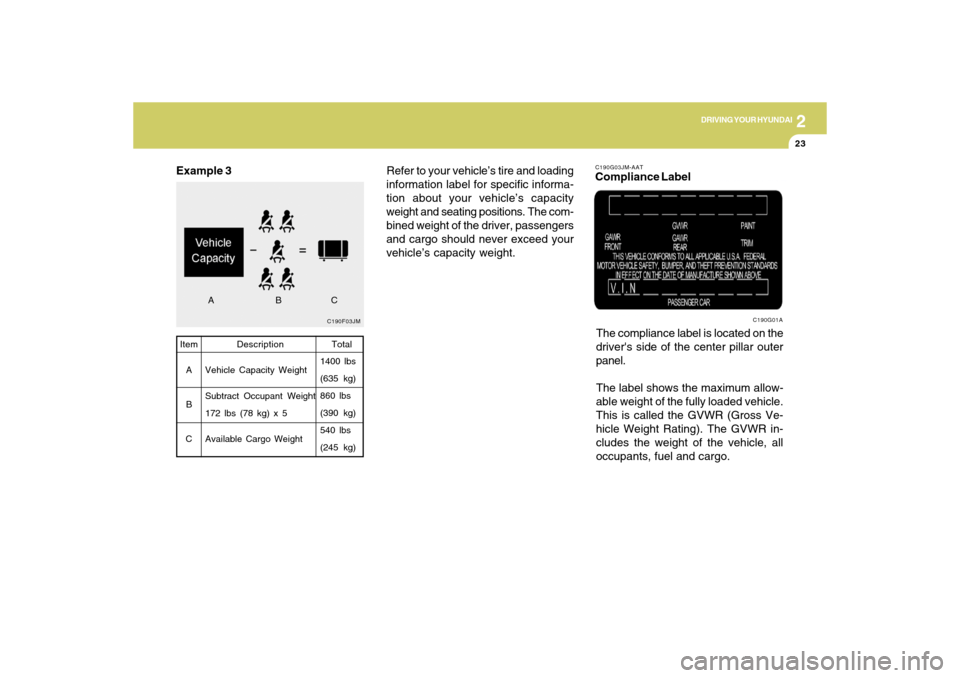
C190G03JM-AATCompliance Label
The compliance label is located on the
driver's side of the center pillar outer
panel.
The label shows the maximum allow-
able weight of the fully loaded vehicle.
This is called the GVWR (Gross Ve-
hicle Weight Rating). The GVWR in-
cludes the weight of the vehicle, all
occupants, fuel and cargo.
C190G01A
Refer to your vehicle’s tire and loading
information label for specific informa-
tion about your vehicle’s capacity
weight and seating positions. The com-
bined weight of the driver, passengers
and cargo should never exceed your
vehicle’s capacity weight.
C190F03JMTotal
1400 lbs
(635 kg)
860 lbs
(390 kg)
540 lbs
(245 kg) Item
A
B
CDescription
Vehicle Capacity Weight
Subtract Occupant Weight
172 lbs (78 kg) x 5
Available Cargo Weight
Example 3
ABC
Page 167 of 266

2
DRIVING YOUR HYUNDAI
24
!
WARNING:
o Never exceed the GVWR for your
vehicle, the GAWR for either the
front or rear axle and vehicle ca-
pacity weight. Exceeding these
ratings can cause an accident or
vehicle damage. You can calcu-
late the weight of your load by
weighing the items (or people)
before putting them in the ve-
hicle. Be careful not to overload
your vehicle.
o Do not load your vehicle any
heavier than the GVWR, either the
maximum front or rear GAWR
and vehicle capacity weight. If
you do, parts, including tires on
your vehicle can break, and it can
change the way your vehicle
handles and braking ability. This
could cause you to lose control
and crash. Also, overloading can
shorten the life of your vehicle. This label also tells you the maximum
weights that can be supported by the
front and rear axles, called Gross Axle
Weight Rating (GAWR). To find out the
actual loads on your front and rear
axles, you need to go to a weigh
station and weigh your vehicle. Your
dealer can help you with this. Be sure
to spread out your load equally on the
left and right sides of the centerline.
!
WARNING:
o Overloading your vehicle can
cause heat buildup in your
vehicle's tires and possible tire
failure that could lead to a crash.
o Overloading your vehicle can
cause increased stopping dis-
tances that could lead to a crash.
o A crash resulting from poor han-
dling vehicle damage, tire failure,
or increased stopping dis-
tances could result in serious
injury or death.
Page 223 of 266

6
DO-IT-YOURSELF MAINTENANCE
18
CAUTION:
An open fuse indicates that there is a
problem in the electrical circuit. If you
replace a fuse and it blows as soon as
the accessory is turned on, the prob-
lem is serious and should be referred to
a Hyundai dealer for diagnosis and re-
pair. Never replace a fuse with anything
except a fuse with the same or a lower
amperage rating. A higher capacity fuse
could cause damage and create a fire
hazard.
!
NOTE:
See page 6-28 for the fuse panel de-
scriptions.
G200C01CM-GATPower Connector
NOTE:
o If the power connector is pulled up
from the fuse panel, the warning
chime, audio, clock and interior
lamps, etc., will not operate. The fol-
lowing items must be reset after re-
placement.
- Digital Clock
- Trip computer
- Automatic heating and cooling con-
trol system
- Audio
o Even though the power connector is
pulled up, the battery can still be
discharged by operation of the head-
lights or other electrical devices.
Your vehicle is equipped with a power
connector to prevent battery discharge if
your vehicle is parked without being op-
erated for prolonged periods. Use the
following procedures before parking the
vehicle for prolonged periods.
1. Turn off the engine.
2. Turn off the headlights and tail lights.
3. Open the driver’s side panel cover and
pull up the power connector.
4. Insert the power connector in the op-
posite direction.
G200F01MC
G200B02L
GoodOpen-Replace
Page 241 of 266
8
CONSUMER INFORMATION, REPORTING SAFETY DEFECTS & BINDING ARBITRATION OF WARRANTY CLAIMS
3
ENGINE NUMBERI010B01A-AATThe engine number is stamped on the
engine block as shown in the drawing.
TIRESI020A02A-AATTIRE INFORMATION
The tires supplied on your new Hyndai
are chosen to provide the best perfor-
mance for normal driving.
If you ever have questions about your
tire warranty and where to obtain ser-
vice, see the tire manufacture's book-
let included with your vehicle's Owner's
Manual Literature Kit.
I030A02MC-AATRECOMMENDED COLD TIRE INFLA-
TION PRESSURES
Tire label located on the driver's side
of the center pillar outer panel gives
the cold tire pressures recommended
for your vehicle with the original tire
size, the number of people that can be
in your vehicle and vehicle capacity
weight.
OMC079012
OMC065001