Page 122 of 266
1FEATURES OF YOUR HYUNDAI
112
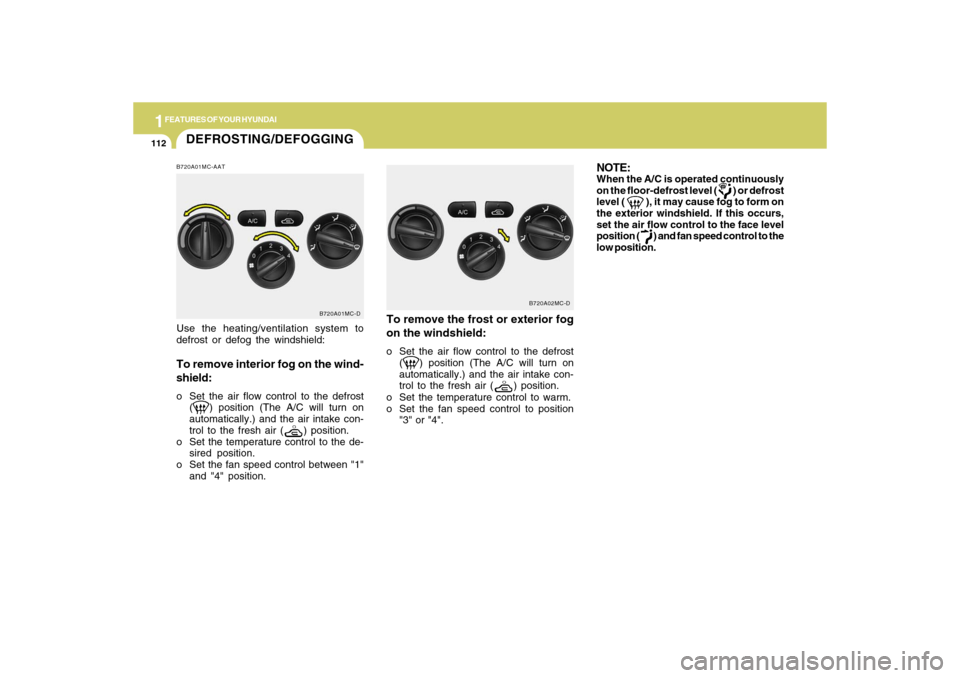
DEFROSTING/DEFOGGINGB720A01MC-AATUse the heating/ventilation system to
defrost or defog the windshield:To remove interior fog on the wind-
shield:o Set the air flow control to the defrost
(
) position (The A/C will turn on
automatically.) and the air intake con-
trol to the fresh air (
) position.
o Set the temperature control to the de-
sired position.
o Set the fan speed control between "1"
and "4" position.
B720A01MC-D
NOTE:When the A/C is operated continuously
on the floor-defrost level (
) or defrost
level (
), it may cause fog to form on
the exterior windshield. If this occurs,
set the air flow control to the face level
position ( ) and fan speed control to the
low position.
To remove the frost or exterior fog
on the windshield:o Set the air flow control to the defrost
(
) position (The A/C will turn on
automatically.) and the air intake con-
trol to the fresh air (
) position.
o Set the temperature control to warm.
o Set the fan speed control to position
"3" or "4".
B720A02MC-D
Page 123 of 266

1
FEATURES OF YOUR HYUNDAI
1131
FEATURES OF YOUR HYUNDAI
113
AIR CONDITIONING SYSTEM
B740A01MC-D B740A01A-AAT
(If Installed)
Air Conditioning SwitchThe air conditioning is turned on by push-
ing the A/C button on the heating/air
conditioning control panel.
B740B02A-AATAir Conditioning Operation
(Cooling)To use the air conditioning to cool the
interior:
o Turn on the fan control switch.
o Turn on the air conditioning switch by
pushing in on the switch.
The air conditioning indicator light
should come on at the same time.
o Set the temperature control to "Cool".
("Cool" provides maximum cooling. The
temperature may be moderated by
moving the control toward "Warm".)
o Adjust the fan control to the desired
speed. For greater cooling, turn the fan
control to one of the higher speeds or
temporarily select the (
)position
on the air intake control.B740B01MC-D B730A01L-AAT
Operation Tipso To keep dust or unpleasant fumes
from entering the car through the ven-
tilation system, temporarily set the air
intake control at the (
) position.
Be sure to return the control to the (
) position when the irritation has
passed to keep fresh air in the vehicle.
This will help keep the driver alert and
comfortable.
o Air for the heating/cooling system is
drawn in through the grilles just ahead
of the windshield. Care should be taken
that these are not blocked by leaves,
snow, ice or other obstructions.
o To prevent interior fog on the wind-
shield, set the air intake control to the
fresh air (
) position, fan speed to
the desired position, turn on the air
conditioning system, and adjust tem-
perature control to desired tempera-
ture.
Page 125 of 266
1
FEATURES OF YOUR HYUNDAI
1151
FEATURES OF YOUR HYUNDAI
115
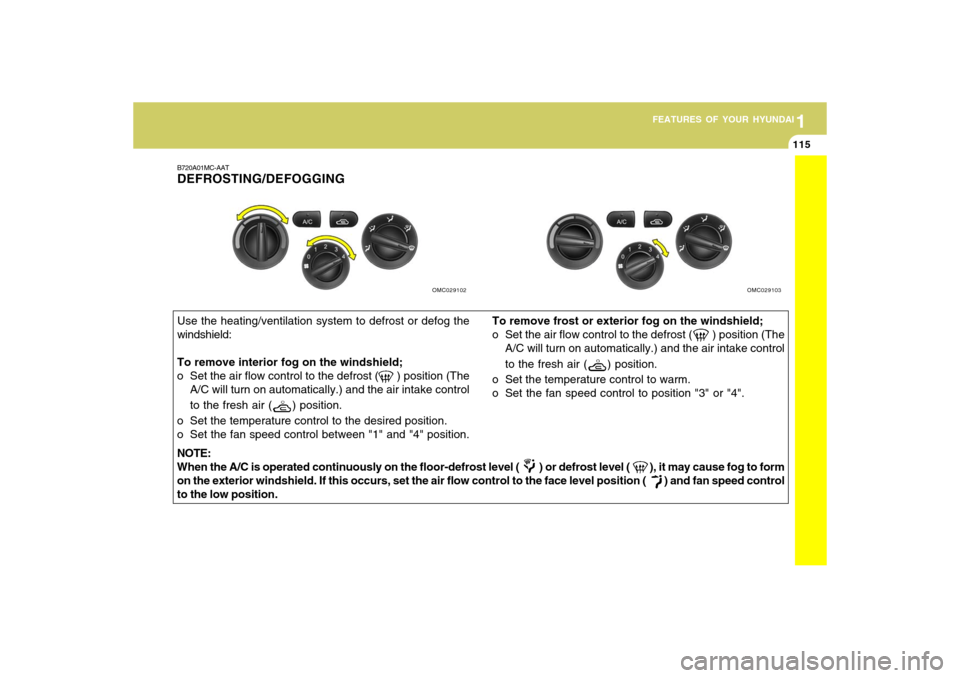
B720A01MC-AATDEFROSTING/DEFOGGINGUse the heating/ventilation system to defrost or defog the
windshield:
To remove interior fog on the windshield;
o Set the air flow control to the defrost ( ) position (The
A/C will turn on automatically.) and the air intake control
to the fresh air (
) position.
o Set the temperature control to the desired position.
o Set the fan speed control between "1" and "4" position.To remove frost or exterior fog on the windshield;
o Set the air flow control to the defrost ( ) position (The
A/C will turn on automatically.) and the air intake control
to the fresh air (
) position.
o Set the temperature control to warm.
o Set the fan speed control to position "3" or "4".
NOTE:
When the A/C is operated continuously on the floor-defrost level ( ) or defrost level ( ), it may cause fog to form
on the exterior windshield. If this occurs, set the air flow control to the face level position ( ) and fan speed control
to the low position.
OMC029102
OMC029103
Page 145 of 266

2
DRIVING YOUR HYUNDAI2
!
WARNING: ENGINE EXHAUST CAN BE DANGEROUS!
C010A03A-AATEngine exhaust fumes can be extremely dangerous. If, at any time, you smell exhaust fumes inside the vehicle, open the
windows immediately.o Do not inhale exhaust fumes.Exhaust fumes contain carbon monoxide, a colorless, odorless gas that can cause unconsciousness and death by
asphyxiation.o Be sure the exhaust system does not leak.The exhaust system should be checked whenever the vehicle is raised to change the oil or for any other purpose. If you hear
a change in the sound of the exhaust or if you drive over something that strikes the underneath side of the car, have the exhaust
system checked as soon as possible by your Hyundai dealer.o Do not run the engine in an enclosed area.Letting the engine idle in your garage, even with the garage door open, is a hazardous practice. Never run the engine in your
garage any longer than it takes to start the engine and back the car out.o Avoid idling the engine for prolonged periods with people inside the car.If it is necessary to idle the engine for a prolonged period with people inside the car, be sure to do so only in an open area
with the air intake set at "Fresh" and fan operating at one of the higher speeds so fresh air is drawn into the interior.
If you must drive with the trunk lid/ tail gate open because you are carrying objects that make this necessary:
1. Close all windows.
2. Open side vents.
3. Set the air intake control at "Fresh", the air flow control at "Floor" or "Face" and the fan at one of the higher speeds.
To assure proper operation of the ventilation system, be sure the ventilation air intakes located just in front of the windshield
are kept clear of snow, ice, leaves or other obstructions.
Page 207 of 266
6
DO-IT-YOURSELF MAINTENANCE2
ENGINE COMPARTMENTG010A01MC-AAT1. Engine oil filler cap .................. 6-6
2. Brake fluid reservoir ...............6-13
3. Air cleaner filter ........................ 6-8
4. Fuse/Relay box .......................6-165. Windshield washer fluid
reservoir cap ...........................6-10
6. Power steering fluid reservoir
(If Installed) .............................6-21
7. Engine oil level dipstick ........... 6-58. Radiator cap ............................. 6-7
9. Automatic transaxle fluid level
dipstick (If Installed) ................6-12
10. Engine coolant reservoir .......... 6-7
11. Battery .....................................6-19
OMC059036L
CAUTION:
When inspecting or servicing
the engine, you should handle
tools and other heavy objects
carefully so that the plastic
cover of the engine is not dam-
aged.
!
Page 208 of 266

6
DO-IT-YOURSELF MAINTENANCE
3
GENERAL CHECKS
G020C01A-AATVehicle InteriorThe following should be checked each
time when the vehicle is driven:
o Light operation
o Windshield wiper operation
o Horn operation
o Defroster, heater system operation (and
air conditioning, if installed)
o Steering operation and condition
o Mirror condition and operation
o Turn signal operation
o Accelerator pedal operation
o Brake operation, including parking
brake
o Manual transaxle operation, including
clutchoperation
o Automatic transaxle operation, includ-
ing "Park" mechanism operation
o Seat control condition and operation
o Seat belt condition and operation
o Sun visor operation
If you notice anything that does not oper-
ate correctly or appear to be functioning
correctly, inspect it carefully and seek
assistance from your Hyundai dealer if
service is needed.
G020A01A-AATEngine Compartment
The following should be checked regu-
larly:
o Engine oil level and condition
o Transaxle fluid level and condition
o Brake fluid level
o Clutch fluid level
o Engine coolant level
o Windshield washer fluid level
o Accessory drive belt condition
o Engine coolant hose condition
o Fluid leaks (on or below components)
o Power steering fluid level and condi-
tion
o Battery condition
o Air cleaner filter condition
G020B01A-AATVehicle ExteriorThe following should be checked monthly:
o Overall appearance and condition
o Wheel condition and wheel nut tight-
ness
o Exhaust system condition
o Light condition and operation
o Windshield glass condition
o Wiper blade condition
o Paint condition and body corrosion
o Fluid leaks
o Door and hood lock condition
o Tire pressure and condition
(including spare tire)
Page 214 of 266
6
DO-IT-YOURSELF MAINTENANCE
9
WINDSHIELD WIPER
BLADESG080A02A-AATThe wiper blades should be carefully
inspected from time to time and cleaned
to remove accumulations of road film or
other debris. To clean the wiper blades
and arms, use a clean sponge or cloth
with a mild soap or detergent and water.
If the wipers continue to streak or smear
the glass, replace them with genuine
Hyundai replacement parts or their
equivalent.
CAUTION:
o Do not operate the wipers on dry
glass. This can result in more rapid
wear of the wiper blades and may
scratch the glass.
o Keep the blade rubber out of contact
with petroleum products such as
engine oil, gasoline, etc.
!
2. Raise the wiper blade lightly and pull
up it.
HHR5049
G080B01HR-GATReplacing the Wiper BladesTo replace the wiper blades, raise the
wiper to the vertical.To remove the wiper blade1. Push down the wiper blade with the
locking clip (1) pressed to detach it
from the wiper arm.
HHR5048
(1)
Page 215 of 266
6
DO-IT-YOURSELF MAINTENANCE
10
FILLING THE WASHER RES-
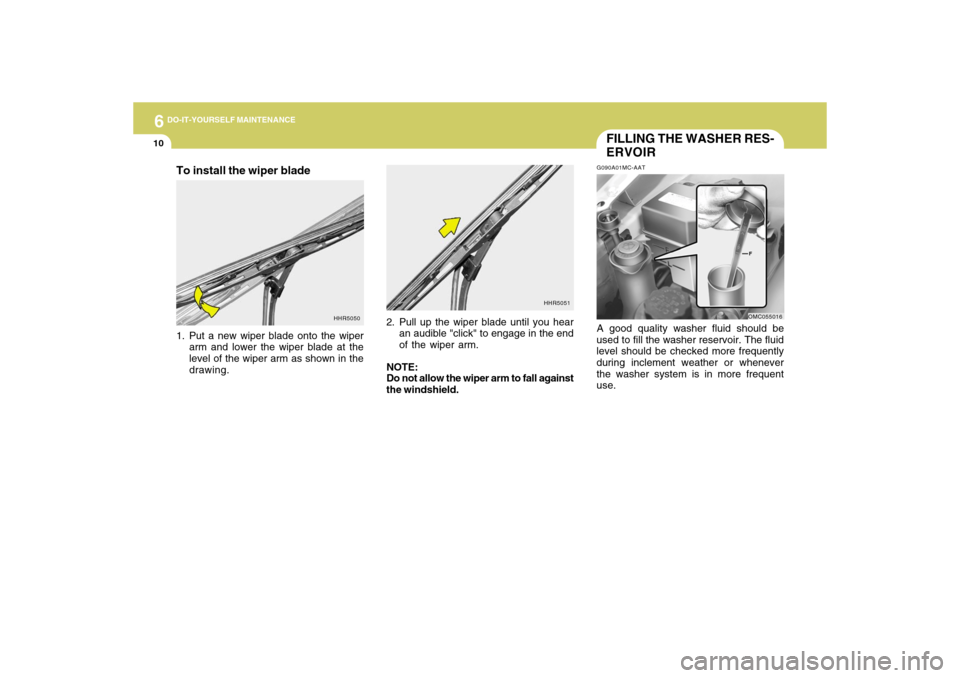
ERVOIRG090A01MC-AATA good quality washer fluid should be
used to fill the washer reservoir. The fluid
level should be checked more frequently
during inclement weather or whenever
the washer system is in more frequent
use.
OMC055016
1. Put a new wiper blade onto the wiper
arm and lower the wiper blade at the
level of the wiper arm as shown in the
drawing.To install the wiper blade
HHR5050
2. Pull up the wiper blade until you hear
an audible "click" to engage in the end
of the wiper arm.
NOTE:
Do not allow the wiper arm to fall against
the windshield.
HHR5051