2009 HONDA S2000 wheel
[x] Cancel search: wheelPage 153 of 268

Check the brakes after driving
through deep water. Apply the
brakes moderately to see if they f eel
normal. If not, apply them gently and
f requently until they do. Be extra
cautious in your driving.
The hydraulic system that operates
the brakes has two separate circuits.
Each circuit works diagonally across
the vehicle (the lef t-f ront brake is
connected with the right-rear brake,
etc.). If one circuit should develop a
problem, you will still have braking
at two wheels.If the brake pads need replacing, you
will hear a distinctive, metallic
screeching sound when you apply
the brake pedal. If you do not have
the brake pads replaced, they will
screech all the time. It is normal f or
the brakes to occasionally squeal or
squeak when you apply them.
The anti-lock brake system (ABS)
helpspreventthewheelsfrom
locking up, and helps you retain
steering control by pumping the
brakes rapidly, much f aster than a
person can do it.The electronic brake distribution
(EBD) system, which is part of the
ABS, also balances the f ront-to-rear
braking distribution according to
vehicle loading.
You will f eel a pulsation in the brake
pedal when the ABS activates, and
may hear some noise. This is normal:
it is the ABS rapidly pumping the
brakes. On dry pavement, you will
need to press on the brake pedal
very hard before the ABS activates.
However, you may f eel the ABS
activate immediately if you are trying
to stop on snow or ice.
Let the ABS work f or you by always
keeping f irm, steady pressure on the
brake pedal. This is sometimes
ref erred to as ‘‘stomp and steer.’’
You should never pump the brake pedal.
Braking System Design
Brake Pad Wear Indicators
Anti-lock Brakes (ABS)
Braking System, Anti-lock Brakes (ABS)
150
2009 S2000
Page 154 of 268
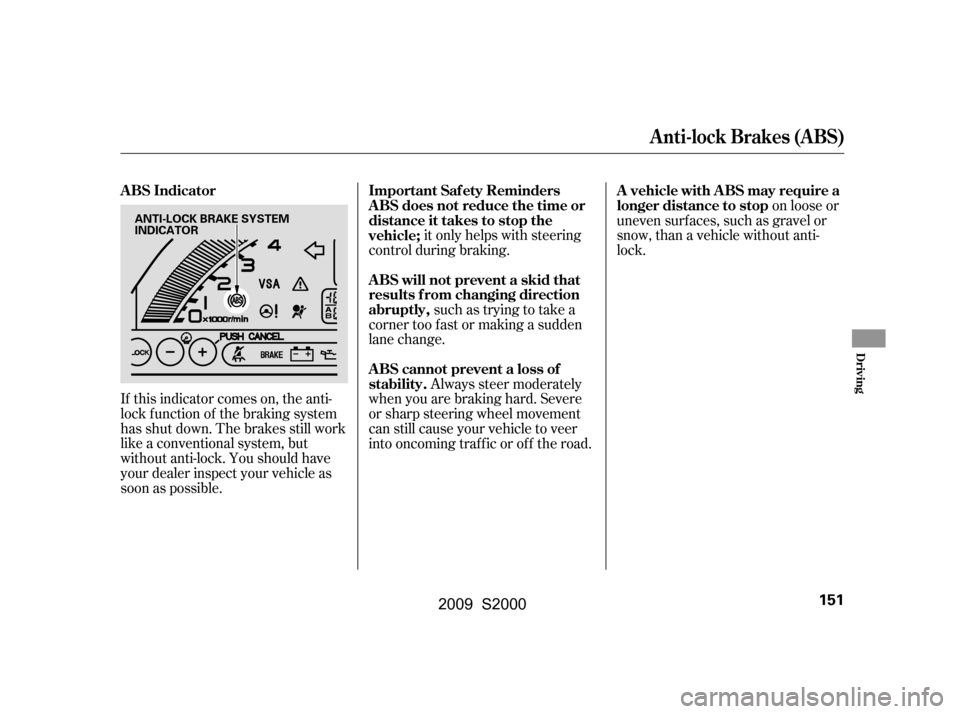
If this indicator comes on, the anti-
lock f unction of the braking system
has shut down. The brakes still work
like a conventional system, but
without anti-lock. You should have
your dealer inspect your vehicle as
soon as possible.it only helps with steering
control during braking.
such as trying to take a
corner too f ast or making a sudden
lane change.
Always steer moderately
when you are braking hard. Severe
or sharp steering wheel movement
can still cause your vehicle to veer
into oncoming traffic or off the road. on loose or
uneven surfaces, such as gravel or
snow, than a vehicle without anti-
lock.
ABS Indicator
A BS does not reduce the time or
distance it takes to stop the
vehicle;
Important Saf ety Reminders
A BS will not prevent a skid that
results f rom changing direction
abruptly,
A BS cannot prevent a loss of
stability.A vehicle with A BS may require a
longer distance to stop
Anti-lock Brakes (ABS)
Driving
151
ANTI-LOCK BRAKE SYSTEM
INDICATOR
2009 S2000
Page 156 of 268
Driving with varying tire or wheel
sizes may cause the VSA to
malf unction. When replacing tires,
make sure they are of the same size
and type as your original tires (see
page ).
In certain unusual conditions when
your vehicle gets stuck in shallow
mud or f resh snow, it may be easier
to free it with the VSA temporarily
switched of f . When the VSA system
is of f , the traction control system is
alsooff.Youshouldonlyattemptto
f ree your vehicle with the VSA of f if
you are not able to f ree it when the
VSA is on. Immediately af ter f reeing your
vehicle, be sure to switch the VSA on
again. We do not recommend driving
your vehicle with the VSA and
traction control systems switched off.
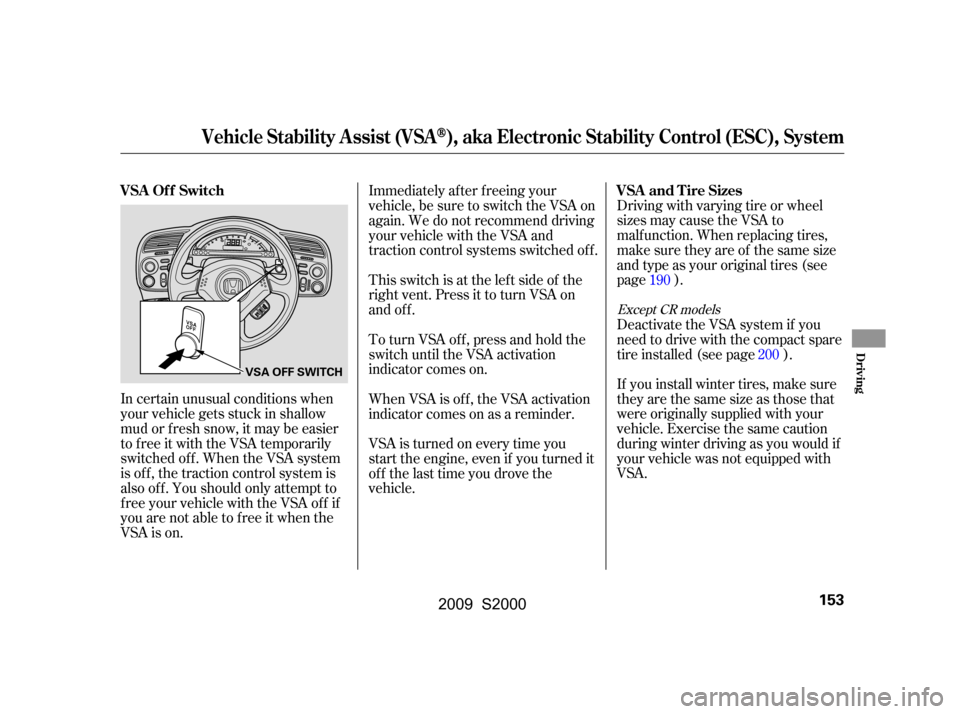
This switch is at the lef t side of the
right vent. Press it to turn VSA on
and off.
If you install winter tires, make sure
they are the same size as those that
were originally supplied with your
vehicle. Exercise the same caution
during winter driving as you would if
your vehicle was not equipped with
VSA.
Deactivate the VSA system if you
need to drive with the compact spare
tire installed (see page ).
To turn VSA of f , press and hold the
switch until the VSA activation
indicator comes on.
When VSA is off, the VSA activation
indicator comes on as a reminder.
VSA is turned on every time you
start the engine, even if you turned it
off the last time you drove the
vehicle. 190
200
Except CR models
VSA Of f Switch VSA and Tire Sizes
Vehicle Stability A ssist (VSA), aka Electronic Stability Control (ESC), System
Driving
153
VSA OFF SWITCH
2009 S2000
Page 158 of 268

For example, if you check and f ill
your tires in a warm area, then drive
in extremely cold weather, the tire
pressure will be lower than
measured and could be underinf lated
and cause the low tire pressure
indicator to come on. Or, if you
check and adjust your tire pressure
in cooler conditions, and drive into
extremely hot conditions, the tire
maybecomeoverinflated.However,
the low tire pressure indicator will
not come on if the tires are
overinf lated.
Refer to page for tire inflation
guidelines.
Although your tire pressure is
monitored, you must manually check
thetirepressuresmonthly.
Each tire, including the spare, should
be checked monthly when cold, and
set to the recommended inf lation
pressure as specif ied on the tireinformation label and in the owner’s
manual (see page ).
This indicator comes on and stays on
if there is a problem with the tire
pressure monitoring system.
If this happens, the system will shut
of f and no longer monitor tire
pressures. Have the system checked
by your dealer as soon as possible.
When you restart the vehicle with
thecompactsparetire,theTPMS
indicator may also come on and stay
on after driving several miles
(kilometers).
If you have a f lat tire, the low tire
pressure indicator will come on.
Replace the flat tire with the
compact spare tire (see page ).
Each wheel (except the compact
sparetirewheel)isequippedwitha
tire pressure sensor mounted inside
the tire behind the valve stem. You
must use TPMS specif ic wheels. It is
recommended that you always have
your tires serviced by your dealer or
qualif ied technician.
189 190
200
Except CR models
Tire Pressure Monitoring System (TPMS)
Tire Pressure Monitoring
System (T PMS) IndicatorChanging a T ire with T PMS
Driving
155
2009 S2000
Page 159 of 268

As required by the FCC:This device complies with Part 15 of theFCC rules. Operation is subject to thef ollowing two conditions: (1) This devicemay not cause harmf ul interf erence, and(2) this device must accept anyinterf erence received, includinginterf erence that may cause undesiredoperation.
Changes or modif ications not expresslyapproved by the party responsible f orcompliance could void the user’sauthority to operate the equipment.
This device complies with IndustryCanada Standard RSS-210.Operation is subject to the f ollowing twoconditions: (1) this device may not causeinterf erence, and (2) this device mustaccept any interf erence that may causeundesired operation of the device.
CR models
If you have a f lat tire, the low tire
pressure indicator will come on.
Repair the f lat tire with the tire
repair kit (see page ).
Each wheel is equipped with a tire
pressure sensor mounted inside the
tire behind the valve stem. You must
use TPMS specif ic wheels. It is
recommended that you always have
your tires serviced by your dealer or
a qualif ied technician.
Af ter you repair the f lat tire, the low
tire pressure indicator may come on.
This is normal; the system is not
monitoring the repaired tire pressure.
Havetheflattirerepairedbythe
dealer as soon as possible.
Never use a puncture-repairing agent
in a f lat tire. If used, you will have to
replace the tire pressure sensor.
Havetheflattirerepairedbyyour
dealer as soon as possible.
After you replace the flat tire with
thecompactsparetire,thelowtire
pressure indicator stays on. This is
normal; the system is not monitoring
the spare tire pressure. Manually
check the spare tire pressure to be
sure it is correct. Af ter several miles
(kilometers) driving with the
compact spare tire, the TPMS
indicator comes on and the low tire
pressure indicator goes of f .
The low tire pressure indicator or
the TPMS indicator will go off, after
several miles (kilometers) driving,
when you replace the spare tire with
the specif ied regular tire equipped
with the tire pressure monitor sensor. 206
Tire Pressure Monitoring System (TPMS)
Repairing a T ire with T PMS
156
2009 S2000
Page 162 of 268

This section explains why it is
important to keep your vehicle well
maintained and how to f ollow basic
maintenance saf ety precautions.
If you have the skills and tools to
perf orm more complex maintenance
tasks on your vehicle, you may want
to purchase the service manual. See
page f or inf ormation on how to
obtain a copy, or see your dealer.
This section also includes
instructions on how to read the
maintenance minder messages on
the information display, and
instructions f or simple maintenance
tasks you may want to take care of
yourself .......................
Maintenance Saf ety .160
....................
Maintenance Minder .161
..............................
Fluid Locations .169
........................
Adding Engine Oil .170
.........
Changing the Oil and Filter .171
..............................
Engine Coolant .173
....................
Windshield Washers .175
........
Manual Transmission Fluid .176
..........................
Dif f erential Fluid .177
................
Brake and Clutch Fluid .178
.............................................
Lights .179
................
Cleaning the Seat Belts .184
.....................................
Floor Mats .185
..................
DustandPollenFilter .185
..............................
Audio Antenna .185
.................................
Wiper Blades .186
...........................................
Wheels .188
...............................................
Tires .188
...................
Checking the Battery .196
.............................
Vehicle Storage .198
251
Maintenance
Maint enance
159
2009 S2000
Page 184 of 268
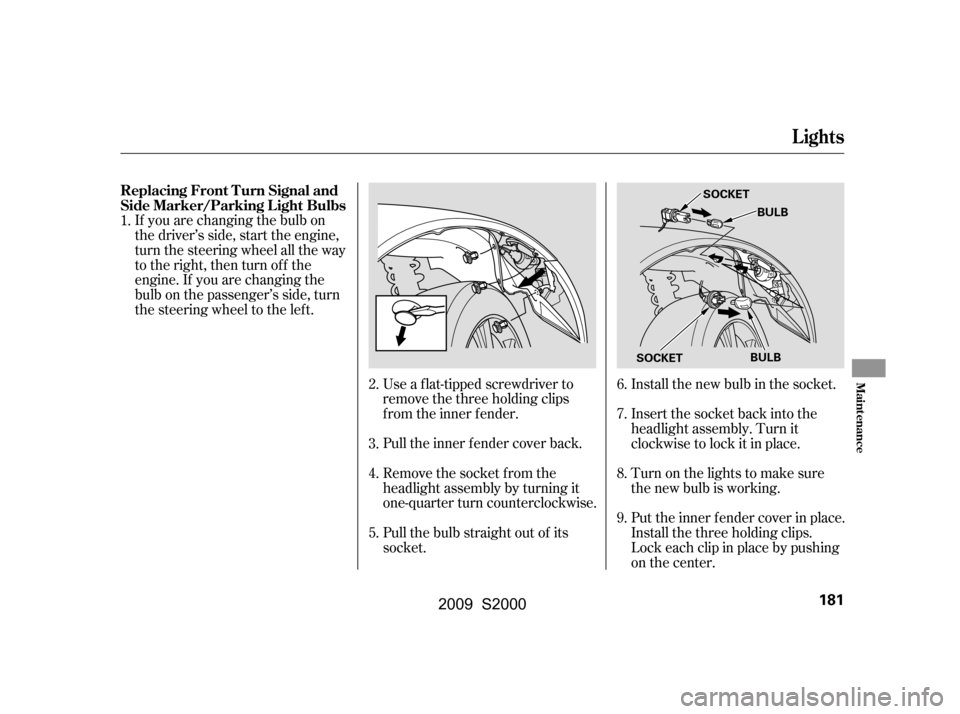
If you are changing the bulb on
the driver’s side, start the engine,
turn the steering wheel all the way
to the right, then turn off the
engine. If you are changing the
bulb on the passenger’s side, turn
the steering wheel to the left.Use a f lat-tipped screwdriver to
remove the three holding clips
f rom the inner f ender.
Pull the inner f ender cover back.
Remove the socket from the
headlight assembly by turning it
one-quarter turn counterclockwise.
Pull the bulb straight out of its
socket.Insert the socket back into the
headlight assembly. Turn it
clockwise to lock it in place.
Install the new bulb in the socket.
Put the inner f ender cover in place.
Install the three holding clips.
Lock each clip in place by pushing
on the center.
Turn on the lights to make sure
the new bulb is working.
1.
2.
3.
4.
5.6.
7.
8.
9.
Replacing Front Turn Signal and
Side Marker/Parking L ight Bulbs
Lights
Maint enance
181
SOCKET
SOCKET BULB
BULB
2009 S2000
Page 191 of 268

Clean the wheels as you would the
rest of the exterior. Wash them with
thesamesolution,andrinsethem
thoroughly.
Aluminum alloy wheels have a
protective clear-coat that keeps the
aluminum f rom corroding and
tarnishing. Cleaning the wheels with
harsh chemicals (including some
commercial wheel cleaners) or a stif f
brush can damage the clear-coat. To
clean the wheels, use a mild
detergent and a sof t brush or sponge.To saf ely operate your vehicle, your
tires must be the proper type and
size, in good condition with adequate
tread, and correctly inf lated.
The f ollowing pages give more
detailed inf ormation on how to take
care of your tires and what to do
when they need to be replaced.
Your vehicle is equipped with high
perf ormance summer tires. These
tires have a high-traction compound
and tread pattern to provide superior
acceleration, cornering, and stopping
under most driving conditions.
However, these tires are not suitable
f or driving on snow or ice, so all-
season or winter tires must be
installed f or winter driving
conditions.
See page f or
194
Wheels, Tires
Wheels T ires
Winter Driving.
188
Using tires that are excessively
worn or improperly inflated can
cause a crash in which you can
be seriously hurt or killed.
Follow all instructions in this
owner’s manual regarding tire
inflation and maintenance.
2009 S2000