Page 36 of 268

Because an inf lating airbag can
seriously injure or kill small children,
we recommend that you do not carry
a small child as a passenger in this
vehicle.
If you decide to transport a small
child in this vehicle, be sure to move
the passenger seat as far to the rear
as possible, and follow the
instructions and guidelines in the
f ollowing pages.Of the different seats available, we
recommend those that have a f ive-
point harness system as shown.
A child who is at least one year old,
and who fits within the child seat
maker’s weight and height limits,
should be restrained in a f orward-
f acing, upright child seat.We also recommend that a small
child use the child seat until the child
reaches the weight or height limit
for the seat.
Protecting Small Children
Child Seat T ype
Child Seat Placement
Driver and Passenger Saf ety
33
Placing a forward-facing child
seat in the passenger’s seat
can result in serious injury or
death if the airbag inflates.
Ifyoumustplaceaforward-
facing child seat in the
passenger’s seat, move the
vehicle seat as far back as
possible and properly restrain
the child.
2009 S2000
Page 39 of 268
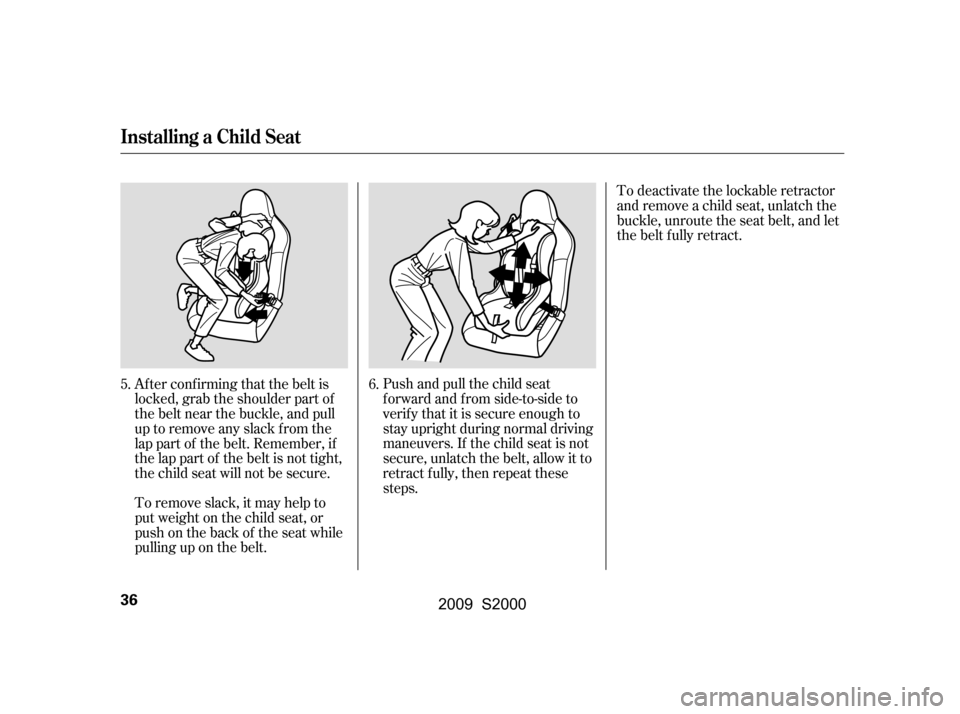
To remove slack, it may help to
putweightonthechildseat,or
push on the back of the seat while
pulling up on the belt.Push and pull the child seat
f orward and f rom side-to-side to
verify that it is secure enough to
stay upright during normal driving
maneuvers. If the child seat is not
secure, unlatch the belt, allow it to
retract f ully, then repeat these
steps.To deactivate the lockable retractor
andremoveachildseat,unlatchthe
buckle, unroute the seat belt, and let
the belt fully retract.
Af ter conf irming that the belt is
locked, grab the shoulder part of
the belt near the buckle, and pull
up to remove any slack from the
lap part of the belt. Remember, if
the lap part of the belt is not tight,
the child seat will not be secure.
5.
6.
Installing a Child Seat
36
2009 S2000
Page 40 of 268
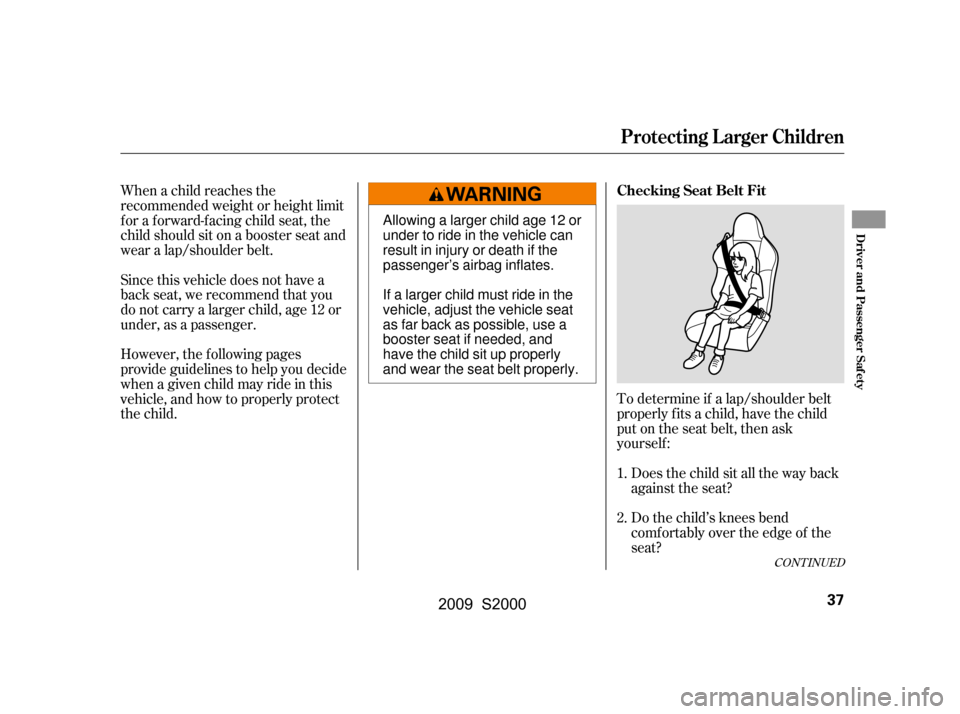
To determine if a lap/shoulder belt
properly f its a child, have the child
put on the seat belt, then ask
yourself :Does the child sit all the way back
against the seat?
Do the child’s knees bend
comf ortably over the edge of the
seat?
When a child reaches the
recommended weight or height limit
for a forward-facing child seat, the
child should sit on a booster seat and
wear a lap/shoulder belt.
Since this vehicle does not have a
back seat, we recommend that you
do not carry a larger child, age 12 or
under, as a passenger.
However, the following pages
provide guidelines to help you decide
when a given child may ride in this
vehicle, and how to properly protect
the child.
1.
2.
CONT INUED
Checking Seat Belt Fit
Protecting L arger Children
Driver and Passenger Saf ety
37
Allowing a larger child age 12 or
under to ride in the vehicle can
result in injury or death if the
passenger’s airbag inflates.
If a larger child must ride in the
vehicle, adjust the vehicle seat
as far back as possible, use a
booster seat if needed, and
have the child sit up properly
and wear the seat belt properly.
2009 S2000
Page 41 of 268
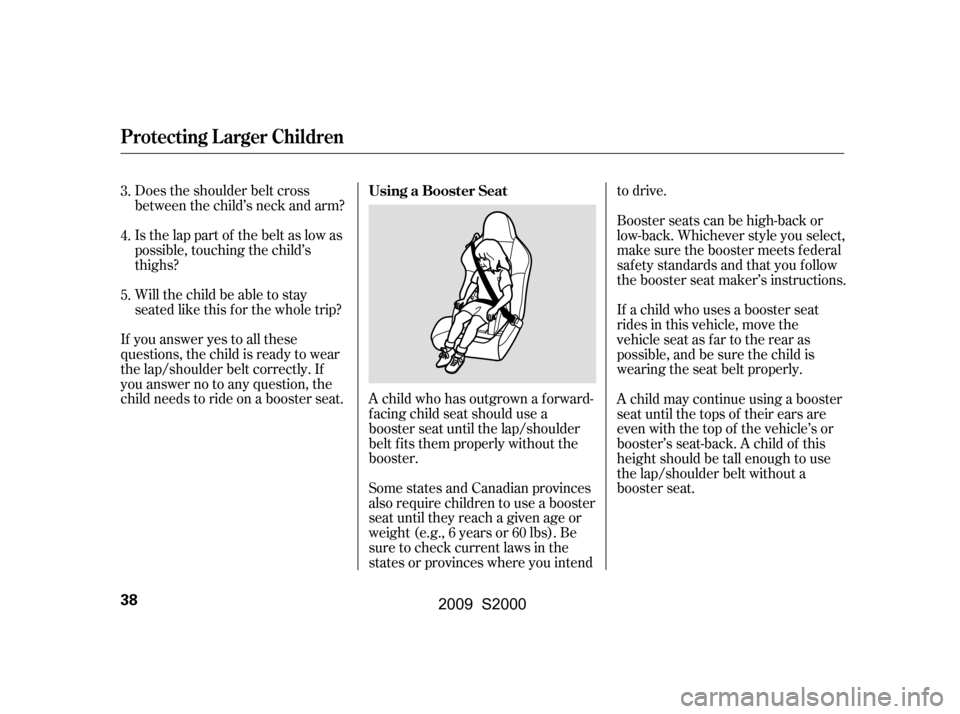
Does the shoulder belt cross
between the child’s neck and arm?
Is the lap part of the belt as low as
possible, touching the child’s
thighs?
Will the child be able to stay
seated like this f or the whole trip?
If you answer yes to all these
questions, the child is ready to wear
the lap/shoulder belt correctly. If
you answer no to any question, the
child needs to ride on a booster seat. A child who has outgrown a f orward- f acing child seat should use a
booster seat until the lap/shoulder
belt fits them properly without the
booster.
Some states and Canadian provinces
also require children to use a booster
seat until they reach a given age or
weight (e.g., 6 years or 60 lbs). Be
sure to check current laws in the
states or provinces where you intendto drive.
Booster seats can be high-back or
low-back. Whichever style you select,
make sure the booster meets f ederal
saf ety standards and that you f ollow
the booster seat maker’s instructions.
If a child who uses a booster seat
ridesinthisvehicle,movethe
vehicle seat as f ar to the rear as
possible, and be sure the child is
wearing the seat belt properly.
A child may continue using a booster
seat until the tops of their ears are
even with the top of the vehicle’s or
booster’s seat-back. A child of this
height should be tall enough to use
the lap/shoulder belt without a
booster seat.
3.
4.
5.
Using a Booster Seat
Protecting L arger Children
38
2009 S2000
Page 50 of 268

See page .
This indicator comes on if the trunk
lid is not closed tightly.
This indicator comes on if either
door is not closed tightly.
This indicator comes on when you
set the cruise control. See pagef or inf ormation on operating the
cruise control.
This indicator normally comes on f or
a f ew seconds when you turn the
ignition switch to the ON (II)
position, and when you push the
START button. If it comes on at any
other time, there is a problem with
theABS.If thishappens,haveyour
vehicle checked at a dealer. With
this indicator on, your vehicle still
has normal braking ability but no
anti-lock f unction. For more
inf ormation, see page .
This indicator comes on brief ly when
you turn the ignition switch to the
ON (II) position. If it comes on at
any other time, it indicates a
potential problem with your airbags.
This indicator will also alert you to a
potential problem with your
automatic seat belt tensioners,
driver’s seat position sensor, or the
passenger’s seat weight sensors. For
more information, see page .
25
150
124219
Instrument Panel Indicators
Supplemental Restraint
System Indicator
Malf unction Indicator
Lamp
Trunk-open Indicator
Door-open Indicator
Cruise Control Indicator
Anti-lock Brake System
(A BS) Indicator
Inst rument s and Cont rols
47
2009 S2000
Page 81 of 268
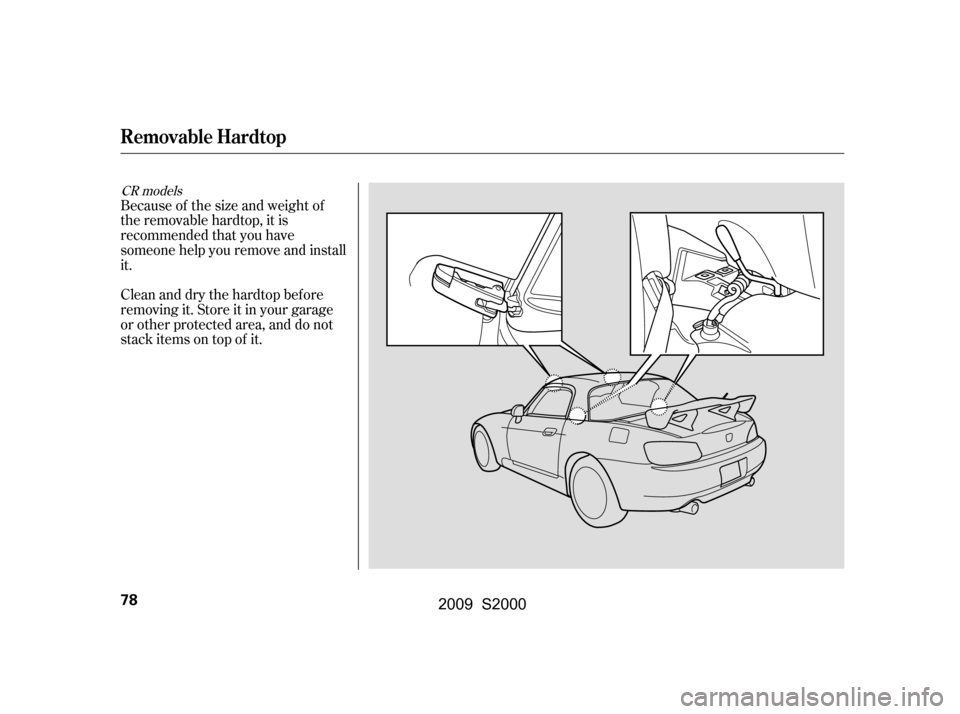
Because of the size and weight of
the removable hardtop, it is
recommended that you have
someone help you remove and install
it.
Clean and dry the hardtop bef ore
removing it. Store it in your garage
or other protected area, and do not
stack items on top of it.
CR models
Removable Hardtop
78
2009 S2000
Page 137 of 268

�µ�µ
�µ �µ
�µ
�µ�µ
Aggressive driving (hard
acceleration and braking)
Excessive idling, accelerating and
braking in stop-and-go traf f ic
Cold engine operation (engines
aremoreefficientwhenwarmed
up)
Driving with a heavy load or the
air conditioner running
Improperly inf lated tires
The f ollowing f actors can lower your
vehicle’s f uel economy:
A properly maintained vehicle
maximizes f uel economy. Poor
maintenance can signif icantly reduce
f uel economy. Always maintain your
vehicle according to the maintenance
messages displayed on the
inf ormation display (see
on page ).
For example: Rapid
acceleration, abrupt cornering,
and hard braking increase fuel
consumption.
Aerodynamic drag has a big ef f ect
on f uel mileage at speeds above 45
mph (75 km/h). Reduce your
speed and you reduce the drag.
Trailers, car top carriers, roof
racks and bike racks are also big
contributors to increased drag.
If your vehicle has a
manual transmission, you can
boost your f uel economy by up
shif ting as early as possible.
Idling
results in 0 miles per gallon.
An underinf lated tire increases
‘‘rolling resistance,’’ which reduces
f uel economy.
It puts a heavier
load on the engine, increasing f uel
consumption.
In
particular, a build-up of snow or
mud on your vehicle’s underside
adds weight and rolling resistance.
Frequent cleaning helps your f uel
economy.
167
Fuel Economy Factors
Use the recommended viscosity
motor oil, displaying the A PI
Certif ication Seal (see page ).
Improving Fuel Economy Owner’s
Maintenance Checks Drive moderately
Observe the speed limit
Always drive in the highest gear
possible
Avoid excessive idling
Maintain proper tire inf lation
A void carrying excess weight in
your vehicle
K eep your vehicle clean
170
Vehicle Maint enance Drive Ef f icient ly
Fuel Economy
134
2009 S2000
Page 142 of 268

�µ�µ�·
Steps f or Determining Correct Load
Limit Locate the statement ‘‘The
combined weight of occupants and
cargo should never exceed XXX
kg or XXX lbs.’’ on your vehicle’s
placard.
Determine the combined weight
of the driver and passengers that
will be riding in your vehicle.
Subtract the combined weight of
the driver and passengers f rom
XXX kg or XXX lbs. The resulting f igure equals the
available amount of cargo and
luggage load capacity. For
example, if the ‘‘XXX’’ amount
equals 1,400 lbs. and there will be
f ive 150 lb. passengers in your
vehicle, the amount of available
cargo and luggage load capacity is
650 lbs.
(1,400 750 (5 150) = 650 lbs.)
Determine the combined weight
of luggage and cargo being loaded
on the vehicle. That weight may
not saf ely exceed the available
cargo and luggage load capacity
calculated in Step 4.
If yourvehiclewillbetowinga
trailer, load f rom your trailer will
be transf erred to your vehicle.
Consult this manual to determine
how this reduces the available
cargo and luggage load capacity of
your vehicle.
See Tire And Loading Inf ormation
label attached to the driver’s
doorjamb.
The maximum load f or your vehicle
is 400 lbs (181 kg) f or U.S. vehicles,
and 185 kg for Canadian vehicles.
This f igure includes the total weight
of all occupants, cargo, and
accessories.
Label Example
This f igure includes the total weight
of all occupants, cargo, and
accessories, and the tongue load if
you are towing a trailer.
(1)
(2)
(3) (4)
(5)
(6)
CONT INUED
Load Limits
Carrying Cargo
Bef ore Driving
139
Overloading or improper
loading can affect handling and
stability and cause a crash in
which you can be hurt or killed.
Follow all load limits and other
loading guidelines in this
manual.
2009 S2000