Page 510 of 578
�´
Wheels:
Tires:
See page f or inf ormation about
DOT Tire Quality Grading, and page
f or tire size and labeling
inf ormation. Tires marked ‘‘M S’’ or ‘‘All
Season’’ on the sidewall have an all-
weather tread design suitable for
most winter driving conditions.
For the best perf ormance in snowy
or icy conditions, you should install
snow tires or tire chains. They may
be required by local laws under
certain conditions.If you mount snow tires on your
vehicle, make sure they are radial
tires of the same size and load range
as the original tires. Mount snow
tires on all f our wheels. The traction
provided by snow tires on dry roads
maybelowerthanyouroriginaltires.
Check with the tire dealer f or
maximum speed recommendations.
544
546
Wheel and T ire Specif ications Winter Driving
Snow T ires
Tires
506
17x71/2J
P245/65R17 105T
�����—�����—�
���y�
�������������y���
�(�/���������y�����
�
�y
2009 Pilot
Page 511 of 578

�Ì
Mount tire chains on your tires when
required by driving conditions or
local laws. Install them only on the
f ront tires.
Clean the wheels as you would the
rest of the exterior. Wash them with
thesamesolution,andrinsethem
thoroughly.
Aluminum alloy wheels have a
protective clear-coat that keeps the
aluminum f rom corroding and
tarnishing. Cleaning the wheels with
harsh chemicals (including some
commercial wheel cleaners) or a stif f
brush can damage the clear-coat. To
clean the wheels, use a mild
detergent and a sof t brush or sponge.
When installing chains, f ollow the
manuf acturer’s instructions and
mount them as tightly as you can.
Drive slowly with chains installed. If
you hear them contacting the body
or chassis, stop and investigate.
Make sure the chains are installed
tightly, and that they are not
contacting the brake lines or
suspension. Remove the chains as
soonasyoustartdrivingoncleared
roads. Because your vehicle has limited tire
clearance, Honda strongly
recommends using the chains listed
below.
SCC Super Z-6 SZ-435 T ire Chains
Wheels
Tires
Maint enance
507
Using the wrong chains, or not
properly installing chains, can
damage the brake lines and
cause a crash in which you can
be seriously injured or killed.
Follow all instructions in this
owner’s manual regarding the
selection and use of tire chains.
Traction devices that are the wrong
size or improperly installed can
damage your vehicle’s brake lines,
suspension, body, and wheels. Stop
driving if they are hitting any part of
the vehicle.
�����—�����—�����y�
�������������y���
�(�/���������y�����
���y
2009 Pilot
Page 514 of 578

If you need to park your vehicle f or
an extended period (more than 1
month), there are several things you
should do to prepare it f or storage.
Proper preparation helps prevent
deterioration and makes it easier to
get your vehicle back on the road. If
possible, store your vehicle indoors.Fill the f uel tank. Block the rear wheels.
If the vehicle is to be stored f or a
longer period, it should be
supported on jackstands so the
tires are of f the ground.
Leave one window open slightly (if
the vehicle is being stored
indoors).
Disconnect the battery.
Support the f ront and rear wiper
blade arms with a f olded towel or
ragsotheydonottouchthe
windshield.
To minimize sticking, apply a
silicone spray lubricant to all door
and tailgate seals. Also, apply a
vehiclebodywaxtothepainted
surfaces that mate with the door
and tailgate seals.Cover the vehicle with a
‘‘breathable’’ cover, one made
f rom a porous material such as
cotton. Non-porous materials, such
as plastic sheeting, trap moisture,
which can damage the paint.
If possible, periodically run the
engine until it reaches f ull
operating temperature (the
cooling f ans cycle on and of f
twice). Pref erably, do this once a
month.
Wash and dry the exterior
completely.
Cleantheinterior.Makesurethe
carpeting, floor mats, etc., are
completely dry.
Leave the parking brake off. Put
the transmission in Park.
Vehicle Storage
510
�����—�����—�
���y�
�������������y���
�(�/���������y�����
���y
2009 Pilot
Page 516 of 578
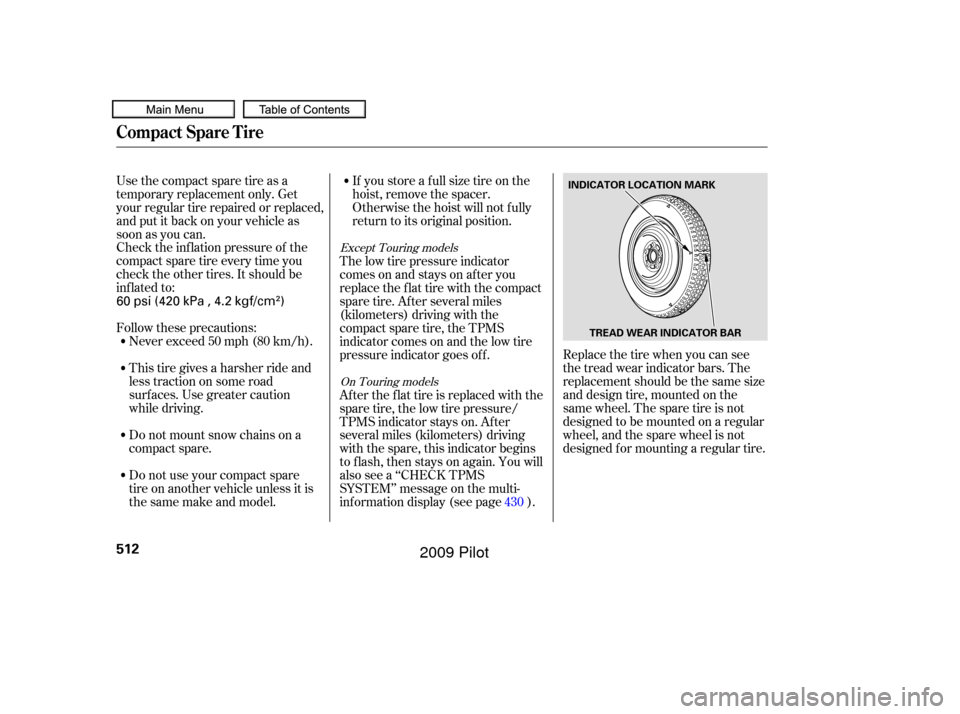
Check the inf lation pressure of the
compact spare tire every time you
check the other tires. It should be
inf lated to:
Follow these precautions:Never exceed 50 mph (80 km/h).
Do not mount snow chains on a
compact spare.
Do not use your compact spare
tire on another vehicle unless it is
thesamemakeandmodel.
Use the compact spare tire as a
temporary replacement only. Get
your regular tire repaired or replaced,
and put it back on your vehicle as
soon as you can.
This tire gives a harsher ride and
less traction on some road
surf aces. Use greater caution
while driving. If you store a f ull size tire on the
hoist, remove the spacer.
Otherwise the hoist will not f ully
return to its original position.
Replace the tire when you can see
the tread wear indicator bars. The
replacement should be the same size
and design tire, mounted on the
same wheel. The spare tire is not
designed to be mounted on a regular
wheel, and the spare wheel is not
designed f or mounting a regular tire.
The low tire pressure indicator
comes on and stays on af ter you
replace the flat tire with the compact
spare tire. Af ter several miles
(kilometers) driving with the
compact spare tire, the TPMS
indicator comes on and the low tire
pressure indicator goes of f .
After the flat tire is replaced with the
spare tire, the low tire pressure/
TPMS indicator stays on. After
several miles (kilometers) driving
with the spare, this indicator begins
to f lash, then stays on again. You will
also see a ‘‘CHECK TPMS
SYSTEM’’ message on the multi-
inf ormation display (see page ).
430Except Touring models
On Touring models
Compact Spare Tire
512
INDICATOR LOCATION MARK
TREAD WEAR INDICATOR BAR
60 psi (420 kPa , 4.2 kgf/cm)
�����—�����—�
���y�
���������
���y���
�(�/���������y�����
���y
2009 Pilot
Page 539 of 578
The operator will load
your vehicle on the back of a truck.
Any other method of towing will
damage the drive system. When you
contact the towing agency, inf orm
them a f lat-bed is required.
If your vehicle needs to be towed,
call a prof essional towing service or
organization. Never tow your vehicle
with just a rope or chain. It is very
dangerous.
4WD models only
Emergency Towing
The only way you can saf ely tow
your vehicle is with f lat-bed
equipment.
T aking Care of t he Unexpect ed
535
Towing with only two tires on the
ground will damage parts of the 4WD
system. It should be transported on a
f lat-bed truck or trailer.
�����—�����—�
���y�
���������
���y���
�(�/���������y���������y
2009 Pilot
Page 543 of 578
�µ
Thediagramsinthissectiongive
you the dimensions and capacities of
your vehicle and the locations of the
identif ication numbers. It also
includes inf ormation you should
know about your vehicle’s tires and
emissions control systems. ................
Identif ication Numbers . 540
................................
Specif ications .542
DOT Tire Quality Grading ..........................
(U.S. Vehicles) .544
.................................
Tire Labeling .546
Tire Pressure Monitoring System (TPMS) Required Federal ............................
Explanation .548
.......................
Emissions Controls .551
..
Three Way Catalytic Converter . 553
........................
Emissions Testing .554
T echnical Inf ormation
Technical Inf ormation
539
�����—�����—�
���y�
�������������y���
�(�/���������y���������y
2009 Pilot
Page 547 of 578

�Î
�µ
�µ
�µ
�µ
�Î �µ
�µ
�µ
�µ
�µ
�µ
�µ
�µ
�µ
�µ
�µ
�µ
�µ
�µ
�µ
�µ
�µ
Specif ications
Technical Inf ormation
543
Battery Lights
Fuses
Engine
Alignment
Tires
60 W
12 V
12 V 55 W
12 V 8 W
12 V 5 W
8W
5W
1.4 W
3.8 W
12 V
12 V
12 V
12 V 12 V 12 V
28/8 W
5W
12 V 5 W
12 V 18 W 55 W
12 V 60 W
12 V
Capacity 12 V
12 V 60 AH/5 HR
72 AH/20 HR
12 V 21/5 W
12 V 21/5 W
5W
12 V
Headlights
Daytime running lights
Front side marker lights
Front turn signal/
parking lights
Front fog lights
Rear turn signal/tail lights
Stop/Taillights
Rear side marker lights
Backup lights
License plate lights
Individual map lights
Cargo area lights
High mount brake lights
Vanity mirror lights
Door courtesy lights See page
534or the fuse label
attached on the side panel.
See page 533or the fuse label
attached to the inside of the fuse
box lid.
Interior
Rear
Under-hood
See page532and 533or the fuse
box cover.
Type
BorexStroke
Displacement
Compression ratio
Spark plugs Water cooled 4-stroke SOHC i-VTEC
VCM 6-cylinder (V6) gasoline engine 3.50 x 3.66 in (89.0 x 93.0 mm) 212 cu-in (3,471 cm
)
10.5 : 1
SXU22HCR11
ILZKR7B11
Toe-in
Camber
Caster 0.00 in (0.0 mm)
0.08 in (2.0 mm)
0°30’
0°30’
4°12’
Size
Pressure P245/65R17 105T
T165/80D17 104M
32 psi (220 kPa , 2.2 kgf/cm
)
60 psi (420 kPa , 4.2 kgf/cm)
Front/Rear
Spare
Front/Rear
Spare Front
Rear
Front
Rear
Front
Front
Rear
: (H11) (HB3)
(HB3)
DENSO:
NGK:
(H11)
High
Low
Except LX models
�����—�����—�
���y�
�������������y���
�(�/���������y���������y
2009 Pilot
Page 548 of 578

The tires on your vehicle meet all
U.S. Federal Saf ety Requirements.
All tires are also graded f or
treadwear, traction, and temperature
perf ormance according to
Department of Transportation
(DOT) standards. The f ollowing
explains these gradings.The treadwear grade is a compara-
tive rating based on the wear rate of
the tire when tested under controlled
conditions on a specif ied government
test course. For example, a tire
graded 150 would wear one and one-
half (1 1/2) times as well on the
government course as a tire graded
100. The relative perf ormance of
tires depends upon the actual condi-
tions of their use, however, and may
depart signif icantly f rom the norm
due to variations in driving habits,
service practices and dif f erences in
road characteristics and climate.The traction grades, f rom highest to
lowest, are AA, A, B, and C. Those
grades represent the tire’s ability to
stop on wet pavement as measured
under controlled conditions on
specif ied government test surf aces
of asphalt and concrete. A tire
marked C may have poor traction
perf ormance.
Warning: The traction grade
assignedtothistireisbasedon
straight-ahead braking traction tests,
and does not include acceleration,
cornering, hydroplaning, or peak
traction characteristics.
All passenger car tires must conf orm
to Federal Saf ety Requirements in
addition to these grades. Quality grades can be f ound where
applicable on the tire sidewall
between tread shoulder and
maximum section width. For
example: Unif orm T ire Quality Grading T readwear
T raction
T readwear 200
Traction AA
Temperature A
DOT Tire Quality Grading (U.S. Vehicles)
544
�����—�����—�
���y�
�������������y���
�(�/���������y���������y
2009 Pilot