2009 HONDA ELEMENT airbag
[x] Cancel search: airbagPage 45 of 345

In any of these situations, we
strongly recommend that you install
the child seat directly behind the
front passenger's seat, move the seat
as far forward as needed, and leave it
unoccupied. Or, you may wish to get
a smaller rear-facing child seat.
Placing a rear-facing child seat
in the front seat can result in
serious injury or death during a
collision.
Always place a rear-facing child
seat in the back seat, not the
front.Protecting Small Children
Child Seat TypeA child who is at least 1 year old, and
who fits within the child seat maker's
weight and height limits, should be
restrained in a forward-facing,
upright child seat.
Of the different seats available, we
recommend those that have a five-
point harness system as shown. We also recommend that a small
child use the child seat until the child
reaches the weight or height limit for
the seat.
Child Seat PlacementWe strongly recommend placing a
forward-facing child seat in a back
seat, not the front.Placing a forward-facing child seat in
the front seat of a vehicle equipped
with a passenger's airbag can be
hazardous.
If the vehicle seat is too
far forward, or the child's head is
thrown forward during a collision, an
inflating airbag can strike the child
with enough force to cause very
serious or fatal injuries.
CONTINUED
Protecting Infants and Small Children
41
Driver and Passenger Safety
2009 Element
Page 46 of 345

Even with advanced front airbags
that automatically turn the
passenger's front airbag off (see page
32),a back seat is the safest place for
a small child.
If it is necessary to put a forward-
facing child seat in the front, move
the vehicle seat as far to the rear as
possible, and be sure the child seat is
firmly secured to the vehicle and the
child is properly strapped in the seat.
Placing a forward-facing child
seat in the front seat can result
in serious injury or death if the
front airbag inflates.
If you must place a forward-
facing child seat in front, move
the vehicle seat as far back as
possible, and properly restrain
the child.Selecting a Child Seat
When buying a child seat, you need
to choose either a conventional child
seat, or one designed for use with
the lower anchors and tethers for
children (LATCH) system.
Conventional child seats must be
secured to a vehicle with a seat belt,
whereas LATCH-compatible seats
are secured by attaching the seat to
hardware built into the rear seats.
Since LATCH-compatible child seats
are easier to install and reduce the
possibility of improper installation,
we recommend selecting this style.
In seating positions and vehicles not
equipped with LATCH, a LATCH-
compatible child seat can be installed
using a seat belt.
Whatever type of seat you choose, to
provide proper protection, a child
seat should meet three
requirements:
1.
The child seat should meet U.S. or
Canadian Motor Vehicle Safety
Standard 213.
Look for FMVSS
213 or CMVSS 213 on the box.
2.
The child seat should be of the proper type and size to fit the child.Rear-facing for infants, forward-
facing for small children.
Protecting Infants and Small Children, Selecting a Child Seat42
2009 Element
Page 53 of 345

When a child reaches the
recommended weight or height limit
for a forward-facing child seat, the
child should sit in a back seat on a
booster seat and wear a lap/shoulder
belt.
The following pages give instructions
on how to check proper seat belt fit,
what kind of booster seat to use if one
is needed, and important precautions
for a child who must sit in front.
Allowing a child age 12 or under
to sit in front can result in injury
or death if the passenger's front
airbag inflates.
If a child must ride in front, move
the vehicle seat as far back as
possible, use a booster seat if
needed, have the child sit up
properly and wear the seat belt
properly.
Checking Seat Belt FitTo determine if a lap/shoulder belt
properly fits a child, have the child
put on the seat belt, then ask
yourself:
1. Does the child sit all the way backagainst the seat?
2. Do the child's knees bend comfortably over the edge of the
seat? 3. Does the shoulder belt cross
between the child's neck and arm?
4. Is the lap part of the belt as low as possible, touching the child's
thighs?
5. Will the child be able to stay seated like this for the whole trip?
If you answer yes to all these
questions, the child is ready to wear
the lap/shoulder belt correctly. If
you answer no to any question, the
child needs to ride on a booster seat.
Protecting Larger Children
49
Driver and Passenger Safety
2009 Element
Page 54 of 345

Using a Booster SeatA child who has outgrown a forward-
facing child seat should ride in a
back seat and use a booster seat until
the lap/shoulder belt fits them
properly without the booster.
Some states, Canadian provinces and
territories also require children to
use a booster seat until they reach a
given age or weight (e.g., 6 years or
60 lbs). Be sure to check current
laws in the states, provinces or
territories where you intend to drive.Booster seats can be high-back or
low-back. Whichever style you select,
make sure the booster meets federal
safety standards and that you follow
the booster seat maker's
instructions.
If a child who uses a booster seat
must ride in front, move the vehicle
seat as far back as possible and be
sure the child is wearing the seat belt
properly.
A child may continue using a booster
seat until the tops of their ears are
even with the top of the vehicle's or
booster's seat-back. A child of this
height should be tall enough to use
the lap/shoulder belt without a
booster seat.
When Can a Larger Child Sit in
Front
The National Highway Traffic Safety
Administration and Transport
Canada recommend that all children
aged 12 and under be properly
restrained in a back seat.
If the passenger's front airbag
inflates in a moderate to severe
frontal collision, the airbag can cause
serious injuries to a child who is
unrestrained, improperly restrained,
sitting too close to the airbag, or out
of position.
A side airbag also poses risks. If any
part of a larger child's body is in the
path of a deploying side airbag, the
child could receive possibly serious
injuries.Protecting Larger Children50
2009 Element
Page 61 of 345

ꭧ: The U.S. instrument panel is shown. Differences for the Canadian models are noted in the text.
DRL
DAYTIME RUNNING LIGHTS
INDICATOR (P.
60)
HIGH BEAM INDICATOR
(P.
61)
CHARGING SYSTEM
INDICATOR (P.
58,295)
VEHICLE STABILITY
ASSIST (VSA)
INDICATOR
(P.
62)
VSA OFF
INDICATOR
(P.
62)
ANTI-LOCK BRAKE SYSTEM
(ABS) INDICATOR (P.
59) LOW OIL
PRESSURE
INDICATOR
(P.
58,295)
DOOR AND TAILGATE
OPEN INDICATOR (P.
61)SIDE AIRBAG OFF
INDICATOR (P.
59)
IMMOBILIZER SYSTEM
INDICATOR (P.
60) SUPPLEMENTAL
RESTRAINT SYSTEM
INDICATOR (P.
59)LOW FUEL
INDICATOR
(P.
61)MAINTENANCE MINDER
INDICATOR (P.
59)SEAT BELT REMINDER
INDICATOR (P.
58)LIGHTS ON INDICATOR (P. 61)PARKING BRAKE AND
BRAKE SYSTEM INDICATOR
(P.
58,297)
CRUISE CONTROL
INDICATOR (P.60)
TPMS INDICATOR
(P.
63) CRUISE MAIN INDICATOR
(P.
60)
MALFUNCTION INDICATOR
LAMP (P.
58,296)
LOW TIRE PRESSURE
INDICATOR (P.
62)
Instrument Panel
57
Instruments and Controls
2009 Element
Page 63 of 345
If either of you do not fasten your
seat belt while driving, the beeper
will sound and the indicator will flash
again at regular intervals. For more
information, see page18.
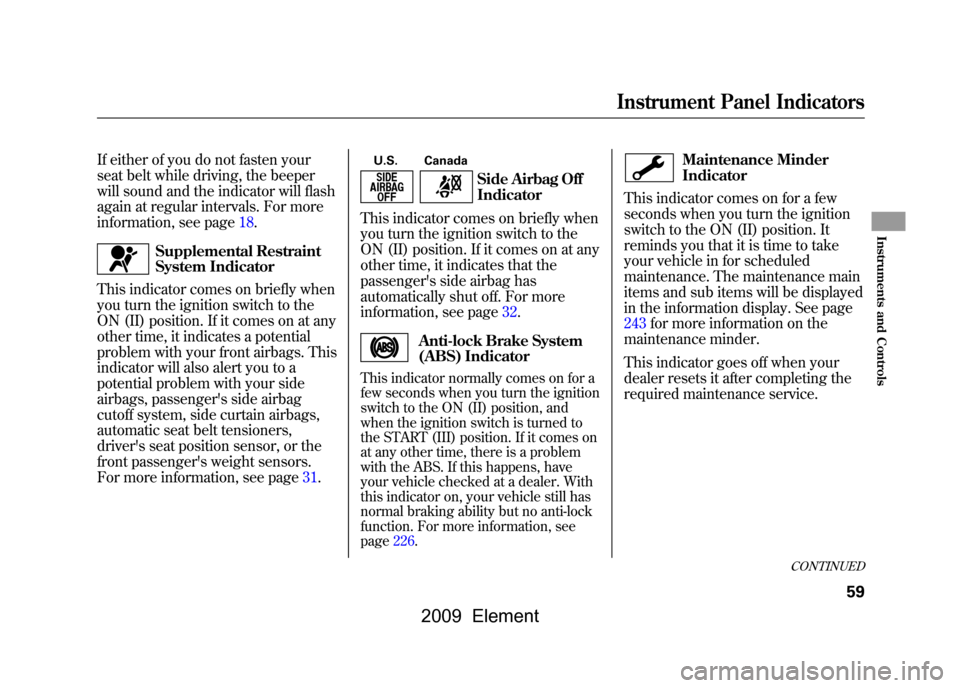
Supplemental Restraint
System Indicator
This indicator comes on briefly when
you turn the ignition switch to the
ON (II) position. If it comes on at any
other time, it indicates a potential
problem with your front airbags. This
indicator will also alert you to a
potential problem with your side
airbags, passenger's side airbag
cutoff system, side curtain airbags,
automatic seat belt tensioners,
driver's seat position sensor, or the
front passenger's weight sensors.
For more information, see page
31.
U.S. Canada
Side Airbag Off
Indicator
This indicator comes on briefly when
you turn the ignition switch to the
ON (II) position. If it comes on at any
other time, it indicates that the
passenger's side airbag has
automatically shut off. For more
information, see page
32.
Anti-lock Brake System
(ABS) Indicator
This indicator normally comes on for a
few seconds when you turn the ignition
switch to the ON (II) position, and
when the ignition switch is turned to
the START (III) position. If it comes on
at any other time, there is a problem
with the ABS. If this happens, have
your vehicle checked at a dealer. With
this indicator on, your vehicle still has
normal braking ability but no anti-lock
function. For more information, see
page
226.
Maintenance Minder
Indicator
This indicator comes on for a few
seconds when you turn the ignition
switch to the ON (II) position. It
reminds you that it is time to take
your vehicle in for scheduled
maintenance. The maintenance main
items and sub items will be displayed
in the information display. See page
243for more information on the
maintenance minder.
This indicator goes off when your
dealer resets it after completing the
required maintenance service.
CONTINUED
Instrument Panel Indicators
59
Instruments and Controls
2009 Element
Page 209 of 345

Modifying your vehicle, or installing
some non-Honda accessories, can
make it unsafe. Before you make any
modifications or add any accessories,
be sure to read the following
information.
Accessories
Your dealer has Honda accessories
that allow you to personalize your
vehicle. These accessories have been
designed and approved for your
vehicle, and are covered by warranty.
Although non-Honda accessories
may fit on your vehicle, they may not
meet factory specifications, and could
adversely affect your vehicle's
handling and stability.
Improper accessories or
modifications can affect your
vehicle's handling, stability, and
performance, and cause a
crash in which you can be hurt
or killed.
Follow all instructions in this
owner's manual regarding
accessories and modifications.
When properly installed, cellular
phones, alarms, two-way radios, and
low-powered audio systems should
not interfere with your vehicle's
computer controlled systems, such
as your airbags, anti-lock brakes, and
tire pressure monitoring system. Before installing any accessory:
●Make sure the accessory does not
obscure any lights, or interfere
with proper vehicle operation or
performance.●Be sure electronic accessories do
not overload electrical circuits (see
page298)or interfere with the
proper operation of your vehicle.●Before installing any electronic
accessory, have the installer
contact your dealer for assistance.
If possible, have your dealer
inspect the final installation.●Do not install accessories on the
side pillars or across the rear
windows. Accessories installed in
these areas may interfere with
proper operation of the side
curtain airbags.
CONTINUED
Accessories and Modifications
205
Before Driving
2009 Element
Page 210 of 345

Modifying Your Vehicle
Removing parts from your vehicle, or
replacing components with some
non-Honda components could
seriously affect your vehicle's
handling, stability, and reliability.
Some examples are:●Lowering the vehicle with a non-
Honda suspension kit that
significantly reduces ground
clearance can allow the
undercarriage to hit speed bumps
or other raised objects, which
could cause the airbags to deploy.●Raising your vehicle with a non-
Honda suspension kit can affect
the handling and stability.
●Non-Honda wheels, because they
are a universal design, can cause
excessive stress on suspension
components, and are not
compatible with the tire pressure
monitoring system (TPMS).●Larger or smaller wheels and tires
can interfere with the operation of
your vehicle's anti-lock brakes and
other systems.●Modifying your steering wheel or
any other part of your vehicle's
safety features can make the
systems ineffective.
If you plan to modify your vehicle,
consult your dealer.
Accessories and Modifications206
2009 Element