2009 HONDA ELEMENT child seat
[x] Cancel search: child seatPage 50 of 345

8. Attach the tether strap hook to thetether anchor, then tighten the
strap as instructed by the child
seat maker.
If the tether strap is too long and
cannot be tightened firmly, find a
route where the strap can be
tightened securely.
9. Push and pull the child seat forward and from side-to-side to
verify that it is secure. Installing a Child Seat with a Lap/
Shoulder Belt
When not using the LATCH system,
all child seats must be secured to the
vehicle with the lap part of a lap/
shoulder belt.
In addition, the lap/shoulder belts in
all seating positions except the
driver's have a lockable retractor that
must be activated to secure a child
seat.
1. With the child seat in the desired
seating position, route the belt
through the child seat according to
the seat maker's instructions, then
insert the latch plate into the
buckle.
TETHER STRAP HOOK
TETHER ANCHOR
Installing a Child Seat46
2009 Element
Page 51 of 345
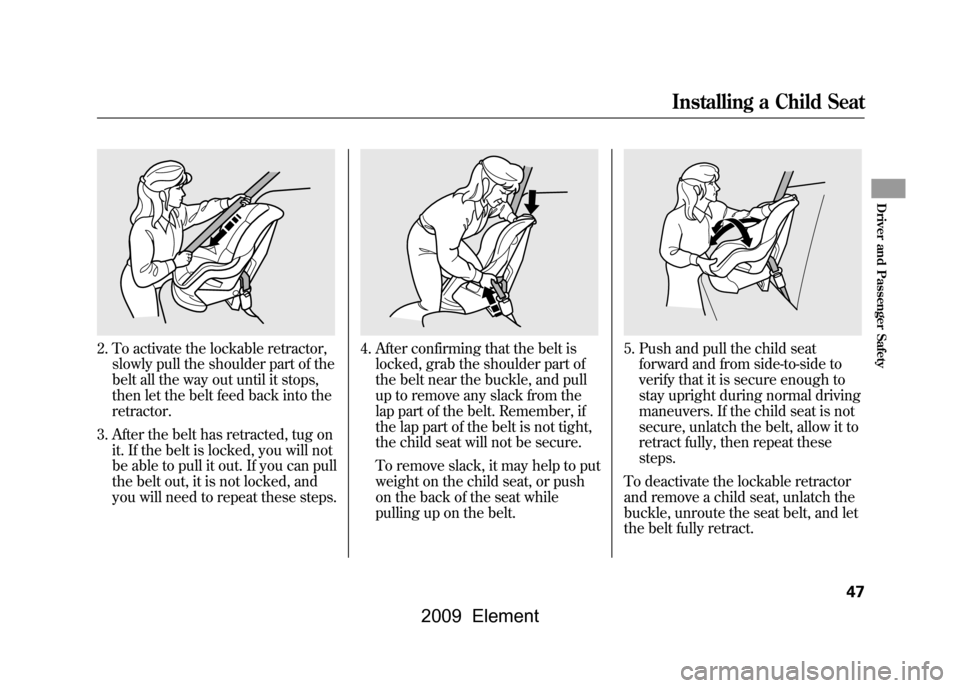
2. To activate the lockable retractor,slowly pull the shoulder part of the
belt all the way out until it stops,
then let the belt feed back into the
retractor.
3. After the belt has retracted, tug on it. If the belt is locked, you will not
be able to pull it out. If you can pull
the belt out, it is not locked, and
you will need to repeat these steps.
4. After confirming that the belt islocked, grab the shoulder part of
the belt near the buckle, and pull
up to remove any slack from the
lap part of the belt. Remember, if
the lap part of the belt is not tight,
the child seat will not be secure.
To remove slack, it may help to put
weight on the child seat, or push
on the back of the seat while
pulling up on the belt.
5. Push and pull the child seatforward and from side-to-side to
verify that it is secure enough to
stay upright during normal driving
maneuvers. If the child seat is not
secure, unlatch the belt, allow it to
retract fully, then repeat these
steps.
To deactivate the lockable retractor
and remove a child seat, unlatch the
buckle, unroute the seat belt, and let
the belt fully retract.
Installing a Child Seat
47
Driver and Passenger Safety
2009 Element
Page 52 of 345

Installing a Child Seat with a
TetherA child seat with a tether can be
installed in either back seat, using
one of the anchor points shown
above.
Since a tether can provide additional
security to the lap/shoulder belt
installation, we recommend using a
tether whenever one is required or
available.
1. After securing the child seat in thedesired position (see page46),
remove the head restraint (see
page85),then route the tether
strap over the top of the seat-back.
2. Slide the anchor cover open as shown.
3. Attach the tether strap hook to the
anchor, making sure the strap is
not twisted.
4. Tighten the strap according to the seat maker's instructions. Make
sure the removed head restraint is
secured in the cargo area. Reinstall
the head restraint in place when
you remove the child seat.
TETHER ANCHORAGE POINTS
TETHER ANCHOR
ANCHOR COVER
TETHER ANCHOR
TETHER STRAP HOOK
Installing a Child Seat48
2009 Element
Page 53 of 345

When a child reaches the
recommended weight or height limit
for a forward-facing child seat, the
child should sit in a back seat on a
booster seat and wear a lap/shoulder
belt.
The following pages give instructions
on how to check proper seat belt fit,
what kind of booster seat to use if one
is needed, and important precautions
for a child who must sit in front.
Allowing a child age 12 or under
to sit in front can result in injury
or death if the passenger's front
airbag inflates.
If a child must ride in front, move
the vehicle seat as far back as
possible, use a booster seat if
needed, have the child sit up
properly and wear the seat belt
properly.
Checking Seat Belt FitTo determine if a lap/shoulder belt
properly fits a child, have the child
put on the seat belt, then ask
yourself:
1. Does the child sit all the way backagainst the seat?
2. Do the child's knees bend comfortably over the edge of the
seat? 3. Does the shoulder belt cross
between the child's neck and arm?
4. Is the lap part of the belt as low as possible, touching the child's
thighs?
5. Will the child be able to stay seated like this for the whole trip?
If you answer yes to all these
questions, the child is ready to wear
the lap/shoulder belt correctly. If
you answer no to any question, the
child needs to ride on a booster seat.
Protecting Larger Children
49
Driver and Passenger Safety
2009 Element
Page 54 of 345

Using a Booster SeatA child who has outgrown a forward-
facing child seat should ride in a
back seat and use a booster seat until
the lap/shoulder belt fits them
properly without the booster.
Some states, Canadian provinces and
territories also require children to
use a booster seat until they reach a
given age or weight (e.g., 6 years or
60 lbs). Be sure to check current
laws in the states, provinces or
territories where you intend to drive.Booster seats can be high-back or
low-back. Whichever style you select,
make sure the booster meets federal
safety standards and that you follow
the booster seat maker's
instructions.
If a child who uses a booster seat
must ride in front, move the vehicle
seat as far back as possible and be
sure the child is wearing the seat belt
properly.
A child may continue using a booster
seat until the tops of their ears are
even with the top of the vehicle's or
booster's seat-back. A child of this
height should be tall enough to use
the lap/shoulder belt without a
booster seat.
When Can a Larger Child Sit in
Front
The National Highway Traffic Safety
Administration and Transport
Canada recommend that all children
aged 12 and under be properly
restrained in a back seat.
If the passenger's front airbag
inflates in a moderate to severe
frontal collision, the airbag can cause
serious injuries to a child who is
unrestrained, improperly restrained,
sitting too close to the airbag, or out
of position.
A side airbag also poses risks. If any
part of a larger child's body is in the
path of a deploying side airbag, the
child could receive possibly serious
injuries.Protecting Larger Children50
2009 Element
Page 55 of 345

Of course, children vary widely. And
while age may be one indicator of
when a child can safely ride in front,
there are other important factors you
should consider.MaturityTo safely ride in front, a child must
be able to follow the rules, including
sitting properly, and wearing the seat
belt properly throughout a ride.Physical SizePhysically, a child must be large
enough for the lap/shoulder belt to
properly fit (see pages14and49).If
the seat belt does not fit properly,
with or without the child sitting on a
booster seat, the child should not sit
in front.If you decide that a child can safely
ride up front, be sure to:
●Carefully read the owner's manual,
and make sure you understand all
seat belt instructions and all safety
information.●Move the vehicle seat to the rear-
most position.●Have the child sit up straight, back
against the seat, and feet on or
near the floor.●Check that the child's seat belt is
properly and securely positioned.●Supervise the child. Even mature
children sometimes need to be
reminded to fasten the seat belts
or sit properly.Additional Safety Precautions
●Do not let a child wear a seat belt
across the neck.
This could result
in serious neck injuries during a
crash.
●Do not let a child put the shoulder part of a seat belt behind the back
or under the arm.
This could cause
very serious injuries during a
crash. It also increases the chance
that the child will slide under the
belt in a crash and be injured.
●Two children should never use the
same seat belt.
If they do, they
could be very seriously injured in a
crash.
●Do not put any accessories on a
seat belt.
Devices intended to
improve a child's comfort or
reposition the shoulder part of a
seat belt can make the belt less
effective and increase the chance
of serious injury in a crash.
Protecting Larger Children
51
Driver and Passenger Safety
2009 Element
Page 332 of 345

Bulbs, Halogen
..........................
261
Bungee Cords
............................
211
C
Capacities Chart
.........................
309
Carbon Monoxide Hazard
............
52
Cargo
.........................................
207
Cargo Area Light
..........................
96
Cargo Hook
................................
212
Cargo, How to Carry
..................
207
Carrying Cargo
..........................
207
CAUTION, Explanation of
............
iii
CD Care
.....................................
183
CD Error Messages
............
125,148
CD Player
...........................
119,140
Certification Label
......................
306
Chains, Tires
..............................
276
Changing a Flat Tire
..................
283
Changing Oil How to
....................................
252
When to
..................................
243
Charging System
Indicator
...........................
58,295
Check Fuel Cap Message
............
66 Checklist, Before Driving
...........
215
Child Safety
..................................
35
Booster Seats
...........................
50
Child Seats
....................
40,41, 42
Important Safety Reminders
.....
39
Infants
......................................
40
Large Children
.........................
49
LATCH
.....................................
44
Risks with Airbags
...................
36
Small Children
.........................
41
Tethers
....................................
48
Warning Labels
........................
37
Where Should a Child Sit?
........
36
Child Seats
.............................
35,42
LATCH Anchorage Points
........
44
Tether Anchorage Points
.........
48
Cleaning the Seat Belts
..............
268
Clock
..........................................
189
Clutch Fluid
...............................
258
Code, Audio System
...................
188
CO in the Exhaust
................
52,316
Cold Weather, Starting in
...........
216
Compact Spare Tire
....................
282
Controls, Instruments and
............
55
Coolant Adding
....................................
254 Checking
................................
201
Proper Solution
.......................
254
Temperature Gauge
.................
67
Cooler Box
...................................
98
Courtesy Light
.............................
96
Crankcase Emissions Control System
...................................
316
Cruise Control Indicator
...............
60
Cruise Control Operation
...........
193
Cruise Main Indicator
..................
60
Cup Holders
.................................
99
Customer Service
.......................
322
D
DANGER, Explanation of
.............
iii
Dashboard
...............................
3,56
Daytime Running Lights
..............
72
Daytime Running Lights Indicator
...................................
60
Dead Battery
..............................
291
Defects, Reporting Safety
...........
324
Defogger, Rear Window
...............
74
Dimensions
................................
308
Dimming the Headlights
..............
71
IndexII
2009 Element
Page 335 of 345

Heating and Cooling
..................
104
Hood, Opening and Closing the
..........................................
200
Horn
............................................
69
Hydraulic Clutch
........................
258
I
Identification Number, Vehicle
...................................
306
Ignition Keys
.........................................
75
Switch
......................................
79
Immobilizer System
.....................
76
Important Safety Precautions
.........
6
Indicators, Instrument Panel
........
57
ABS (Anti-lock Brake)
..............
59
Brake (Parking and Brake System)
.........................
58,297
Charging System
..............
58,295
Cruise Control
..........................
60
Cruise Main
.............................
60
Door and Tailgate Open
...........
61
DRL (Daytime Running Lights)
..................................
60 High Beam
...............................
61
Key (Immobilizer System)
.......
60
Lights On
.................................
61
Low Fuel
..................................
61
Low Oil Pressure
..............
58,295
Low Tire Pressure
.............
62,227
Maintenance Minder
.........
59,243
Malfunction Indicator Lamp
.............................
58,296
Passenger Airbag Off
...............
32
Seat Belt Reminder
.............
18,58
Side Airbag Off
....................
32,59
SRS
.....................................
31,59
TPMS
................................
63,228
Turn Signal and Hazard Warning
...............................
60
VSA OFF
..................................
62
VSA System
.............................
62
Washer Level
...........................
61
Individual Map Lights
..................
95
Infant Restraint
............................
40
Infant Seats
..................................
40
Tether Anchorage Point
...........
48
Inflation, Proper Tire
..................
271
Recommended Pressures
.......
272
Inside Mirror
...............................
93 Inspection, Tire
..........................
273
Installing a Child Seat
..................
43
Instrument Panel
..........................
57
Instrument Panel Brightness
.......
72
Instruments and Controls
.............
55
Interior Lights
..............................
95
Introduction
...................................
i
iPod
®Error Messages
................
172
J
Jacking up the Vehicle
...............
283
Jack, Tire
...................................
283
Jump Starting
.............................
291
K
Keys
.............................................
75
L
Label, Certification
.....................
306
Lane Change, Signaling
...............
71
Lap/Shoulder Belt
.................
14,19
CONTINUED
Index
V
INDEX
2009 Element