Page 348 of 384

�µ
�µ
CONT INUED
If , due to damage, your vehicle must
be towed with the f ront wheels on
the ground, do this:
With the f ront wheels on the ground,
it is best to tow the vehicle no farther
than 50 miles (80 km), and keep the
speedbelow35mph(55km/h).
If your vehicle needs to be towed,
call a prof essional towing service or
organization. Never tow your vehicle
with just a rope or chain. It is very
dangerous.
Therearetwowaystotowyour
vehicle:
The tow
truck uses two pivoting arms that go
under the tires (f ront) and lif t them
of f the ground. The other two tires
remain on the ground. The operator
loads your vehicle on the back of a
truck. Start the engine.
Press on the brake pedal. Move
the shif t lever through all its
positions.
Shif t to D position f or 5 seconds,
then to N.
Turn of f the engine.
Release the parking brake.
Leave the ignition switch in the
ACCESSORY (I) position so the
steering wheel does not lock.
Wheel-lif t Equipment
Flat -bed Equipment
T his is an
acceptable way to tow your
vehicle. T his is the best way to
transport your vehicle.
Emergency Towing
T aking Care of t he Unexpect ed
345
Improper towing preparation will
damage the transmission. Follow the
above procedure exactly. If you cannot
shif t the transmission or start the
engine, your vehicle must be
transported with the f ront wheels of f
the ground.
�\f���—�\f���—�
���y�
�\f��
��������y���
�(�#�������\f�y�\f�����\f�y
2009 Civic Hybrid
Page 351 of 384
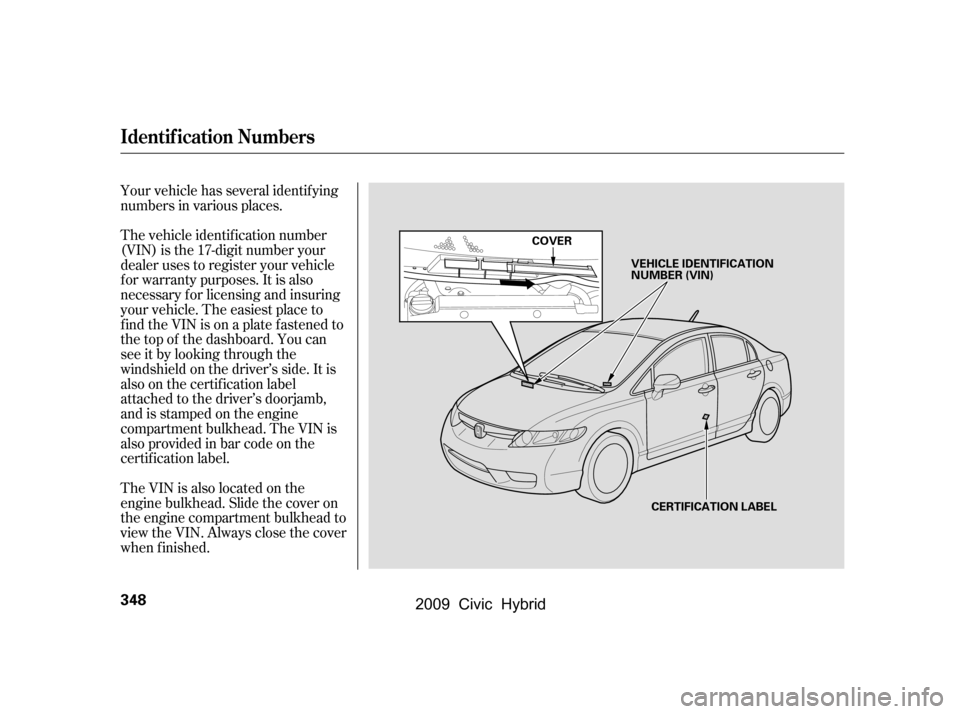
Your vehicle has several identif ying
numbers in various places.
The vehicle identif ication number
(VIN) is the 17-digit number your
dealer uses to register your vehicle
f or warranty purposes. It is also
necessary f or licensing and insuring
your vehicle. The easiest place to
find the VIN is on a plate fastened to
the top of the dashboard. You can
seeitbylookingthroughthe
windshield on the driver’s side. It is
also on the certification label
attached to the driver’s doorjamb,
and is stamped on the engine
compartment bulkhead. The VIN is
also provided in bar code on the
certif ication label.
The VIN is also located on the
engine bulkhead. Slide the cover on
the engine compartment bulkhead to
view the VIN. Always close the cover
when f inished.
Identif ication Numbers
348
COVERCERTIFICATION LABEL
VEHICLE IDENTIFICATION
NUMBER (VIN)
�\f���—�\f���—�
���y�
�\f��
��������y���
�(�#�������\f�y�\f�������y
2009 Civic Hybrid
Page 352 of 384
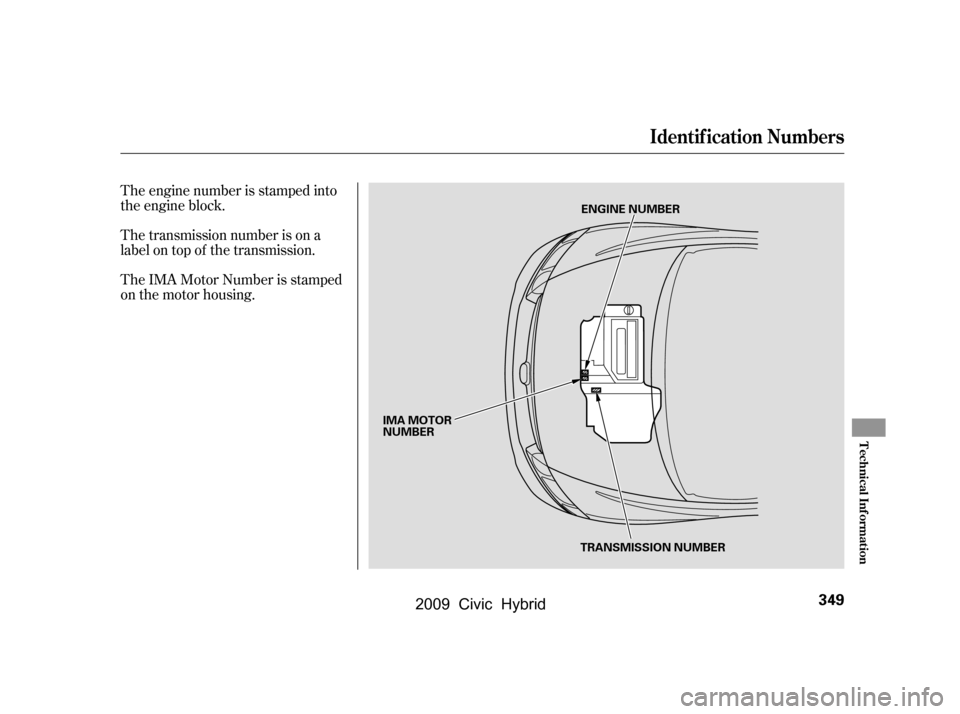
The engine number is stamped into
the engine block.
The transmission number is on a
label on top of the transmission.
The IMA Motor Number is stamped
on the motor housing.
Identif ication Numbers
Technical Inf ormation
349
ENGINE NUMBER
IMA MOTOR
NUMBER TRANSMISSION NUMBER
�\f���—�\f���—�
���y�
�\f��
������\f�y���
�(�#�������\f�y�\f�������y
2009 Civic Hybrid
Page 353 of 384

�Î
�Î
�Î
�Î
Specif ications
350
Dimensions
Weights
Engine
Seating CapacitiesCapacities
176.7 in (4,489 mm)
69.0 in (1,752 mm)
56.3 in (1,430 mm)
106.3 in (2,700 mm)
59.1 in (1,501 mm)
60.2 in (1,529 mm)
Length
Width
Height
Wheelbase
Track
Gross vehicle weight rating See the certification label attached
to the driver’s doorjamb. 3.0 US qt (2.8
)
5.4 US qt (5.1)
1.255 US gal (4.75
)
1.59 US gal (6.0)
3.4 US qt (3.2
)
3.2 US qt (3.0)
4.0 US qt (3.8)
12.3 US gal (46.6
)
Type
BorexStroke
Displacement
Compression ratio
Spark plugs SK20HPR-L11
ILFR6J-11K10.8
82 cu-in (1,339 cm
)
2.87 x 3.15 in (73.0 x 80.0 mm)
Water cooled 4-stroke SOHC i-VTEC
gasoline engine with Hybrid Electric
Total
Front
Rear
5
2
3Fuel tank
Engine
coolant
Engine oil
Automatic
transmission
fluid
Windshield
washer
reservoir
Excluding the oil remaining in the engine
Including the coolant in the reserve tank and that remaining in the
engine
Reserve tank capacity: 0.11 US gal (0.4
)
2.6 US qt (2.5
)
4.8 US qt (4.5)
Front
Rear
Approx.
1:
2:
(NGK) (DENSO) Change
Total
Change
Including filter
Without filter
Total
Change
Total
U.S. Vehicles
Canada Vehicles
1
2
�\f���—�\f���—�
���y�
�\f��
��������y���
�(�#�������\f�y�\f�������y
2009 Civic Hybrid
Page 360 of 384

�Î
�ÎThe burning of gasoline in your
vehicle’s engine produces several by-
products. Some of these are carbon
monoxide (CO), oxides of nitrogen
(NOx), and hydrocarbons (HC).
Gasoline evaporating f rom the tank
also produces hydrocarbons. Con-
trolling the production of NOx, CO,
and HC is important to the environ-
ment. Under certain conditions of
sunlight and climate, NOx and HC
react to f orm photochemical ‘‘smog.’’
Carbon monoxide does not contri-
bute to smog creation, but it is a
poisonous gas. The United States Clean Air Act
sets standards f or automobile
emissions. It also requires that
automobile manufacturers explain to
owners how their emissions controls
workandwhattodotomaintain
them. This section summarizes how
the emissions controls work.
In Canada, Honda vehicles comply
with the Canadian emission
requirements, as specif ied in an
agreement with Environment
Canada, at the time they are
manuf actured.
Your vehicle has a positive
crankcase ventilation system. This
keeps gasses that build up in the
engine’s crankcase f rom going into
the atmosphere. The positive
crankcase ventilation valve routes
them from the crankcase back to the intake manif old. They are then
drawn into the engine and burned.
As gasoline evaporates in the f uel
tank, an evaporative emissions
control canister f illed with charcoal
adsorbs the vapor. It is stored in this
canister while the engine is of f . Af ter
the engine is started and warmed up,
the vapor is drawn into the engine
and burned during driving.
The onboard ref ueling vapor
recovery (ORVR) system captures
the f uel vapors during ref ueling. The
vapors are adsorbed in a canister
f illed with activated carbon. While
driving, the f uel vapors are drawn
into the engine and burned of f .
The Clean Air Act
Crankcase Emissions Control
System
Evaporative Emissions Control
System
Onboard Ref ueling Vapor
Recovery
Emissions Cont rols
Technical Inf ormation
357
�\f���—�\f���—�
���y�
�\f��
����
�\f�y���
�(�#�������\f�y�\f�������y
2009 Civic Hybrid
Page 361 of 384

The exhaust emissions controls
include f our systems: PGM-FI,
ignition timing control, exhaust gas
recirculation, and three way catalytic
converter. These f our systems work
together to control the engine’s
combustion and minimize the
amount of HC, CO, and NOx that
come out the tailpipe. The exhaust
emissions control systems are
separate f rom the crankcase and
evaporative emissions control
systems.The emissions control systems are
designed and certif ied to work to-
gether in reducing emissions to
levels that comply with the Clean Air
Act. To make sure the emissions
remain low, you should use only new
Honda replacement parts or their
equivalent f or repairs. Using lower
quality parts may increase the
emissions f rom your vehicle.
The emissions control systems are
covered by warranties separate from
the rest of your vehicle. Read your
warranty manual for more informa-
tion.
The PGM-FI system uses sequential
multiport f uel injection.
It has three subsystems: air intake,
engine control, and f uel control. The
powertrain control module (PCM)
uses various sensors to determine
how much air is going into the
engine. It then controls how much
f uel to inject under all operating
conditions. This system constantly adjusts the
ignition timing, reducing the amount
of HC, CO, and NOx produced.
The exhaust gas recirculation (EGR)
system takes some of the exhaust
gas and routes it back into the intake
manif old. Adding exhaust gas to the
air/f uel mixture reduces the amount
of NOx produced when the f uel is
burned.
The three way catalytic converter is
in the exhaust system. Through
chemical reactions, it converts HC,
CO, and NOx in the engine’s exhaust
to carbon dioxide (CO ), nitrogen
(N ), and water vapor.
2
2
Exhaust Emissions Controls Replacement Parts
PGM-FI SystemIgnit ion T iming Cont rol Syst em
Exhaust Gas Recirculat ion (EGR)Syst em
Three Way Catalytic Converter
Emissions Cont rols
358
�\f���—�\f���—�
���y�
�\f��
����
���y���
�(�#�������\f�y�\f�������y
2009 Civic Hybrid
Page 362 of 384
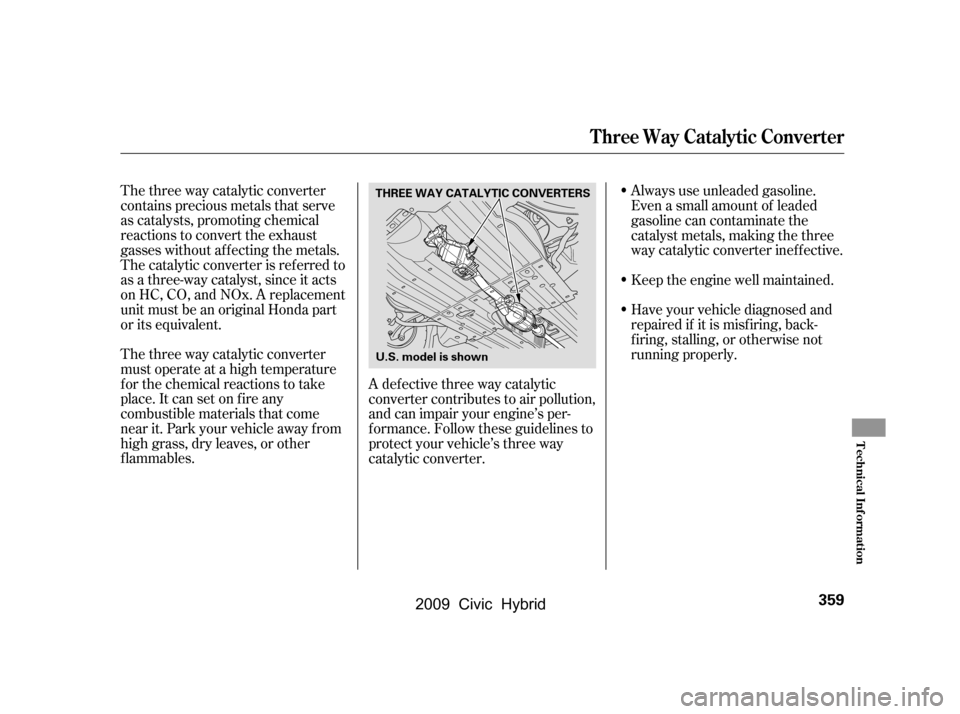
The three way catalytic converter
contains precious metals that serve
as catalysts, promoting chemical
reactions to convert the exhaust
gasses without af f ecting the metals.
The catalytic converter is ref erred to
as a three-way catalyst, since it acts
on HC, CO, and NOx. A replacement
unit must be an original Honda part
or its equivalent.
The three way catalytic converter
must operate at a high temperature
for the chemical reactions to take
place. It can set on f ire any
combustible materials that come
near it. Park your vehicle away from
high grass, dry leaves, or other
f lammables.A defective three way catalytic
converter contributes to air pollution,
and can impair your engine’s per-
f ormance. Follow these guidelines to
protect your vehicle’s three way
catalytic converter. Always use unleaded gasoline.
Even a small amount of leaded
gasoline can contaminate the
catalyst metals, making the three
way catalytic converter inef f ective.
Keep the engine well maintained.
Have your vehicle diagnosed and
repaired if it is misf iring, back-
f iring, stalling, or otherwise not
running properly.
Three Way Catalytic Converter
Technical Inf ormation
359
THREE WAY CATALYTIC CONVERTERS
U.S. model is shown
�\f���—�\f���—�
���y�
�\f��
��������y���
�(�#�������\f�y�\f�������y
2009 Civic Hybrid
Page 363 of 384

If you take your vehicle f or an
emissions test shortly af ter the
battery has been disconnected or
gone dead, it may not pass the test.
This is because of certain ‘‘readiness
codes’’ that must be set in the on-
board diagnostics f or the emissions
systems. These codes are erased
when the battery is disconnected,
and set again only after several days
of driving under a variety of
conditions.Without touching the accelerator
pedal, start the engine, and let it
idle f or 20 seconds.
Keep the vehicle in Park. Increase
the engine speed to 2,000 rpm, and
hold it there until the temperature
gauge rises to at least 1/4 of the
scale (about 3 minutes).
Without touching the accelerator
pedal, let the engine idle f or 20
seconds.
If the testing f acility determines that
the readiness codes are not set, you
will be requested to return at a later
date to complete the test. If you must
get the vehicle retested within the
next two or three days, you can
condition the vehicle f or retesting by
doing the f ollowing.
Make sure the gas tank is nearly,
but not completely, f ull (around
3/4).
Make sure the vehicle has been
parked with the engine of f f or 6
hours or more.
Make sure the ambient
temperature is between 40° and
95°F (4° and 35°C).
1.
2.
3. 4.
5.
6.
T esting of Readiness Codes
Emissions T esting
360
�\f���—�\f���—�
���y�
�\f��
��������y���
�(�#�������\f�y�\f�������y
2009 Civic Hybrid