Page 35 of 94
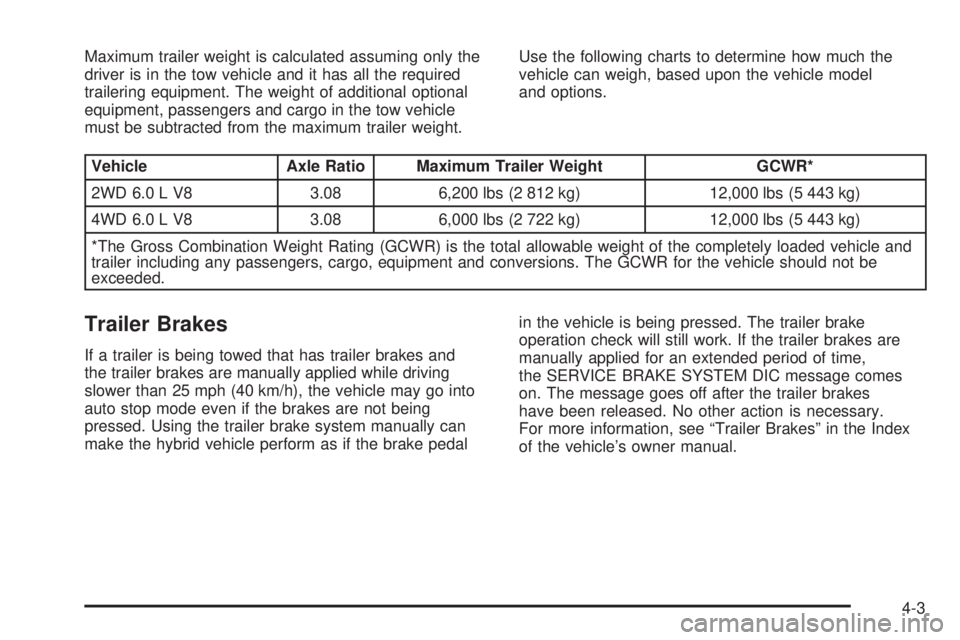
Maximum trailer weight is calculated assuming only the
driver is in the tow vehicle and it has all the required
trailering equipment. The weight of additional optional
equipment, passengers and cargo in the tow vehicle
must be subtracted from the maximum trailer weight.Use the following charts to determine how much the
vehicle can weigh, based upon the vehicle model
and options.
Vehicle Axle Ratio Maximum Trailer Weight GCWR*
2WD 6.0 L V8 3.08 6,200 lbs (2 812 kg) 12,000 lbs (5 443 kg)
4WD 6.0 L V8 3.08 6,000 lbs (2 722 kg) 12,000 lbs (5 443 kg)
*The Gross Combination Weight Rating (GCWR) is the total allowable weight of the completely loaded vehicle and
trailer including any passengers, cargo, equipment and conversions. The GCWR for the vehicle should not be
exceeded.
Trailer Brakes
If a trailer is being towed that has trailer brakes and
the trailer brakes are manually applied while driving
slower than 25 mph (40 km/h), the vehicle may go into
auto stop mode even if the brakes are not being
pressed. Using the trailer brake system manually can
make the hybrid vehicle perform as if the brake pedalin the vehicle is being pressed. The trailer brake
operation check will still work. If the trailer brakes are
manually applied for an extended period of time,
the SERVICE BRAKE SYSTEM DIC message comes
on. The message goes off after the trailer brakes
have been released. No other action is necessary.
For more information, see “Trailer Brakes” in the Index
of the vehicle’s owner manual.
4-3
Page 37 of 94

Service............................................................5-2
Doing Your Own Service Work.........................5-2
Checking Things Under the Hood.....................5-3
High Voltage Devices and Wiring......................5-3
Engine Compartment Overview.........................5-4
Automatic Transmission Fluid...........................5-5
Drive Motor/Generator Control Module (DMCM)
Coolant Surge Tank Pressure Cap..................5-6
Drive Motor/Generator Control Module (DMCM)
Cooling System...........................................5-6
Power Steering Fluid.....................................5-11
Brakes........................................................5-11
Battery........................................................5-15
Jump Starting...............................................5-16
Bulb Replacement..........................................5-21
Taillamps, Turn Signal, Stoplamps and
Back-up Lamps.........................................5-21
Replacement Bulbs.......................................5-22Electrical System............................................5-22
Fuses and Circuit Breakers............................5-22
Underhood Fuse Block..................................5-22
Tires..............................................................5-24
Inflation - Tire Pressure.................................5-24
Tire Pressure Monitor Operation.....................5-25
Tire Inspection and Rotation...........................5-29
Tire Chains..................................................5-30
If a Tire Goes Flat........................................5-30
Tire Sealant and Compressor Kit
(Without Selector Switch)............................5-32
Tire Sealant and Compressor Kit
(With Selector Switch)................................5-42
Tire Sealant and Compressor Kit Storage.........5-50
Capacities and Specications..........................5-52
Section 5 Service and Appearance Care
5-1
Page 38 of 94
Service
Doing Your Own Service Work
{CAUTION:
Never try to do your own service on hybrid
components. You can be injured and the vehicle
can be damaged if you try to do your own service
work. Service and repair of these hybrid
components should only be performed by a
trained service technician with the proper
knowledge and tools.
{CAUTION:
You can be injured and the vehicle could be
damaged if you try to do service work on a vehicle
without knowing enough about it.
•Be sure you have sufficient knowledge,
experience, the proper replacement parts,
and tools before attempting any vehicle
maintenance task.
•Be sure to use the proper nuts, bolts, and
other fasteners. English and metric fasteners
can be easily confused. If the wrong fasteners
are used, parts can later break or fall off.
You could be hurt.
5-2
Page 39 of 94
If doing some of your own service work, use the proper
service manual. It tells you much more about how to
service the vehicle than this manual can. To order
the proper service manual, see “Service Publications
Ordering Information” in the owner manual.
This vehicle has an airbag system. Before attempting
to do your own service work, see “Servicing Your
Airbag-Equipped Vehicle” in the owner manual.
Keep a record with all parts receipts and list the
mileage and the date of any service work performed.
See “Maintenance Record” in the owner manual.Checking Things Under
the Hood
High Voltage Devices and Wiring
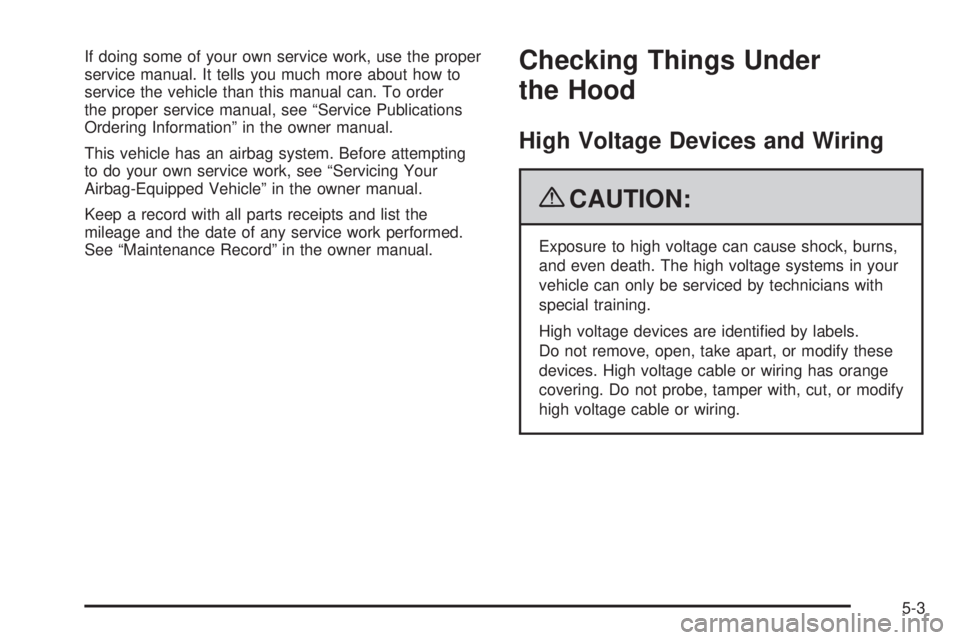
{CAUTION:
Exposure to high voltage can cause shock, burns,
and even death. The high voltage systems in your
vehicle can only be serviced by technicians with
special training.
High voltage devices are identified by labels.
Do not remove, open, take apart, or modify these
devices. High voltage cable or wiring has orange
covering. Do not probe, tamper with, cut, or modify
high voltage cable or wiring.
5-3
Page 42 of 94

Drive Motor/Generator Control
Module (DMCM) Coolant Surge Tank
Pressure Cap
SeeEngine Compartment
Overview on page 5-4
for more information
on location.
The Drive Motor/Generator Control Module (DMCM)
coolant surge tank pressure cap must be fully installed
on the hybrid coolant surge tank.
Notice:If the pressure cap is not tightly installed,
coolant loss and possible damage to the Drive
Motor/Generator Control Module (DMCM) may occur.
Be sure the cap is properly and tightly secured.
Drive Motor/Generator Control
Module (DMCM) Cooling System
In addition to the regular cooling system, the vehicle is
also equipped with a cooling system for the DMCM
system. This system is serviced differently than
the vehicle’s main cooling system. The DMCM cooling
system includes the DMCM coolant surge tank,
DMCM surge tank pressure cap, DMCM cooling pumps,
hybrid cooling radiator and the Drive Motor/Generator
Control Module (DMCM). The DMCM cooling system
uses a 50/50 pre-mixed DEX-COOL™ coolant and
deionized water available at your dealer/retailer.
See “Engine Coolant” and “Cooling System” in the
owner manual for more information.
5-6
Page 45 of 94
{CAUTION:
You can be burned if you spill coolant on hot
engine parts. Coolant contains ethylene glycol
and it will burn if the engine parts are hot enough.
Do not spill coolant on a hot engine.
If the DMCM coolant is empty, your vehicle must be
serviced by your dealer and a special fill procedure
must be followed.
Notice:Attempting to ll the DMCM cooling surge
tank yourself when the uid level is empty can
damage your vehicle. Your vehicle must be serviced.1. Park the vehicle on a level surface and turn the
vehicle off. Remove the DMCM coolant surge
tank pressure cap when the DMCM cooling system,
including the DMCM coolant surge tank pressure
cap and DMCM cooling hoses, are no longer hot.
Turn the DMCM coolant surge tank pressure cap
slowly counterclockwise (left) about one full turn.
Wait 30 seconds.
5-9
Page 46 of 94

2. Then keep turning the DMCM coolant surge tank
pressure cap slowly, and remove it.
3. Add the pre-mixed DEX-COOL™, available at your
dealer/retailer, to the DMCM coolant surge tank
until the level reaches the FULL COLD mark.
4. Turn the ignition to ON/RUN without starting the
engine. The hybrid cooling pumps will run and
any trapped air will purge to the surge tank.5. Add the pre-mixed DEX-COOL™, available at your
dealer/retailer, until the coolant level is maintained
at the FULL COLD mark. This should take no
longer than two minutes of hybrid cooling pump
operation.
If the level cannot be kept at the FULL COLD
level, your vehicle may need service. See your
dealer/retailer.
6. Then replace the
DMCM coolant surge
tank pressure cap.
Be sure the pressure
cap is hand-tight
and fully seated.
Notice:Using tap water, cooling system sealers or
conditioners in an attempt to stop coolant leaks
can damage the DMCM and engine cooling systems.
Never use tap water, cooling system sealers or
conditioners in your cooling system.
5-10
Page 49 of 94

Notice:
Using the wrong uid can badly damage brake
hydraulic system parts. For example, just a
few drops of mineral-based oil, such as engine
oil, in the brake hydraulic system can damage
brake hydraulic system parts so badly that they
will have to be replaced. Do not let someone
put in the wrong kind of uid.
If brake uid is spilled on the vehicle’s painted
surfaces, the paint nish can be damaged.
Be careful not to spill brake uid on the
vehicle. If you do, wash it off immediately.
See “Washing Your Vehicle” in the owner
manual.
Brake Wear
This vehicle has disc brakes. Disc brake pads have
built-in wear indicators that make a high-pitched warning
sound when the brake pads are worn and new pads
are needed. The sound can come and go or be heard all
the time the vehicle is moving, except when applying
the brake pedal firmly.
{CAUTION:
The brake wear warning sound means that soon
the brakes will not work well. That could lead to an
accident. When the brake wear warning sound is
heard, have the vehicle serviced.
Notice:Continuing to drive with worn-out brake
pads could result in costly brake repair.
Some driving conditions or climates can cause a brake
squeal when the brakes are first applied or lightly
applied. This does not mean something is wrong with
the brakes.
5-13