2009 GMC SIERRA maintenance schedule
[x] Cancel search: maintenance schedulePage 548 of 596

Scheduled Maintenance (cont’d)
Service MaintenanceIMaintenanceII
Perform any needed additional services. See “Additional Required Services” in
this section.••
Inspect suspension and steering components.See footnote (b).•
Inspect engine cooling system.See footnote (c).•
Inspect wiper blades.See footnote (d).•
Inspect restraint system components.See footnote (e).•
Lubricate body components.See footnote (f).•
Check transmission uid level and add uid as needed.•
Inspect shields, vehicles with diesel engine or with GVWR above 10,000 lbs
(4 536 kg) only.See footnote (n).•
6-6
Page 549 of 596

Additional Required Services
This maintenance section applies to vehicles with a gasoline engine. If your vehicle has a diesel engine, see the
maintenance schedule section in the DURAMAX®Diesel manual.
The following services should be performed at the rst maintenance service (IorII) after the indicated miles
(kilometers) shown for each item.
Additional Required Services
Service and Miles (Kilometers)25,000
(40 000)50,000
(80 000)75,000
(120 000)100,000
(160 000)125,000
(200 000)150,000
(240 000)
Inspect fuel system for damage or leaks.• •••••
Inspect exhaust system for loose or
damaged components.• •••••
Vehicles without a lter restriction
indicator: Replace engine air cleaner
lter. SeeEngine Air Cleaner/Filter on
page 5-19.•••
Change automatic transmission uid and
lter (severe service).See footnote (h).•••
Change automatic transmission uid and
lter (normal service).•
Four-wheel drive only: Change transfer
case uid (extreme duty service).
See footnotes (g) and (l).• •••••
6-7
Page 551 of 596

Maintenance Footnotes
This maintenance section applies to vehicles with a
gasoline engine. For diesel engine vehicles, see
the maintenance schedule section in the DURAMAX
®
Diesel manual.
†The U.S. Environmental Protection Agency or the
California Air Resources Board has determined that the
failure to perform this maintenance item will not nullify
the emission warranty or limit recall liability prior to
the completion of the vehicle’s useful life. We, however,
urge that all recommended maintenance services be
performed at the indicated intervals and the
maintenance be recorded.
#Lubricate the front suspension, steering linkage,
and parking brake cable guides. Control arm ball joints
on 2500/3500 series vehicles require lubrication but
should not be lubricated unless their temperature is
10°F (−12°C) or higher, or they could be damaged.
Control arm ball joints on 1500 series vehicles are
maintenance-free. Vehicles used under severe
commercial operating conditions require lubrication
on a regular basis every 3,000 miles (5 000 km).
(a)Visually inspect brake lines and hoses for proper
hook-up, binding, leaks, cracks, chafing, etc. Inspect disc
brake pads for wear and rotors for surface condition.
Inspect drum brake linings/shoes for wear or cracks.
Inspect other brake parts, including drums, wheel
cylinders, calipers, parking brake, etc.(b)Visually inspect front and rear suspension and
steering system for damaged, loose or missing parts,
signs of wear or lack of lubrication. Inspect power
steering lines and hoses for proper hook-up, binding,
leaks, cracks, chafing, etc. Visually check constant
velocity joints, rubber boots, and axle seals for leaks.
(c)Visually inspect hoses and have them replaced if
they are cracked, swollen, or deteriorated. Inspect all
pipes, fittings and clamps; replace with genuine parts as
needed. To help ensure proper operation, a pressure test
of the cooling system and pressure cap and cleaning the
outside of the radiator and air conditioning condenser is
recommended at least once a year.
(d)Inspect wiper blades for wear, cracking, or
contamination. Clean the windshield and wiper blades,
if contaminated. Replace wiper blades that are worn or
damaged. See Windshield Wiper Blade Replacement
on page 5-64 and Windshield and Wiper Blades on
page 5-118 for more information.
(e)Make sure the safety belt reminder light and safety
belt assemblies are working properly. Look for any other
loose or damaged safety belt system parts. If you see
anything that might keep a safety belt system from doing
its job, have it repaired. Have any torn or frayed safety
belts replaced. Also see Checking the Restraint Systems
on page 1-90.
6-9
Page 557 of 596

Recommended Fluids and
Lubricants
This maintenance section applies to vehicles with a
gasoline engine. If your vehicle has a diesel engine, see
the maintenance schedule section in the DURAMAX
®
Diesel manual.
Fluids and lubricants identied below by name, part
number, or specication can be obtained from your
dealer/retailer.
Usage Fluid/Lubricant
Engine OilEngine oil which meets GM Standard
GM6094M and displays the
American Petroleum Institute
Certied for Gasoline Engines
starburst symbol. To determine the
proper viscosity for your vehicle’s
engine, seeEngine Oil on page 5-15.
Engine Coolant50/50 mixture of clean, drinkable
water and use only DEX-COOL
®
coolant. SeeEngine Coolant on
page 5-29.
Hydraulic Brake
SystemDelco
®Supreme 11 Brake Fluid or
equivalent DOT-3 brake uid.
Windshield
WasherOptikleen
®Washer Solvent.
Usage Fluid/Lubricant
Power Steering
SystemGM Power Steering Fluid
(GM Part No. U.S. 89021184,
in Canada 89021186).
Automatic
TransmissionDEXRON
®-VI Automatic
Transmission Fluid.
Key Lock
CylindersMulti-Purpose Lubricant, Superlube
(GM Part No. U.S. 12346241,
in Canada 10953474).
Floor Shift
LinkageLubriplate Lubricant Aerosol
(GM Part No. U.S. 12346293,
in Canada 992723) or lubricant
meeting requirements of NLGI #2
Category LB or GC-LB.
Chassis
LubricationChassis Lubricant
(GM Part No. U.S. 12377985,
in Canada 88901242) or lubricant
meeting requirements of NLGI #2,
Category LB or GC-LB.
Front Axle
(1500 Series) -
Four-Wheel
DriveSAE 80W-90 Axle Lubricant
(GM Part No. U.S. 89021671,
in Canada 89021672).
Front Axle
(1500 HD,
1500 AWD,
2500,
2500 HD, and
3500 Series)SAE 75W-90
Synthetic Axle Lubricant
(GM Part No. U.S. 89021677,
in Canada 89021678) meeting
GM Specication 9986115.
6-15
Page 561 of 596
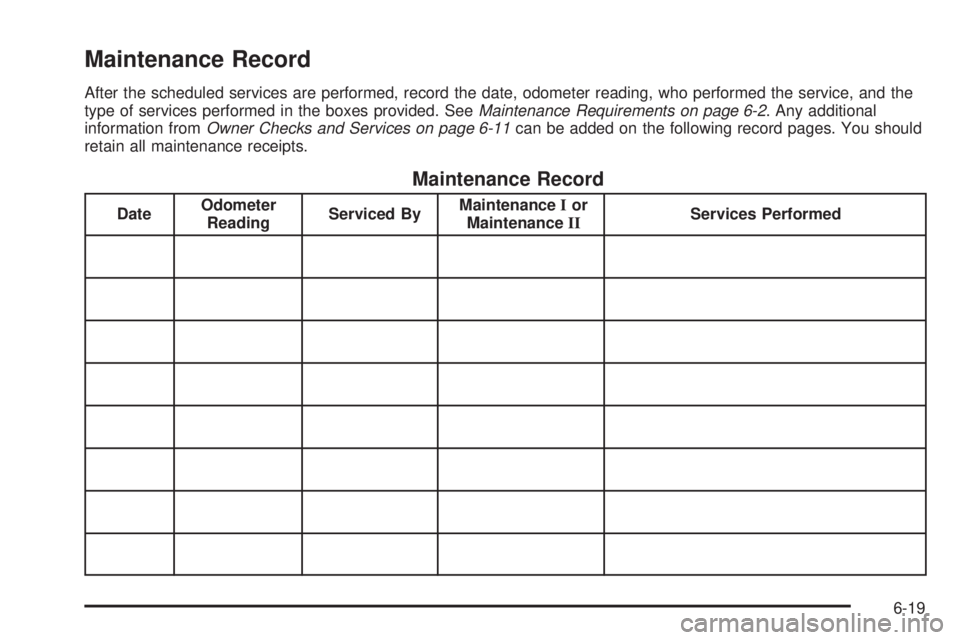
Maintenance Record
After the scheduled services are performed, record the date, odometer reading, who performed the service, and the
type of services performed in the boxes provided. SeeMaintenance Requirements on page 6-2. Any additional
information fromOwner Checks and Services on page 6-11can be added on the following record pages. You should
retain all maintenance receipts.
Maintenance Record
DateOdometer
ReadingServiced ByMaintenanceIor
MaintenanceIIServices Performed
6-19
Page 569 of 596
Online Owner Center
Online Owner Center (U.S.) —
www.gmownercenter.com/gmc
Information and services customized for your specic
vehicle — all in one convenient place.
Digital owner manual, warranty information,
and more
Online service and maintenance records
Find GMC dealers for service nationwide
Exclusive privileges and offers
Recall notices for your specic vehicle
OnStar®and GM Cardmember Services Earnings
summaries
Other Helpful Links:
GMC−www.gmc.com
GMC Merchandise — www.gmccollection.com
Help Center — www.gmc.com/helpcenter
FAQ
Contact Us
My GM Canada (Canada) — www.gm.ca
My GM Canada is a password-protected section of
www.gm.ca where you can save information on
GM vehicles, get personalized offers, and use handy
tools and forms with greater ease.
Here are a few of the valuable tools and services you
will have access to:
My Showroom: Find and save information on
vehicles and current offers in your area.
My Dealers/Retailers: Save details such as address
and phone number for each of your preferred GM
dealers/retailers.
My Driveway: Access quick links to parts and
service estimates, check trade-in values, or
schedule a service appointment by adding the
vehicles you own to your driveway prole.
My Preferences: Manage your prole and use tools
and forms with greater ease.
To sign up, visit the My GM Canada section within
www.gm.ca.
7-5
Page 579 of 596
Reporting Safety Defects to the
Canadian Government
If you live in Canada, and you believe that your
vehicle has a safety defect, notify Transport Canada
immediately, in addition to notifying General Motors of
Canada Limited. Call them at 1-800-333-0510 or write to:
Transport Canada
Road Safety Branch
2780 Sheffield Road
Ottawa, Ontario K1B 3V9
Reporting Safety Defects to
General Motors
In addition to notifying NHTSA (or Transport Canada) in
a situation like this, please notify General Motors.
Call 1-800-GMC-8782 (1-800-462-8782), or write:
GMC Customer Assistance Center
P.O. Box 33172
Detroit, MI 48232-5172
In Canada, call 1-800-263-3777 (English) or
1-800-263-7854 (French), or write:
General Motors of Canada Limited
Customer Communication Centre, CA1-163-005
1908 Colonel Sam Drive
Oshawa, Ontario L1H 8P7
Service Publications Ordering
Information
Service Manuals
Service Manuals have the diagnosis and repair
information on engines, transmission, axle suspension,
brakes, electrical, steering, body, etc.
Service Bulletins
Service Bulletins give additional technical service
information needed to knowledgeably service General
Motors cars and trucks. Each bulletin contains
instructions to assist in the diagnosis and service of
your vehicle.
Owner Information
Owner publications are written specically for owners
and intended to provide basic operational information
about the vehicle. The owner manual includes the
Maintenance Schedule for all models.
In-Portfolio: Includes a Portfolio, Owner Manual, and
Warranty Booklet.
RETAIL SELL PRICE: $35.00 (U.S.) plus processing fee
Without Portfolio: Owner Manual only.
RETAIL SELL PRICE: $25.00 (U.S.) plus processing fee
7-15
Page 590 of 596

Lights
Exterior Lamps............................................3-16
Flash-to-Pass..............................................3-10
High/Low Beam Changer..............................3-10
On Reminder..............................................3-17
Loading Your Vehicle.......................................4-32
Locking Rear Axle............................................ 4-9
Lockout Protection..........................................2-12
Locks
Delayed Locking..........................................2-11
Door ..........................................................2-10
Lockout Protection.......................................2-12
Power Door ................................................2-10
Programmable Automatic Door Locks.............2-11
Rear Door Security Locks.............................2-11
Loss of Control...............................................4-11
Low Fuel Warning Light...................................3-52
Lower Anchors and Tethers for Children.............1-49
Luggage Carrier..............................................2-82
Lumbar
Manual Controls............................................ 1-6
Power Controls............................................. 1-7
M
Maintenance Schedule
Additional Required Services........................... 6-7
At Each Fuel Fill.........................................6-11
At Least Once a Month................................6-12Maintenance Schedule (cont.)
At Least Once a Year..................................6-12
At the First 100, 1,000 and 6,000 Miles
(160, 1 600 and 10 000km).......................6-11
Introduction.................................................. 6-2
Maintenance Footnotes.................................. 6-9
Maintenance Record....................................6-19
Maintenance Replacement Parts....................6-17
Maintenance Requirements............................. 6-2
Owner Checks and Services.........................6-11
Recommended Fluids and Lubricants.............6-15
Scheduled Maintenance................................. 6-4
Using.......................................................... 6-3
Your Vehicle and the Environment................... 6-2
Malfunction Indicator Lamp...............................3-45
Manual Lumbar Controls.................................... 1-6
Manual Seats................................................... 1-4
Manual Windows............................................2-16
Memory Seat, Mirrors, and Pedals...................... 1-8
Message
DIC Warnings and Messages........................3-66
Mirrors
Automatic Dimming Rearview........................2-57
Manual Rearview Mirror................................2-57
Outside Convex Mirror.................................2-61
Outside Heated Mirrors................................2-61
Outside Manual Mirrors................................2-58
Outside Power Foldaway Mirrors....................2-59
8