2009 GMC CANYON lock
[x] Cancel search: lockPage 79 of 414
If the shoulder portion of the belt is pulled out all the
way, the child restraint locking feature will be engaged.
This may unintentionally cause the passenger sensing
system to turn the airbag off for some adult size
occupants. If this happens, let the belt go back all the
way and start again.
A thick layer of additional material, such as a blanket or
cushion, or aftermarket equipment such as seat covers,
seat heaters, and seat massagers can affect how well the
passenger sensing system operates. We recommend
that you not use seat covers or other aftermarket
equipment except when approved by GM for your specic
vehicle. SeeAdding Equipment to Your Airbag-Equipped
Vehicle on page 1-76for more information about
modications that can affect how the system operates.
{CAUTION:
Stowing of articles under the passenger seat or
between the passenger seat cushion and seatback
may interfere with the proper operation of the
passenger sensing system.
Servicing Your Airbag-Equipped
Vehicle
Airbags affect how the vehicle should be serviced.
There are parts of the airbag system in several places
around the vehicle. Your dealer/retailer and the
service manual have information about servicing the
vehicle and the airbag system. To purchase a service
manual, seeService Publications Ordering Information
on page 7-15.
{CAUTION:
For up to 10 seconds after the ignition is turned off
and the battery is disconnected, an airbag can still
inate during improper service. You can be injured
if you are close to an airbag when it inates. Avoid
yellow connectors. They are probably part of the
airbag system. Be sure to follow proper service
procedures, and make sure the person performing
work for you is qualied to do so.
1-75
Page 83 of 414

Keys...............................................................2-3
Remote Keyless Entry (RKE) System................2-4
Remote Keyless Entry (RKE) System
Operation...................................................2-4
Doors and Locks.............................................2-6
Door Locks....................................................2-6
Power Door Locks..........................................2-7
Programmable Automatic Door Locks................2-7
Rear Door Security Locks (Crew Cab)...............2-8
Lockout Protection..........................................2-8
Rear Doors (Extended Cab).............................2-9
Tailgate........................................................2-9
Windows........................................................2-11
Manual Windows..........................................2-12
Power Windows............................................2-12
Sliding Rear Window.....................................2-13
Sun Visors...................................................2-13
Theft-Deterrent Systems..................................2-14
Content Theft-Deterrent.................................2-14
Passlock
®(U.S. Only)...................................2-15
PASS-Key®III+ Electronic Immobilizer.............2-16
PASS-Key®III+ Electronic Immobilizer
Operation (Canada Only)............................2-16Starting and Operating Your Vehicle................2-18
New Vehicle Break-In....................................2-18
Ignition Positions..........................................2-18
Retained Accessory Power (RAP)...................2-19
Starting the Engine.......................................2-20
Engine Coolant Heater..................................2-21
Automatic Transmission Operation...................2-22
Manual Transmission Operation......................2-25
Four-Wheel Drive..........................................2-26
Parking Brake..............................................2-31
Shifting Into Park (Automatic
Transmission)...........................................2-32
Shifting Out of Park (Automatic
Transmission)...........................................2-34
Parking the Vehicle (Manual
Transmission)...........................................2-34
Parking Over Things That Burn.......................2-35
Engine Exhaust............................................2-35
Running the Vehicle While Parked..................2-36
Section 2 Features and Controls
2-1
Page 85 of 414
Keys
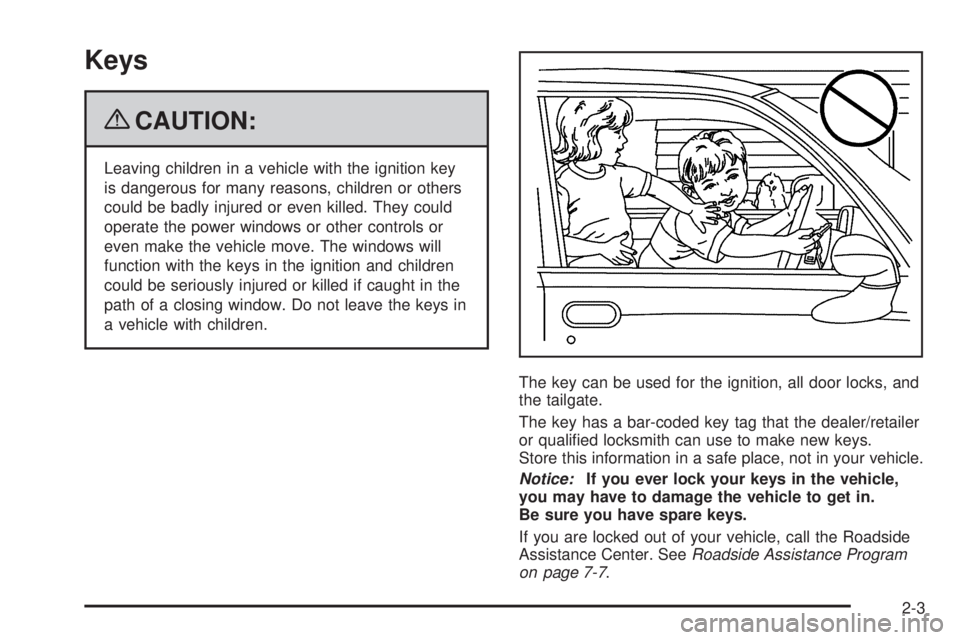
{CAUTION:
Leaving children in a vehicle with the ignition key
is dangerous for many reasons, children or others
could be badly injured or even killed. They could
operate the power windows or other controls or
even make the vehicle move. The windows will
function with the keys in the ignition and children
could be seriously injured or killed if caught in the
path of a closing window. Do not leave the keys in
a vehicle with children.
The key can be used for the ignition, all door locks, and
the tailgate.
The key has a bar-coded key tag that the dealer/retailer
or qualied locksmith can use to make new keys.
Store this information in a safe place, not in your vehicle.
Notice:If you ever lock your keys in the vehicle,
you may have to damage the vehicle to get in.
Be sure you have spare keys.
If you are locked out of your vehicle, call the Roadside
Assistance Center. SeeRoadside Assistance Program
on page 7-7.
2-3
Page 86 of 414
Remote Keyless Entry (RKE)
System
If this vehicle has the Remote Keyless Entry (RKE)
system, it operates on a radio frequency subject
to Federal Communications Commission (FCC) Rules
and with Industry Canada.
This device complies with Part 15 of the FCC Rules.
Operation is subject to the following two conditions:
1. This device may not cause interference.
2. This device must accept any interference received,
including interference that may cause undesired
operation of the device.
This device complies with RSS-210 of Industry Canada.
Operation is subject to the following two conditions:
1. This device may not cause interference.
2. This device must accept any interference received,
including interference that may cause undesired
operation of the device.
Changes or modications to this system by other than
an authorized service facility could void authorization to
use this equipment.If there is a decrease in the RKE operating range,
try this:
Check the distance. The transmitter may be too far
from the vehicle. Stand closer during rainy or
snowy weather.
Check the location. Other vehicles or objects
may be blocking the signal. Take a few steps to
the left or right, hold the transmitter higher, and
try again.
Check the transmitter’s battery. See “Battery
Replacement” later in this section.
If the transmitter is still not working correctly,
see your dealer/retailer or a qualied technician
for service.
Remote Keyless Entry (RKE)
System Operation
Vehicles with Remote Keyless Entry (RKE), transmitter
functions work up to 30 feet (9 m) away from the vehicle.
There are other conditions which can affect the
performance of the transmitter. SeeRemote Keyless
Entry (RKE) System on page 2-4.
2-4
Page 87 of 414

UNLOCK:Press to unlock
the driver door and turn on
the interior lamps. The
parking lamps may ash
and the horn may sound.
Press UNLOCK again within three seconds and all of
the doors unlock.
LOCK:Press to lock all the doors. The parking lamps
may ash and the horn may sound.
If a door is open or ajar when LOCK is pressed, the
horn sounds several times to let you know the doors did
not lock and the content theft-deterrent system is not
armed. Pressing LOCK again while the horn is sounding
or within three seconds after the horn stops sounding,
the doors lock but the content theft-deterrent system
does not arm until the opened door is closed.Different feedback modes can be programmed through
the Driver Information Center (DIC). See “Remote
Keyless Entry Feedback” underDIC Operation and
Displays on page 3-35.
L(Panic):Press to make the horn sound and the
headlamps and taillamps ash for up to 30 seconds.
To turn them off wait for 30 seconds, or press
Lagain,
or start the vehicle.
Programming Transmitters to
the Vehicle
Only RKE transmitters programmed to the vehicle will
work. If a transmitter is lost or stolen, a replacement
can be purchased and programmed through your
dealer/retailer. When the replacement transmitter is
programmed to the vehicle, all remaining transmitters
must also be programmed. Any lost or stolen
transmitters no longer work once the new transmitter
is programmed. Each vehicle can have up to
four transmitters programmed to it.
2-5
Page 88 of 414
Battery Replacement
Notice:When replacing the battery, do not touch
any of the circuitry on the transmitter. Static
from your body could damage the transmitter.
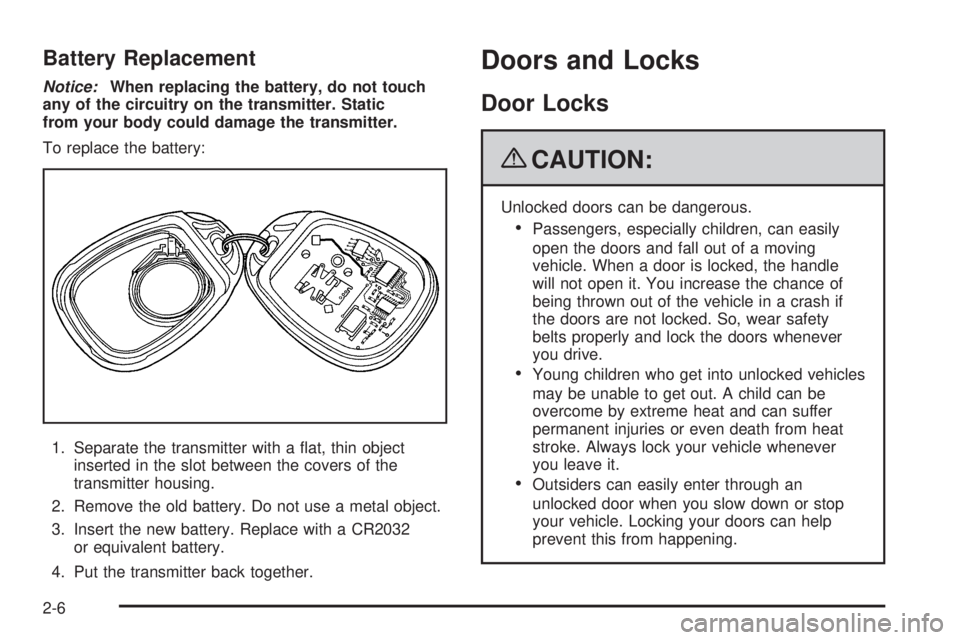
To replace the battery:
1. Separate the transmitter with a at, thin object
inserted in the slot between the covers of the
transmitter housing.
2. Remove the old battery. Do not use a metal object.
3. Insert the new battery. Replace with a CR2032
or equivalent battery.
4. Put the transmitter back together.
Doors and Locks
Door Locks
{CAUTION:
Unlocked doors can be dangerous.
Passengers, especially children, can easily
open the doors and fall out of a moving
vehicle. When a door is locked, the handle
will not open it. You increase the chance of
being thrown out of the vehicle in a crash if
the doors are not locked. So, wear safety
belts properly and lock the doors whenever
you drive.
Young children who get into unlocked vehicles
may be unable to get out. A child can be
overcome by extreme heat and can suffer
permanent injuries or even death from heat
stroke. Always lock your vehicle whenever
you leave it.
Outsiders can easily enter through an
unlocked door when you slow down or stop
your vehicle. Locking your doors can help
prevent this from happening.
2-6
Page 89 of 414
There are several ways to lock and unlock the vehicle.
To lock or unlock the door from the outside, use the
key in the driver or front passenger door or press
the lock or unlock button on the Remote Keyless
Entry (RKE) transmitter.
To lock a door from the inside, push the manual lever
on the door forward. To unlock a door from the inside,
push the lever on the door rearward.
You will see a colored area on the lever when the door
is unlocked.
Power Door Locks
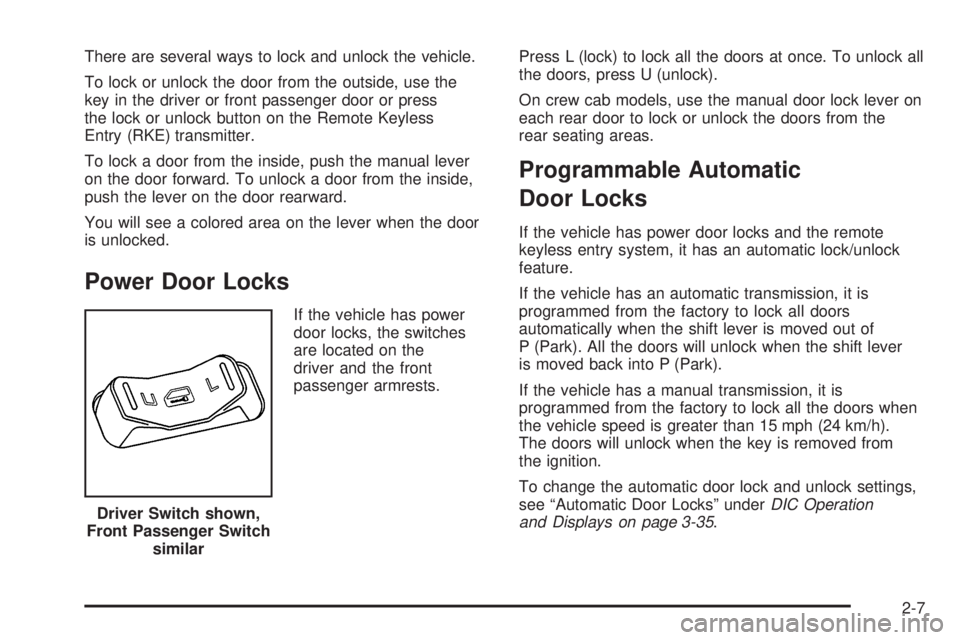
If the vehicle has power
door locks, the switches
are located on the
driver and the front
passenger armrests.Press L (lock) to lock all the doors at once. To unlock all
the doors, press U (unlock).
On crew cab models, use the manual door lock lever on
each rear door to lock or unlock the doors from the
rear seating areas.
Programmable Automatic
Door Locks
If the vehicle has power door locks and the remote
keyless entry system, it has an automatic lock/unlock
feature.
If the vehicle has an automatic transmission, it is
programmed from the factory to lock all doors
automatically when the shift lever is moved out of
P (Park). All the doors will unlock when the shift lever
is moved back into P (Park).
If the vehicle has a manual transmission, it is
programmed from the factory to lock all the doors when
the vehicle speed is greater than 15 mph (24 km/h).
The doors will unlock when the key is removed from
the ignition.
To change the automatic door lock and unlock settings,
see “Automatic Door Locks” underDIC Operation
and Displays on page 3-35. Driver Switch shown,
Front Passenger Switch
similar
2-7
Page 90 of 414
Rear Door Security Locks
(Crew Cab)
If the vehicle is a crew cab model, it may have rear
door security locks. With this feature, the rear doors are
locked so they cannot be opened from the inside.
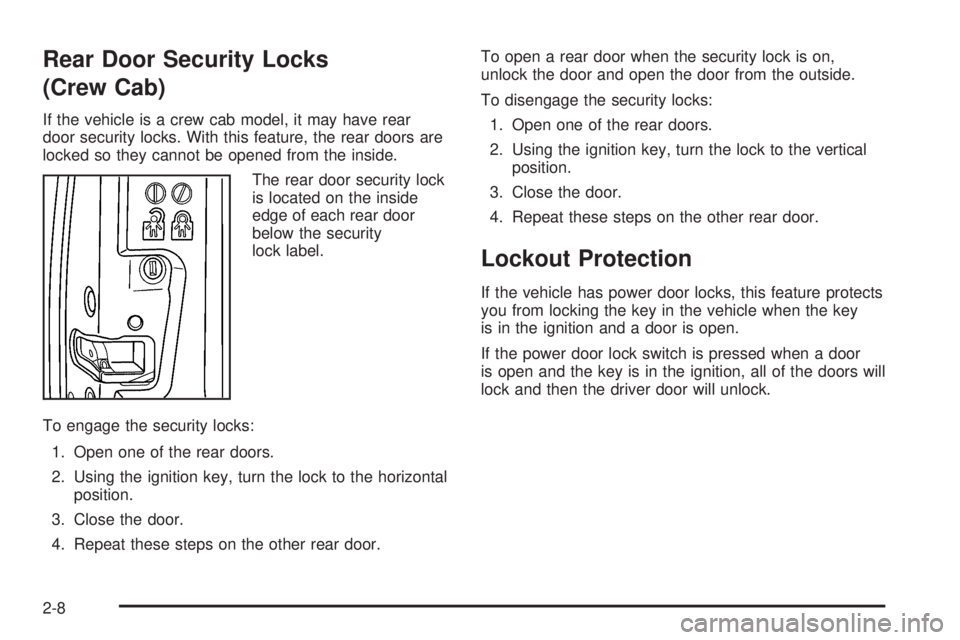
The rear door security lock
is located on the inside
edge of each rear door
below the security
lock label.
To engage the security locks:
1. Open one of the rear doors.
2. Using the ignition key, turn the lock to the horizontal
position.
3. Close the door.
4. Repeat these steps on the other rear door.To open a rear door when the security lock is on,
unlock the door and open the door from the outside.
To disengage the security locks:
1. Open one of the rear doors.
2. Using the ignition key, turn the lock to the vertical
position.
3. Close the door.
4. Repeat these steps on the other rear door.
Lockout Protection
If the vehicle has power door locks, this feature protects
you from locking the key in the vehicle when the key
is in the ignition and a door is open.
If the power door lock switch is pressed when a door
is open and the key is in the ignition, all of the doors will
lock and then the driver door will unlock.
2-8