Page 340 of 414
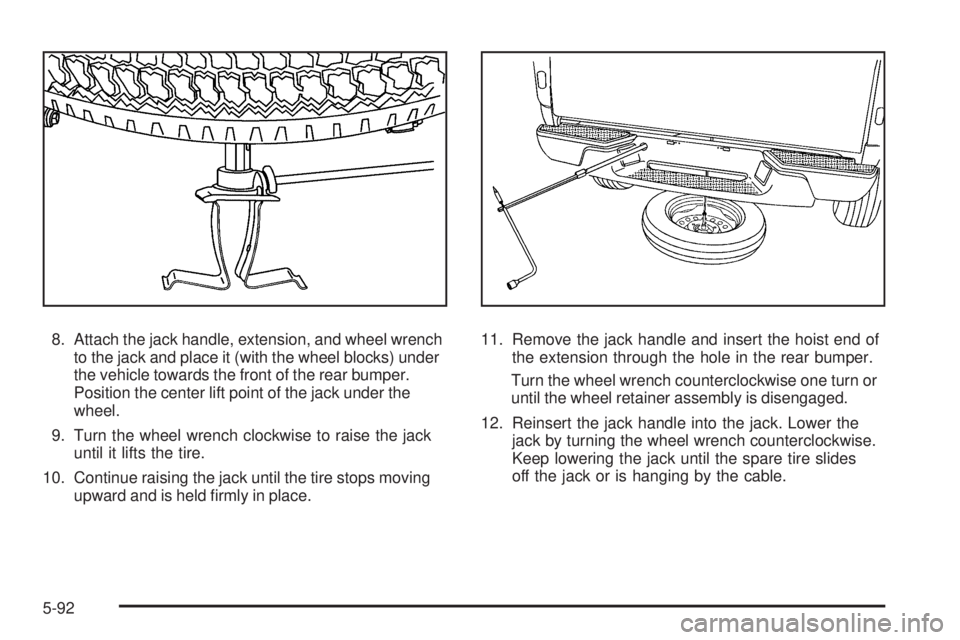
8. Attach the jack handle, extension, and wheel wrench
to the jack and place it (with the wheel blocks) under
the vehicle towards the front of the rear bumper.
Position the center lift point of the jack under the
wheel.
9. Turn the wheel wrench clockwise to raise the jack
until it lifts the tire.
10. Continue raising the jack until the tire stops moving
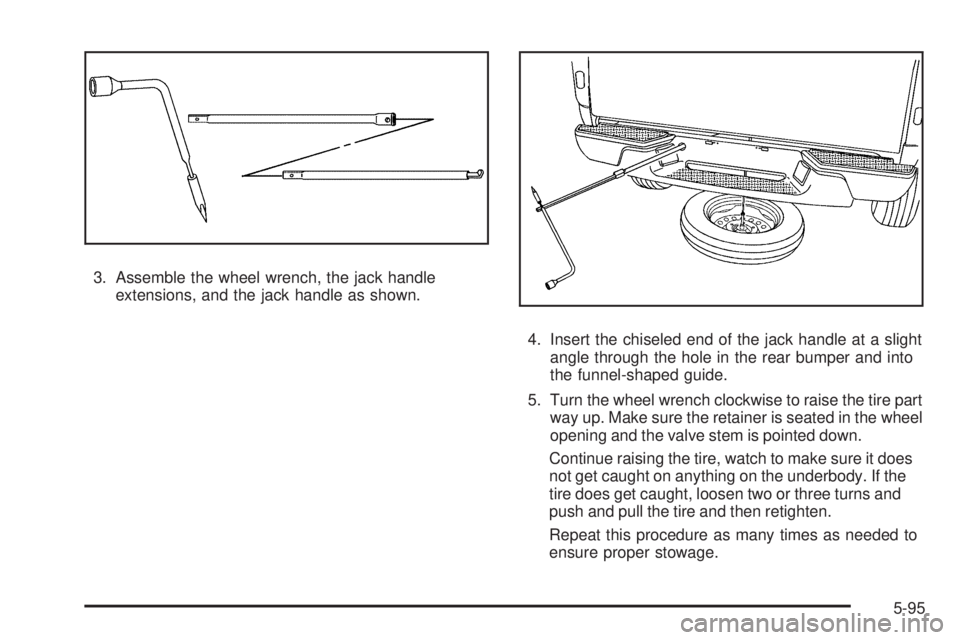
upward and is held rmly in place.11. Remove the jack handle and insert the hoist end of
the extension through the hole in the rear bumper.
Turn the wheel wrench counterclockwise one turn or
until the wheel retainer assembly is disengaged.
12. Reinsert the jack handle into the jack. Lower the
jack by turning the wheel wrench counterclockwise.
Keep lowering the jack until the spare tire slides
off the jack or is hanging by the cable.
5-92
Page 341 of 414
{CAUTION:
Someone standing too close during the procedure
could be injured by the jack. If the spare tire does
not slide off the jack completely, make sure no
one is behind you or on either side of you as you
pull the jack out from the under spare.
13. Disconnect the jack handle from the jack and
carefully remove the jack. Use one hand to push
against the spare while rmly pulling the jack out
from under the spare tire with the other hand.
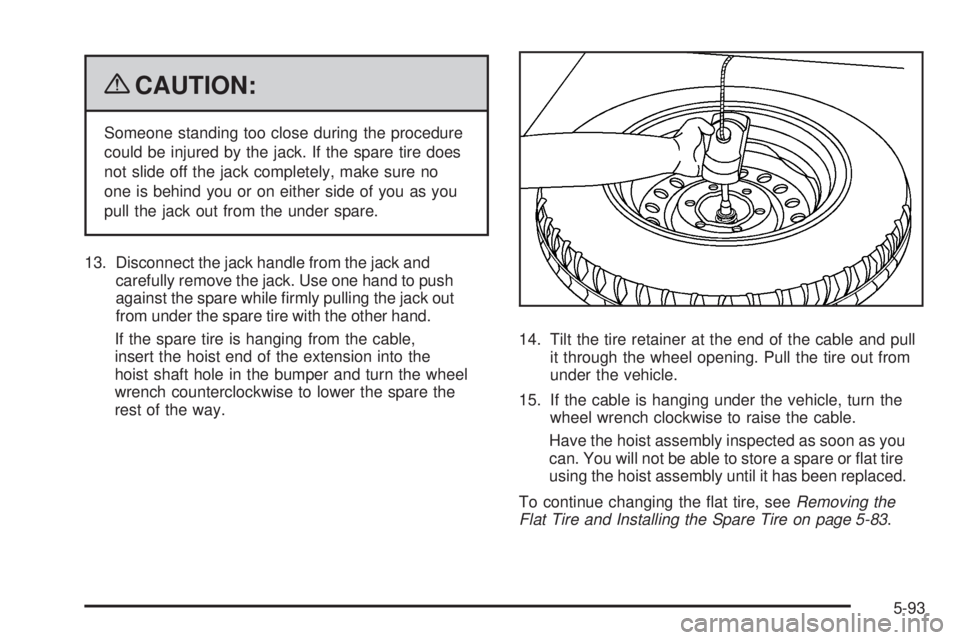
If the spare tire is hanging from the cable,
insert the hoist end of the extension into the
hoist shaft hole in the bumper and turn the wheel
wrench counterclockwise to lower the spare the
rest of the way.14. Tilt the tire retainer at the end of the cable and pull
it through the wheel opening. Pull the tire out from
under the vehicle.
15. If the cable is hanging under the vehicle, turn the
wheel wrench clockwise to raise the cable.
Have the hoist assembly inspected as soon as you
can. You will not be able to store a spare or at tire
using the hoist assembly until it has been replaced.
To continue changing the at tire, seeRemoving the
Flat Tire and Installing the Spare Tire on page 5-83.
5-93
Page 343 of 414
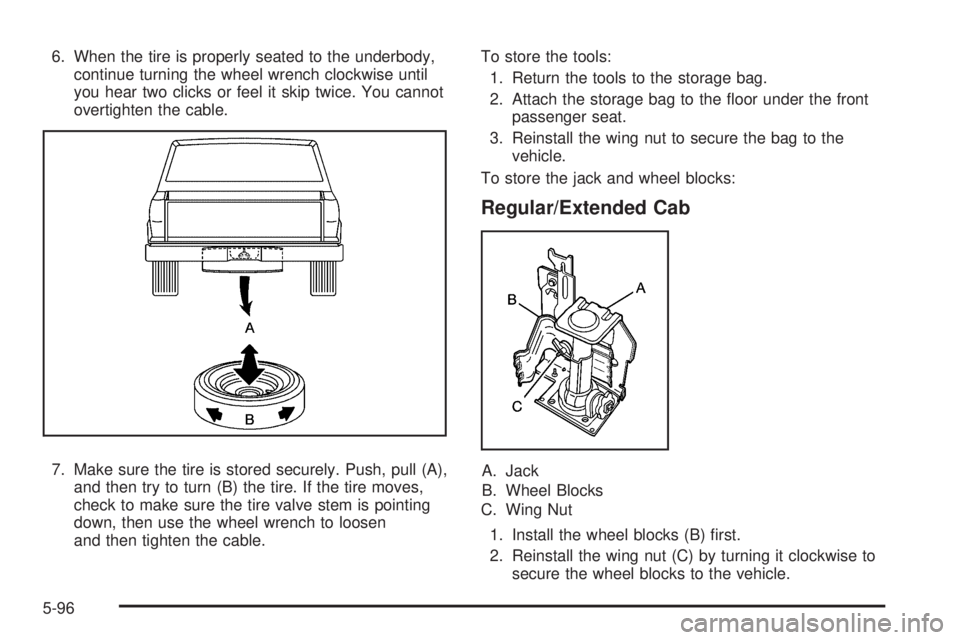
3. Assemble the wheel wrench, the jack handle
extensions, and the jack handle as shown.
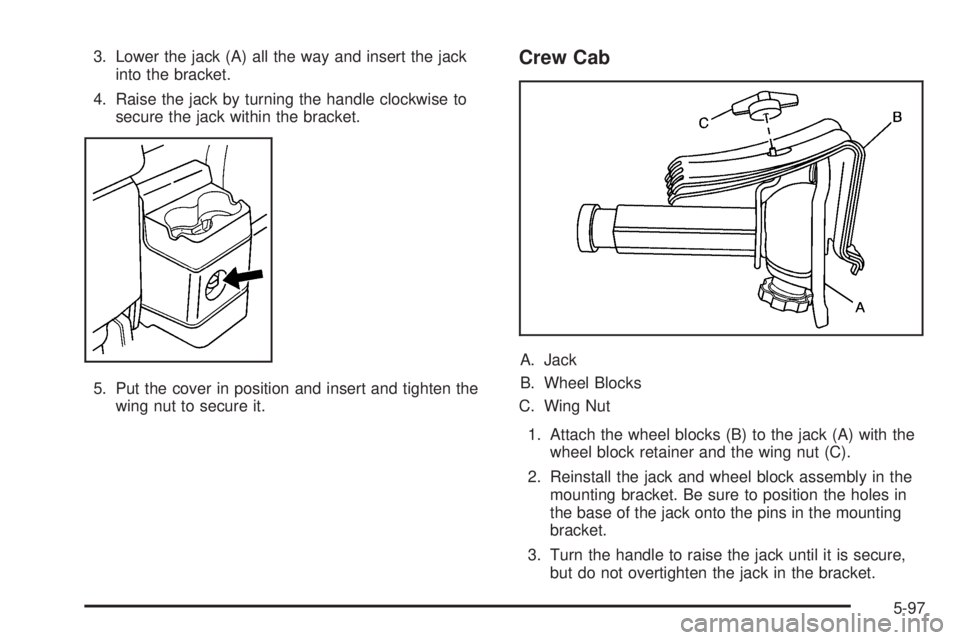
4. Insert the chiseled end of the jack handle at a slight
angle through the hole in the rear bumper and into
the funnel-shaped guide.
5. Turn the wheel wrench clockwise to raise the tire part
way up. Make sure the retainer is seated in the wheel
opening and the valve stem is pointed down.
Continue raising the tire, watch to make sure it does
not get caught on anything on the underbody. If the
tire does get caught, loosen two or three turns and
push and pull the tire and then retighten.
Repeat this procedure as many times as needed to
ensure proper stowage.
5-95
Page 344 of 414
6. When the tire is properly seated to the underbody,
continue turning the wheel wrench clockwise until
you hear two clicks or feel it skip twice. You cannot
overtighten the cable.
7. Make sure the tire is stored securely. Push, pull (A),
and then try to turn (B) the tire. If the tire moves,
check to make sure the tire valve stem is pointing
down, then use the wheel wrench to loosen
and then tighten the cable.To store the tools:
1. Return the tools to the storage bag.
2. Attach the storage bag to the oor under the front
passenger seat.
3. Reinstall the wing nut to secure the bag to the
vehicle.
To store the jack and wheel blocks:
Regular/Extended Cab
A. Jack
B. Wheel Blocks
C. Wing Nut
1. Install the wheel blocks (B) rst.
2. Reinstall the wing nut (C) by turning it clockwise to
secure the wheel blocks to the vehicle.
5-96
Page 345 of 414
3. Lower the jack (A) all the way and insert the jack
into the bracket.
4. Raise the jack by turning the handle clockwise to
secure the jack within the bracket.
5. Put the cover in position and insert and tighten the
wing nut to secure it.Crew Cab
A. Jack
B. Wheel Blocks
C. Wing Nut
1. Attach the wheel blocks (B) to the jack (A) with the
wheel block retainer and the wing nut (C).
2. Reinstall the jack and wheel block assembly in the
mounting bracket. Be sure to position the holes in
the base of the jack onto the pins in the mounting
bracket.
3. Turn the handle to raise the jack until it is secure,
but do not overtighten the jack in the bracket.
5-97
Page 357 of 414
Windshield Wiper Fuses
The windshield wiper motor is protected by a circuit
breaker and a fuse. If the motor overheats due to heavy
snow, etc., the wiper will stop until the motor cools.
If the overload is caused by some electrical problem,
have it xed.
Fuses and Circuit Breakers
The wiring circuits in the vehicle are protected from
short circuits by a combination of fuses and circuit
breakers. This greatly reduces the chance of res
caused by electrical problems.
Look at the silver-colored band inside the fuse. If the
band is broken or melted, replace the fuse. Be sure you
replace a bad fuse with a new one of the identical size
and rating.
If you ever have a problem on the road and do not have
a spare fuse, you can borrow one that has the same
amperage. Just pick some feature of the vehicle that you
can get along without — like the radio or cigarette
lighter — and use its fuse, if it is the correct amperage.
Replace it as soon as you can.
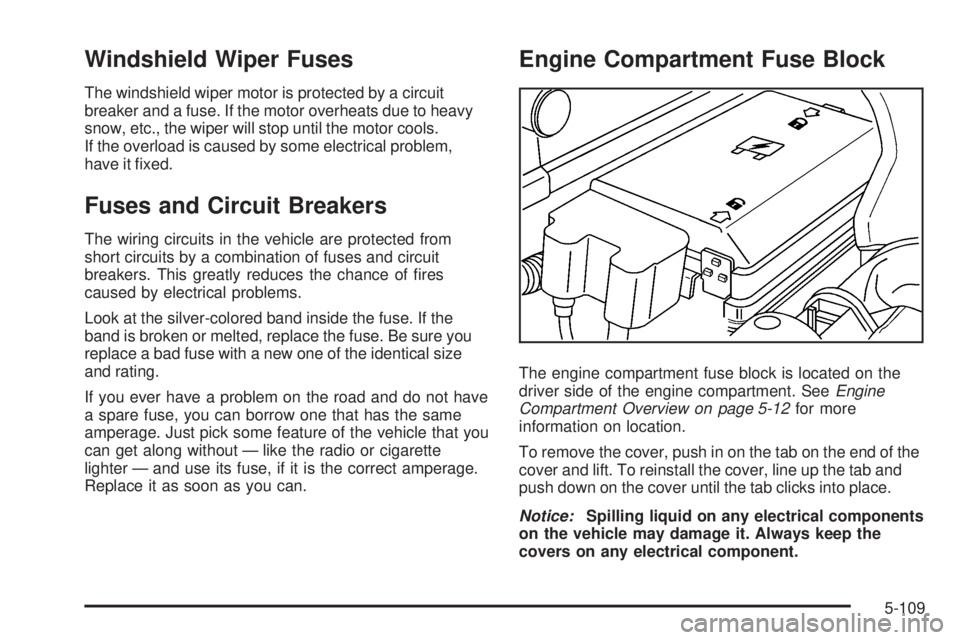
Engine Compartment Fuse Block
The engine compartment fuse block is located on the
driver side of the engine compartment. SeeEngine
Compartment Overview on page 5-12for more
information on location.
To remove the cover, push in on the tab on the end of the
cover and lift. To reinstall the cover, line up the tab and
push down on the cover until the tab clicks into place.
Notice:Spilling liquid on any electrical components
on the vehicle may damage it. Always keep the
covers on any electrical component.
5-109
Page 359 of 414
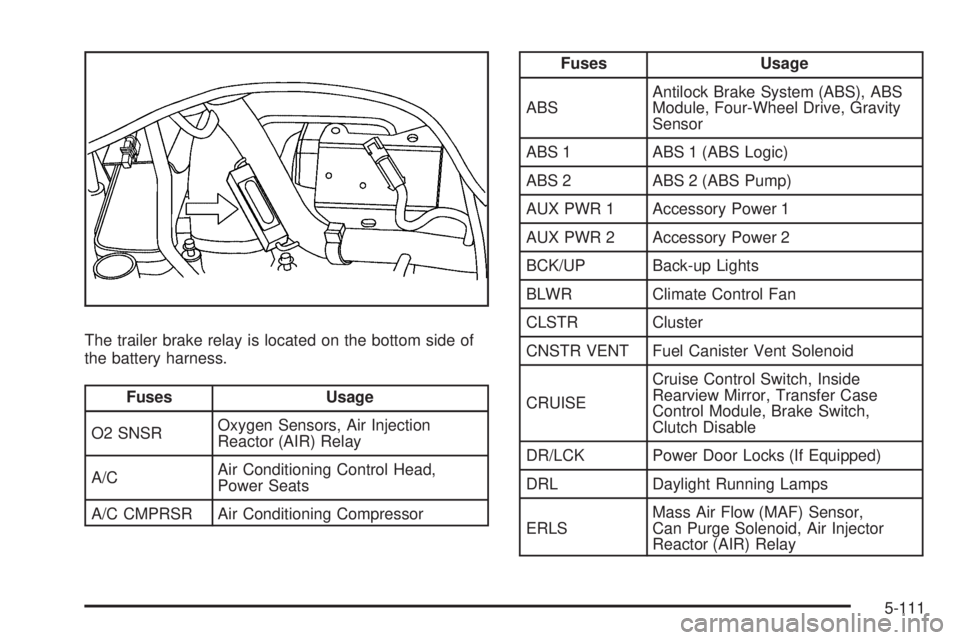
The trailer brake relay is located on the bottom side of
the battery harness.
Fuses Usage
O2 SNSROxygen Sensors, Air Injection
Reactor (AIR) Relay
A/CAir Conditioning Control Head,
Power Seats
A/C CMPRSR Air Conditioning Compressor
Fuses Usage
ABSAntilock Brake System (ABS), ABS
Module, Four-Wheel Drive, Gravity
Sensor
ABS 1 ABS 1 (ABS Logic)
ABS 2 ABS 2 (ABS Pump)
AUX PWR 1 Accessory Power 1
AUX PWR 2 Accessory Power 2
BCK/UP Back-up Lights
BLWR Climate Control Fan
CLSTR Cluster
CNSTR VENT Fuel Canister Vent Solenoid
CRUISECruise Control Switch, Inside
Rearview Mirror, Transfer Case
Control Module, Brake Switch,
Clutch Disable
DR/LCK Power Door Locks (If Equipped)
DRL Daylight Running Lamps
ERLSMass Air Flow (MAF) Sensor,
Can Purge Solenoid, Air Injector
Reactor (AIR) Relay
5-111
Page 371 of 414
Maintenance Footnotes
(a)Visually inspect brake lines and hoses for proper
hook-up, binding, leaks, cracks, chafing, etc. Inspect disc
brake pads for wear and rotors for surface condition.
Inspect drum brake linings/shoes for wear or cracks.
Inspect other brake parts, including drums, wheel
cylinders, calipers, parking brake, etc. Check parking
brake adjustment.
(b)Visually inspect front and rear suspension and
steering system for damaged, loose, or missing parts or
signs of wear. Inspect power steering lines and hoses
for proper hook-up, binding, leaks, cracks, chafing,
etc. Visually check constant velocity joints, rubber boots,
and axle seals for leaks.
(c)Visually inspect hoses and have them replaced if they
are cracked, swollen, or deteriorated. Inspect all pipes,
fittings, and clamps; replace with genuine parts as
needed. To help ensure proper operation, a pressure test
of the cooling system and pressure cap and cleaning the
outside of the radiator and air conditioning condenser is
recommended at least once a year.(d)Inspect wiper blades for wear, cracking, or
contamination. Clean the windshield and wiper blades,
if contaminated. Replace wiper blades that are worn
or damaged. See Windshield Wiper Blade Replacement
on page 5-52 and Windshield and Wiper Blades on
page 5-104 for more information.
(e)Make sure the safety belt reminder light and safety
belt assemblies are working properly. Look for any
other loose or damaged safety belt system parts. If you
see anything that might keep a safety belt system
from doing its job, have it repaired. Have any torn or
frayed safety belts replaced. Also see Checking
the Restraint Systems on page 1-77.
(f)Lubricate all key lock cylinders, body door and fuel
door hinges, latches and locks (including glove box and
console doors), hood latch assembly, secondary
latch, pivots, spring anchor, release pawl, and any
moving seat hardware. Lubricate hood safety lever pivot
and prop rod pivot and tailgate latch bolt, handle
assembly pivot points, and hinges. More frequent
lubrication may be required when exposed to a corrosive
environment. Applying silicone grease on weatherstrips
with a clean cloth will make them last longer, seal
better, and not stick or squeak.
6-7