2009 FORD RANGER spare tire
[x] Cancel search: spare tirePage 194 of 280

Stopping and securing the vehicle
1. Park on a level surface, activate
hazard flashers and place gearshift
lever in P (Park) (automatic
transmission) or 1 (First) (manual
transmission).
2. Set the parking brake and turn
engine OFF.
Location of the spare tire and tools
Note:The tire pressure monitoring system (TPMS) indicator light will
illuminate when the spare is in use. To restore the full functionality of
the TPMS system, all road wheels equipped with the tire pressure
monitoring sensors must be mounted on the vehicle.
Have a flat tire serviced by an authorized dealer in order to prevent
damage to the TPMS sensor, refer toTire Pressure Monitoring System
(TPMS)in theTires, Wheels and Loadingchapter. Replace the spare
tire with a road tire as soon as possible.
The spare tire and tools for your vehicle are stowed in the following
locations:
Tool Location
Spare tire Under the vehicle, just forward of the rear bumper
Jack, jack
handle, wheel
nut wrenchRegular Cab: behind the passenger seat, underneath
the jack and tools cover on the floor
SuperCab: stowed in the passenger side rear cab
under the plastic tray inside the storage bin or
behind the jump seat in a separate tool bag
Four-door models: stowed behind the front seats,
between jump seats and underneath jack and tools
cover. The lug wrench is held in place with a
wingnut.
Key, spare tire
lock (if
equipped)In the glove box
2009 Ranger(ran)
Owners Guide, 1st Printing
USA(fus)
Roadside Emergencies
194
Page 195 of 280
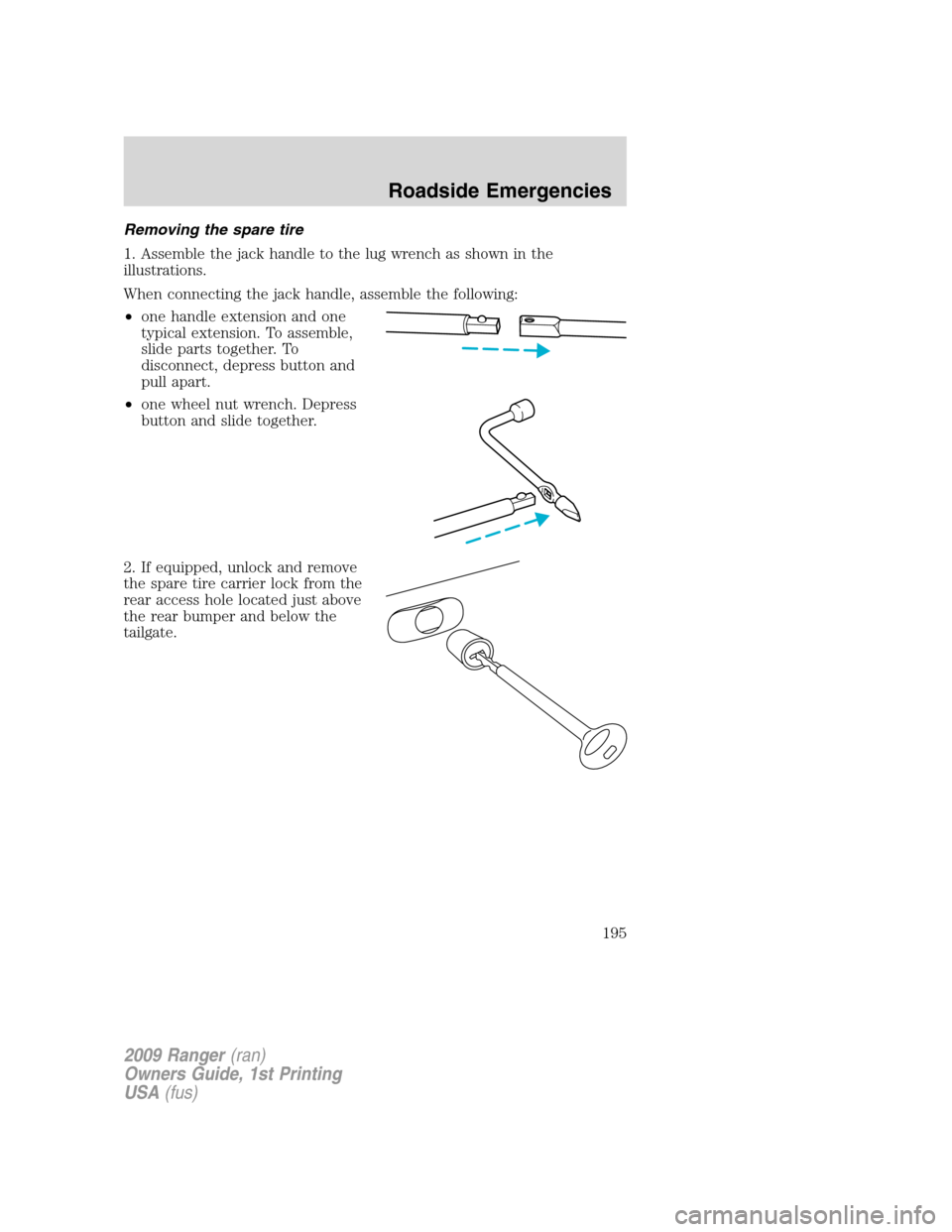
Removing the spare tire
1. Assemble the jack handle to the lug wrench as shown in the
illustrations.
When connecting the jack handle, assemble the following:
•one handle extension and one
typical extension. To assemble,
slide parts together. To
disconnect, depress button and
pull apart.
•one wheel nut wrench. Depress
button and slide together.
2. If equipped, unlock and remove
the spare tire carrier lock from the
rear access hole located just above
the rear bumper and below the
tailgate.
2009 Ranger(ran)
Owners Guide, 1st Printing
USA(fus)
Roadside Emergencies
195
Page 196 of 280

3. Insert the square end of the jack
handle into the rear access hole
located just above the rear bumper
and below the tailgate.
Forward motion will stop and
resistance to turning will be felt
when properly engaged.
4. Turn the handle counterclockwise
until tire is lowered to the ground
and the cable is slightly slack.
5. With the spare tire on the ground,
remove the retainer from the spare
tire.
Tire change procedure
WARNING:When one of the front wheels is off the ground, the
transmission alone will not prevent the vehicle from moving or
slipping off the jack, even if the vehicle is in P (Park) (automatic
transmission) or R (Reverse) (manual transmission)..
WARNING:To help prevent the vehicle from moving when you
change a tire, be sure the parking brake is set, then block (in
both directions) the wheel that is diagonally opposite (other side and
end of the vehicle) to the tire being changed.
2009 Ranger(ran)
Owners Guide, 1st Printing
USA(fus)
Roadside Emergencies
196
Page 198 of 280

•Rear
WARNING:To lessen the
risk of personal injury, do
not put any part of your body
under the vehicle while changing a
tire. Do not start the engine when
your vehicle is on the jack. The
jack is only meant for changing
the tire.
•Never use the differential as a jacking point.
5. Remove the wheel lug nuts with the lug wrench.
6. Replace the flat tire with the spare tire, making sure the valve stem is
facing outward. Reinstall the lug nuts until the wheel is snug against the
hub. Do not fully tighten the lug nuts until the wheel has been lowered.
7. Lower the wheel by turning the jack handle counterclockwise.
8. Remove the jack and fully tighten
the lug nuts, in the order shown.
Refer toWheel lug nut torque
specificationslater in this chapter
for the proper lug nut torque
specification.
9. Stow the flat tire. Refer to
Stowing the flat/spare tire.
10. Stow the jack and lug wrench.
Make sure the jack is fastened so it
does not rattle when you drive.
11. Unblock the wheels.
1
4 3
2 5
2009 Ranger(ran)
Owners Guide, 1st Printing
USA(fus)
Roadside Emergencies
198
Page 199 of 280

Stowing the flat/spare tire
Note:Failure to follow spare tire stowage instructions may result in
failure of cable or loss of spare tire.
1. Lay the tire on the ground with the valve stem facing up.
2. Slide the wheel partially under the vehicle and install the wire and
retainer through the center of the wheel.
3. Turn the jack handle clockwise until the tire is raised to its original
position underneath the vehicle. The effort to turn the jack handle
increases significantly as the tire contacts the frame. The spare tire
carrier will ratchet when the tire is in the fully stowed position. The
spare tire carrier has a built-in ratchet feature that will not allow you to
overtighten. If the spare tire carrier ratchets with very little effort, take
the vehicle to your authorized dealer for assistance at your earliest
convenience.
4. Check that the tire lies flat against the frame assembly. Push against
the tire to make sure it is tightly seated under the vehicle. Loosen and
retighten, if necessary. Failure to properly stow the spare tire may result
in failure of the winch cable and loss of the spare tire.
5. Repeat this tightness check procedure when servicing the spare tire
pressure (every six months, perScheduled Maintenance Guide),or at
any time that the spare tire is disturbed through service of other
components.
6. Install the spare tire lock (if equipped) into the access hole above the
rear bumper with the spare tire lock key (if equipped) and jack handle.
WHEEL LUG NUT TORQUE SPECIFICATIONS
Retighten the lug nuts to the specified torque within 100 miles (160 km)
after any wheel disturbance (rotation, flat tire, wheel removal, etc.).
Lug nut socket
size/Bolt sizeWheel lug nut torque*
lb.ft. N•m
Lug nut socket size:
34
inch (19 mm) hex
Bolt size:12x20100 135
* Torque specifications are for nut and bolt threads free of dirt and
rust. Use only Ford recommended replacement fasteners.
2009 Ranger(ran)
Owners Guide, 1st Printing
USA(fus)
Roadside Emergencies
199
Page 273 of 280

extension assembly ..................83
for adults .......................78, 80–81
for children ...............................97
lap belt ......................................79
Occupant Classification
Sensor ........................................75
safety belt maintenance .........114
warning light and chime ....83–84
Safety restraints - LATCH
anchors ......................................106
Safety seats for children ..........102
Safety Compliance
Certification Label ....................265
Satellite Radio Information ........37
Seats ............................................70
child safety seats ....................102
SecuriLock passive anti-theft
system ..........................................67
Servicing your vehicle ..............224
Setting the clock
AM/FM stereo ...........................20
AM/FM stereo CD .....................21
Premium AM/FM stereo
CD6/MP3 ...................................27
Snowplowing .................................8
Spark plugs,
specifications .....................259, 264
Special notice
ambulance conversions ..............8
utility-type vehicles ....................8
Specification chart,
lubricants ...................................260
Speed control ..............................58
Starting your vehicle ........154–156
jump starting ..........................200
Steering wheel
tilting .........................................55T
Tilt steering wheel ......................55
Tire Pressure Monitoring
System (TPMS)
Roadside Emergencies ...........191
Tires, Wheels and Loading ....132
Tires ...........................117–119, 191
alignment ................................126
care ..........................................122
changing ..........................191, 196
checking the pressure ............122
inflating ...................................120
label .........................................131
replacing ..................................123
rotating ....................................126
safety practices .......................125
sidewall information ...............127
snow tires and chains ............137
spare tire .................................192
terminology .............................119
tire grades ...............................118
treadwear ........................118, 122
Towing .......................................143
recreational towing .................152
trailer towing ..........................143
wrecker ....................................206
Transfer case
fluid checking .........................257
Transmission
automatic operation ...............163
brake-shift interlock (BSI) ....163
fluid, checking and adding
(manual) .................................256
fluid, refill capacities ..............260
lubricant specifications ..........260
manual operation ....................167
Turn signal ..................................48
2009 Ranger(ran)
Owners Guide, 1st Printing
USA(fus)
Index
273