2009 FORD MUSTANG warning lights
[x] Cancel search: warning lightsPage 167 of 292

Low Tire Pressure
Warning LightPossible cause Customer Action Required
Flashing Warning
LightSpare tire in use Your temporary spare tire is in
use. Repair the damaged road
wheel and re-mount it on the
vehicle to restore system
functionality. For a description
of how the system functions
under these conditions, refer to
When your temporary spare
tire is installedin this section.
TPMS
malfunctionIf your tires are properly
inflated and your spare tire is
not in use and the TPMS
warning light still flashes, have
the system inspected by your
authorized dealer.
When inflating your tires
When putting air into your tires (such as at a gas station or in your
garage), the Tire Pressure Monitoring System may not respond
immediately to the air added to your tires.
It may take up to two minutes of driving over 20 mph (32 km/h) for the
light to turn OFF after you have filled your tires to the recommended
inflation pressure.
How temperature affects your tire pressure
The Tire Pressure Monitoring System (TPMS) monitors tire pressure in
each pneumatic tire. While driving in a normal manner, a typical
passenger tire inflation pressure may increase approximately 2 to 4 psi
(14 to 28 kPa) from a cold start situation. If the vehicle is stationary
over night with the outside temperature significantly lower than the
daytime temperature, the tire pressure may decrease approximately 3 psi
(20.7 kPa) for a drop of 30° F (16.6°C) in ambient temperature. This
lower pressure value may be detected by the TPMS as being significantly
lower than the recommended inflation pressure and activate the TPMS
warning for low tire pressure. If the low tire pressure warning light is
ON, visually check each tire to verify that no tire is flat. (If one or more
tires are flat, repair as necessary.) Check air pressure in the road tires. If
any tire is under-inflated, carefully drive the vehicle to the nearest
location where air can be added to the tires. Inflate all the tires to the
recommended inflation pressure.
2009 05+ Mustang(197)
Owners Guide
USA(fus)
Tires, Wheels and Loading
167
Page 175 of 292

Hitches
Do not use hitches that clamp onto the vehicle bumper. Use a load
carrying hitch. You must distribute the load in your trailer so that
10–15% of the total weight of the trailer is on the tongue.
Safety chains
Always connect the trailer’s safety chains to the frame or hook retainers
of the vehicle hitch. To connect the trailer’s safety chains, cross the
chains under the trailer tongue and allow slack for turning corners.
If you use a rental trailer, follow the instructions that the rental agency
gives to you.
Do not attach safety chains to the bumper.
Trailer brakes
Electric brakes and manual, automatic or surge-type trailer brakes are
safe if installed properly and adjusted to the manufacturer’s
specifications. The trailer brakes must meet local and Federal
regulations.
WARNING:Do not connect a trailer’s hydraulic brake system
directly to your vehicle’s brake system. Your vehicle may not
have enough braking power and your chances of having a collision
greatly increase.
The braking system of the tow vehicle is rated for operation at the
GVWR not GCWR.
Trailer lamps
Trailer lamps are required on most towed vehicles. Make sure all running
lights, brake lights, turn signals and hazard lights are working.
Do not splice into the vehicle lamp wiring for trailer lamps. Your
vehicle uses an advanced electronic module to control and
monitor your vehicle lamps. Splicing into the wiring or attaching
wiring to the vehicle bulb. may DISABLE the rear vehicle lamps
or cause them not to function properly.
See your authorized dealer for proper instructions and equipment for
hooking up trailer lamps.
2009 05+ Mustang(197)
Owners Guide
USA(fus)
Tires, Wheels and Loading
175
Page 178 of 292
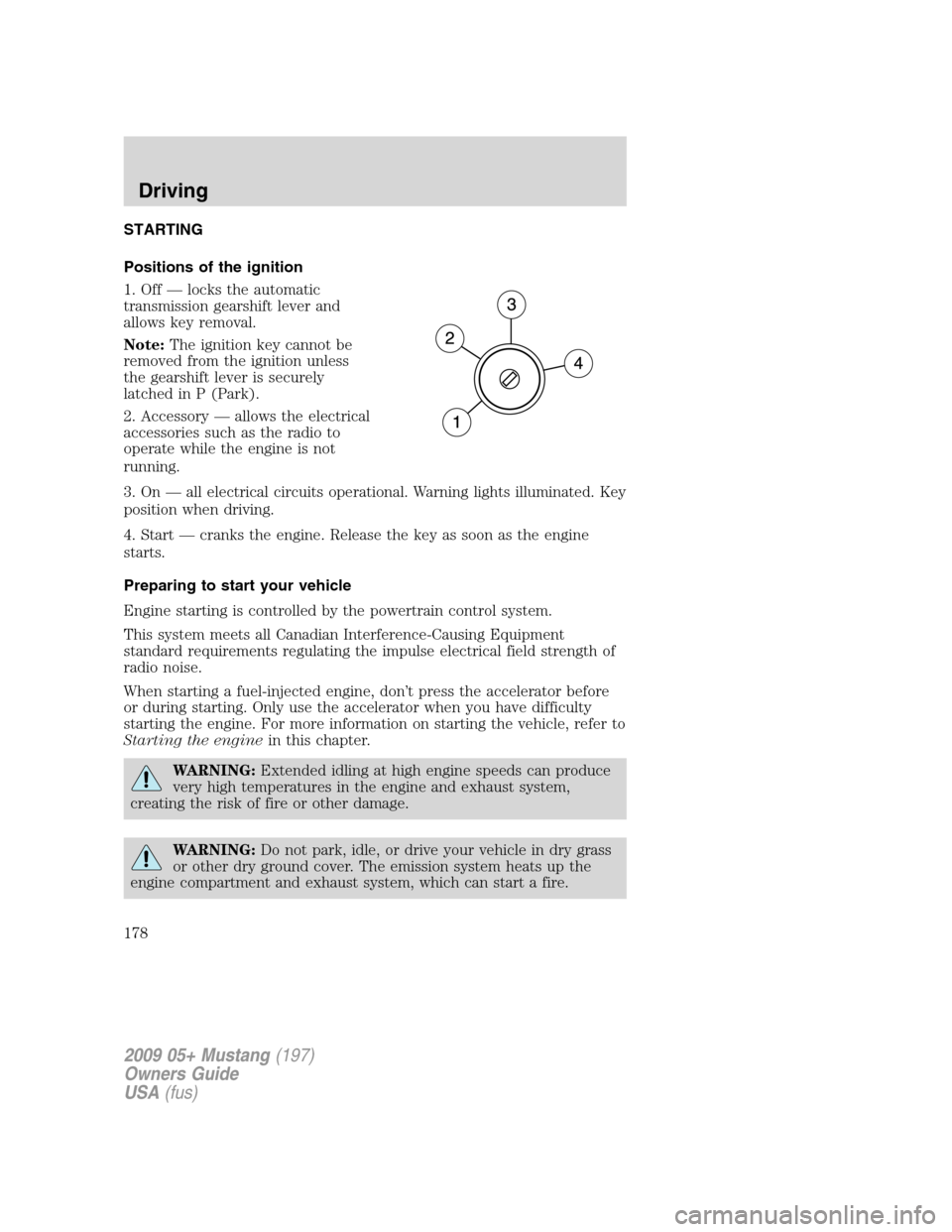
STARTING
Positions of the ignition
1. Off — locks the automatic
transmission gearshift lever and
allows key removal.
Note:The ignition key cannot be
removed from the ignition unless
the gearshift lever is securely
latched in P (Park).
2. Accessory — allows the electrical
accessories such as the radio to
operate while the engine is not
running.
3. On — all electrical circuits operational. Warning lights illuminated. Key
position when driving.
4. Start — cranks the engine. Release the key as soon as the engine
starts.
Preparing to start your vehicle
Engine starting is controlled by the powertrain control system.
This system meets all Canadian Interference-Causing Equipment
standard requirements regulating the impulse electrical field strength of
radio noise.
When starting a fuel-injected engine, don’t press the accelerator before
or during starting. Only use the accelerator when you have difficulty
starting the engine. For more information on starting the vehicle, refer to
Starting the enginein this chapter.
WARNING:Extended idling at high engine speeds can produce
very high temperatures in the engine and exhaust system,
creating the risk of fire or other damage.
WARNING:Do not park, idle, or drive your vehicle in dry grass
or other dry ground cover. The emission system heats up the
engine compartment and exhaust system, which can start a fire.
2009 05+ Mustang(197)
Owners Guide
USA(fus)
Driving
178
Page 181 of 292

3. Turn the key to 3 (on) without
turning the key to 4 (start).
Some warning lights will briefly illuminate. SeeWarning lights and
chimesin theInstrument Clusterchapter for more information
regarding the warning lights.
Starting the engine
1. Turn the key to 3 (on) without
turning the key to 4 (start). If there
is difficulty in turning the key,
rotate the steering wheel until the
key turns freely.
2. Turn the key to 4 (start), then
release the key as soon as the
engine starts.
Note:If the engine does not start within five seconds on the first try,
turn the key to off, wait 10 seconds and try again. If the engine still fails
to start, press and hold the accelerator to the floor and try again; this
will allow the engine to crank with the fuel shut off in case the engine is
flooded with fuel.
Guarding against exhaust fumes
Carbon monoxide is present in exhaust fumes. Take precautions to avoid
its dangerous effects.
WARNING:If you smell exhaust fumes inside your vehicle, have
your dealer inspect your vehicle immediately. Do not drive if you
smell exhaust fumes.
2009 05+ Mustang(197)
Owners Guide
USA(fus)
Driving
181
Page 212 of 292

General information
WARNING:Failure to follow these guidelines could result in an
increased risk of loss of vehicle control, injury or death.
Do not attempt to repair punctures larger than
14inch (6.4 mm) or
damage to the tire’s sidewall. The tire may not completely seal.
Note:Do not use the temporary mobility kit if a tire has become
severely damaged by driving the vehicle with a tire that has insufficient
air pressure. Only punctured areas located within the tire tread can be
sealed with the temporary mobility kit.
Loss of air pressure may adversely affect tire performance. For this
reason:
•Do notdrive the vehicle above 50 mph (80 km/h).
•Do notdrive further than 120 miles (200 km). Drive only to the
closest Ford Motor Company authorized dealer or tire repair shop to
have your tire inspected.
•Drive carefully and avoid abrupt steering maneuvers.
•Periodically monitor tire inflation pressure in the affected tire; if the
tire is losing pressure, have the vehicle towed.
•Read the information in theTips for use of the temporary mobility
kitsection to ensure safe operation of the temporary mobility kit and
your vehicle.
Tips for use of the temporary mobility kit
Read the following list of tips to ensure safe operation of the temporary
mobility kit:
•Before operating the temporary mobility kit, make sure your vehicle is
safely off the road and away from moving traffic. Turn on the hazard
lights.
•Always set the parking brake to ensure the vehicle doesn’t move
unexpectedly.
•Do not remove any foreign objects, such as nails or screws, from the
tire.
•When using the temporary mobility kit, leave the engine running
(only if the vehicle is outdoors or in a well-ventilated area)so
the compressor doesn’t drain the vehicle’s battery.
•Do not allow the compressor to operate continuously for more than
15 minutes; this will help prevent the compressor from overheating.
2009 05+ Mustang(197)
Owners Guide
USA(fus)
Roadside Emergencies
212
Page 267 of 292
performance and emission control system protection for your vehicle.
Gasolines that meet the World-Wide Fuel Charter should be used when
available. Ask your fuel supplier about gasolines that meet the
World-Wide Fuel Charter.
Cleaner air
Ford endorses the use of reformulated “cleaner-burning” gasolines to
improve air quality, per the recommendations in theChoosing the right
fuelsection.
Running out of fuel
Avoid running out of fuel because this situation may have an adverse
effect on powertrain components.
If you have run out of fuel:
•You may need to cycle the ignition from off to on several times after
refueling to allow the fuel system to pump the fuel from the tank to
the engine. On restarting, cranking time will take a few seconds longer
than normal.
•Normally, adding 1 gallon (3.8L) of fuel is enough to restart the
engine. If the vehicle is out of fuel and on a steep grade, more than
1 gallon (3.8L) may be required.
•TheService engine soon
indicator may come on. For more
information on theService engine soon
indicator, refer to
Warning lights and chimesin theInstrument Clusterchapter.
ESSENTIALS OF GOOD FUEL ECONOMY
Measuring techniques
Your best source of information about actual fuel economy is you, the
driver. You must gather information as accurately and consistently as
possible. Fuel expense, frequency of fill-ups or fuel gauge readings are
NOT accurate as a measure of fuel economy. We do not recommend
taking fuel economy measurements during the first 1,000 miles
(1,600 km) of driving (engine break-in period). You will get a more
accurate measurement after 2,000 miles–3,000 miles (3,000 km–5,000
km).
Filling the tank
The advertised fuel capacity of the fuel tank on your vehicle is equal to
the rated refill capacity of the fuel tank as listed in theMaintenance
product specifications and capacitiessection of this chapter.
2009 05+ Mustang(197)
Owners Guide
USA(fus)
Maintenance and Specifications
267
Page 290 of 292

L
Lamps
bulb replacement
specifications chart ..................53
daytime running light ...............49
fog lamps ...................................48
headlamps .................................48
headlamps, flash to pass ..........49
instrument panel, dimming .....49
interior lamps .....................51, 53
replacing bulbs .........................53
LATCH anchors .........................138
Lights, warning and indicator ....10
anti-lock brakes (ABS) ..........184
Limited slip axle
(see Traction Loc) ....................187
Load limits .................................169
Locks ............................................83
autolock .....................................85
doors ..........................................83
Lubricant specifications ...........279
Lug nuts ....................................220
Lumbar support, seats ...............99
M
Manual transmission .................192
fluid capacities ........................279
lubricant specifications ..........279
reverse .....................................193
Message center .....................73–74
display color ..............................75
english/metric button ...............76
MyColor display ........................75
system check button ................74
warning messages .....................79
Mirrors ...................................64, 66automatic dimming rearview
mirror ........................................64
side view mirrors (power) .......66
Motorcraft parts ........243, 262, 278
N
Navigation system .......................43
O
Octane rating ............................266
Oil (see Engine oil) ..................249
P
Parking brake ............................185
Parts (see Motorcraft parts) ....278
Passenger Occupant
Classification Sensor .................105
Power distribution box
(see Fuses) ...............................200
Power door locks ........................85
Power mirrors .............................66
Power point .................................60
Power steering ..........................187
fluid, checking and adding ....273
fluid, refill capacity ................279
fluid, specifications .................279
Power Windows ...........................62
R
Radio ................................19, 23, 28
Recommendations for
attaching safety restraints for
children ......................................132
Relays ........................................197
2009 05+ Mustang(197)
Owners Guide
USA(fus)
Index
290
Page 292 of 292

recreational towing .................177
trailer towing ..........................174
wrecker ....................................226
Traction control ........................185
Traction-lok rear axle ...............187
Transmission
automatic operation
...............188
brake-shift interlock (BSI)
....188
fluid, checking and adding
(automatic)
.............................274
fluid, checking and adding
(manual)
.................................275
fluid, refill capacities
..............279
lubricant specifications
..........279
manual operation
....................192
Trunk
...........................................85
remote release
..........................88
Turn signal
..................................51V
Vehicle Identification Number
(VIN) ..........................................283
Vehicle loading ..........................169
Ventilating your vehicle ...........182
W
Warning lights (see Lights) .......10
Washer fluid ..............................248
Water, Driving through .............194
Windows
power .........................................62
Windshield washer fluid and
wipers
checking and adding fluid .....248
operation ...................................59
replacing wiper blades ...........249
Wrecker towing .........................226
2009 05+ Mustang(197)
Owners Guide
USA(fus)
Index
292