2009 FORD F650 warning
[x] Cancel search: warningPage 192 of 276

Habits
•Smooth, moderate operation can yield up to 10% savings in fuel.
•Steady speeds without stopping will usually give the best fuel
economy.
•Anticipate stopping; slowing down may eliminate the need to stop.
•Sudden or hard accelerations may reduce fuel economy.
•Slow down gradually.
•Driving at reasonable speeds (traveling at 55 mph [88 km/h] uses 15%
less fuel than traveling at 65 mph [105 km/h]).
•Using the air conditioner or defroster may reduce fuel economy.
•Resting your foot on the brake pedal while driving may reduce fuel
economy.
Conditions
•Carrying unnecessary weight may reduce fuel economy.
•Fuel economy may decrease with lower temperatures during the first
8–10 miles (12–16 km) of driving.
•Flat terrain driving improves fuel economy over hilly roads.
•Transmissions give their best fuel economy when operated in the top
cruise gear and with steady pressure on the accelerator.
•Close windows for highway driving.
DIESEL PARTICULATE FILTER (DPF)
Your vehicle is equipped with a diesel particulate filter (DPF), as part of
the after-treatment exhaust system, to trap soot and other large particles
produced by the engine combustion process. The soot that accumulates
in the filter must be periodically reduced to ash to prevent excessive
exhaust restriction. The soot reduction process, also known as “filter
regeneration,” is generally performed automatically by your engine and
after-treatment system.
WARNING:The normal operating temperature of the exhaust
system is very high. Never work around, or attempt to repair,
any part of the exhaust system until it has cooled. Use special care
when working around the diesel particulate filter. The DPF heats up to
a high temperature after only a short period of engine operation, and
can remain hot even after the engine is turned off. Failure to follow
these instructions may result in serious personal injury.
2009 F-650/750(f67)
Supplement
USA(fus)
Maintenance and Specifications
192
Page 194 of 276
Diesel Particulate Filter Four–Level Loading Chart
Level/Lamp status Filter status Requested action
Level 4
Stop Engine lamp
solidOver full. Engine
performance is highly
limited. Continued
operation may result
in irreparable damage
to the filter.Pull vehicle safely off
roadway, turn on
hazard flashers and
shut down engine as
soon as possible. Seek
service immediately.
Instrument cluster lamp(s) will
illuminate and/or flash when
operator assistance is required. In
addition, engine performance will
become increasingly limited above
Level 1.
At Levels 1 and 2, two courses of action may be taken by the operator to
facilitate filter regeneration:
1. The vehicle may be driven on the highway at highway speeds,
2. The operator may perform a parked regeneration by following the
steps inParked regeneration procedure (Cummins engine only).
At Level 3, performing a parked regeneration is the only available course
of action (short of professional servicing) available to the operator for
regenerating the filter. At Level 4, professional servicing is the only way
to regenerate the filter.
Parked regeneration procedure (Cummins engine only)
WARNING:When performing the parked regeneration
procedure, make certain the vehicle is safely off roadway, and
the exhaust system is away from people, or any flammable materials,
vapors, or structures. Engine speed may increase during parked
regeneration.
Note:Parked regeneration is only available when the DPF lamp on the
instrument cluster is illuminated (solid or flashing).
1. Bring the vehicle to a complete stop on level ground and safely off the
road with the exhaust system away from people, flammable materials,
vapors or structures.
2. If your vehicle is equipped with an automatic transmission and a
steering column shift lever, place transmission in P (Park). Otherwise,
place the transmission in N (Neutral).
2009 F-650/750(f67)
Supplement
USA(fus)
Maintenance and Specifications
194
Page 196 of 276

Exhaust outlet assembly
WARNING:The normal operating temperature of the exhaust
system is very high. Never work around or attempt to repair any
part of the exhaust system until it has cooled. Failure to follow these
instructions may result in serious personal injury.
The exhaust outlet assembly on your vehicle is a uniquely functioning
device that accompanies the DPF assembly. It is designed to help control
the temperature of the exhaust during the DPF regeneration process.Do
not modify or remove this device. Modification of the system
and/or additions of aftermarket devices can reduce the
effectiveness of the system, as well as cause damage to the
exhaust system and/or engine. Any modifications may also
invalidate the vehicle and/or engine warranties. See the vehicle
and engine warranty guides for more information.
The inlet holes in the side of the assembly are functional. These holes
allow outside air to be drawn into the outlet assembly. The holes need to
be kept clear of mud and other foreign material to maintain proper
functionality of the system. One way to keep the holes clear is to spray
the outlet assembly with a hose when washing the vehicle. Failure to
keep the functional holes clear of foreign material may result in the holes
becoming blocked or plugged.Blocked/plugged holes or
modification/removal of the outlet assembly could result in
elevated exhaust temperatures which may result in
vehicle/property damage and/or personal injury.
NOISE EMISSIONS – EXTERIOR
In order to comply with the federal exterior noise regulations, your
vehicle may be equipped with noise emission items. Depending on the
vehicle configuration, it may have all or some of the following items:
Air Intake System
•Air Cleaner:should be inspected and its location should not be
altered. Do not alter inlet and outlet piping.
Body
•Wheel Well:splash shields, cab shields and under-hood insulation
should be inspected for deterioration, dislocation, and orientation.
Cooling System
•Check the fan for damage to blades; replace, if damaged, with the
recommended parts. Inspect for fan to shroud interference, and any
damage to shroud such as cracks and holes.
2009 F-650/750(f67)
Supplement
USA(fus)
Maintenance and Specifications
196
Page 199 of 276
4. Use only a DOT 3 brake fluid certified to meet manufacturer
specifications. Refer toLubricant specificationsin this chapter.
WARNING:Brake fluid is toxic. If brake fluid contacts the eyes,
flush eyes with running water for 15 minutes. Seek medical
attention if irritation persists. If taken internally, drink water and
induce vomiting. Seek medical attention immediately.
WARNING:If you use a brake fluid that is not DOT 3, you will
cause permanent damage to your brakes.
WARNING:Do not let the reservoir for the master cylinder run
dry. This may cause the brakes to fail.
CLUTCH FLUID/LINKAGE ADJUSTMENTS
Clutch fluid (if equipped)
Check the clutch fluid level. Refer to theScheduled Maintenance
Guidechapter for the service interval schedules.
During normal operation, the fluid level in the clutch reservoir should
remain constant. If the fluid level drops, maintain the fluid level at the
step in the reservoir.
Use only a DOT 3 brake fluid designed to meet manufacturer
specifications. Refer toLubricant specificationsin this chapter.
WARNING:Carefully read cautionary information on product
label. For MEDICAL EMERGENCY INFORMATION, contact a
physician or Poison Control Center immediately; on Ford-Motorcraft
products call: 1-800-959-3673 (FORD). Failure to follow these
instructions may result in personal injury.
2009 F-650/750(f67)
Supplement
USA(fus)
Maintenance and Specifications
199
Page 205 of 276

WARNING:Do not use a jack when working under a vehicle. It
may give way, causing the vehicle to fall and result in property
damage, personal injury or death. Always use floor stands to support
the vehicle.
FRAME AND TOW HOOKS
Your vehicles chassis is manufactured with frame rails of either HSLA
steel or heat-treated steel. Each must be handled in a specific manner to
ensure maximum service life. Before attempting frame repair or
modification, consult the service manual or your dealer.
It is important, particularly on vehicles where the tow hooks are used
frequently, to inspect the front and rear tow hooks for damage or a loose
mounting.
U-BOLT NUT TORQUE
U-bolt diameter (nominal) (all
spring suspensions)U-bolt diameter (nominal)
Ft. lb. N•m
IROS Air w/15,500 lb. axles and
less260–300 353–407
IROS Air w/greater than 15,500 lb.
axles370–400 502–542
Hendrickson 23,000 lb. axle 370–400 502–542
Air suspension U-bolt checks and re-torquing procedures
1. Inspect the threads of the U-bolt and nut for rust and debris. Clean
the threads if contaminated.
2. Using a torque wrench, determine if any nuts can be turned with a
force below the specified torque.
3. Using the lowest discovered torqued nut as a starting point, retighten
the nuts using the sequence listed underAir suspension U-bolt and
U-bolt nut installation.
Air suspension U-bolt and U-bolt nut installation
1. Inspect the threads of the U-bolt and nut for rust and debris. Clean
the threads if contaminated.
2. Install the U-bolts and nuts and torque the nuts to 15 ft. lb. (20 N•m),
using a diagonal pattern.
2009 F-650/750(f67)
Supplement
USA(fus)
Maintenance and Specifications
205
Page 212 of 276

WARNING:Use only the same type and style wheels and
mounting hardware to replace original parts. Failure to do so
may result in an assembly that looks fine, but does not fit together
properly. This could possibly cause wheel or fastener failures which
could result in property damage, personal injury or death.
Note:Do not attempt to mix stud-piloted wheels or fasteners with
hub-piloted wheels or fasteners.
Note:Do not change from aluminum wheels to steel wheels or
vice-versa without changing the mounting hardware required or, with
flange-nut mounting systems, changing the hub and stud assembly.
WHEEL NUT TORQUE
Size Nut mountingTorque
Ft. lb. N•m
22 mm Flange 450–500 610–678
Note:Do not use lubrication on dry threads. Where excessive corrosion
exists, a light coat of lubricant on the first three threads of the stud bolt
is permitted. Keep lubricant away from:
•Hex nut and rim clamp contact surfaces.
•Cap nut ball face and ball seat on the disc wheel.
•Flange nut washer surface and flat on the disc wheel.
TIRE INFORMATION
Inflation
WARNING:Always maintain your tires in good condition.
Frequently check and maintain correct inflation pressures as
specified by tire manufacturers. Inspect periodically for abnormal wear
patterns and repair/replace cut or broken tire casing. Always use
experienced, trained personnel with proper equipment and correct
procedures to mount or remove tires and wheels. Failure to adhere to
these warnings could result in wheel or tire malfunction, damage to
your vehicle, personal injury, or death.
2009 F-650/750(f67)
Supplement
USA(fus)
Maintenance and Specifications
212
Page 213 of 276
WARNING:To avoid personal injury or death, always follow
these instructions when mounting radial tires on wheels:
•Only personnel that have had proper training and experience should
mount or remove tires from rims or wheels.
•Use only heavy-duty rims or approved rims for radial tires. It may be
necessary to contact your wheel and rim distributor to determine if
your rims are approved for radial tires.
•If a tube is to be used, make sure special radial tire tubes are used
because of the increased flexing of the sidewalls on radial tires.
•Never use anti-freeze, silicones, or petroleum based lubricants when
mounting radial tires. Only an approved lubricant should be used as
an aid for mounting tires.
•Always inflate tires in a safety cage.
•Do not attempt to mix stud piloted wheels or fasteners with hub
piloted wheels or fasteners. To do so may cause premature wheel
failure resulting in property damage, personal injury, or death.
•Do no mix foreign (not made in North America) wheel mounting
parts with domestic (made in North America) parts. Many foreign
wheel components look similar to, but not exactly the same as
domestic made components. Mixing components could cause wheel
or fastener failures and result in property damage, personal injury, or
death.
•Do not change from aluminum wheels to steel wheels or vice-versa
without changing the mounting hardware where required or, in some
cases with flange nut mounting systems, changing the hub and stud
assembly. Mixing components could cause wheel or fastener failures
and result in property damage, personal injury, or death.
All tires with Steel Carcass Plies (if equipped):
This type of tire utilizes steel cords in the sidewalls. As such, they
cannot be treated like normal light truck tires. Tire service, including
adjusting the air pressure, must be performed by personnel trained,
supervised and equipped according to Federal Occupational Safety and
Health Administration (OSHA) regulations. For example, during any
procedure involving tire inflation, the technician or individual must
utilize a remote inflation device, and ensure that all persons are clear of
the trajectory area.
2009 F-650/750(f67)
Supplement
USA(fus)
Maintenance and Specifications
213
Page 214 of 276
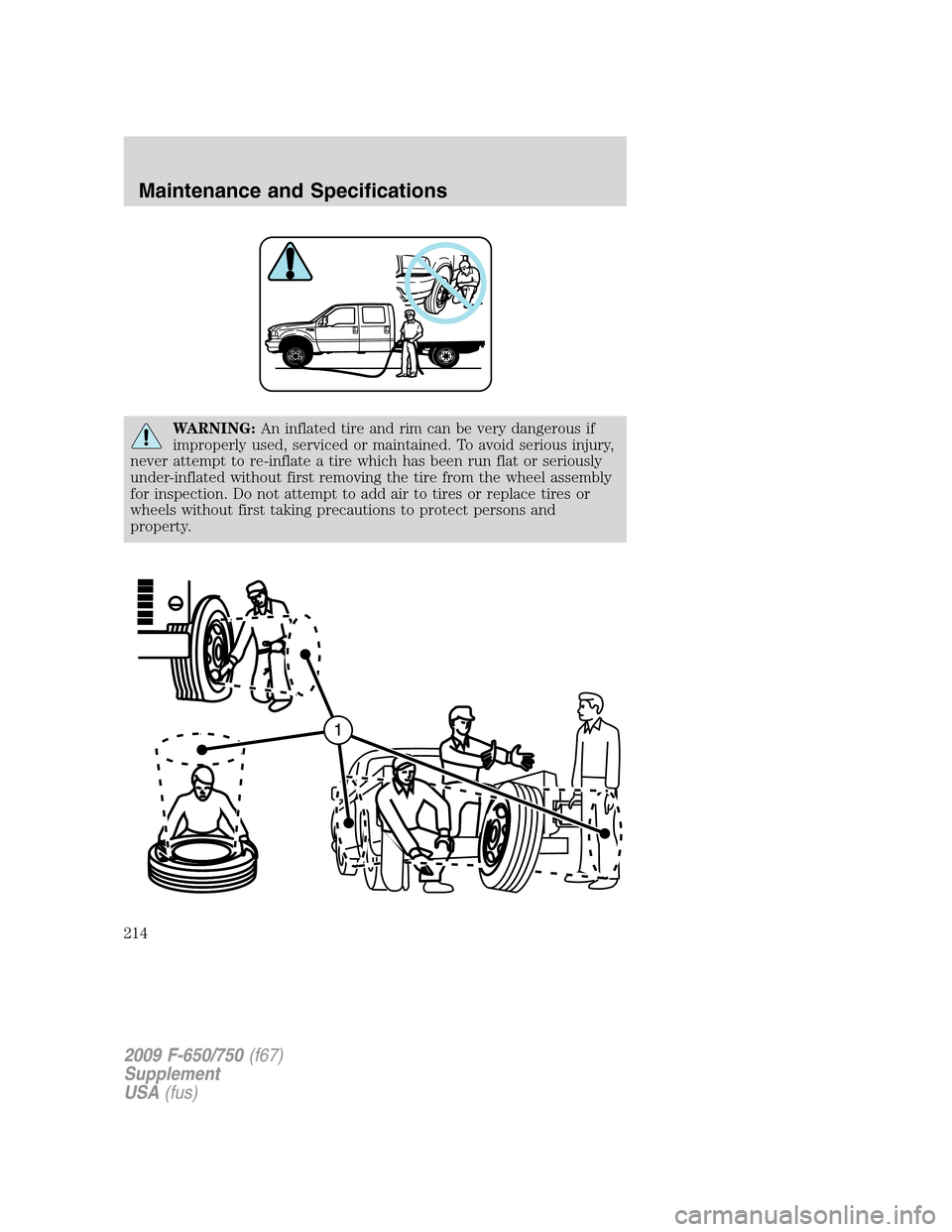
WARNING:An inflated tire and rim can be very dangerous if
improperly used, serviced or maintained. To avoid serious injury,
never attempt to re-inflate a tire which has been run flat or seriously
under-inflated without first removing the tire from the wheel assembly
for inspection. Do not attempt to add air to tires or replace tires or
wheels without first taking precautions to protect persons and
property.
2009 F-650/750(f67)
Supplement
USA(fus)
Maintenance and Specifications
214