2009 FORD EXPLORER lights
[x] Cancel search: lightsPage 270 of 407
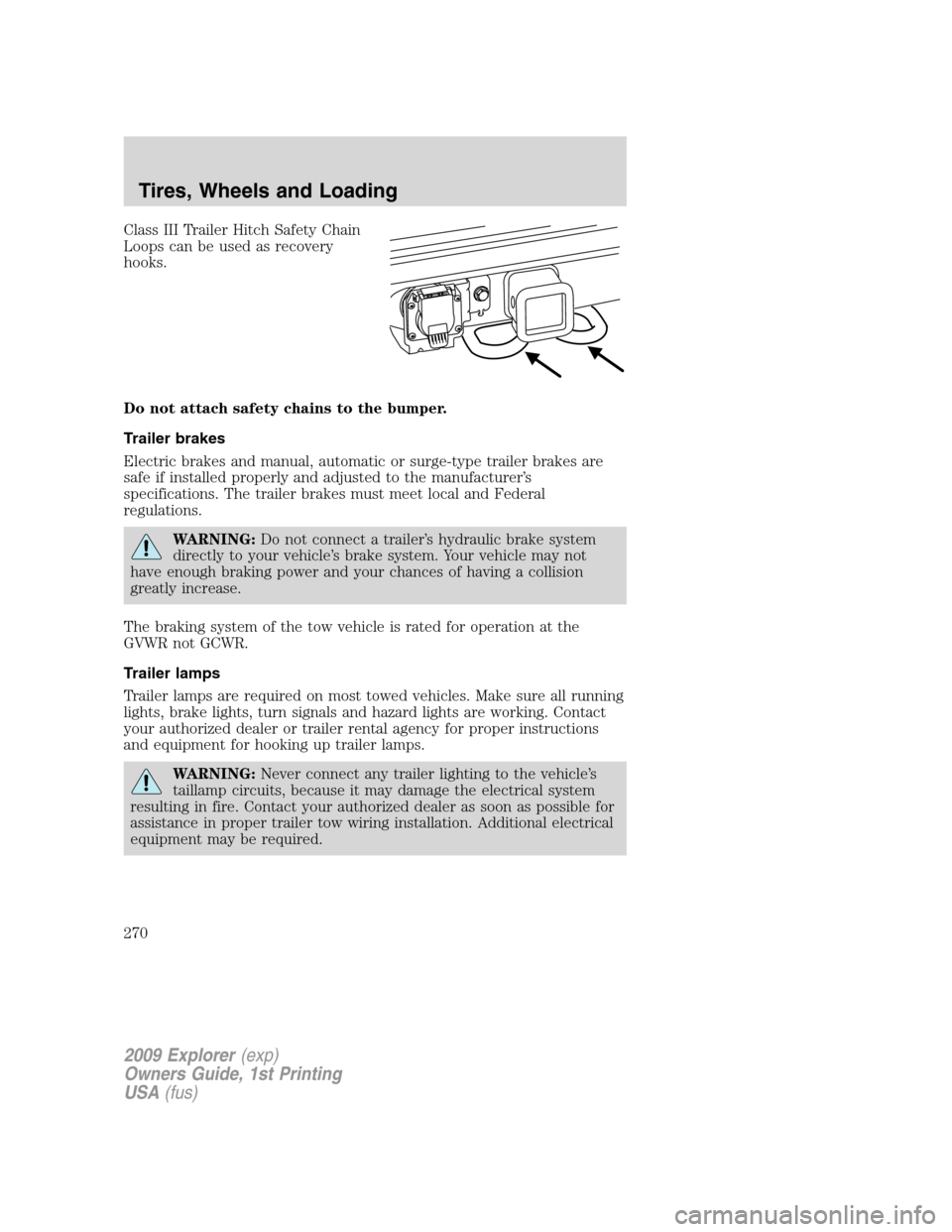
Class III Trailer Hitch Safety Chain
Loops can be used as recovery
hooks.
Do not attach safety chains to the bumper.
Trailer brakes
Electric brakes and manual, automatic or surge-type trailer brakes are
safe if installed properly and adjusted to the manufacturer’s
specifications. The trailer brakes must meet local and Federal
regulations.
WARNING:Do not connect a trailer’s hydraulic brake system
directly to your vehicle’s brake system. Your vehicle may not
have enough braking power and your chances of having a collision
greatly increase.
The braking system of the tow vehicle is rated for operation at the
GVWR not GCWR.
Trailer lamps
Trailer lamps are required on most towed vehicles. Make sure all running
lights, brake lights, turn signals and hazard lights are working. Contact
your authorized dealer or trailer rental agency for proper instructions
and equipment for hooking up trailer lamps.
WARNING:Never connect any trailer lighting to the vehicle’s
taillamp circuits, because it may damage the electrical system
resulting in fire. Contact your authorized dealer as soon as possible for
assistance in proper trailer tow wiring installation. Additional electrical
equipment may be required.
2009 Explorer(exp)
Owners Guide, 1st Printing
USA(fus)
Tires, Wheels and Loading
270
Page 274 of 407

STARTING
Positions of the ignition
1. Off— locks the gearshift lever
and allows key removal. This
position also shuts the engine and
all electrical accessories off.
2. Accessory— allows the electrical
accessories such as the radio to
operate while the engine is not
running.
3. On— all electrical circuits
operational. Warning lights
illuminated. Key position when driving.
4. Start— cranks the engine. Release the key as soon as the engine
starts.
Preparing to start your vehicle
Engine starting is controlled by the powertrain control system.
This system meets all Canadian Interference-Causing Equipment
standard requirements regulating the impulse electrical field strength of
radio noise.
When starting a fuel-injected engine, don’t press the accelerator before
or during starting. Only use the accelerator when you have difficulty
starting the engine. For more information on starting the vehicle, refer to
Starting the enginein this chapter.
WARNING:Extended idling at high engine speeds can produce
very high temperatures in the engine and exhaust system,
creating the risk of fire or other damage.
WARNING:Do not park, idle, or drive your vehicle in dry grass
or other dry ground cover. The emission system heats up the
engine compartment and exhaust system, which can start a fire.
WARNING:Do not start your vehicle in a closed garage or in
other enclosed areas. Exhaust fumes can be toxic. Always open
the garage door before you start the engine. SeeGuarding against
exhaust fumesin this chapter for more instructions.
2009 Explorer(exp)
Owners Guide, 1st Printing
USA(fus)
Driving
274
Page 276 of 407

•Make sure the gearshift is in P
(Park).
3. Turn the key to 3 (on) without
turning the key to 4 (start).
Some warning lights will briefly illuminate. SeeWarning lights and
chimesin theInstrument Clusterchapter for more information
regarding the warning lights.
2009 Explorer(exp)
Owners Guide, 1st Printing
USA(fus)
Driving
276
Page 299 of 407
The radar sensor is located behind the rear bumper/fascia. Always
keep the rear bumper/fascia free from snow, ice and large
accumulations of dirt. These elements may cause the system to
operate inaccurately.
If the vehicle sustains damage to the rear bumper/fascia, leaving
it misaligned or bent, the sensing zone may be altered causing
inaccurate measurement of obstacles or false alarms.
FOUR-WHEEL DRIVE (4WD) OPERATION (IF EQUIPPED)
WARNING:For important information regarding safe operation
of this type of vehicle, seePreparing to drive your vehiclein
this chapter.
Four–wheel drive (4WD) supplies power to all four wheels. Do not use
4X4 High or 4X4 Low on dry, hard surfaced roads. Doing so will produce
excessive noise, increase tire wear and may damage drive components.
4X4 High and 4X4 Low are only intended for consistently slippery or
loose surfaces. The use of 4X4 High or 4X4 Low on these surfaces may
produce some noise, such as occasional clunks, but will not damage the
drive system.
If equipped with the Electronic Shift 4WD System, and 4WD Low
is selected while the vehicle is moving above 3 mph (5 km/h), the
4WD system will not engage. This is normal and should be no
reason for concern.Refer toShifting to/from 4WD Lowfor proper
operation.
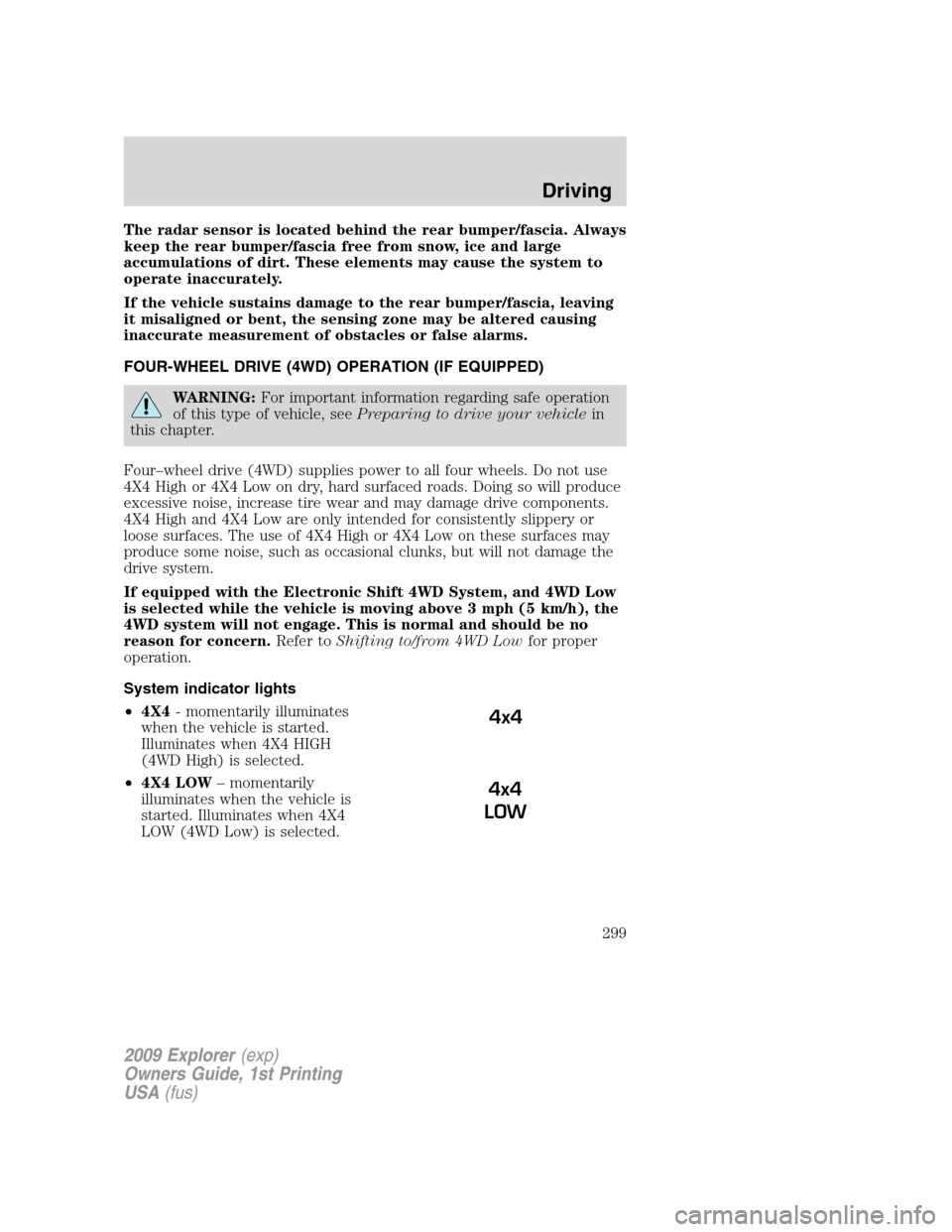
System indicator lights
•4X4- momentarily illuminates
when the vehicle is started.
Illuminates when 4X4 HIGH
(4WD High) is selected.
•4X4 LOW– momentarily
illuminates when the vehicle is
started. Illuminates when 4X4
LOW (4WD Low) is selected.
4x4
4x4
LOW
2009 Explorer(exp)
Owners Guide, 1st Printing
USA(fus)
Driving
299
Page 379 of 407
Fuel quality
If you are experiencing starting, rough idle or hesitation driveability
problems, try a different brand of unleaded gasoline. “Premium”
unleaded gasoline is not recommended for vehicles designed to use
“Regular” unleaded gasoline because it may cause these problems to
become more pronounced. If the problems persist, see your authorized
dealer.
Do not add aftermarket fuel additive products to your fuel tank. It
should not be necessary to add any aftermarket products to your fuel
tank if you continue to use high quality fuel of the recommended octane
rating. These products have not been approved for your engine and
could cause damage to the fuel system. Repairs to correct the effects of
using an aftermarket product in your fuel may not be covered by your
warranty.
Many of the world’s automakers approved the World-Wide Fuel Charter
that recommends gasoline specifications to provide improved
performance and emission control system protection for your vehicle.
Gasolines that meet the World-Wide Fuel Charter should be used when
available. Ask your fuel supplier about gasolines that meet the
World-Wide Fuel Charter.
Cleaner air
Ford endorses the use of reformulated “cleaner-burning” gasolines to
improve air quality, per the recommendations in theChoosing the right
fuelsection.
Running out of fuel
Avoid running out of fuel because this situation may have an adverse
effect on powertrain components.
If you have run out of fuel:
•You may need to cycle the ignition from off to on several times after
refueling to allow the fuel system to pump the fuel from the tank to
the engine. On restarting, cranking time will take a few seconds longer
than normal.
•Normally, adding 1 gallon (3.8L) of fuel is enough to restart the
engine. If the vehicle is out of fuel and on a steep grade, more than
1 gallon (3.8L) may be required.
•TheService engine soon
indicator may come on. For more
information on the “service engine soon” indicator, refer toWarning
lights and chimesin theInstrument Clusterchapter.
2009 Explorer(exp)
Owners Guide, 1st Printing
USA(fus)
Maintenance and Specifications
379
Page 403 of 407

lubrication specifications .......392
refill capacities ........................392
service points ..................357–358
starting after a collision .........312
Engine block heater .................278
Engine oil ..................................361
checking and adding ..............361
dipstick ....................................361
filter, specifications ........364, 391
recommendations ...................364
refill capacities ........................392
specifications ..........................392
Event data recording ....................7
Exhaust fumes ..........................277
F
Fail safe cooling ........................373
Family entertainment system ....49
Floor mats .................................150
Fluid capacities .........................392
Fog lamps ....................................90
Four-Wheel Drive vehicles .......299
driving off road .......................302
indicator light .........................299
preparing to drive your
vehicle .....................................288
Fuel ............................................375
calculating fuel
economy ..................124, 137, 381
cap ...........................................377
capacity ...................................392
choosing the right fuel ...........378
comparisons with EPA fuel
economy estimates .................384
detergent in fuel .....................379
filler funnel .............................379
filling your vehicle with
fuel ...........................375, 377, 381filter, specifications ........374, 391
fuel pump shut-off switch .....312
improving fuel economy ........381
octane rating ...................378, 396
quality ......................................379
running out of fuel .........331, 379
safety information relating to
automotive fuels .....................375
Fuses ..................................313–314
G
Garage door opener ..................103
Gas cap (see Fuel cap) ............377
Gas mileage
(see Fuel economy) .................381
Gauges .........................................18
GAWR
(Gross Axle Weight Rating)
calculating ...............................266
GVWR
(Gross Vehicle Weight Rating)
calculating ...............................266
H
Hazard flashers .........................311
Headlamps ...................................89
aiming ........................................91
bulb specifications ....................94
daytime running lights .............90
flash to pass ..............................91
high beam .................................90
turning on and off ....................89
Heating
heating and air conditioning
system .................................82, 84
Homelink wireless control
system ........................................117
2009 Explorer(exp)
Owners Guide, 1st Printing
USA(fus)
Index
403
Page 404 of 407

Hood ..........................................356
How to get going ........................21
I
Ignition ...............................274, 396
Illuminated visor mirror ...........101
Infant seats
(see Safety seats) .....................223
Inspection/maintenance (I/M)
testing ........................................386
Instrument panel
cleaning ...................................351
cluster ........................................12
J
Jack ....................................321, 324
positioning .......................321, 326
storage .............................321, 324
Jump-starting your vehicle ......331
K
Keyless entry system ...............165
autolock ...........................154, 156
keypad .....................................165
locking and unlocking doors ..166
programming entry code .......165
Keys ...........................................168
positions of the ignition .........274
L
Lamps
bulb replacement
specifications chart ..................94
daytime running light ...............90
fog lamps ...................................90
headlamps .................................89interior lamps ...........................93
LATCH anchors .........................227
Liftgate ......................................151
remote release ........................161
Lights, warning and indicator ....12
anti-lock brakes (ABS) ..........280
Load limits .................................260
Loading instructions .................266
Locks
autolock ...........................154, 156
childproof ................................159
doors ........................................154
Lubricant specifications ...........392
Lug nuts ....................................330
Luggage rack .............................152
Lumbar support, seats .....174, 176
M
Message center .................123, 135
english/metric button .....126, 140
system check button ......125, 139
warning messages ...........131, 146
Mirrors ...............................107–108
automatic dimming rearview
mirror ......................................108
fold away .................................109
heated ......................................109
side view mirrors (power) .....108
Moon roof ..................................116
Motorcraft parts ........353, 374, 391
N
Navigation system .......................81
O
Octane rating ............................378
2009 Explorer(exp)
Owners Guide, 1st Printing
USA(fus)
Index
404
Page 406 of 407
SecuriLock passive anti-theft
system ........................................166
Setting the clock
AM/FM single CD .....................27
AM/FM/In-dash 6 CD ................35
Snowplowing .................................8
Spark plugs,
specifications .....................391, 396
Special notice
ambulance conversions ..............8
utility-type vehicles ....................7
Specification chart,
lubricants ...................................392
Speed control ............................111
Starting your
vehicle ........................274–275, 277
jump starting ..........................331
Steering wheel
controls ....................................114
tilting .......................................101
SYNC ............................................81
T
Tilt steering wheel ....................101
Tire Pressure Monitoring
System (TPMS)
Driving .....................................305
Roadside Emergencies ...........321
Tires, Wheels and Loading ....255
Warning Displays ......12, 131, 146
Tires ...........................240–241, 321
alignment ................................249
care ..........................................245
changing ..........................321, 326
checking the pressure ............245
inflating ...................................242
label .........................................254replacing ..........................246, 326
rotating ....................................249
safety practices .......................248
sidewall information ...............250
snow tires and chains ............260
spare tire .................321, 324–325
terminology .............................242
tire grades ...............................241
treadwear ........................241, 245
Towing .......................................267
recreational towing .................273
trailer towing ..........................267
wrecker ....................................337
Transfer case
fluid checking .........................388
Transmission .............................289
brake-shift interlock (BSI) ....289
fluid, checking and adding
(automatic) .............................388
fluid, refill capacities ..............392
lubricant specifications ..........392
Turn signal ..................................93
U
USB port ......................................43
V
Vehicle Identification Number
(VIN) ..........................................397
Vehicle loading ..........................260
Ventilating your vehicle ...........277
W
Warning lights (see Lights) .......12
Washer fluid ..............................359
Water, Driving through .............309
Windows ....................................161
2009 Explorer(exp)
Owners Guide, 1st Printing
USA(fus)
Index
406