2009 FORD EDGE lights
[x] Cancel search: lightsPage 155 of 320

In case there is a problem with the
front passenger sensing system, the
airbag readiness light in the
instrument cluster will stay lit.
If the airbag readiness light is lit, do the following:
The driver and/or adult passengers should check for any objects that
may be lodged underneath the front passenger seat or cargo interfering
with the seat.
If objects are lodged and/or cargo is interfering with the seat; please take
the following steps to remove the obstruction:
•Pull the vehicle over.
•Turn the vehicle off.
•Driver and/or adult passengers should check for any objects lodged
underneath the front passenger seat or cargo interfering with the seat.
•Remove the obstruction(s) (if found).
•Restart the vehicle.
•Wait at least 2 minutes and verify that the airbag readiness light is no
longer illuminated
•If the airbag readiness light remains illuminated, this may or may/not
be a problem due to the front passenger sensing system.
DO NOT attempt to repair or service the system; take your vehicle
immediately to an authorized dealer.
If it is necessary to modify an advanced front airbag system to
accommodate a person with disabilities, contact the Ford Customer
Relationship Center at the phone number shown in theCustomer
Assistancesection of thisOwner’s Guide.
WARNING:Any alteration/modification to the front passenger
seat may affect the performance of the front passenger sensing
system.
Determining if the system is operational
The supplemental restraint system uses a warning indicator light in the
instrument cluster or a back-up tone to indicate the condition of the
system. Refer to theWarning lights and chimessection in the
Instrument Clusterchapter. Routine maintenance of the airbag is not
required.
2009 Edge(edg)
Owners Guide, 1st Printing
USA(fus)
Seating and Safety Restraints
155
Page 209 of 320

Preparing to tow
Use the proper equipment for towing a trailer and make sure it is
properly attached to your vehicle. Contact your authorized dealer or a
reliable trailer dealer as soon as possible if you require assistance.
Hitches
Do not use hitches that clamp onto the vehicle’s bumper or attach to the
axle. You must distribute the load in your trailer so that 10%–15% of the
total weight of the trailer is on the tongue.
Safety chains
Always connect the trailer’s safety chains to the hook retainers on the
hitch. To connect the trailer’s safety chains, cross the chains under the
trailer tongue and allow slack for turning corners.
If you use a rental trailer, follow the instructions that the rental agency
gives to you.
Do not attach safety chains to the bumper.
Trailer brakes
Be sure your trailer conforms to all applicable local and Federal
Regulations regarding trailer braking. If your trailer is equipped with
electronically controlled brakes you will need to have an electronic brake
controller with associated wiring installed to your vehicle by an
authorized dealer.
WARNING:Do not connect a trailer’s hydraulic brake system
directly to your vehicle’s brake system. Your vehicle may not
have enough braking power and your chances of having a collision
greatly increase.
The braking system of the tow vehicle is rated for operation at the
GVWR not GCWR.
Trailer lamps
Trailer lamps are required on most towed vehicles. Make sure all running
lights, brake lights, turn signals and hazard lights are working.
Do not splice into the vehicle lamp wiring for trailer lamps. Your
vehicle uses an advanced electronic module to control and
monitor your vehicle lamps. Splicing into the wiring or attaching
wiring to the vehicle bulb may DISABLE the rear vehicle lamps or
2009 Edge(edg)
Owners Guide, 1st Printing
USA(fus)
Tires, Wheels and Loading
209
Page 213 of 320

STARTING
Positions of the ignition
1. Off— locks the automatic
transmission gearshift lever and
allows key removal. This position
also shuts the engine and all
electrical accessories off without
locking the steering wheel. To lock
the steering wheel, remove the key
then turn the steering wheel.
2. Accessory— allows the electrical accessories such as the radio to
operate while the engine is not running. This position also unlocks the
steering wheel.
3. On— all electrical circuits operational. Warning lights illuminated. Key
position when driving.
4. Start— cranks the engine. Release the key as soon as the engine
starts.
Preparing to start your vehicle
Engine starting is controlled by the powertrain control system.
This system meets all Canadian Interference-Causing Equipment
standard requirements regulating the impulse electrical field strength of
radio noise.
When starting a fuel-injected engine, avoid pressing the accelerator
before or during starting. Only use the accelerator when you have
difficulty starting the engine. For more information on starting the
vehicle, refer toStarting the enginein this chapter.
WARNING:Extended idling at high engine speeds can produce
very high temperatures in the engine and exhaust system,
creating the risk of fire or other damage.
WARNING:Do not park, idle, or drive your vehicle in dry grass
or other dry ground cover. The emission system heats up the
engine compartment and exhaust system, which can start a fire.
2009 Edge(edg)
Owners Guide, 1st Printing
USA(fus)
Driving
213
Page 215 of 320

•Make sure the gearshift is in P
(Park).
3. Turn the key to 3 (on) without
turning the key to 4 (start).
Some warning lights will briefly illuminate. SeeWarning lights and
chimesin theInstrument Clusterchapter for more information
regarding the warning lights.
Starting the engine
1. Turn the key to 3 (on) without
turning the key to 4 (start). If there
is difficulty in turning the key,
rotate the steering wheel until the
key turns freely. This condition may
occur when:
•the front wheels are turned
•a front wheel is against the curb
2. Turn the key to 4 (start), then release the key as soon as the engine
begins cranking. Your vehicle has a computer assisted cranking system
2009 Edge(edg)
Owners Guide, 1st Printing
USA(fus)
Driving
215
Page 243 of 320
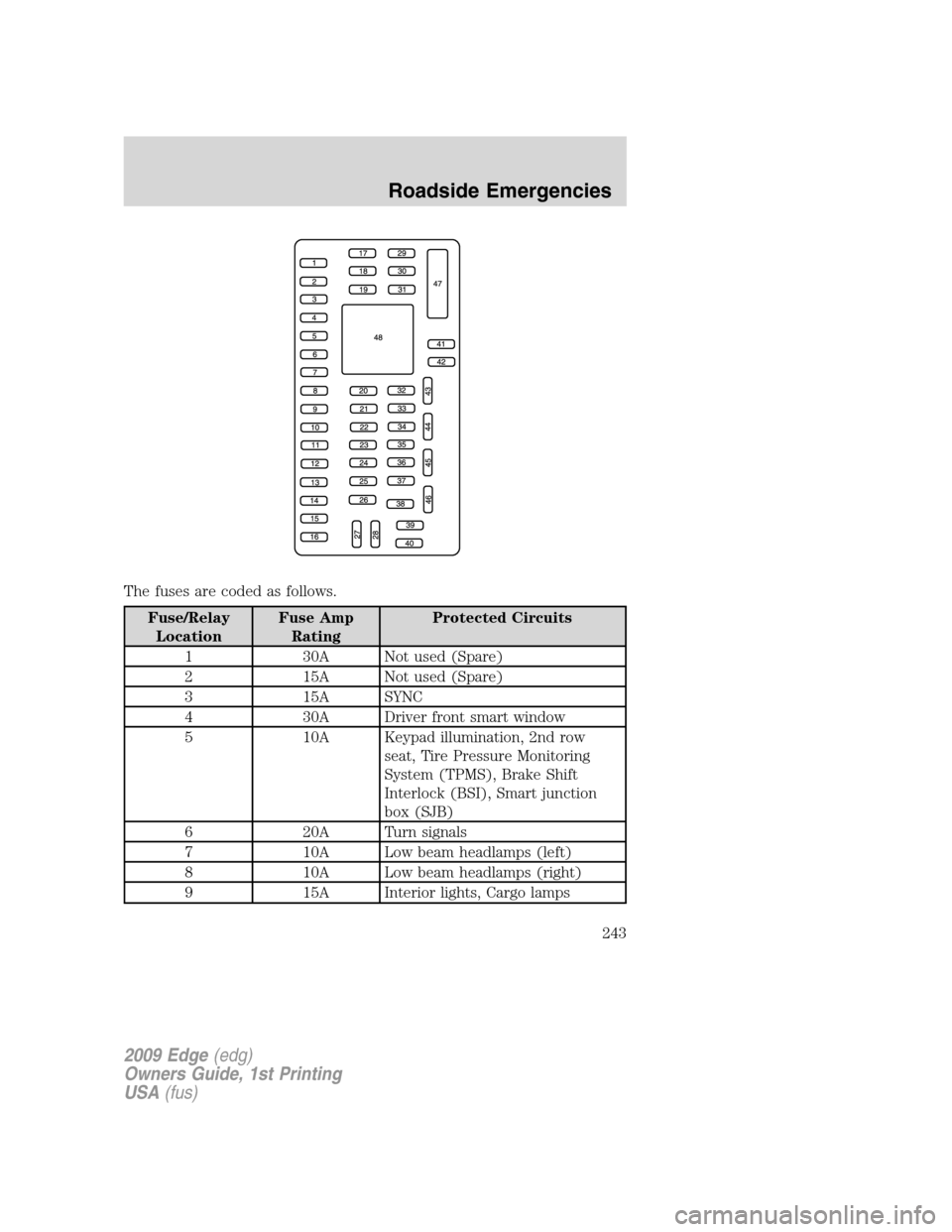
The fuses are coded as follows.
Fuse/Relay
LocationFuse Amp
RatingProtected Circuits
1 30A Not used (Spare)
2 15A Not used (Spare)
3 15A SYNC
4 30A Driver front smart window
5 10A Keypad illumination, 2nd row
seat, Tire Pressure Monitoring
System (TPMS), Brake Shift
Interlock (BSI), Smart junction
box (SJB)
6 20A Turn signals
7 10A Low beam headlamps (left)
8 10A Low beam headlamps (right)
9 15A Interior lights, Cargo lamps
2009 Edge(edg)
Owners Guide, 1st Printing
USA(fus)
Roadside Emergencies
243
Page 297 of 320

•TheService engine soonindicator may come on. For more
information on theService engine soon
indicator, refer to
Warning lights and chimesin theInstrument Clusterchapter.
ESSENTIALS OF GOOD FUEL ECONOMY
Measuring techniques
Your best source of information about actual fuel economy is you, the
driver. You must gather information as accurately and consistently as
possible. Fuel expense, frequency of fill-ups or fuel gauge readings are
NOT accurate as a measure of fuel economy. We do not recommend
taking fuel economy measurements during the first 1,000 miles
(1,600 km) of driving (engine break-in period). You will get a more
accurate measurement after 2,000 miles–3,000 miles (3,000 km–5,000
km).
Filling the tank
The advertised fuel capacity of the fuel tank on your vehicle is equal to
the rated refill capacity of the fuel tank as listed in theMaintenance
product specifications and capacitiessection of this chapter.
The advertised capacity is the amount of the indicated capacity and the
empty reserve combined. Indicated capacity is the difference in the
amount of fuel in a full tank and a tank when the fuel gauge indicates
empty. Empty reserve is the small amount of fuel remaining in the fuel
tank after the fuel gauge indicates empty.
The amount of usable fuel in the empty reserve varies and should
not be relied upon to increase driving range. When refueling your
vehicle after the fuel gauge indicates empty, you might not be
able to refuel the full amount of the advertised capacity of the
fuel tank due to the empty reserve still present in the tank.
For consistent results when filling the fuel tank:
•Turn the engine/ignition switch to the off position prior to refueling,
an error in the reading will result if the engine is left running.
•Use the same filling rate setting (low — medium — high) each time
the tank is filled.
•Allow no more than two automatic click-offs when filling.
•Always use fuel with the recommended octane rating.
•Use a known quality gasoline, preferably a national brand.
•Use the same side of the same pump and have the vehicle facing the
same direction each time you fill up.
2009 Edge(edg)
Owners Guide, 1st Printing
USA(fus)
Maintenance and Specifications
297
Page 317 of 320

refill capacities ........................308
specifications ..........................308
Event data recording ....................7
Exhaust fumes ..........................216
F
Fail safe cooling ........................290
Floor mats ...................................93
Fluid capacities .........................308
Fog lamps ....................................56
Four-Wheel Drive vehicles
driving off road .......................233
Fuel ............................................292
calculating fuel
economy ............................85, 297
cap ...........................................294
capacity ...................................308
choosing the right fuel ...........295
comparisons with EPA fuel
economy estimates .................299
detergent in fuel .....................296
filling your vehicle with
fuel ...........................292, 294, 297
filter, specifications ........291, 307
fuel pump shut-off switch .....240
improving fuel economy ........297
octane rating ...................295, 310
quality ......................................296
running out of fuel .................296
safety information relating to
automotive fuels .....................292
Fuses ..................................241–242
G
Gas cap (see Fuel cap) ............294
Gas mileage (see Fuel
economy) ...................................297Gauges .........................................17
H
Hazard flashers .........................240
Head restraints .........................130
Headlamps ...................................55
aiming ........................................57
autolamp system .......................55
bulb specifications ....................61
daytime running lights .............56
flash to pass ..............................56
high beam .................................56
replacing bulbs .........................62
turning on and off ....................55
Heating
heating and air conditioning
system .................................49, 51
Homelink wireless control
system ..........................................79
Hood ..........................................277
How to get going ........................20
I
Ignition ...............................213, 310
Illuminated visor mirror .............67
Infant seats (see Safety
seats) .........................................166
Inspection/maintenance (I/M)
testing ........................................302
Instrument panel
cleaning ...................................272
cluster ........................................12
lighting up panel and
interior .......................................57
J
Jack ............................................248
positioning ...............................248
storage .....................................248
Jump-starting your vehicle ......255
2009 Edge(edg)
Owners Guide, 1st Printing
USA(fus)
Index
317
Page 318 of 320

K
Keyless entry system
autolock ...................................103
keypad .....................................115
locking and unlocking doors ..116
programming entry code .......115
Keys ...................................101, 118
positions of the ignition .........213
L
Lamps
autolamp system .......................55
bulb replacement
specifications chart ..................61
daytime running light ...............56
fog lamps ...................................56
headlamps .................................55
headlamps, flash to pass ..........56
instrument panel,
dimming .....................................57
interior lamps .....................59–61
replacing bulbs .........................62
LATCH anchors .........................170
Liftgate ..................94–95, 100, 110
Lights, warning
and indicator ...............................12
anti-lock brakes
(ABS) ......................................219
Load limits .................................201
Locks
autolock ...................................103
childproof ................................107
doors ........................................103
Lubricant specifications ...........308
Lug nuts ....................................254Lumbar support,
seats ...........................................124
M
Message center .....................83–84
english/metric button ...............89
system check button ................88
warning messages .....................91
Mirrors ...................................72–73
automatic dimming rearview
mirror ........................................72
fold away ...................................73
heated ........................................73
programmable memory ..........111
side view mirrors (power) .......73
Moon roof ....................................78
Motorcraft parts ........274, 291, 307
N
Navigation system .......................48
O
Octane rating ............................295
Oil (see Engine oil) ..................281
Overdrive ...................................227
P
Parking brake ............................219
Parts (see Motorcraft parts) ....307
Passenger Occupant
Classification Sensor .................135
Power distribution box (see
Fuses) ........................................245
Power door locks ......................103
Power liftgate ..............................95
Power mirrors .............................73
Power point .................................68
2009 Edge(edg)
Owners Guide, 1st Printing
USA(fus)
Index
318