2009 FORD EDGE flat tire
[x] Cancel search: flat tirePage 239 of 320

ROADSIDE ASSISTANCE
Getting roadside assistance
To fully assist you should you have a vehicle concern, Ford Motor
Company offers a complimentary roadside assistance program. This
program is separate from the New Vehicle Limited Warranty. The service
is available:
•24–hours, seven days a week
•for the coverage period listed on the Roadside Assistance Card
included in your Owner Guide portfolio.
Roadside assistance will cover:
•a flat tire change with a good spare (except vehicles that have been
supplied with a tire inflation kit)
•battery jump start
•lock-out assistance (key replacement cost is the customer’s
responsibility)
•fuel delivery – Independent Service Contractors, if not prohibited by
state, local or municipal law shall deliver up to 2.0 gallons (7.5L) of
gasoline or 5 gallons (18.9L) of diesel fuel to a disabled vehicle. Fuel
delivery service is limited to two no-charge occurrences within a
12-month period.
•winch out – available within 100 feet (30.5 meters) of a paved or
county maintained road, no recoveries.
•towing – Ford/Mercury/Lincoln eligible vehicle towed to an authorized
dealer within 35 miles (56.3 km) of the disablement location or to the
nearest authorized dealer. If a member requests to be towed to an
authorized dealer more than 35 miles (56.3 km) from the disablement
location, the member shall be responsible for any mileage costs in
excess of 35 miles (56.3 km).
Trailers shall be covered up to $200 if the disabled eligible vehicle
requires service at the nearest authorized dealer. If the trailer is disabled,
but the towing vehicle is operational, the trailer does not qualify for any
roadside services.
Canadian customers refer to your Customer Information Guide
for information on:
•coverage period
•exact fuel amounts
2009 Edge(edg)
Owners Guide, 1st Printing
USA(fus)
Roadside Emergencies
239
Page 248 of 320

Fuse/Relay
LocationFuse Amp Rating Power Distribution Box
Description
45 — Not used
46 10A* Trailer tow right stop/turn lamp
47 — Trailer tow right stop/turn lamp relay
48 — Run/Start relay
49 10A* PCM ISPR
50 10A* ABS Run/Start
51 — Not used
52 5A* Fuel pump relay coil
53 30A** SPDJB Run/Start
54 — Not used
55 — Not used
56 — A/C clutch diode
57 40A** ABS valves
58 30A** Front wipers
59 30A** Power liftgate
60 30A** Driver power seat
61 30A** Passenger power seat
62 — Not used
63 40A** Blower motor
64 20A** Cigar lighter/Power point
65 20A** Cigar lighter/Power point
66 20A** Cigar lighter/Power point
67 — Not used
68 15A* Fuel pump
69 — Not used
70 — Not used
71 10A* Stop lamps
72 — Not used
* Mini Fuses ** Cartridge Fuses
CHANGING THE TIRES
If you get a flat tire while driving, do not apply the brake heavily.
Instead, gradually decrease your speed. Hold the steering wheel firmly
and slowly move to a safe place on the side of the road.
2009 Edge(edg)
Owners Guide, 1st Printing
USA(fus)
Roadside Emergencies
248
Page 249 of 320

Note:If your vehicle is equipped with the tire pressure monitoring
system (TPMS), the indicator light will illuminate when the spare tire is
in use. To restore the full functionality of the monitoring system, all road
wheels equipped with tire pressure monitoring sensors must be mounted
on the vehicle.
If your vehicle is equipped with TPMS, have a flat serviced by an
authorized dealer in order to prevent damage to the TPMS sensors, refer
toTire Pressure Monitoring System (TPMS)in theTires, Wheels and
Loadingchapter.
WARNING:The use of tire sealants may damage your Tire
Pressure Monitoring System and should not be used.
WARNING:Refer toTire Pressure Monitoring System (TPMS)
in theTires, Wheels and Loadingchapter for important
information. If the tire pressure monitor sensor becomes damaged, it
will no longer function.
Dissimilar spare tire/wheel information
WARNING:Failure to follow these guidelines could result in an
increased risk of loss of vehicle control, injury or death.
If you have a dissimilar spare tire/wheel, then it is intended for
temporary use only. This means that if you need to use it, you should
replace it as soon as possible with a road tire/wheel that is the same size
and type as the road tires and wheels that were originally provided by
Ford. If the dissimilar spare tire or wheel is damaged, it should be
replaced rather than repaired.
A dissimilar spare tire/wheel is defined as a spare tire and/or wheel that
is different in brand, size or appearance from the road tires and wheels
and can be one of three types:
1.T-type mini-spare:This spare tire begins with the letter “T” for tire
size and may have “Temporary Use Only” molded in the sidewall
2.Full-size dissimilar spare with label on wheel:This spare tire has
a label on the wheel that states: “THIS TIRE AND WHEEL FOR
TEMPORARY USE ONLY”
When driving with one of the dissimilar spare tires listed above,do not:
•Exceed 50 mph (80 km/h)
2009 Edge(edg)
Owners Guide, 1st Printing
USA(fus)
Roadside Emergencies
249
Page 253 of 320
WARNING:To lessen the risk of personal injury, do not put any
part of your body under the vehicle while changing a tire. Do not
start the engine when your vehicle is on the jack. The jack is only
meant for changing the tire.
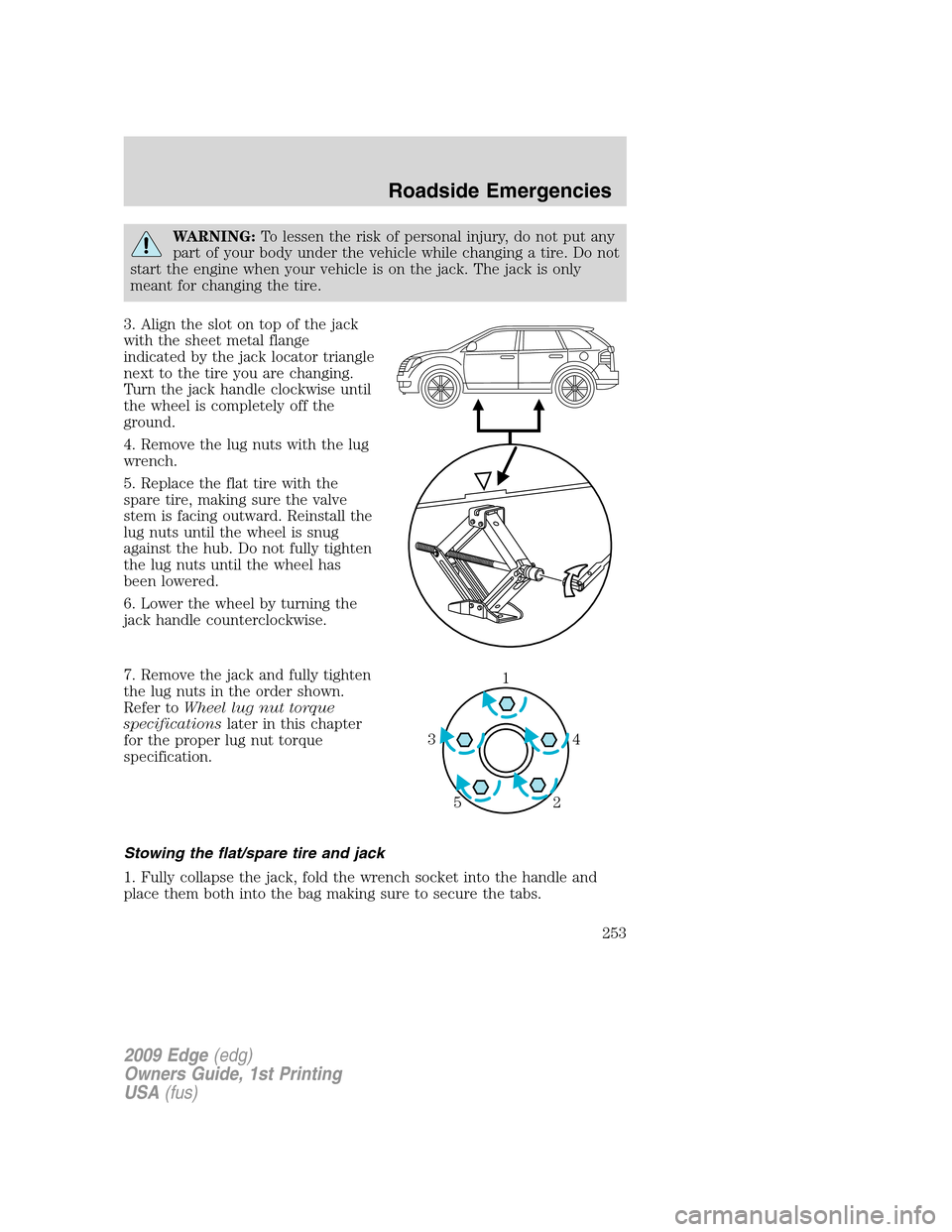
3. Align the slot on top of the jack
with the sheet metal flange
indicated by the jack locator triangle
next to the tire you are changing.
Turn the jack handle clockwise until
the wheel is completely off the
ground.
4. Remove the lug nuts with the lug
wrench.
5. Replace the flat tire with the
spare tire, making sure the valve
stem is facing outward. Reinstall the
lug nuts until the wheel is snug
against the hub. Do not fully tighten
the lug nuts until the wheel has
been lowered.
6. Lower the wheel by turning the
jack handle counterclockwise.
7. Remove the jack and fully tighten
the lug nuts in the order shown.
Refer toWheel lug nut torque
specificationslater in this chapter
for the proper lug nut torque
specification.
Stowing the flat/spare tire and jack
1. Fully collapse the jack, fold the wrench socket into the handle and
place them both into the bag making sure to secure the tabs.
1
4 3
2 5
2009 Edge(edg)
Owners Guide, 1st Printing
USA(fus)
Roadside Emergencies
253
Page 254 of 320

2. Place the jack assembly in the spare tire well aligning it with the two
vertical studs.
3. Place the tire in the spare tire well over the jack assembly.
If you are stowing a flat 22 inch tire and wheel assembly,
temporarily remove the load floor, plastic stowage bins, and the foam
load floor supports to make space for the 22 inch tire and wheel
assembly. Place the 22 inch tire & wheel assembly in the spare tire well
with the valve stem facing down. Rotate the tire until the jack assembly
is able to protrude through a wheel opening. Replace the plastic stowage
bins and foam supports around the 22 inch tire and wheel assembly and
then replace the load floor.
If you are stowing a flat tire,place the tire in the spare tire well with
the valve stem facing down. Rotate the tire until the jack assembly is
able to protrude through a wheel opening.
If you are stowing the spare tire,place the spare in the spare tire
well in its original position.
4. Secure the wheel by replacing the washer and the wing nut and
turning the wing nut clockwise.
WHEEL LUG NUT TORQUE SPECIFICATIONS
Retighten the lug nuts to the specified torque within 100 miles (160 km)
after any wheel disturbance (rotation, flat tire, wheel removal, etc.).
Lug nut socket
size/Bolt sizeWheel lug nut torque*
lb.ft. N•m
Lug nut socket size:
34
inch (19 mm) hex
Bolt size:12x20100 135
* Torque specifications are for nut and bolt threads free of dirt and
rust. Use only Ford recommended replacement fasteners.
WARNING:When a wheel is installed, always remove any
corrosion, dirt or foreign materials present on the mounting
surfaces of the wheel or the surface of the wheel hub, brake drum or
brake disc that contacts the wheel. Ensure that any fasteners that
attach the rotor to the hub are secured so they do not interfere with
the mounting surfaces of the wheel. Installing wheels without correct
metal-to-metal contact at the wheel mounting surfaces can cause the
wheel nuts to loosen and the wheel to come off while the vehicle is in
motion, resulting in loss of control.
2009 Edge(edg)
Owners Guide, 1st Printing
USA(fus)
Roadside Emergencies
254
Page 299 of 320

•Revving the engine before turning it off may reduce fuel economy.
•Using the air conditioner or defroster may reduce fuel economy.
•You may want to turn off the speed control in hilly terrain if
unnecessary shifting between the top gears occurs. Unnecessary
shifting of this type could result in reduced fuel economy.
•Warming up a vehicle on cold mornings is not required and may
reduce fuel economy.
•Resting your foot on the brake pedal while driving may reduce fuel
economy.
•Combine errands and minimize stop-and-go driving.
Maintenance
•Keep tires properly inflated and use only recommended size.
•Operating a vehicle with the wheels out of alignment will reduce fuel
economy.
•Use recommended engine oil. Refer toMaintenance product
specifications and capacitiesin this chapter.
•Perform all regularly scheduled maintenance items. Follow the
recommended maintenance schedule and owner maintenance checks
found inscheduled maintenance information.
Conditions
•Heavily loading a vehicle may reduce fuel economy at any speed.
•Carrying unnecessary weight may reduce fuel economy (approximately
1 mpg [0.4 km/L] is lost for every 400 lb [180 kg] of weight carried).
•Adding certain accessories to your vehicle (for example; bug
deflectors, rollbars/light bars, running boards, ski/luggage racks) may
reduce fuel economy.
•Using fuel blended with alcohol may lower fuel economy.
•Fuel economy may decrease with lower temperatures during the first
8–10 miles (12–16 km) of driving.
•Driving on flat terrain offers improved fuel economy as compared to
driving on hilly terrain.
•Transmissions give their best fuel economy when operated in the top
cruise gear and with steady pressure on the gas pedal.
•Close windows for high speed driving.
EPA fuel economy estimates
Every new vehicle should have a window sticker containing EPA fuel
economy estimates. Contact your authorized dealer if the window sticker
2009 Edge(edg)
Owners Guide, 1st Printing
USA(fus)
Maintenance and Specifications
299
Page 320 of 320

T
Tilt steering wheel ......................66
Tire Pressure Monitoring
System (TPMS)
Tires, Wheels and Loading ....196
Tires ...........................181–182, 248
alignment ................................189
care ..........................................185
changing ..................248, 251–252
checking the pressure ............185
inflating ...................................183
label .........................................195
replacing ..................................187
rotating ....................................189
safety practices .......................188
sidewall information ...............190
snow tires and chains ............200
spare tire .........................249, 251
terminology .............................182
tire grades ...............................182
treadwear ........................181, 186
Towing .......................................207
recreational towing .................211
trailer towing ..........................207
wrecker ....................................260
Transmission .............................226
brake-shift interlock (BSI) ....226
fluid, checking and adding
(automatic) .............................304fluid, refill capacities ..............308
lubricant specifications ..........308
Turn signal ..................................59
U
USB port ......................................42
V
Vehicle Identification Number
(VIN) ..........................................311
Vehicle loading ..........................201
Ventilating your vehicle ...........216
W
Warning lights (see Lights) .......12
Washer fluid ..............................279
Water, Driving through .............238
Windows
power .........................................70
rear wiper/washer .....................66
Windshield washer fluid and
wipers ..........................................65
checking and adding fluid .....279
replacing wiper blades ...........280
Wrecker towing .........................260
2009 Edge(edg)
Owners Guide, 1st Printing
USA(fus)
Index
320