2009 FIAT PANDA Aerial
[x] Cancel search: AerialPage 6 of 226
5KNOW YOUR
VEHICLESAFETY
CORRECT USE
OF THE CAR
WARNING LIGHTS
AND MESSAGES
IN
AN EMERGENCY
CAR
MAINTENANCE
TECHNICAL
SPECIFICATIONS
INDEX
F0Z0003m
fig. 3
THE FIAT CODE SYSTEMTo further protect your car from theft, it has been fitted
with an engine immobilising system. It is automatically acti-
vated when the ignition key is removed.
An electronic device, in fact, is fitted in each ignition key grip.
The device transmits a radio-frequency signal when the en-
gine is started through a special aerial built into the igni-
tion switch. The modulated signal, which changes each time
the engine is started, is the “password”, by means of which
the control unit recognises the key and enables to start
the engine.
OPERATION
Each time the car is started by turning the ignition key to
MAR, the Fiat CODE system control unit sends an ac-
knowledgement code to the engine management control
unit to deactivate the inhibitor.
The acknowledgement code is sent only if the Fiat CODE
system control unit has recognised the code transmitted
from the key.
Each time the ignition key is turned to STOP, the Fiat
CODE system deactivates the functions of the engine man-
agement control unit.
If the code has not been recognised correctly, the instru-
ment panel warning light
Y
turns on.
In this case, turn the key to STOP and then back to MAR;
if the lock continues, possibly try with the other keys pro-
vided with the car. If you still cannot start the engine, per-
form the emergency start procedure (see chapter “In an
emergency”) and then contact the Fiat Dealership.
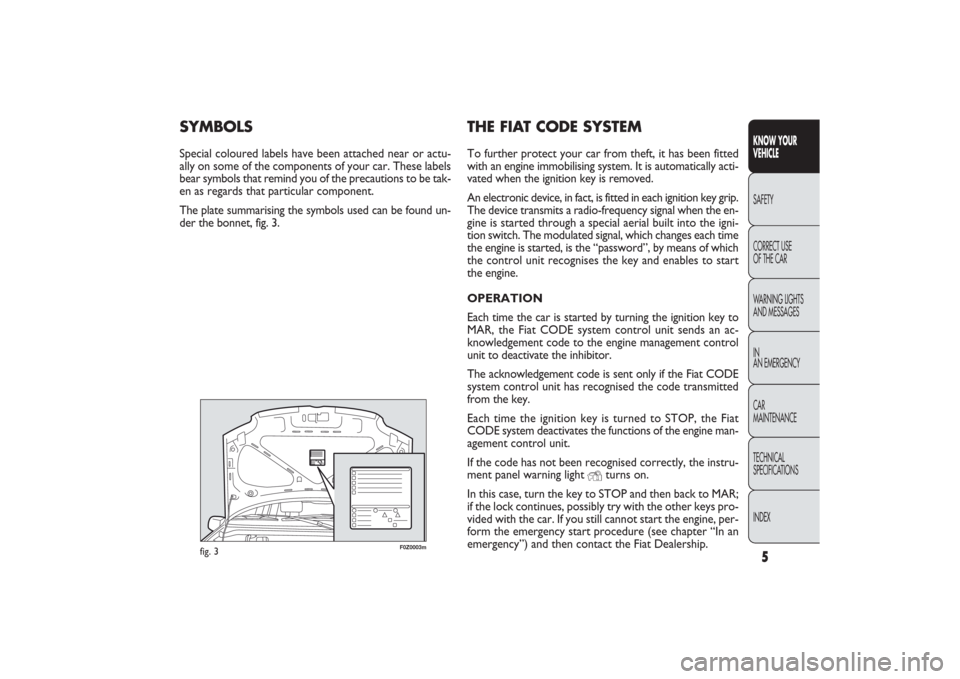
SYMBOLSSpecial coloured labels have been attached near or actu-
ally on some of the components of your car. These labels
bear symbols that remind you of the precautions to be tak-
en as regards that particular component.
The plate summarising the symbols used can be found un-
der the bonnet, fig. 3.
001-030 PANDA EN 7-10-2009 13:39 Pagina 5
Page 85 of 226

F0Z0071m
fig. 94
SOUND SYSTEMWhen the sound system has not been requested, the car
is provided with two oddment compartments on the
instrument panel.
STANDARD EQUIPMENT fig. 94
The system consists of:❒
sound system power wires;
❒
sound system compartment;
❒
housings for front and rear speakers in the doors.
Remove door panels to install the speakers. Have this
operation carried out at a Fiat Dealership.
The sound system must be fitted in the dedicated seat
inside the oddment compartment, which can beremoved
by pressing the two retaining tabs A. Here, you can find
the power supply wires.SOUND SYSTEM PRESETTING
(for versions/markets where provided)
In addition to the standard equipment the car also features:
❒
two 165 mm full range 40 W speakers in the front
doors;
❒
two 130 mm full range 350 W speakers in the rear
doors;
❒
aerial power cable;
❒
front and rear speaker power wires;
❒
sound system power wires;
❒
aerial on the car roof.
If you wish to have a sound system installed
after purchasing the car, first contact
a Fiat Dealership whose qualified person-
nel will give you advise about a sound system that
does not damage the battery charge. Excessive ab-
sorption will drain and damage the battery and may
invalidate the battery warranty.
84
KNOW YOUR
VEHICLE
SAFETY
CORRECT USE
OF THE CAR
WARNING LIGHTS
AND MESSAGES
IN
AN EMERGENCY
CAR
MAINTENANCE
TECHNICAL
SPECIFICATIONS
INDEX
065-090 PANDA EN 7-10-2009 13:45 Pagina 84
Page 86 of 226

F0Z0073m
fig. 95
With HiFi system (if requested):❒
two tweeters A – fig. 95 and two woofers B, 40 W max.
power each, on the front doors;
❒
two full range 40 W speakers, in the rear doors;
❒
a 100 W subwoofer under the right seat;
❒
aerial on the roof;
❒
sound system with CD player or sound system with CD
MP3 player (for its operation and characteristics see the
“Sound system” supplement attached to the present
Handbook). SOUND SYSTEM (for versions/markets, where
provided)
The complete system consists of:
❒
two 165 mm full range 40 W speakers in the front
doors;
❒
two 130 mm full range 350 W speakers in the rear
doors;
❒
aerial on the car roof;
❒
radio with tape-recorder or sound system with CD
player or sound system with MP3 CD player (for its op-
eration and characteristics see the “Sound system” sup-
plement attached to the present Handbook).
85KNOW YOUR
VEHICLESAFETY
CORRECT USE
OF THE CAR
WARNING LIGHTS
AND MESSAGES
IN
AN EMERGENCY
CAR
MAINTENANCE
TECHNICAL
SPECIFICATIONS
INDEX
065-090 PANDA EN 7-10-2009 13:45 Pagina 85
Page 88 of 226

RADIO TRANSMITTERS AND MOBILE
PHONES
Radio transceivers (e.g.: CB radio systems and the like)
should not be used inside the vehicle unless a separate
aerial is mounted on the roof.
IMPORTANT The use of similar devices inside the pas-
senger compartment (without an external aerial) may, in
addition to potential damage to the health of the passen-
gers, cause malfunctions in the vehicle electronic systems,
compromising the safety of the vehicle.
In addition, transmission and reception of these devices
may be affected by the shielding effect of the vehicle body.
As far as the use of EC-approved mobile phones is con-
cerned (GSM, GPRS, UMTS), follow the instructions for
use provided by the mobile phone manufacturer.
AT THE FILLING STATIONPETROL ENGINES
Use only unleaded petrol.
To avoid mistakes, the diameter of the fuel filler is too
small to introduce the bit of a leaded petrol pumps.
The petrol octane rating (RON) must not be lower than 95.
IMPORTANT An inefficient catalytic converter leads
to harmful exhaust emissions, thus contributing to air
pollution.
IMPORTANT Never use leaded petrol, even in small
amount or in an emergency, as this would damage the cat-
alytic converter beyond repair.
87KNOW YOUR
VEHICLESAFETY
CORRECT USE
OF THE CAR
WARNING LIGHTS
AND MESSAGES
IN
AN EMERGENCY
CAR
MAINTENANCE
TECHNICAL
SPECIFICATIONS
INDEX
065-090 PANDA EN 7-10-2009 13:45 Pagina 87
Page 190 of 226
189KNOW
YOUR VEHICLE
SAFETY
CORRECT USE
OF THE CAR
WARNING LIGHTS
AND MESSAGES
IN
AN EMERGENCYCAR
MAINTENANCETECHNICAL
SPECIFICATIONS
INDEX
Glasses
To clean glasses, use specific window cleaner products.
Also use clean cloths to avoid scratching the glass or dam-
aging the transparency.
IMPORTANT Wipe the rear window inside gently with
a cloth in the direction of the filaments to avoid damag-
ing the heating device.
Engine compartment
At the end of the winter the engine compartment should
be carefully washed, without directing the jet against any
electronic control unit. Have this operation performed
at a specialised workshop.
IMPORTANT The washing should take place with the en-
gine cold and the ignition key in the
STOP
position. After
the washing operation, make sure that the various pro-
tections (e.g. rubber caps and guards) have not been re-
moved or damaged.
Front headlights
IMPORTANT Never use aromatic substances (e.g.: petrol)
or ketenes (e.g.: acetone) for cleaning front headlight plas-
tic lens. To correctly wash the vehicle, proceed as follows:
❒
remove the aerial from the roof to prevent damage to
it if the car is washed in an automatic system;
❒
wash the body using a low pressure jet of water;
❒
wipe a sponge with a slightly soapy solution over the
bodywork, frequently rinsing with the sponge;
❒
rinse well with water and dry with a jet of air or
a chamois leather.
Dry the less visible parts, such as the door frames, bonnet
and the headlight frames with special care, as in these ar-
eas water may stagnate more easily. The car should not
be taken to a closed area immediately, but left outside so
that residual water can evaporate.
Do not wash the car after it has been left in the sun or
with the bonnet hot: this may alter the shine of the paint-
work.
Exterior plastic parts must be cleaned in the same way as
the rest of the car.
Where possible, do not park under trees; the resinous
substance many species release give the paint a dull ap-
pearance and increase the possibility of triggering rust
processes.
IMPORTANT Bird droppings must be washed off imme-
diately and thoroughly as the acid they contain is particu-
larly aggressive.
Detergents cause water pollution. The vehi-
cle should be washed in areas equipped for
collecting and cleaning the liquid used in the
washing process.
169-190 PANDA EN 7-10-2009 14:15 Pagina 189