2009 FIAT PANDA Starting
[x] Cancel search: StartingPage 113 of 226

112
KNOW YOUR
VEHICLE
SAFETYCORRECT USE
OF THE CARWARNING LIGHTS
AND MESSAGESI
IN
AN EMERGENCY
CAR
MAINTENANCE
TECHNICAL
SPECIFICATIONS
INDEX
If, when the ignition key is at MAR, warning light
Y
re-
mains lit together with warning light
U
turn the key to
STOP and then back to MAR; if the warning light remains
on, try with the other keys provided with the car.
If you are still unable to start the engine, perform the emer-
gency start-up procedure (see “Emergency start-up” in “In
an emergency” chapter) and contact a Fiat Dealership.
STARTING PROCEDURE FOR DIESEL
VERSIONS
Proceed as follows:
❒
engage the handbrake;
❒
put the gearshifting lever into neutral;
❒
turn the ignition key at MAR: the warning lights
m
and
Y
on the instrument panel will turn on;
❒
wait for the warning lights
Y
and
m
to turn off.
The hotter the engine is, the quicker this will happen;
❒
press the clutch pedal all the way down without touch-
ing the accelerator;
❒
turn the ignition key to AVV as soon as the warning lightm
turns off. Waiting too long will waste the work
done by the glow plugs.
Release the key as soon as the engine starts.
IMPORTANT With cold engine, the accelerator must
be entirely released when turning the ignition key to
position AVV.If the engine does not start at the first attempt, return
the ignition key to STOP before repeating starting.
If, when the ignition key is at MAR, the instrument panel
warning light
Y
remains lit, turn the key to STOP
and then back to MAR; if the warning lights remain on,
try with the other keys provided with the car.
If you still cannot start the engine, contact a Fiat Dealership.
Warning light
m
will flash for 60 seconds
after starting or during prolonged cranking
to indicate a fault to the glow plug heating
system. You can use the car as usual if the engine
starts but you should contact a Fiat Dealership as
soon as possible.
HOW TO WARM UP THE ENGINE AFTER IT
HAS JUST STARTED
Proceed as follows:❒
drive off slowly, letting the engine turn at medium speed.
Do not accelerate abruptly;
❒
do not demand maximum performance for the first few
kilometres. Wait until the engine temperature coolant
gauge starts moving.
111-122 PANDA EN 7-10-2009 15:01 Pagina 112
Page 117 of 226

116
KNOW YOUR
VEHICLE
SAFETYCORRECT USE
OF THE CARWARNING LIGHTS
AND MESSAGESI
IN
AN EMERGENCY
CAR
MAINTENANCE
TECHNICAL
SPECIFICATIONS
INDEX
clutching is absolutely pointless on modern cars and also
increases consumption and pollution.
Gear selection
As soon as the conditions of the traffic and road allow, use
a higher gear. Using a low gear for faster acceleration will
increase consumption.
In the same way improper use of a high gear increases con-
sumption, emissions an engine wear.
Top speed
Fuel consumption considerably increases with speed.
Avoiding unnecessary braking and acceleration, which cost
in terms of both fuel and emissions.
Acceleration
Accelerating violently increasing the revs will greatly af-
fect consumption and emissions: acceleration should be
gradual.
CONDITIONS OF USE
Cold starting
Short journeys and frequent cold starts will prevent the en-
gine from reaching optimal running temperature. This re-
sults in a significant increase in consumption levels (from
+15 to +30% on the urban cycle) and emission of harmful
substances. Electric devices
Use electric devices only for the amount of time needed.
Rear heated window, additional headlights, windscreen
wipers and heater fan need a considerable amount of en-
ergy, therefore a higher requirement of current involves
and increase of fuel consumption (up to +25% in the
urban cycle).
Climate control system
The climate control system is an additional load which
greatly affects the engine leading to higher consumption
(on average up to +20%): when the temperature outside
the car permits it, use the air vents where possible.
Devices for aerodynamic control
The use of non-certified devices for aerodynamic control
may adversely affect air drag and consumption levels.
DRIVING STYLE
Starting
Do not warm the engine with the car at a standstill or at
idle or high speed: under these conditions the engine
warms up much more slowly, increasing electrical con-
sumption and emissions. It is therefore advisable to move
off immediately, slowly, avoiding high speeds: in this way
the engine will warm faster.
Unnecessary actions
Avoid accelerating when starting at traffic lights or be-
fore switching off the engine. This and also double de-
111-122 PANDA EN 7-10-2009 15:01 Pagina 116
Page 126 of 226

ABS SYSTEM FAILURE (amber)Turning the ignition key to
MAR
the
warning light turns on, but it should go off
after a few seconds.
The warning light will light up when the system is either
not working or not available. Under these circumstances
the braking system will work as normal without the ex-
tra performance offered by the ABS system. Drive care-
fully and contact a Fiat Dealership as soon as possible.
On some versions the display shows the dedicated message.
125KNOW
YOUR VEHICLE
SAFETY
CORRECT USE
OF THE CARWARNING LIGHTS
AND MESSAGESIN
AN EMERGENCY
CAR
MAINTENANCE
TECHNICAL
SPECIFICATIONS
INDEX
IMPORTANT Under severe use of the car, it is advisable
to keep the engine on and slightly accelerated for a few
minutes before switching it off.
On some versions the display shows the dedicated message. ENGINE COOLANT HIGH TEMPERA-
TURE (red)
Turning the ignition key to MAR the warning light
turns on, but it should go off after a few seconds. The
warning light turns on when the engine is overheated. If
the warning light comes on when driving, proceed as fol-
lows:
❒in standard normal driving conditions: stop the car,
switch off the engine and check whether the water lev-
el in the reservoir is not below the MIN. mark. In this
case, wait for a few minutes for the engine to cool
down, then slowly and carefully open the cap, top-up
with coolant and check that the level is between the
MIN. and MAX. marks on the reservoir itself. Also
check for any fluid leaks. If, when restarting, the warn-
ing light should come on again, contact a Fiat Dealer-
ship.
❒In case of car heavy duty (e.g.: towing trailer uphill or
fully laden car): decrease speed, if the warning light stays
on, stop the car. Wait for 2 or 3 minutes with the en-
gine running and slightly accelerated to further accel-
erate the coolant circulation. Then stop the engine.
Check the correct liquid level as described above.
ç
LOW BATTERY CHARGE (red)
Turning the ignition key to
MAR
, the warning
light turns on and should go out as soon as the
engine is started (with the engine running at idle speed
a short delay in going out is allowed).
If the warning light stays on contact immediately a Fiat
Dealership.
wx
>
123-134 PANDA EN 7-10-2009 13:49 Pagina 125
Page 136 of 226
135KNOW
YOUR VEHICLE
SAFETY
WARNING LIGHTS
AND MESSAGESIN
AN EMERGENCYCAR
MAINTENANCE
TECHNICAL
SPECIFICATIONS
INDEX
IN AN EMERGENCY
STARTING THE ENGINEEMERGENCY START-UP
If the Fiat CODE system fails to deactivate engine immo-
bilising system the instrument panel warning lights
Y
and
U
stay on and the engine cannot be started.
To start the engine the emergency start-up can be per-
formed.
Read the whole procedure carefully before trying to car-
ry it out: if you make a mistake, you need to turn the ig-
nition key back to STOP and repeat the whole operation
from the beginning.
Proceed as follows:
❒
read the five-digit electronic code from the CODE card;
❒
turn the ignition key to MAR;
❒
press and hold down the accelerator pedal: the warn-
ing light
U
turns on for about 8 seconds, and then goes
off;
❒
release the accelerator pedal and count the flashes of
the warning light
U
;
❒
count the number of flashes that corresponds to the
first digit of the code on the CODE card, then press the
accelerator pedal and hold it there until the warning
light
U
comes on (for 4 seconds) and then goes off. Re-
lease the accelerator pedal;
CORRECT USE
OF THE CAR
❒
the warning light
U
will start flashing again: after it has
flashed the number of times corresponding to the
second digit on the CODE card, fully depress the ac-
celerator pedal and hold it there;
❒
do the same for the remaining digits on the CODE card;
❒
once the last digit has been entered, hold the acceler-
ator pedal pressed. The warning light
U
will light up for
four seconds and then go out. Release the accelerator
pedal;
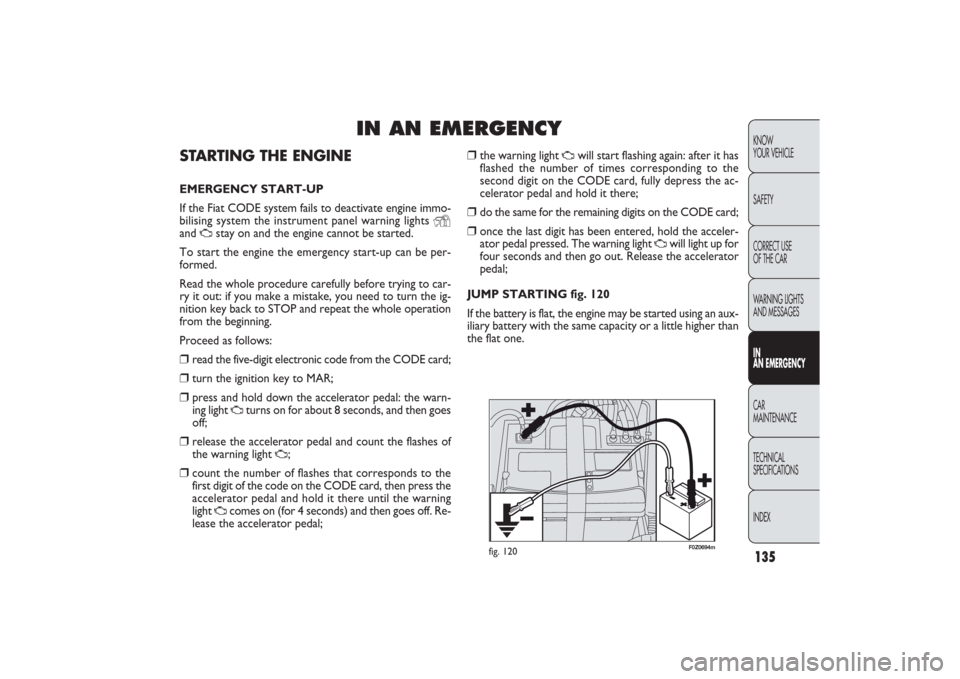
JUMP STARTING fig. 120
If the battery is flat, the engine may be started using an aux-
iliary battery with the same capacity or a little higher than
the flat one.
F0Z0694m
fig. 120
135-168 PANDA EN 7-10-2009 14:06 Pagina 135
Page 137 of 226

136KNOW
YOUR VEHICLE
SAFETY
CORRECT USE
OF THE CAR
WARNING LIGHTS
AND MESSAGES
IN
AN EMERGENCYCAR
MAINTENANCE
TECHNICAL
SPECIFICATIONS
INDEX
Never use a fast battery-charger to start the
engine as this could damage the electron-
ic systems of your car, particularly the ig-
nition and fuel supply control units.This procedure must be performed by qual-
ified personnel as incorrect actions may
cause high-intensity electrical discharge. Further-
more, battery fluid is poisonous and corrosive: avoid
contact with your skin and eyes. Keep naked flames
away from the battery. No smoking. Do not cause
sparks.
WARNING
If after a few attempts the engine does not start, do not
insist rather contact the nearest Fiat Dealership.
IMPORTANT Do not directly connect the negative ter-
minals of the two batteries: any sparks may ignite the det-
onating gas which could come out of the battery. If the aux-
iliary battery is installed on another car, prevent any contact
between metal parts of the cars and the flat battery.
BUMP STARTING
Never bump start the engine by pushing, towing or driving
downhill.
This could cause a flow of fuel into the catalytic convert-
er and damage it beyond repair.
IMPORTANT Remember that the servo-brake and elec-
trical power steering system (for versions/markets where
provided) are not operating until the engine is started, a
greater effort will therefore be required to press the brake
pedal or turn the steering wheel. Proceed as follows to start the car:
❒
connect the positive terminals (+ sign close to the ter-
minal) of both batteries using a lead;
❒
with a second lead, connect the negative terminal − of
the auxiliary battery to an earthing point
E
on the en-
gine or the gearbox of the car to be started;
❒
start the engine;
❒
when the engine has been started, follow the sequence
above in reverse order to remove the leads.
135-168 PANDA EN 7-10-2009 14:06 Pagina 136
Page 184 of 226

183KNOW
YOUR VEHICLE
SAFETY
CORRECT USE
OF THE CAR
WARNING LIGHTS
AND MESSAGES
IN
AN EMERGENCYCAR
MAINTENANCETECHNICAL
SPECIFICATIONS
INDEX
F0Z0112m
fig. 185
WHEELS AND TYRESCheck the pressure of each tyre, including the space-saver
wheel, approximately every two weeks and before long
journeys: the pressure should be checked with the tyre
rested and cold.
While driving the car, the pressure increases under stan-
dard conditions: for the correct tyre inflation pressure, see
“Wheels” in “Technical specifications” chapter.
Incorrect pressure causes abnormal tyre wear fig. 185:
A standard pressure: tread evenly worn.
B low pressure: tread particularly worn at the edges.
C high pressure: tread particularly worn in the centre.
❒
the ceiling lights must be off. The car is however pro-
vided with an automatic system for switching-off inter-
nal lights;
❒
do not keep accessories (e.g. sound system, hazard
warning lights, etc...) switched on for a long time when
the engine is not running;
❒
before performing any operation on the electric system,
disconnect the battery negative cable;
❒
battery terminals shall always be perfectly tightened.
IMPORTANT If the charge level remains for a long time
under 50%, the battery is damaged by sulphation, reduc-
ing its capacity and starting attitude.
The battery will also be more at risk of freezing (e.g. al-
ready at −10 °C). Refer to the paragraph “Car inactivity”
in “Starting and driving” if the car is left parked for a long
time.
If after buying the car, you want to install electric acces-
sories which require permanent electric supply (alarm, etc.)
or accessories influencing the electrical supply require-
ments, contact Fiat Dealership whose skilled personnel, in
addition to suggesting the most suitable devices included
in Lineaccessori Fiat, will evaluate the overall electric ab-
sorption, checking whether the car’s electric system is ca-
pable of withstanding the load required, or whether it
should be integrated with a more powerful battery.
Since these devices continue absorbing energy even when
the ignition key is off, they gradually run down the battery.
169-190 PANDA EN 7-10-2009 14:15 Pagina 183
Page 207 of 226

206
KNOW YOUR
VEHICLE
SAFETY
CORRECT USE OF
THE CAR
WARNING LIGHTS
AND MESSAGES
IN
AN EMERGENCY
CAR
MAINTENANCETECHNICAL
SPECIFICATIONS
INDEX
❒
extra-urban cycle: drive simulating the driving of the car
out of town with frequent acceleration in all gears; the
speed varies from 0 to 120 km/h;
❒
combined consumption: the weighting is around 37%
urban cycle and 63% extra-urban cycle.
IMPORTANT The type of route, traffic conditions, weath-
er conditions, driving style, general condition of the car,
trim level/equipment/accessories, use of the climate con-
trol system, vehicle load, presence of roof racks and oth-
er situations that adversely affect the aerodynamics or wind
resistance lead to different fuel consumption figures than
those measured.
FUEL CONSUMPTIONThe fuel consumption figures given in the table below are
determined on the basis of the homologation tests set
down by relevant European Directives.
The procedures below are followed for measuring con-
sumption:❒
urban cycle: cold starting followed by driving that sim-
ulates urban use of the car;
Consumption according to the European Directive in force (litres/100 km)Versions Urban Extra-urban Combined
1.1 – Actual – Active 7.0 4.8 5.6(*) Eco 6.6 4.1 5.0
1.2 – Dynamic – Emotion 7.1 4.8 5.6
(*) Eco 6.6 4.1 5.0(▲) 6.4 4.0 4.9
1.3 Multijet 70 HP
Dynamic – Emotion 5.4 3.7 4.3
1.3 Multijet 75 HP with DPFDynamic – Emotion 5.2 3.6 4.2(*) Extended ratios to reduce CO
2 emissions
(
▲) Euro 5 ECO versions
191-214 PANDA EN 7-10-2009 14:18 Pagina 206
Page 216 of 226

215KNOW
YOUR VEHICLE
SAFETY
CORRECT USE
OF THE CAR
WARNING LIGHTS
AND MESSAGES
IN
AN EMERGENCY
CAR
MAINTENANCE
TECHNICAL
SPECIFICATIONSINDEX
Baby surveillance mirror .......... 43
Battery
– battery recharging ................. 166
– battery replacement ............. 182
– servicing ................................... 181
– starting with auxiliary
battery ..................................... 135
– useful advice for extending
the life of your battery ......... 182
Beam adjustment .......................... 72
Body Computer (trip) ................. 28
Body paintwork identification
plate .............................................. 89
Bodywork marking ...................... 192
Bodywork versions ..................... 193
Bodywork
– advice for preserving
the bodywork ......................... 188
– bodywork version codes ..... 193
Bonnet
– opening/closing ................... 69-70Boot extension ......................... 67-68
Boot ................................................ 65
– boot extension ................... 67-68
– parcel shelf (removal) ........... 67
– parcel shelf lifting ................... 66
– tailgate closing ........................ 66
– tailgate opening ...................... 65
Brake fluid
– level check and top-up ......... 179
– specifications .......................... 205
Brake lights (stop)
– bulb replacement ........... 155-157
Brakes
– technical specifications ......... 196
– handbrake ............................... 113
– brake fluid (type) ................... 179
– fluid level check and top-up .. 179
Bulb replacement ......................... 149
– bulb types ................................ 150
– exterior ................................... 152
– general instructions .............. 149
ABS system .................................. 74
Accessories purchased by
the owner .................................... 86
Additional brake light
– bulb replacement ................... 157
Air bag deactivation ..................... 106
Air filter ......................................... 180
Air recirculation .................. 38-41-45
Air vent and diffusors ................. 37
Annual inspection plan ............... 172
Ashtray ........................................... 55
ASR (system) ................................ 77
ASR function ................................. 77
ASR system ................................... 77
Automatic climate control
system .......................................... 44
– controls ................................... 44
– system servicing ..................... 47
– using the climate control
system ...................................... 47
INDEX
215-224 PANDA EN 13-10-2009 11:48 Pagina 215