2009 FIAT BRAVO engine
[x] Cancel search: enginePage 54 of 246

53
SAFETY
DEVICES
CORRECT USE
OF THE CAR
WARNING
LIGHTS AND
MESSAGES
IN AN
EMERGENCY
CAR
MAINTENANCE
TECHNICAL
SPECIFICATIONS
INDEX
DASHBOARD
AND CONTROLS
ALIGNMENT OF SET
TEMPERATURES
(MONO function)
Pressing button MONO automatically
aligns the temperature on the passenger’s
side with that on the driver’s side.
Turn the knob AUTO or MONO to
raise/reduce the temperature between the
two zones by the same value.
Press again MONO to disable the func-
tion.CLIMATE CONTROL
COMPRESSOR ON/OFF
Press button
❄to switch on the climate
control compressor.
Compressor on
❒button led ❄on;
❒symbol ❄on the display, lit.
Compressor off
❒button led ❄off;
❒symbol ❄on the display, off;
❒inside air recirculation off;
❒AQS function disabled.
With the climate control compressor off,
it is not possible to admit air to the pas-
senger compartment with a temperature
below the outside temperature; in this
case symbol ò flashes on the display.
The switching off of the climate control
compressor remains in storage even when
the engine has been stopped. To restore
automatic control for switching on the cli-
mate control compressor, press button
❄or AUTO, in which case, the other man-
ual settings set will be cancelled.AIR DISTRIBUTION SELECTION
Pressing one or more buttons
Q/E/Zit
is possible to choose manually 7 of the
possible air distributions to the passenger
compartment:
QAir flow to the windscreen and
front side window vents to demist
or defrost them.
ZAir flow towards the front and
rear lower parts of the passenger
compartment. This type of distri-
bution allows heating of the pas-
senger compartment in the short-
est time.
Q
ZESplitting of the air flow between
front and rear vents, centre and
side dashboard outlets, rear out-
let, windscreen and front side win-
dow demisting vents.
EAir flow to the dashboard centre
and side outlets (passenger’s
body).
037-056 BRAVO GB:037-056 BRAVO GB 11-11-2009 10:52 Pagina 53
Page 55 of 246

54
SAFETY
DEVICES
CORRECT USE
OF THE CAR
WARNING
LIGHTS AND
MESSAGES
IN AN
EMERGENCY
CAR
MAINTENANCE
TECHNICAL
SPECIFICATIONS
INDEX
DASHBOARD
AND CONTROLS
QSplitting of the air flow between
Zfeet vents and windscreen and
front side window demisting/ de-
frosting vents. This type of air dis-
tribution allows satisfactory heat-
ing of the passenger compartment
while preventing possible misting
of the windows.
ESplitting of the air flow between
Zfeet vents (warmest air) and the
dashboard centre and side outlets
and the rear outlet (coolest air).
QSplitting of the air flow between
Ecentre and side dashboard outlets,
rear outlet and windscreen and
side window demisting/defrosting
vents. This type of air distribution
allows satisfactory ventilation of
the passenger compartment while
preventing possible misting of the
windows.IMPORTANT For operation of the cli-
mate control system, at least one of but-
tons
Q/E/Zshall be activated. Deacti-
vation of all buttons
Q/E/Zis therefore
not enabled by the system.
IMPORTANT To switch the system on
again, press button OFF; this operation re-
sets all operating conditions stored before
switching off.
To restore automatic air distribution con-
trol after a manual selection, press button
AUTO.
SUPPLEMENTARY HEATER
(for versions/markets, where provided)
This device heats up the passenger com-
partment more rapidly in cold weather
conditions with the engine coolant tem-
perature very low.
In the above climate conditions, the de-
vice comes on automatically when the en-
gine is started with at least one bar of the
fan speed indicator lit up.
The radiator is turned off automatically
when conditions of comfort are achieved.
IMPORTANT heater activation is pre-
vented if the battery voltage is too low.SWITCHING THE CLIMATE
CONTROL SYSTEM OFF
Press button OFF.
The following information is displayed:
❒writing OFF;
❒outside temperature;
❒inside air recirculation on (button led
Ton).
037-056 BRAVO GB:037-056 BRAVO GB 11-11-2009 10:52 Pagina 54
Page 57 of 246

56
SAFETY
DEVICES
CORRECT USE
OF THE CAR
WARNING
LIGHTS AND
MESSAGES
IN AN
EMERGENCY
CAR
MAINTENANCE
TECHNICAL
SPECIFICATIONS
INDEX
DASHBOARD
AND CONTROLS
AUTOMATIC HEADLIGHTS
SENSOR (daylight sensor) fig. 48
(for versions/markets, where provided)
It detects the changes of the external light
intensity of the car according to the light
sensitivity set: greater is the sensitivity,
smaller is the amount of external light nec-
essary to control the switching-on of the
exterior headlights. The daylight sensor
sensitivity can be adjusted with the “Set-
up Menu” of the instrument panel.
Activation
Turn the knurled ring to
2A: in this way,
the automatic activation of the
side/taillights and dipped beam headlights
are simultaneously enabled according to
the external luminosity.
During the sensor operation lights can on-
ly be made flashing.
Deactivation
As a result of the sensor deactivation, the
main beam headlights will switch off and,
after about 10 seconds, sidelights will
switch off too.
The light sensor is not able to detect the
fog presence, lights shall therefore be
switched on manually.
fig. 48F0Q0652m
“Cornering lights”
With low beams on at a speed of less than
40 km/h, when the steering wheel is
turned through a large angle or upon ac-
tivation of the direction indicator, a light
(incorporated in the fog lamp) will come
on to expand the angle of night-time visi-
bility on the side to which the vehicle is
turned.
“FOLLOW ME HOME”
DEVICE fig. 47
This function allows the illumination of the
space in front of the car for a preset pe-
riod of time.Activation
With the ignition key at STOPor re-
moved, pull the stalk towards the steering
wheel and operate it within 2 minutes
from when the engine is turned off.
At each single movement of the stalk, the
staying on of the lights is extended by 30
seconds up to a maximum of 210 seconds;
then the lights are switched off automati-
cally.
Each time the lever is operated, the in-
strument panel warning light
3turns
on (together with the message on the dis-
play) (see section “Warning lights and
messages”).
Deactivation
Keep the stalk pulled towards the steer-
ing wheel for more than 2 seconds.
fig. 47F0Q0651m
037-056 BRAVO GB:037-056 BRAVO GB 11-11-2009 10:52 Pagina 56
Page 60 of 246

Activation
Move the right-hand stalk downwards by
one position.
The activation of the rain sensor is sig-
nalled by a control acquisition “stroke”.
IMPORTANT Keep clean the glass in the
sensor area.
Turning the knurled ring F-fig. 49it is
possible to increase the sensitivity of the
rain sensor, obtaining a quicker change
from stationary (no wiping) when the
windscreen is dry, to first continuous
speed (continuous slow).
The increase of the sensitivity of the rain
sensor is signalled by a control and acqui-
sition “stroke”.
Operating the windscreen washer with
the rain sensor activated the normal wash-
ing cycle is performed at the end of which
the rain sensor resumes its normal auto-
matic function.Do not activate the rain sen-
sor when washing the car in
an automatic washing station.
In the event of ice on the
windscreen, make sure to have
disconnected the device.
Make sure to have discon-
nected the device when
cleaning the windscreen.
WARNING
Deactivation
Turn the ignition key to STOP.
At next engine starting (key at MAR), the
sensor will not be reactivated even is the
stalk is on B-fig. 49. In this event, to ac-
tivate the rain sensor, you have to move
the stalk to Aor Cand then again to B.
When the rain sensor is again activated in
this way, at least one windscreen wiper
stroke occurs, even if the windscreen is
dry.
59
SAFETY
DEVICES
CORRECT USE
OF THE CAR
WARNING
LIGHTS AND
MESSAGES
IN AN
EMERGENCY
CAR
MAINTENANCE
TECHNICAL
SPECIFICATIONS
INDEX
DASHBOARD
AND CONTROLS
057-082 BRAVO GB.qxd 11-11-2009 10:53 Pagina 59
Page 64 of 246
63
SAFETY
DEVICES
CORRECT USE
OF THE CAR
WARNING
LIGHTS AND
MESSAGES
IN AN
EMERGENCY
CAR
MAINTENANCE
TECHNICAL
SPECIFICATIONS
INDEX
DASHBOARD
AND CONTROLS
CEILING LIGHTS
FRONT CEILING LIGHT
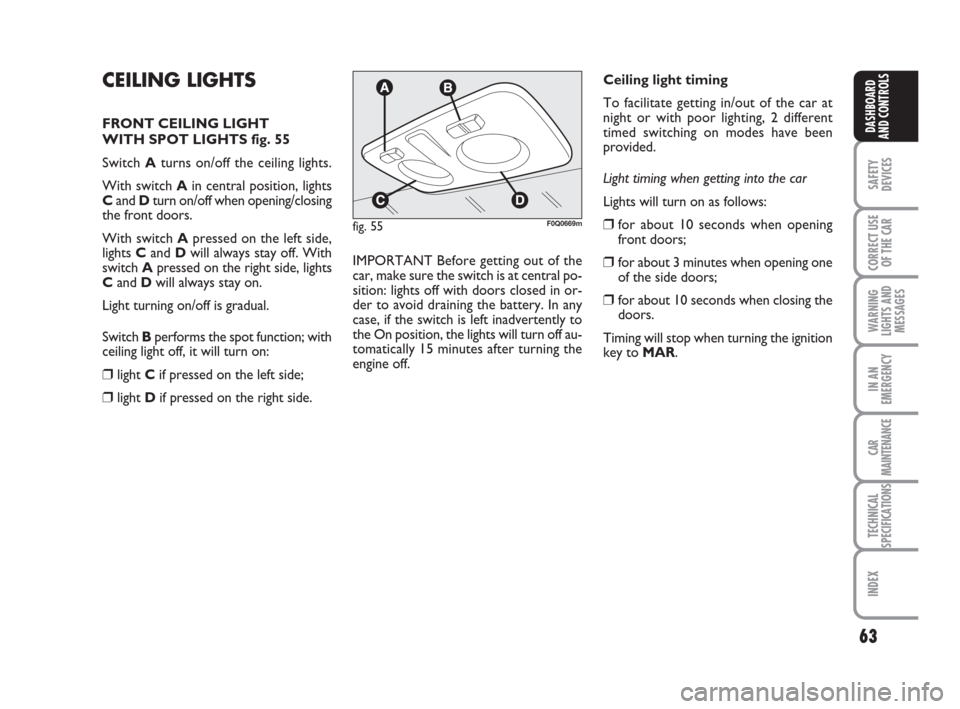
WITH SPOT LIGHTS fig. 55
Switch Aturns on/off the ceiling lights.
With switch Ain central position, lights
Cand Dturn on/off when opening/closing
the front doors.
With switch Apressed on the left side,
lights Cand Dwill always stay off. With
switch Apressed on the right side, lights
Cand Dwill always stay on.
Light turning on/off is gradual.
Switch Bperforms the spot function; with
ceiling light off, it will turn on:
❒light Cif pressed on the left side;
❒light Dif pressed on the right side.IMPORTANT Before getting out of the
car, make sure the switch is at central po-
sition: lights off with doors closed in or-
der to avoid draining the battery. In any
case, if the switch is left inadvertently to
the On position, the lights will turn off au-
tomatically 15 minutes after turning the
engine off.Ceiling light timing
To facilitate getting in/out of the car at
night or with poor lighting, 2 different
timed switching on modes have been
provided.
Light timing when getting into the car
Lights will turn on as follows:
❒for about 10 seconds when opening
front doors;
❒for about 3 minutes when opening one
of the side doors;
❒for about 10 seconds when closing the
doors.
Timing will stop when turning the ignition
key to MAR.
fig. 55F0Q0669m
057-082 BRAVO GB.qxd 11-11-2009 10:53 Pagina 63
Page 67 of 246

66
SAFETY
DEVICES
CORRECT USE
OF THE CAR
WARNING
LIGHTS AND
MESSAGES
IN AN
EMERGENCY
CAR
MAINTENANCE
TECHNICAL
SPECIFICATIONS
INDEX
DASHBOARD
AND CONTROLS
FUEL CUT-OFF SWITCH fig. 60
(as an alternative to the fuel cut off
system, for versions/markets where
provided)
It is located next to the passenger’s door
post, at the bottom, and comes into op-
eration in the case of a crash:
❒cutting off fuel and switching off the
engine;
❒automatically unlocking the doors;
❒switching on interior lights (for about
15 minutes).
When the switch comes into operation,
the instrument panel warning light èor
symbol °will turn on (together with the
message on the display) (see section
“Warning lights and messages”).
Carefully inspect the car to find fuel leaks,
e.g. in the engine compartment, under the
car or near the tank.
fig. 60F0Q0638mIf, after a crash, you smell fu-
el or see leaks from the fuel
system, do not reset the switch to
avoid fire risk.
WARNING
If, after a crash, you smell fu-
el or notice leaks from the
fuel system, do not reset the system
to avoid fire risk.
WARNING
If no fuel leaks are found and the car can
be started again, press button Ato reset
the fuel system and the lights.
After a crash, remember to turn the igni-
tion key to STOPto prevent battery run-
down.
FUEL CUT-OFF SYSTEM
(as an alternative to the fuel cut off
switch, for versions/markets where
provided)
This system intervenes in the event of a
collision, activating:
❒cut off of fuel supply with resultant en-
gine shut down;
❒automatic door lock release;
❒activation of all lights inside the car.
The intervention of the system is indicat-
ed by a message shown on the display.
Carefully check the car for fuel leaks, for
instance in the engine compartment, un-
der the car or near the tank area.Following a collision, turn the ignition key
to STOPto avoid draining the battery.
To reset car operation, follow this pro-
cedure:
❒turn the ignition key to MAR;
❒activate the right-hand indicator;
❒deactivate the right-hand indicator;
❒activate the left-hand indicator;
❒deactivate the left-hand indicator;
❒activate the right-hand indicator;
❒deactivate the right-hand indicator;
❒activate the left-hand indicator;
❒deactivate the left-hand indicator;
❒turn the ignition key to STOP.
057-082 BRAVO GB.qxd 17-11-2009 15:46 Pagina 66
Page 84 of 246

83
SAFETY
DEVICES
CORRECT USE
OF THE CAR
WARNING
LIGHTS AND
MESSAGES
IN AN
EMERGENCY
CAR
MAINTENANCE
TECHNICAL
SPECIFICATIONS
INDEX
DASHBOARD
AND CONTROLS
BONNET
TO OPEN THE BONNET
Proceed as follows:
❒pull lever A-fig. 96in the direction of
the arrow;
❒pull lever B-fig. 97and raise the bon-
net.
❒lift the bonnet and at the same time re-
lease the rod C-fig. 98from the catch,
then fit the rod end into the bonnet re-
cess D.
IMPORTANT Before opening the bonnet,
check that windscreen wiper arms are not
lifted from the windscreen.TO CLOSE THE BONNET
Proceed as follows:
❒hold the bonnet up with one hand and
with the other remove rod C-fig. 98
from recess Dand fit it back into its
catch;
❒lower the bonnet at approx. 20 cen-
timetres from the engine compartment
and then let it drop, ensuring that it is
fully closed and not just held in position
by the safety catch. If the bonnet does
not close properly, do not push it down
but open it again and repeat the above
procedure. If the bonnet is not shut
properly, the instrument panel warning
light ´or symbol Swill turn on to-
gether with the message on the display
(see section “Warning lights and mes-
sages”).
fig. 96F0Q0689mfig. 97
B
F0Q0690m
fig. 98F0Q0748m
083-104 BRAVO GB:083-104 BRAVO GB 11-11-2009 10:53 Pagina 83
Page 89 of 246

88
SAFETY
DEVICES
CORRECT USE
OF THE CAR
WARNING
LIGHTS AND
MESSAGES
IN AN
EMERGENCY
CAR
MAINTENANCE
TECHNICAL
SPECIFICATIONS
INDEX
DASHBOARD
AND CONTROLS
ESP SYSTEM
(Electronic Stability
Program)
(for versions/markets, where
provided)
The ESP system is an electronic system
controlling the car stability in the event of
tyre grip loss.
The ESP system is therefore particularly
useful when grip conditions of the road
surfaces changes.
With ESP, ASR and Hill Holder systems
is also installed (for versions/markets,
where provided) the MSR system (engine
brake torque control system).
ESP SYSTEM INTERVENTION
It is signalled by the blinking of the warn-
ing light
áon the instrument panel, to in-
form the driver that the car is in critical
stability and grip conditions.HILL HOLDER SYSTEM
This system is an integral part of the ESP
system and it is provided to facilitate start-
ing on slopes.
It will activate automatically with the fol-
lowing conditions:
❒Uphill: car at a standstill on a road with
a gradient higher than 5%, engine run-
ning, clutch and brake pedal pressed,
gearbox to neutral or engaged gear oth-
er than reverse.
❒Downhill: car at a standstill on a road
with a gradient higher than 5%, engine
running, clutch and brake pedal pressed
and reverse gear engaged.
At pickup the ESP system control unit will
keep brake force on wheels until reaching
the torque suitable for starting, or in any
case for max. 2 seconds in order to pass
easily from the brake pedal to the accel-
erator pedal.
After two seconds without starting, the
system will deactivate automatically by re-
leasing gradually the brake force.
At releasing, the typical brake disengage-
ment noise indicating that the car is go-
ing to move will be heard.
Performance of the ESP sys-
tem, in terms of active safe-
ty should not induce the driver to take
pointless and unnecessary risks. The
style of driving must in any case al-
ways be adapted to the conditions of
the road surface, visibility an traffic.
Road safety is always the driver’s re-
sponsibility.
WARNING
ESP SYSTEM ACTIVATION
The ESP system is automatically activat-
ed when the car is started and cannot be
de-activated.
FAILURE INDICATIONS
In the event of failure, the ESP system is
automatically disconnected and the warn-
ing light
ácomes on with fixed light on
the instrument panel (on certain versions
together with the message on the display)
(see section “Warning lights and mes-
sages”). In this case contact a Fiat Deal-
ership as soon as possible.
083-104 BRAVO GB:083-104 BRAVO GB 11-11-2009 10:53 Pagina 88