2009 DODGE VIPER ECO mode
[x] Cancel search: ECO modePage 131 of 299

Operating Tips
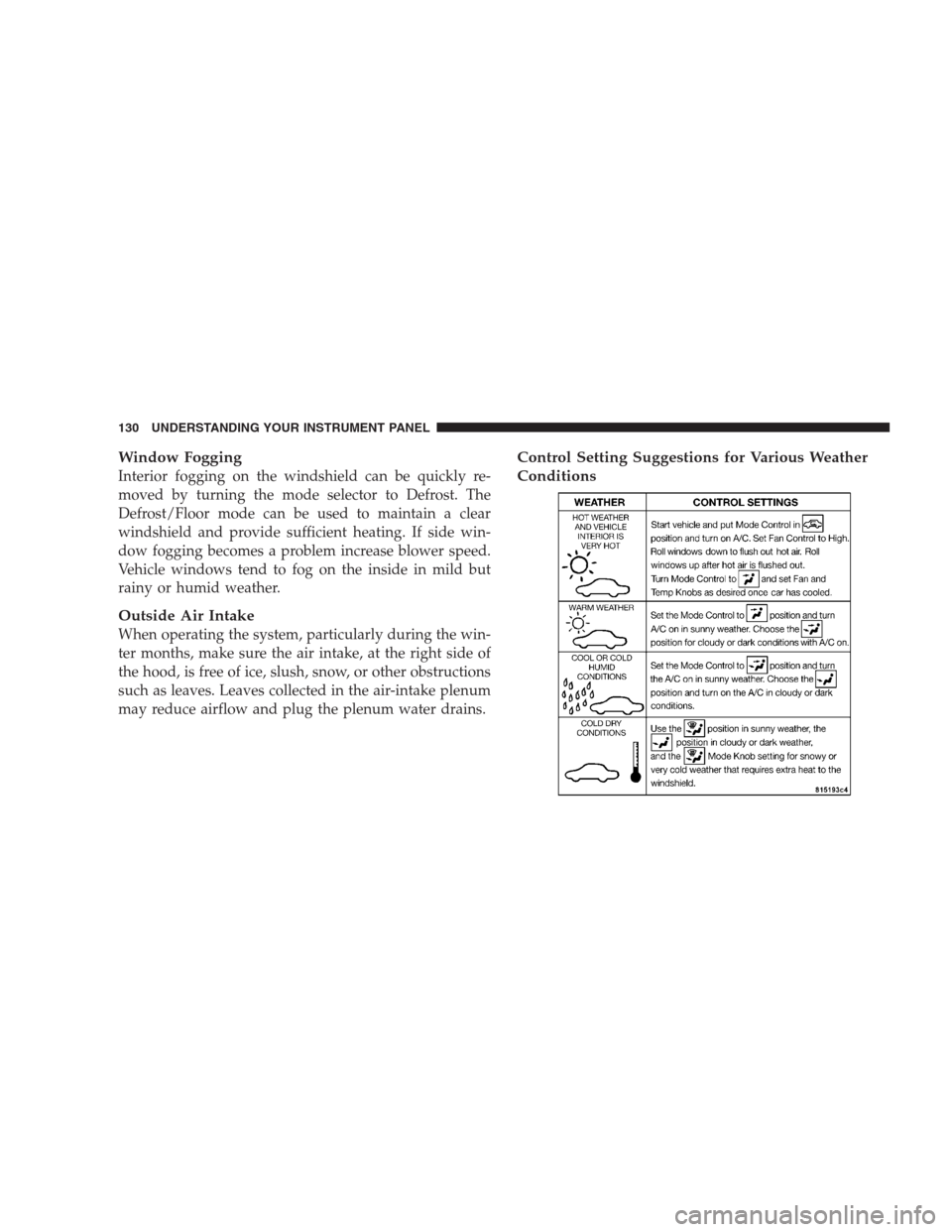
NOTE:Refer to the chart at the end of this section for
suggested control settings for various weather condi-
tions.
Summer Operation
The engine cooling system in air-conditioned vehicles
must be protected with a high-quality antifreeze coolant
to provide proper corrosion protection and to protect
against engine overheating. A 50% solution of ethylene
glycol antifreeze coolant in water is recommended. Refer
to “Maintenance Procedures” in Section 7 of this manual
for proper coolant selection.
Winter Operation
•
Use the Defrost mode to direct cold air away from the
occupants during engine warm-up in cold weather.
•The blower air will heat faster in cold weather if you
use only the low blower speeds for the first ten
minutes of vehicle operation.
•Use of the air Recirculation mode during winter
months is not recommended because it may cause
window fogging.
Vacation Storage
Anytime you store your vehicle, or keep it out of service
(i.e., vacation) for two weeks or more, run the air
conditioning system at idle for about five minutes in the
fresh air and high blower setting. This will insure ad-
equate system lubrication to minimize the possibility of
compressor damage when the system is started again.
UNDERSTANDING YOUR INSTRUMENT PANEL 129
4
Page 132 of 299
Window Fogging
Interior fogging on the windshield can be quickly re-
moved by turning the mode selector to Defrost. The
Defrost/Floor mode can be used to maintain a clear
windshield and provide sufficient heating. If side win-
dow fogging becomes a problem increase blower speed.
Vehicle windows tend to fog on the inside in mild but
rainy or humid weather.
Outside Air Intake
When operating the system, particularly during the win-
ter months, make sure the air intake, at the right side of
the hood, is free of ice, slush, snow, or other obstructions
such as leaves. Leaves collected in the air-intake plenum
may reduce airflow and plug the plenum water drains.
Control Setting Suggestions for Various Weather
Conditions
130 UNDERSTANDING YOUR INSTRUMENT PANEL
Page 174 of 299

Problems that result from using methanol/gasoline or
E85 Ethanol blends are not the responsibility of the
manufacturer. While MTBE is an oxygenate made from
Methanol, it does not have the negative effects of
Methanol.
E-85 Usage In Non-Flex Fuel Vehicles
Non-FFV vehicles are compatible with gasoline contain-
ing 10% ethanol (E10). Gasoline with higher ethanol
content may void the vehicle’s warranty.
If a Non-FFV vehicle is inadvertently fueled with E-85
fuel, the engine will have some or all of these symptoms:
•operate in a lean mode
•OBD II “Malfunction Indicator Light” on
•poor engine performance
•poor cold start and cold drivability
•increased risk for fuel system component corrosionTo fix a Non-FFV vehicle inadvertently fueled once with
E-85 perform the following:
•drain the fuel tank (see your authorized dealer)
•change the engine oil and oil filter
•disconnect and reconnect the battery to reset the
engine controller memory
More extensive repairs will be required for prolonged
exposure to E-85 fuel.
MMT In Gasoline
MMT is a manganese containing metallic additive that is
blended into some gasoline to increase the octane num-
ber. Gasolines blended with MMT offer no performance
advantage beyond gasolines of the same octane number
without MMT. Gasolines blended with MMT have shown
to reduce spark plug life and reduce emission system
performance in some vehicles. The manufacturer recom-
mends using gasolines without MMT. Since the MMT
172 STARTING AND OPERATING
Page 189 of 299

5. Remove the cap from the valve stem and then screw
the fitting at the end of the Sealant Hose 7 onto the valve
stem.
6. Uncoil the Power Plug and Cable 5 and then insert the
plug into the vehicle’s power outlet.
NOTE:Do not remove foreign objects (e.g., screws or
nails) from the tire.
C. Injecting TIREFIT Sealant into the Deflated Tire
1. Always start the engine before turning ON the TIRE-
FIT kit.
2. After pressing the AIR PUMP POWER
button 3, the air pump should start to inflate
the tire and the sealant (white fluid) will flow
from the Sealant Bottle 1 through the Sealant
Hose 7 and into the tire.NOTE:Some sealant may leak
out through the puncture in the tire.3.If the sealant Does Not Flow Through the Clear
Sealant Hose 7
•Press the AIR PUMP POWER button 3 to turn OFF
the TIREFIT kit. Disconnect the Clear Sealant Hose 7
from the valve stem. Make sure the valve stem is
free of debris. Reconnect the Clear Sealant Hose 7 to
the valve stem. Press the AIR PUMP POWER button
3 to turn ON the TIREFIT kit.
•Turn the Mode Select knob to the Sealant/Air Mode.
•Connect the Power Plug 5 to a different power
outlet in your vehicle or another vehicle, if available.
Make sure the engine is running before turning ON
the TIREFIT kit.
•The Sealant Bottle 1 may be empty due to previous
use. Call for assistance.
WHAT TO DO IN EMERGENCIES 187
6
Page 212 of 299

Battery Save Feature
The Battery Save feature conserves battery power when
storing the vehicle. It allows for up to three months of
storage time without losing radio and engine controller
memory. Using this feature is an alternative to discon-
necting the battery.
NOTE:This vehicle is designed to sit in storage with a
fully charged battery for up to 30 days. If you plan to
store the vehicle longer than 30 days, we recommend
doing one of the following:
•Disconnect the battery.
•Use the battery charger.
•Put the vehicle into Battery Save mode (3-month charge).
To Activate the Battery Save Feature
1. Insert the key into the ignition switch.2. Cycle the ignition switch from OFF/LOCK to ACC
four times. Leave the switch in the OFF/LOCK position
after the fourth cycle.
3. Push the driver’s POWER DOOR LOCK switch in the
UP direction. A single chime will sound and the horn will
chirp to indicate that the process has begun.
4. Remove the key from the ignition switch and exit the
vehicle. The Battery Save Feature will be enabled 45 sec-
onds after all doors are closed.
NOTE:
•Turning the ignition switch to the ON/RUN position
at any time will cancel activation of the Battery Save
Feature.
•The Remote Keyless Entry (RKE) and the exterior
passenger door handle will not work when the Battery
Save feature is enabled. Enter the vehicle by using the
key to unlock the door manually and by using the
exterior driver door handle to open the door.
210 MAINTAINING YOUR VEHICLE
Page 239 of 299

LIGHT BULBS — Exterior
(Coupe Models) Bulb Number
Low/High Beam High Intensity Discharge
(HID) Headlight.... Serviced at authorized dealer only
Auxiliary High Beam Headlight......(HB3A) 9005XS
Front Park/Turn Signal Light.............3157AK
Fog Light.......................(H10 U) 9145
Front Side Marker Light..................2886X
Center High Mounted Stop Light (CHMSL). . . 16 LED
(not serviceable)
Tail/Stop/Turn Signal Light................3157
Rear Marker Light........................ 194
Backup Light...........................3157
License Light........................... 168
NOTE:Upon turning the High Intensity Discharge
(HID) Headlights on, there is a blue hue to the lamps.
This diminishes and becomes more white after approxi-
mately 10 seconds as the system charges.BULB REPLACEMENT
Auxiliary High Beam Headlight, Front Park/Turn
Signal Light, Front Side Marker Light
1. Remove the push pin from the upper outer corner of
the splash shield and remove the splash shield.
MAINTAINING YOUR VEHICLE 237
7
Page 297 of 299

INTRODUCTION INTRODUCTION HOW TO USE THIS MANUAL WARNINGS AND CAUTIONS VEHICLE IDENTIFICATION NUMBER VEHICLE MODIFICATIONS/ALTERATIONS THINGS TO KNOW BEFORE STARTING YOUR VEHICLE A WORD ABOUT YOUR KEYS
Ignition Key RemovalKey-In-Ignition ReminderVEHICLE SECURITY ALARM SYSTEM Rearming of the SystemTo Arm the SystemTo Disarm the SystemElectronicImmobilization System - Canada OnlyILLUMINATED ENTRY SYSTEM REMOTE KEYLESS ENTRY (RKE)
To Unlock the DoorsTo Lock the DoorsTo Unlatch the Trunk/LiftgateUsing The Panic AlarmProgramming Additional TransmittersBattery ReplacementGeneral InformationDOOR LOCKS Manual Door LockPower Door LocksWINDOWS Power WindowsAuto Down Feature
Wind BuffetingLIFTGATE - COUPE MODELS ONLY TRUNK LOCK AND RELEASE - CONVERTIBLE MODELS ONLY TRUNK SAFETY WARNING - CONVERTIBLE MODELS ONLY Trunk Emergency ReleaseOCCUPANT RESTRAINTS Lap/Shoulder BeltsLap/Shoulder
Belt Untwisting ProcedureEnhanced Seat Belt Reminder System (BeltAlert) Automatic Locking ModeSeat Belts and Pregnant WomenSeat Belt ExtenderDriver and Passenger Supplemental Restraint System (SRS) - AirbagChild RestraintBREAK-IN RECOMMENDATIONS
SAFETY TIPS Exhaust SystemSafety Checks You Should Make Inside the VehiclePeriodic Safety Checks You Should Make Outside The VehicleUNDERSTANDINGTHE FEATURES OF YOUR VEHICLE CONVERTIBLE TOP OPERATION - IF EQUIPPED To Lower the
TopTo Raise the TopConvertible Top Boot Cover Installation - If EquippedConvertible Top Boot Cover Removal and StorageMIRRORS Inside Day/Night MirrorOutside MirrorsPower MirrorsSEATS Manual Seat AdjustmentsTO OPEN AND CLOSE THE HOOD LIGHTS Exterior
and Interior Lighting ControlHeadlights and Parking LightsHeadlight Time DelayDaytime Running LightsLights-On ReminderBattery Saver Feature -Exterior LightsFog LightsTurn Signals High Beam/Low Beam Select SwitchFlash-to-PassInterior LightsWINDSHIELD WIPERS
AND WASHERS Intermittent Wiper SystemMist FeatureWindshield WashersTILT STEERING COLUMN ADJUSTABLE PEDALS Adjustable Foot RestCONSOLE FEATURES REAR WINDOW FEATURES Electric Rear Window DefrosterUNDERSTANDING YOUR
INSTRUMENT PANEL INSTRUMENT PANEL FEATURES INSTRUMENT CLUSTER DESCRIPTION SpeedometerMessage CenterGauges and Indicator LightsSETTING THE DIGITAL CLOCK Clock Setting ProcedureSALES CODE RAH - AM AND FM STEREO RADIO
WITH CD PLAYER AND CD/DVD CHANGER CONTROLS Radio OperationCD Player OperationCD/DVD Changer OperationNotes On Playing MP3 FilesOperation Instructions - (CD Mode For MP3 Audio Play)SATELLITE RADIO - IF EQUIPPED System ActivationElectronic
Serial Number/Sirius Identification Number (ENS/SID)Selecting Satellite Mode in RBB, RAH, REV and RBK RadiosSelecting Satellite Mode in RBP, RBU,RAZ, RB1 and RBQ RadiosSelecting a ChannelStoring and Selecting Pre-Set ChannelsUsing the PTY (Program Type)
Button (If Equipped)PTY (SCAN) ButtonPTY (SEEK) ButtonSatellite AntennaReception QualityRADIO ANTENNA CD/DVD MAINTENANCE RADIO OPERATION AND CELLULAR PHONES CLIMATE CONTROLS Air Conditioning and Heating System Operating Tips
STARTING AND OPERATING STARTING PROCEDURES Normal StartingIf Engine Fails to StartAfter StartingMANUAL TRANSMISSION Recommended Shift SpeedsSkip Shift Indicator LightDRIVING ON SLIPPERY SURFACES AccelerationTraction DRIVING THROUGH
WATER Flowing/Rising WaterShallow Standing WaterPOWER STEERING Power Steering Fluid CheckPARKING BRAKE BRAKE SYSTEM Brake Pad Break-InAnti-Lock Brake SystemTIRE SAFETY INFORMATION Tire Markings Tire Identification Number (TIN)Tire Loading
and Tire PressureTIRES - GENERAL INFORMATION Tire PressureTire Inflation PressuresTire Pressures for High Speed OperationRadial Ply TiresTire SpinningTread Wear IndicatorsLife of TireReplacement TiresTire StorageTIRE CHAINS SNOW TIRES TIRE ROTATION
RECOMMENDATIONS TIRE PRESSURE MONITOR SYSTEM (TPMS) Low Tire IndicatorFUEL REQUIREMENTS 8.4L EngineReformulated GasolineGasoline/Oxygenate BlendsE-85 Usage In Non-Flex Fuel VehiclesMMT In GasolineMaterials Added to FuelFuel System
CautionsCarbon Monoxide WarningsADDING FUEL Fuel Filler Cap (Gas Cap)TRAILER TOWING RECREATIONAL TOWING (BEHIND MOTORHOME, ETC.) Towing This Vehicle Behind Another Vehicle (Flat towing with all four wheels on the ground)GROUND CLEARANCE
WHAT TO DO IN EMERGENCIES HAZARD WARNING FLASHER IF YOUR ENGINE OVERHEATS TIREFIT KIT TIREFIT StorageTIREFIT Usage PrecautionsTIREFIT Kit Components and Operation Sealing a Tire with TIREFITJUMP-STARTING PROCEDURES FREEING
A STUCK VEHICLE TOWING A DISABLED VEHICLE MAINTAINING YOUR VEHICLE ENGINE COMPARTMENT - 8.4L ONBOARD DIAGNOSTIC SYSTEM (OBD II) EMISSIONS INSPECTION AND MAINTENANCE PROGRAMS REPLACEMENT PARTS DEALER
SERVICE MAINTENANCE PROCEDURES Engine OilEngine Oil FilterEngine Air Cleaner FilterMaintenance-Free BatteryBattery Save FeatureAir Conditioner MaintenanceBody LubricationWindshield Wiper BladesAdding Washer FluidExhaust SystemCooling SystemBrake
SystemManual TransmissionHydraulic ClutchRear AxleAppearance Care And Protection From CorrosionFUSES Power Distribution CenterMini-Power Distribution CenterVEHICLE STORAGE REPLACEMENT BULBS BULB REPLACEMENT Auxiliary High Beam Headlight,
Front Park/Turn Signal Light, Front Side Marker LightHigh Intensity Discharge Headlights (HID)Front Fog LightTaillight, Tail/Stop Light, Rear Marker LightTaillight, Tail/Stop Light, Rear Marker Light (Coupe Models)Backup Light, Rear Turn Signal LightLicense LightFLUIDS
AND CAPACITIES FLUIDS, LUBRICANTS, AND GENUINE PARTS EngineChassisMAINTENANCE SCHEDULES EMISSIONS CONTROL SYSTEM MAINTENANCE MAINTENANCE SCHEDULES MAINTENANCE SCHEDULE BMAINTENANCE SCHEDULE AIF YOU
NEED CONSUMER ASSISTANCE SUGGESTIONS FOR OBTAINING SERVICE FOR YOUR VEHICLE Prepare For The AppointmentPrepare A ListBe Reasonable With RequestsIF YOU NEED ASSISTANCE Chrysler LLC Customer CenterChrysler Canada Inc. Customer
CenterIn Mexico contactCustomer Assistance For The Hearing Or Speech Impaired (TDD/TTY)Service ContractWARRANTY INFORMATION (U.S. Vehicles Only) MOPAR PARTS REPORTING SAFETY DEFECTS In The 50 United States And Washington, D.CIn Canada
PUBLICATION ORDER FORMS DEPARTMENT OF TRANSPORTATION UNIFORM TIRE QUALITY GRADES TreadwearTraction GradesTemperature GradesINDEX