Page 170 of 299

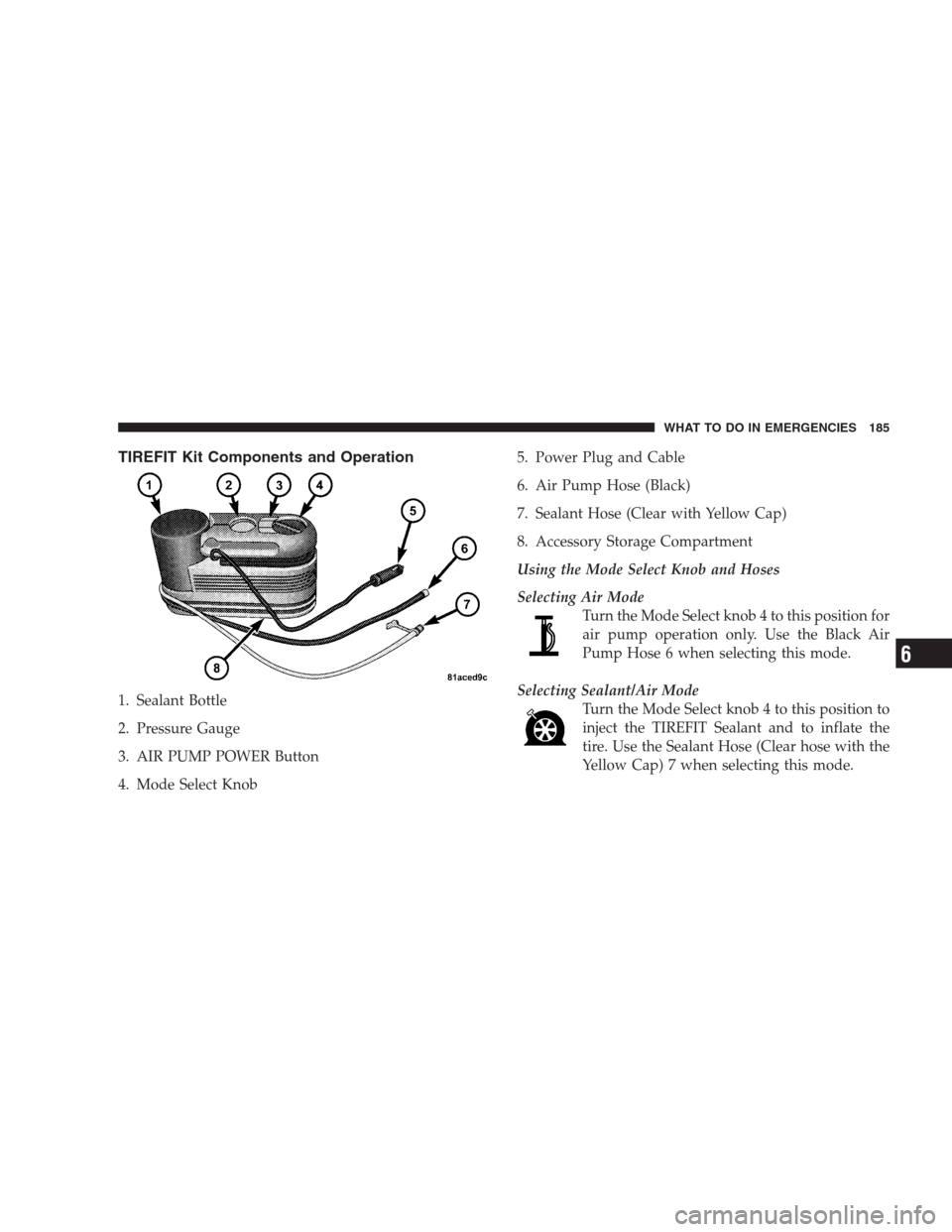
Rotate the tires “side-to-side” as shown in the diagram.
These effects can be reduced by timely rotation of tires.
The benefits of rotation are especially worthwhile with
aggressive tread designs such as those on all season type
tires. Rotation will increase tread life, help to maintain
mud, snow, and wet traction levels, and contribute to a
smooth, quiet ride.Refer to the “Maintenance Schedules” in Section 8 for the
recommended tire rotation frequency for your type of
driving. Remember, more frequent rotation is permissible
if desired. Also, correct for anything causing rapid or
unusual wear prior to performing the tire rotation.
NOTE:Each wheel on your vehicle contains a tire
pressure sensor. The Tire Pressure Monitor System
(TPMS) learns the location of each sensor though system
programming. Although not required, the manufacturer
recommends reprogramming the TPMS after rotating the
tires so that the system can relearn each sensor ’s location.
See your authorized dealer for system reprogramming.
168 STARTING AND OPERATING
Page 171 of 299

TIRE PRESSURE MONITOR SYSTEM (TPMS)
Low Tire Indicator
If tire pressure falls below 23 psi (159 kpa), the Low Tire
Pressure Telltale in the Message Center will illuminate, a
chime will sound, and the words LOW TIRE will flash
slowly in the Liquid Crystal Display (LCD) panel in the
bottom of the speedometer. If tire pressure falls below
18 psi (124 kpa), the Low Tire Pressure Telltale will
illuminate, a chime will sound, and the words “FLAT
TIRE” will flash rapidly in the display. You should obtain
immediate service if the low tire indicator is activated.
NOTE:Each wheel on your vehicle contains a tire
pressure sensor. The TPMS learns the location of each
sensor though system programming. Although not re-
quired, the manufacturer recommends reprogramming
the TPMS after rotating the tires so that the system can
relearn each sensor ’s location. See your authorized dealer
for system reprogramming.
CAUTION!
The Tire Pressure Monitor System (TPMS) has been
optimized for the original equipment tires and
wheels. The TPMS pressures have been established
for the tire size equipped on your vehicle. Undesir-
able operation or sensor damage may result when
using replacement equipment that is not of the same
size, type, and/or style. Aftermarket wheels can cause
sensor damage. Do not use aftermarket tire sealants
or balance beads if your vehicle is equipped with the
TPMS, as damage to the sensors may result.
WARNING!
Do not exceed 55 mph (88 km/h) if the LOW Tire
indicator is activated. Vehicle handling and braking
may be reduced. You could have an accident and be
severely or fatally injured.
STARTING AND OPERATING 169
5
Page 172 of 299

TPMS Malfunction Warning
Your vehicle has also been equipped with a TPMS
malfunction indicator to indicate when the system is not
operating properly. The TPMS malfunction indicator is
combined with the low tire pressure telltale.
When the system detects a malfunction, the telltale will
flash for approximately one minute and then remain
continuously illuminated. This sequence will continue
upon subsequent vehicle start-ups as long as the mal-
function exists. When the malfunction indicator is illumi-
nated, the system may not be able to detect or signal low
tire pressure as intended.
TPMS malfunctions may occur for a variety of reasons,
including the installation of replacement or alternate tires
or wheels on the vehicle that prevent the TPMS from
functioning properly. Always check the TPMS malfunc-
tion telltale after replacing one or more tires or wheels onyour vehicle to ensure that the replacement or alternate
tires and wheels allow the TPMS to continue to function
properly.
FUEL REQUIREMENTS
8.4L Engine
The 8.4L engine is designed to meet all
emissions regulations and provide excel-
lent fuel economy and performance when
using high-quality premium unleaded
gasoline with an octane rating of 91 or
higher.
Light spark knock at low engine speeds is not harmful to
your engine. However, continued heavy spark knock at
high speeds can cause damage and immediate service is
required.
170 STARTING AND OPERATING
Page 185 of 299
only the Black Air Pump Hose 6 and make sure the
Mode Select Knob 4 is in the Air Mode when inflating
such items to avoid injecting sealant into them. The
TIREFIT Sealant is only intended to seal small punc-
tures in the tire tread of a tire on this vehicle.
WARNING!
•Do not attempt to seal a tire on the side of the
vehicle close to traffic. Pull far enough off the road
to avoid the danger of being hit when using the
TIREFIT kit.
•Do not use TIREFIT or drive the vehicle under the
following circumstances:
If the cut or puncture in the tire tread is approxi-
mately 0.24 in (6 mm) or larger.
If the tire has any sidewall damage.
(Continued)
WARNING! (Continued)
If the tire has any damage from driving with
extremely low tire pressure.
If the tire has any damage from driving on a flat
tire.
If the wheel has any damage.
If you are unsure of the condition of the tire or the
wheel.
•Keep TIREFIT away from open flame or heat source.
•TIREFIT is not a permanent flat tire repair. Have
the tire inspected and repaired or replaced after
using TIREFIT. Do not exceed 55 mph (90 km/h)
until having the tire repaired or replaced.
•A loose TIREFIT kit thrown forward in a collision
or hard stop could endanger the occupants of the
vehicle. Always stow the TIREFIT kit in the place
provided.
(Continued)
WHAT TO DO IN EMERGENCIES 183
6
Page 187 of 299
TIREFIT Kit Components and Operation
1. Sealant Bottle
2. Pressure Gauge
3. AIR PUMP POWER Button
4. Mode Select Knob5. Power Plug and Cable
6. Air Pump Hose (Black)
7. Sealant Hose (Clear with Yellow Cap)
8. Accessory Storage Compartment
Using the Mode Select Knob and Hoses
Selecting Air Mode
Turn the Mode Select knob 4 to this position for
air pump operation only. Use the Black Air
Pump Hose 6 when selecting this mode.
Selecting Sealant/Air Mode
Turn the Mode Select knob 4 to this position to
inject the TIREFIT Sealant and to inflate the
tire. Use the Sealant Hose (Clear hose with the
Yellow Cap) 7 when selecting this mode.
WHAT TO DO IN EMERGENCIES 185
6
Page 190 of 299
D. After Injecting TIREFIT Sealant
1. Allow the air pump to inflate the tire to the pressure
indicated on the tire pressure label on the driver-side
latch pillar. Check the pressure in the tire by looking at
the Pressure Gauge 2.
•If the tire inflates to at least 26 psi (1.8 bar) within
15 minutes, proceed to Step 2 of this procedure.
•If tire fails to inflate to 26 psi (1.8 bar) within
15 minutes, perform the procedure steps described
under “G. Distributing TIREFIT Sealant to Better
Enable Tire Inflation.”
2. Press the AIR PUMP POWER button 3 to
turn OFF the TIREFIT kit.3. Remove the Speed Limit sticker from the top of the
Sealant Bottle 1 and place the sticker on the steering
wheel.
4. Disconnect the Clear Sealant Hose 7 from the valve
stem, reinstall the Yellow Cap on the fitting at the end of
the hose, and place the TIREFIT kit in the vehicle.
CAUTION!
Failure to reinstall the Yellow Cap on the fitting at
the end of the Clear Sealant Hose 7 can result in
sealant contacting your skin, clothing, and the ve-
hicle interior. It can also result in sealant contacting
internal TIREFIT kit components causing permanent
damage to the kit.
E. Securing TIREFIT Sealant in the Tire
Drive the vehicle for approximately 5 mi (8 km) to ensure
distribution of the TIREFIT Sealant within the tire.
188 WHAT TO DO IN EMERGENCIES
Page 191 of 299
WARNING!
TIREFIT is not a permanent flat tire repair. Have the
tire inspected and repaired or replaced after using
TIREFIT. Do not exceed 55 mph (90 km/h) until
having the tire repaired or replaced. Failure to follow
this warning can result in injuries that are serious or
fatal to you, your passengers, and others around you.
F. After Securing TIREFIT Sealant in the Tire
1. Turn the Mode Select knob 4 to the Air
Mode position.
2. Uncoil the Black Air Pump Hose 6 and connect it to the
valve stem.
3. Check the pressure in the tire by reading the Pressure
Gauge 2.
•If the pressure is less than 19 psi (1.3 bar), the tire is
too badly damaged. Do not attempt to drive the
vehicle further. Call for assistance.
•If the pressure is equal to or greater than 19 psi
(1.3 bar), but less than the level indicated on the tire
pressure label, proceed to Step 4 of this procedure.
•If the pressure is at the level indicated on the tire
pressure label on the driver-side latch pillar, proceed
to Step 5 of this procedure.
4. Inflate the tire to the pressure indicated on the tire
pressure label on the driver-side latch pillar.
5. Disconnect the TIREFIT kit from the valve stem and
then reinstall the cap on the valve stem.
6. Place the TIREFIT kit in its proper storage area in the
vehicle.
WHAT TO DO IN EMERGENCIES 189
6
Page 197 of 299

NOTE:The Vehicle Security Alarm System will prevent
the engine from starting.
12. Start the engine in the vehicle with the discharged
battery. If engine does not start in 15 seconds, stop
cranking engine and allow starter to cool down before
cranking again.
13. When removing the booster cables, reverse the above
sequence exactly. Be careful of the moving belts and fans.
WARNING!
Any procedure other than above could result in:
•Personal injury caused by electrolyte squirting out
the battery vent;
•Personal injury or property damage due to battery
explosion;
•Damage to charging system of booster vehicle or
of immobilized vehicle.
FREEING A STUCK VEHICLE
If your vehicle becomes stuck in mud, sand, or snow, it
can often be moved by a rocking motion. Turn your
steering wheel right and left to clear the area around the
front wheels. Then shift back and forth between RE-
VERSE and First gear. Usually the least accelerator pedal
pressure to maintain the rocking motion without spin-
ning the wheels is most effective.
CAUTION!
Racing the engine or spinning the wheels too fast
may lead to transmission/axle overheating and fail-
ure. It can also damage the tires. Do not spin the
wheels above 30 mph (48 km/h).
WHAT TO DO IN EMERGENCIES 195
6