2009 DODGE VIPER child restraint
[x] Cancel search: child restraintPage 57 of 299
The belt-positioning booster seat is for children weighing
more than 40 lbs (18 kg), but who are still too small to fit
the vehicle’s seat belts properly. If the child cannot sit
with knees bent over the vehicle’s seat cushion while the
child’s back is against the seat back, they should use a
belt-positioning booster seat. The child and belt-
positioning booster seat are held in the vehicle by the
lap/shoulder belt.
Children Too Large for Booster Seats
Children who are large enough to wear the shoulder belt
comfortably, and whose legs are long enough to bend
over the front of the seat when their back is against the
seat back, should use the lap/shoulder belt in a rear seat.
•Make sure that the child is upright in the seat.
•The lap portion should be low on the hips and as snug
as possible.
•Check belt fit periodically. A child’s squirming or
slouching can move the belt out of position.
•If the shoulder belt contacts the face or neck, move the
child closer to the center of the vehicle. Never allow a
child to put the shoulder belt under an arm or behind
their back.
NOTE: For additional information, refer to
www.seatcheck.org or call 1–866–SEATCHECK.
WARNING!
Improper installation can lead to failure of a child
restraint. It could come loose in a collision. The child
could be injured badly or killed. Follow the manu-
facturer’s directions exactly when installing a child
restraint.
THINGS TO KNOW BEFORE STARTING YOUR VEHICLE 55
2
Page 58 of 299

Here are some tips on getting the most out of your child
restraint:
•Before buying any restraint system, make sure that it
has a label certifying that it meets all applicable Safety
Standards. We also recommend that you make sure
that you can install the child restraint in the vehicle
where you will use it before you buy it.
•The restraint must be appropriate for your child’s
weight and height. Check the label on the restraint for
weight and height limits.
•Carefully follow the instructions that come with the
restraint. If you install the restraint improperly, it may
not work when you need it.
•Buckle the child into the seat according to the child
restraint manufacturer’s directions.
•When your child restraint is not in use, secure it in the
vehicle with the seat belt or remove it from the vehicle.
Do not leave it loose in the vehicle. In a sudden stop or
collision, it could strike the occupants or seat backs
and cause serious personal injury.
Child Restraint Tether Anchor
Child restraints having tether straps and hooks
for connection to tether anchors have been
available for some time. In fact, many child
restraint manufacturers will provide add-on
tether-strap kits for some of their older products. There is
a tether strap anchor located behind the child tether
access cover behind the passenger seat.
To attach a child restraint tether strap:
1. Move the seat forward.
2. Move the seatback to its full forward position.
56 THINGS TO KNOW BEFORE STARTING YOUR VEHICLE
Page 59 of 299
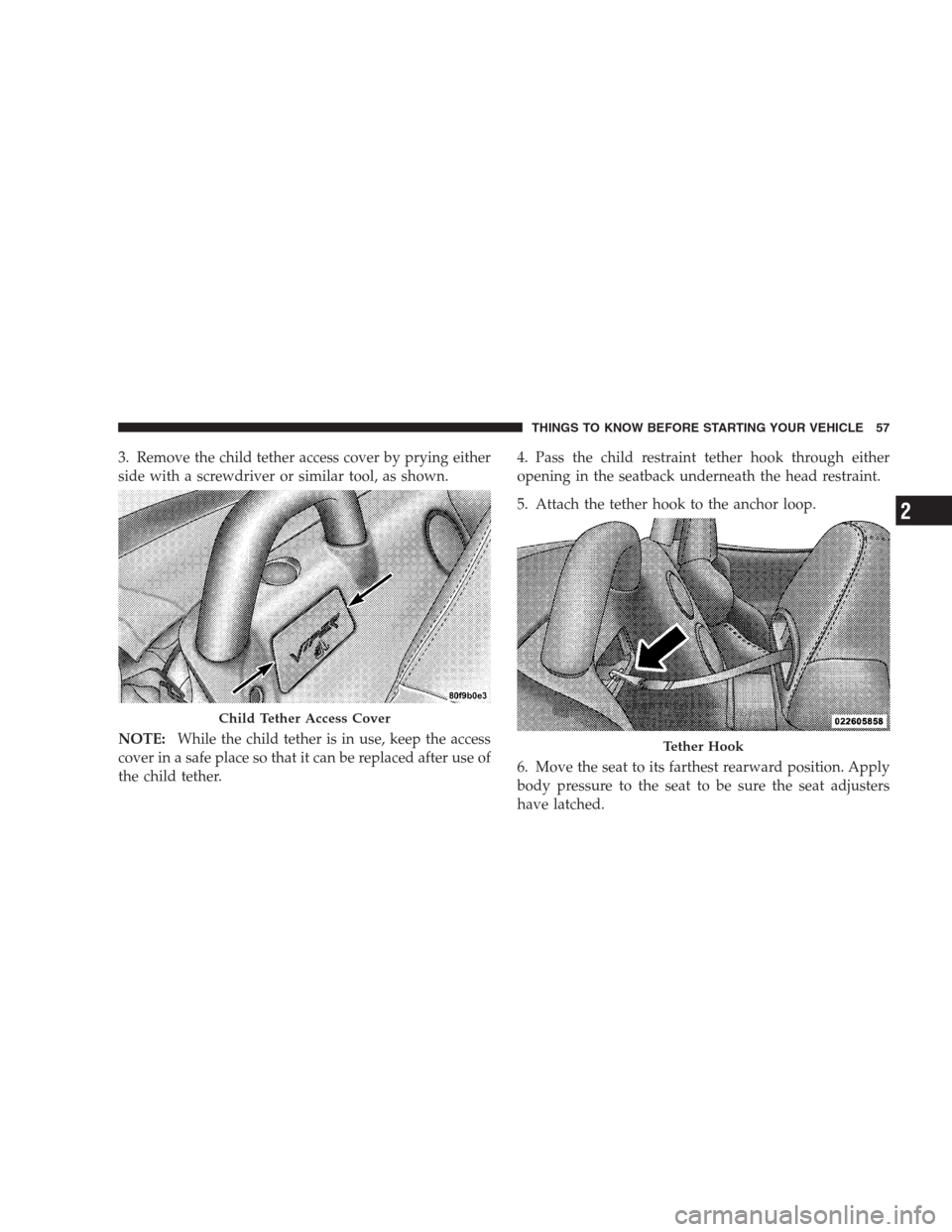
3. Remove the child tether access cover by prying either
side with a screwdriver or similar tool, as shown.
NOTE:While the child tether is in use, keep the access
cover in a safe place so that it can be replaced after use of
the child tether.4. Pass the child restraint tether hook through either
opening in the seatback underneath the head restraint.
5. Attach the tether hook to the anchor loop.
6. Move the seat to its farthest rearward position. Apply
body pressure to the seat to be sure the seat adjusters
have latched.
Child Tether Access Cover
Tether Hook
THINGS TO KNOW BEFORE STARTING YOUR VEHICLE 57
2
Page 60 of 299

7. Return the seatback to an upright position.
8. Install the child restraint according to the manufactur-
er’s directions.
9. Remove slack from the tether strap according to the
child restraint manufacturer’s directions.
WARNING!
An incorrectly anchored tether strap could lead to
increased head motion and possible injury to the
child. Use only the anchor position directly behind
the child seat to secure a child restraint top tether
strap.
Installing Child Restraints Using the Vehicle Seat
belt
The passenger seat belt is equipped with an automatic
locking retractor for child restraint system installation. It
is designed to keep the lap portion of the restraint held
tightly to the passenger seat. Seat belts equipped with
automatic locking retractors have a distinctive label on
the webbing. (Refer to “Automatic Locking Mode” in this
section for additional information).
To restrain the child seat:
1. Pull enough webbing from the retractor to allow the
belt to pass through the child restraint and insert the latch
plate into the buckle until you hear a “click.”
2. Grasp the shoulder portion of the belt and pull all of
the webbing out of the retractor.
58 THINGS TO KNOW BEFORE STARTING YOUR VEHICLE
Page 61 of 299
3.Allow some of the webbing to retract back into the
retractor. As the belt retracts, you will hear a clicking sound
indicating that the belt is now in automatic locking mode.
4. Tighten the lap portion of the belt and allow the excess
webbing to retract back to the retractor. If it still does not
make the child restraint secure, then secure the child
restraint with the Child Restraint Tether Anchor.
NOTE:
Once the belt is in automatic locking mode, you
will not be able to pull any more of the webbing out of the
retractor. In this mode, you will only be able to retract excess
webbing into the retractor to secure the child restraint.
Transporting Pets
Deploying airbags could harm your pet. An unrestrained
pet will be thrown about and possibly injured, or injure a
passenger during panic braking or in a collision.
Pets should be restrained in pet harnesses or pet carriers
that are secured by seat belts.
BREAK-IN RECOMMENDATIONS
A long break-in period is not required for the drivetrain
(engine, transmission, and rear axle) in your new vehicle.
Following these few simple guidelines is all that is
necessary for a good break-in.
For the first 500 miles (800 km):
•Keep your vehicle speed below the legal, posted speed
limit and your engine speed below 4,000 RPM.
•Avoid driving at a constant speed, either fast or slow,
for long periods.
•Do not make any full throttle starts and avoid full
throttle acceleration.
•Use the proper gear for your speed range.
•Wait until the engine has reached normal operating
temperature before driving at the recommended maxi-
mum break-in speed.
THINGS TO KNOW BEFORE STARTING YOUR VEHICLE 59
2
Page 283 of 299

Location..........................192,207
Saving Feature (Protection)............... 210
Storing Vehicle........................ 210
Belts, Seat............................33,34
Body Mechanism Lubrication............... 212
Boot, Convertible Top...................69,74
B-Pillar Location........................ 156
Brake, Parking.......................... 145
Brake System........................147,222
Anti-Lock (ABS)....................147,148
Fluid Check.......................222,248
Master Cylinder....................... 222
Warning Light........................ 104
Break-In Recommendations, New Vehicle.....59,147
Bulb Replacement....................... 237
Bulbs, Light............................ 236
Capacities, Antifreeze (Engine Coolant)........ 246
Capacities, Fluid........................ 246Caps, Filler
Fuel................................ 175
Oil (Engine).......................... 205
Power Steering........................ 144
Radiator (Coolant Pressure)............... 219
Car Washes............................ 227
Carbon Monoxide Warning...............60,174
CD (Compact Disc) Changer................ 116
CD (Compact Disc) Player............... 111,115
Cellular Phone.......................... 125
Chains, Tire............................ 167
Charging System Light.................... 109
Chart, Tire Sizing........................ 153
Check Engine Light
(Malfunction Indicator Light)............... 201
Checks, Safety........................... 60
Child Restraint....................53,54,55,58
Child Restraint Tether Anchors............... 56
Circuit Breakers......................... 230
INDEX 281
10
Page 292 of 299

Radial Ply Tires......................... 163
Radiator Cap (Coolant Pressure Cap).......... 219
Radio Antenna......................... 124
Radio Operation........................ 125
Radio, Satellite.......................... 120
Radio (Sound Systems).................... 111
Rear Axle (Differential).................... 226
Rear Liftgate............................ 30
Rear Window Defroster.................... 95
Rear Window Features..................... 95
Rearview Mirrors........................ 77
Reclining Front Seats...................... 80
Recreational Towing...................... 176
Reformulated Gasoline.................... 171
Refrigerant............................ 212
Reminder, Lights On...................... 84
Reminder, Seat Belt....................39,107
Remote Keyless Entry (RKE)................. 18
Remote Trunk Release..................... 32Replacement Parts....................... 202
Replacement Tires....................... 166
Reporting Safety Defects................... 274
Restraints, Child......................... 53
Restraints, Infant......................... 54
Restraints, Occupant...................... 33
Rocking Vehicle When Stuck................ 195
Rotation, Tires.......................... 167
Safety Checks Inside Vehicle................. 61
Safety Checks Outside Vehicle............... 62
Safety Defects, Reporting.................. 274
Safety, Exhaust Gas....................... 31
Safety Information, Tire................... 151
Safety Tips............................. 60
Satellite Radio.......................... 120
Satellite Radio Antenna................... 124
Schedule, Maintenance.................... 250
Scheduled Maintenance................... 203
290 INDEX
Page 293 of 299

Seat Belt Reminder.....................39,107
Seat Belts............................33,34
And Pregnant Women................... 41
Child Restraint...................53,54,55,58
Extender............................. 41
Inspection............................ 61
Maintenance.......................... 229
Operating Instructions................... 35
Reminder............................ 107
Untwisting Procedure.................... 39
Seats................................. 79
Adjustment........................... 79
Reclining............................. 80
Security Alarm (Theft Alarm)................ 13
Selection of Coolant (Antifreeze)..........217,247
Selection of Oil......................... 205
Service Assistance....................... 271
Service Contract......................... 273Service Engine Soon Light
(Malfunction Indicator).................... 102
Service Manuals........................ 275
Setting the Clock........................ 110
Shift Indicator Light...................107,139
Shift Speeds.........................137,139
Shift Speeds, Manual Transaxle.............. 139
Shoulder Belts........................... 34
Signals, Turn.........................85,103
Slippery Surfaces, Driving On............... 141
Snow Chains (Tire Chains)................. 167
Snow Tires............................ 167
Speedometer........................... 100
Starting............................... 134
Emergency (Jump Starting)............... 192
Engine Fails to Start.................... 136
Starting and Operating.................... 134
Starting Procedures...................... 134
INDEX 291
10