Page 209 of 429
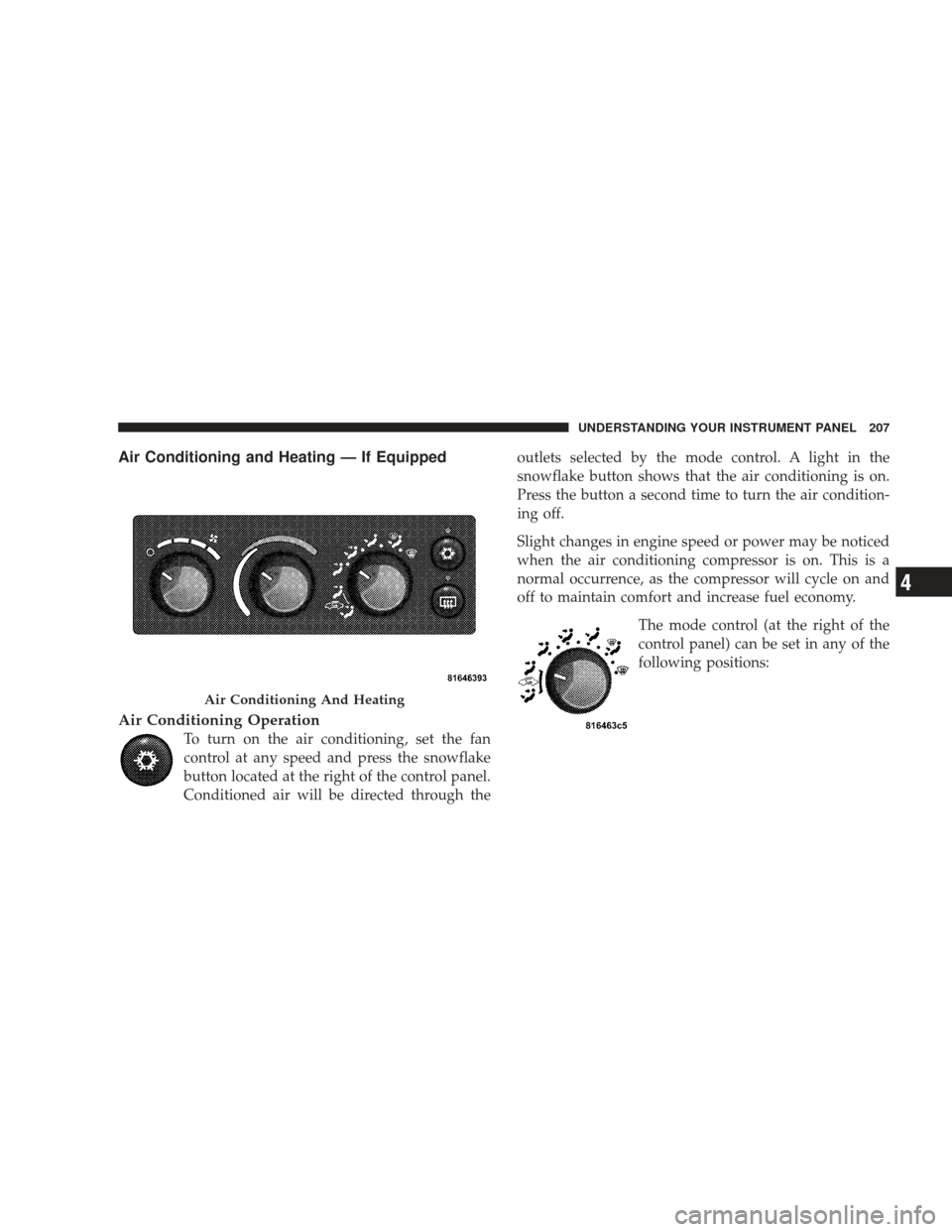
Air Conditioning and Heating — If Equipped
Air Conditioning Operation
To turn on the air conditioning, set the fan
control at any speed and press the snowflake
button located at the right of the control panel.
Conditioned air will be directed through theoutlets selected by the mode control. A light in the
snowflake button shows that the air conditioning is on.
Press the button a second time to turn the air condition-
ing off.
Slight changes in engine speed or power may be noticed
when the air conditioning compressor is on. This is a
normal occurrence, as the compressor will cycle on and
off to maintain comfort and increase fuel economy.
The mode control (at the right of the
control panel) can be set in any of the
following positions:
Air Conditioning And Heating
UNDERSTANDING YOUR INSTRUMENT PANEL 207
4
Page 212 of 429
Air Conditioning With Dual Zone Temperature
Control — If Equipped
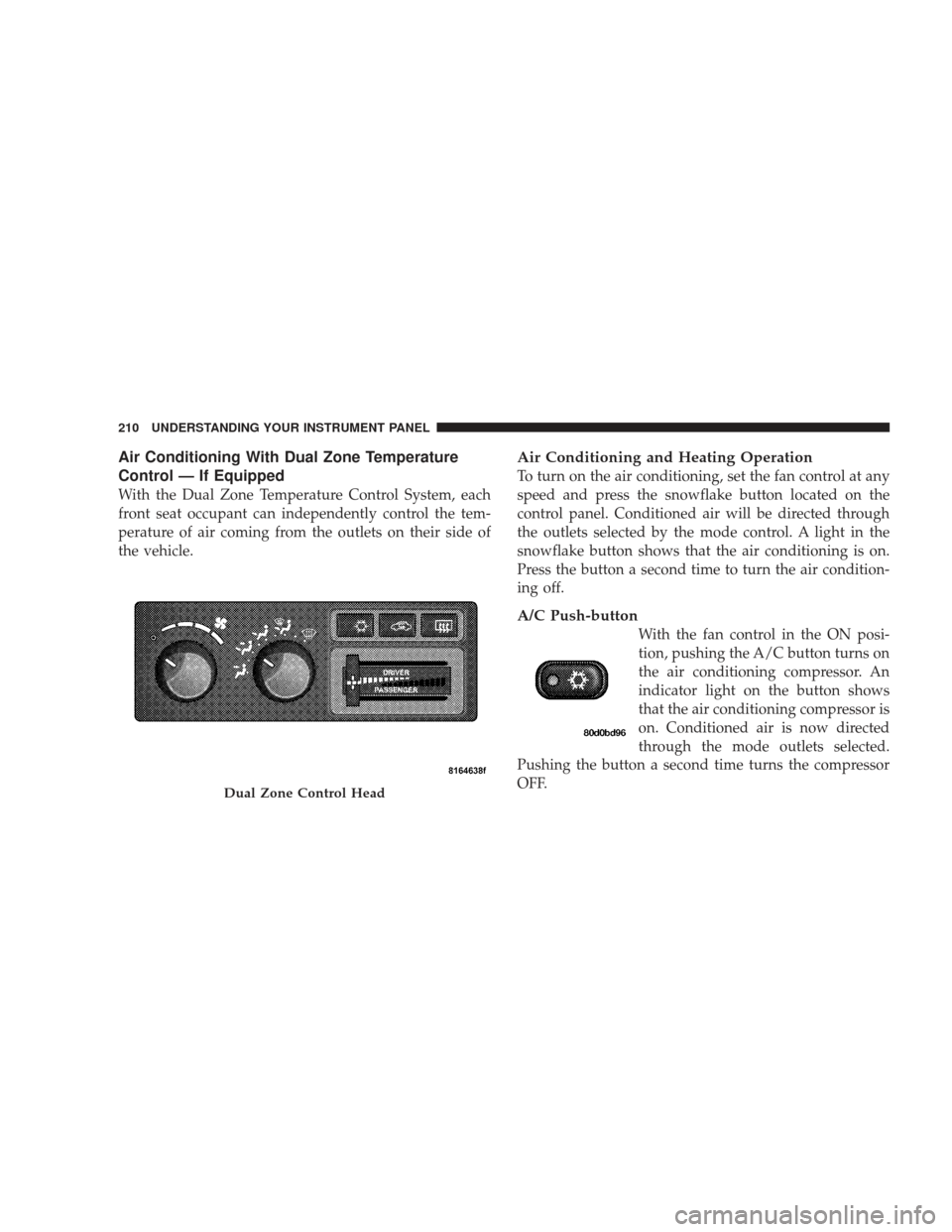
With the Dual Zone Temperature Control System, each
front seat occupant can independently control the tem-
perature of air coming from the outlets on their side of
the vehicle.
Air Conditioning and Heating Operation
To turn on the air conditioning, set the fan control at any
speed and press the snowflake button located on the
control panel. Conditioned air will be directed through
the outlets selected by the mode control. A light in the
snowflake button shows that the air conditioning is on.
Press the button a second time to turn the air condition-
ing off.
A/C Push-button
With the fan control in the ON posi-
tion, pushing the A/C button turns on
the air conditioning compressor. An
indicator light on the button shows
that the air conditioning compressor is
on. Conditioned air is now directed
through the mode outlets selected.
Pushing the button a second time turns the compressor
OFF.
Dual Zone Control Head
210 UNDERSTANDING YOUR INSTRUMENT PANEL
Page 214 of 429
Mix
Outside air flows in equal proportions through the
floor and defroster outlets.
Defrost
Outside air is primarily directed to the windshield
through the defroster outlets located at the base of
the windshield and side window demist outlets.
NOTE: The air conditioning compressor operates in
both Mix and Defrost or a blend of these modes, even if
the A/C button has not been pressed. This dehumidifies
the air to help dry the windshield.
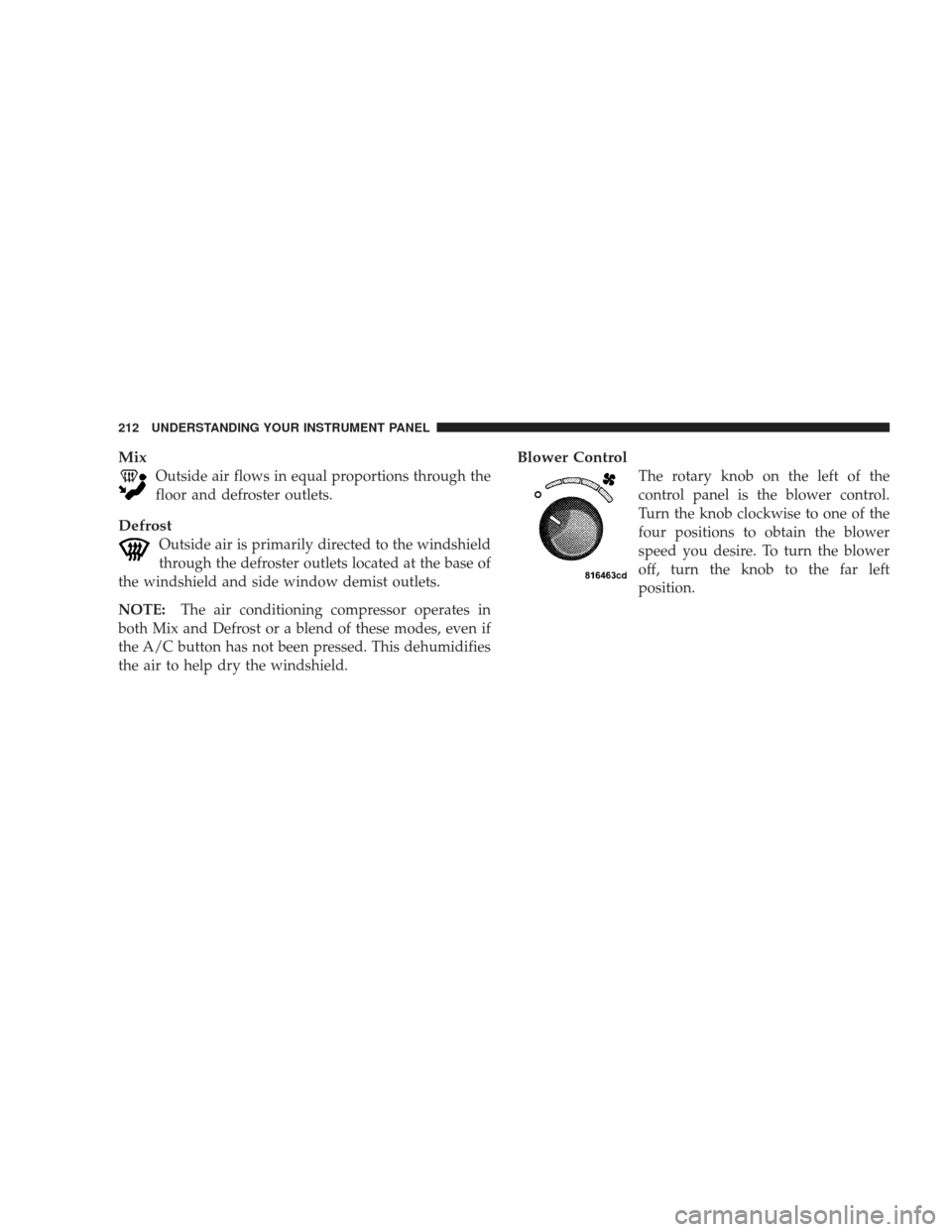
Blower Control
The rotary knob on the left of the
control panel is the blower control.
Turn the knob clockwise to one of the
four positions to obtain the blower
speed you desire. To turn the blower
off, turn the knob to the far left
position.
212 UNDERSTANDING YOUR INSTRUMENT PANEL
Page 344 of 429
WARNING! (Continued)
•Battery posts, terminals and related accessories
contain lead and lead compounds. Wash hands
after handling.
CAUTION!
•It is essential when replacing the cables on the
battery that the positive cable is attached to the
positive post and the negative cable is attached to
the negative post. Battery posts are marked (+)
positive and negative (-) and identified on the
battery case.
•If a “fast charger” is used while battery is in
vehicle, disconnect both vehicle battery cables
before connecting the charger to battery. Do not
use a “fast charger” to provide starting voltage.
Air Conditioner Maintenance
For best possible performance, your air conditioner
should be checked and serviced by an authorized dealer
at the start of each warm season. This service should
include cleaning of the condenser fins and a performance
test. Drive belt tension should also be checked at this
time.
WARNING!
•Use only refrigerants and compressor lubricants
approved by the manufacturer for your air condi-
tioning system. Some unapproved refrigerants are
flammable and can explode, injuring you. Other
unapproved refrigerants or lubricants can cause
the system to fail, requiring costly repairs. Refer to
Section 3 of the Warranty Information Book for
further warranty information.(Continued)
342 MAINTAINING YOUR VEHICLE
Page 371 of 429

VEHICLE STORAGE
If you are storing your vehicle for more than 21 days, we
recommend that you take the following steps to mini-
mize the drain on your vehicle’s battery:
•Disconnect the Ignition-Off Draw (IOD) fuse located in
the Integrated Power Module, located in the engine
compartment. The IOD cavity includes a snap-in re-
tainer that allows the fuse to be disconnected without
removing it from the fuse block.
•The electronic shift transfer case should be placed in
the 4HI mode and kept in this position to minimize the
battery drain.
•As an alternative to the above steps you may discon-
nect the negative cables from both batteries.
•Any time you store your vehicle or keep it out of
service (i.e., vacation) for two weeks or more, run the
air conditioning system at idle for about five minutesin the fresh air and high blower setting. This will
ensure adequate system lubrication to minimize the
possibility of compressor damage when the system is
started again.
NOTE:
•When reinstalling the IOD fuse push firmly until fully
seated; the gauges in the instrument cluster will do a
full sweep when the ignition key is cycled to RUN.
This is a normal condition.
•When the vehicle is shipped from the factory, the IOD
fuse is in the up or extracted position. If the radio,
interior lamps, keyless entry or other features do not
work with the key OFF, check the position of the fuse
(or check to see if the fuse is blown) to ensure that it is
fully seated. When the IOD fuse is extracted, the
instrument cluster in the odometer window will dis-
play �NO FUSE.”
MAINTAINING YOUR VEHICLE 369
7