Page 335 of 532
WARNING! (Continued)
•
The Anti-Lock Brake System (ABS) cannot prevent
the natural laws of physics from acting on the
vehicle, nor can it increase braking or steering
efficiency beyond that afforded by the condition
of the vehicle brakes and tires or the traction
afforded.
•
The ABS cannot prevent accidents, including
those resulting from excessive speed in turns,
following another vehicle too closely, or hydro-
planing. Only a safe, attentive, and skillful driver
can prevent accidents.
•
The capabilities of an ABS-equipped vehicle must
never be exploited in a reckless or dangerous
manner which could jeopardize the user’s safety
or the safety of others.
ELECTRONIC BRAKE CONTROL SYSTEM — IF
EQUIPPEDYour vehicle is equipped with an advanced electronic
brake control system that includes Anti-Lock Brake Sys-
tem (ABS), Traction Control System (TCS), Brake Assist
System (BAS), HSA (Hill Start Assist), Electronic Roll
Mitigation (ERM), Electronic Stability Program (ESP) and
Trailer Sway Control (TSC). All six systems work to-
gether to enhance vehicle stability and control in various
driving conditions, and are commonly referred to as ESP.Anti-Lock Brake System (ABS)The ABS aids the driver in maintaining vehicle control
under adverse braking conditions. The system controls
hydraulic brake pressure to prevent wheel lockup and
help avoid skidding on slippery surfaces during braking.
For more information about ABS, refer to “Anti-Lock
Brake System” under “Brake System” in Section 5 of this
manual.
STARTING AND OPERATING 333
5
Page 336 of 532
NOTE:ABS improves steering control of the vehicle
during hard braking maneuvers.
WARNING!
•
ABS cannot prevent the natural laws of physics
from acting on the vehicle, nor can it increase
braking or steering efficiency beyond that af-
forded by the condition of the vehicle brakes and
tires or the traction afforded.
•
The ABS cannot prevent accidents, including
those resulting from excessive speed in turns,
following another vehicle too closely, or hydro-
planing. Only a safe, attentive, and skillful driver
can prevent accidents.
•
The capabilities of an ABS-equipped vehicle must
never be exploited in a reckless or dangerous
manner which could jeopardize the user’s safety
or the safety of others.
Traction Control System (TCS)The TCS monitors the amount of wheel spin of each of
the driven wheels. If wheel spin is detected, brake
pressure is applied to the slipping wheel(s), and engine
power is reduced to provide enhanced acceleration and
stability. A feature of the TCS functions similar to a
limited-slip differential and controls the wheel spin
across a driven axle. If one wheel on a driven axle is
spinning faster than the other, the system will apply the
brake of the spinning wheel. This will allow more engine
torque to be applied to the wheel that is not spinning.
This feature remains active even if TCS and ESP are in the
“Partial Off” mode. Refer to “Electronic Stability Pro-
gram (ESP)” in this section of this manual. This brake
pressure modulation transfers drive torque from slipping
to non-slipping wheels to provide optimal forward
traction.
334 STARTING AND OPERATING
Page 337 of 532
Brake Assist System (BAS)The BAS is designed to optimize the vehicle’s braking
capability during emergency braking maneuvers. The
BAS detects an emergency braking situation by sensing
the rate and amount of brake application and then
applies optimum pressure to the brakes. The system
applies optimum pressure to the brakes in emergency
braking conditions. This can help reduce braking dis-
tances. The BAS complements the ABS. Applying the
brakes very quickly results in the best BAS assistance. To
receive the benefit of BAS, you must apply continuous
braking pressure during the stopping sequence. Do not
reduce brake pedal pressure unless braking is no longer
desired.
Once the brake pedal is released, the BAS is deactivated.
WARNING!
•
The BAS cannot prevent the natural laws of phys-
ics from acting on the vehicle, nor can it increase
braking efficiency beyond that afforded by the
condition of the vehicle brakes and tires or the
traction afforded.
•
The BAS cannot prevent accidents, including
those resulting from excessive speed in turns,
following another vehicle too closely, or hydro-
planing. Only a safe, attentive, and skillful driver
can prevent accidents.
•
The capabilities of a BAS-equipped vehicle must
never be exploited in a reckless or dangerous
manner which could jeopardize the user ’s safety
or the safety of others.
STARTING AND OPERATING 335
5
Page 348 of 532
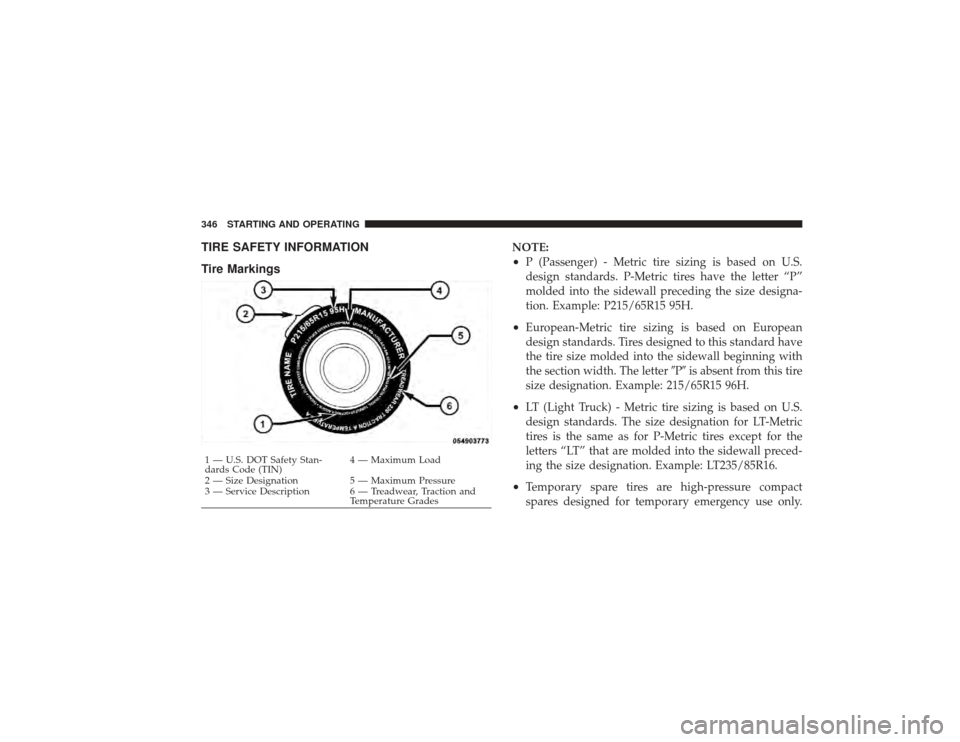
TIRE SAFETY INFORMATION
Tire Markings
NOTE:•
P (Passenger) - Metric tire sizing is based on U.S.
design standards. P-Metric tires have the letter “P”
molded into the sidewall preceding the size designa-
tion. Example: P215/65R15 95H.
•
European-Metric tire sizing is based on European
design standards. Tires designed to this standard have
the tire size molded into the sidewall beginning with
the section width. The letter�P�is absent from this tire
size designation. Example: 215/65R15 96H.
•
LT (Light Truck) - Metric tire sizing is based on U.S.
design standards. The size designation for LT-Metric
tires is the same as for P-Metric tires except for the
letters “LT” that are molded into the sidewall preced-
ing the size designation. Example: LT235/85R16.
•
Temporary spare tires are high-pressure compact
spares designed for temporary emergency use only.
1 — U.S. DOT Safety Stan-
dards Code (TIN) 4 — Maximum Load
2 — Size Designation 5 — Maximum Pressure
3 — Service Description 6 — Treadwear, Traction and Temperature Grades
346 STARTING AND OPERATING
Page 350 of 532
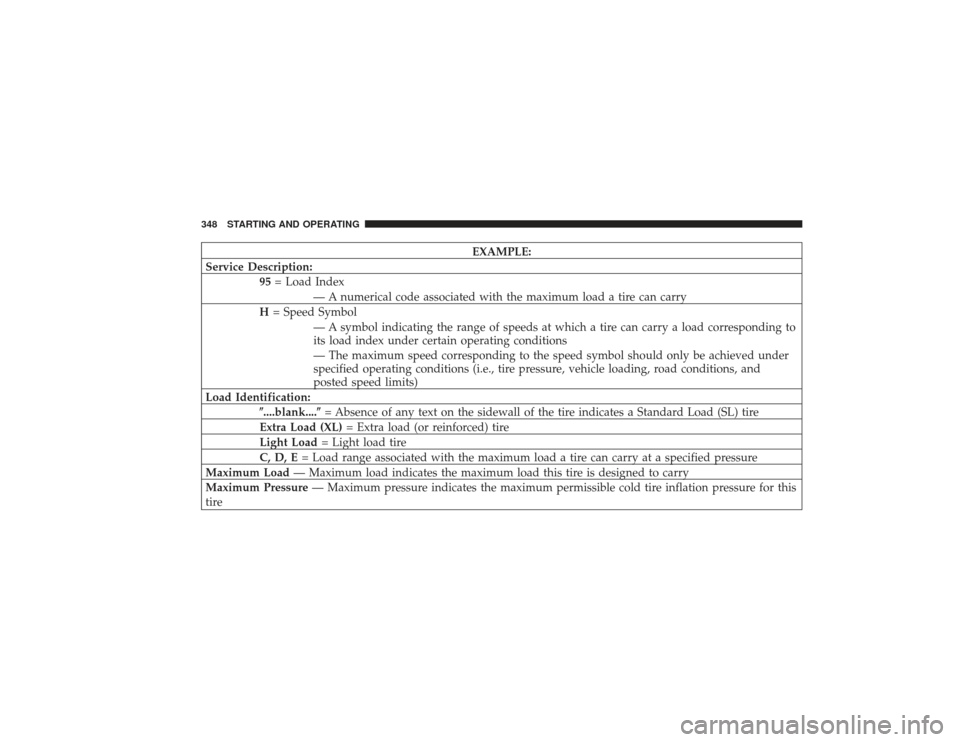
EXAMPLE:
Service Description: 95= Load Index
— A numerical code associated with the maximum load a tire can carry
H = Speed Symbol
— A symbol indicating the range of speeds at which a tire can carry a load corresponding to
its load index under certain operating conditions
— The maximum speed corresponding to the speed symbol should only be achieved under
specified operating conditions (i.e., tire pressure, vehicle loading, road conditions, and
posted speed limits)
Load Identification: \b....blank....\b = Absence of any text on the sidewall of the tire indicates a Standard Load (SL) tire
Extra Load (XL) = Extra load (or reinforced) tire
Light Load = Light load tire
C, D, E = Load range associated with the maximum load a tire can carry at a specified pressure
Maximum Load — Maximum load indicates the maximum load this tire is designed to carry
Maximum Pressure — Maximum pressure indicates the maximum permissible cold tire inflation pressure for this
tire
348 STARTING AND OPERATING
Page 414 of 532
•
Operate the jack using the jack drive tube and the
wheel wrench. The tube extension, may be used, but
is not required.
•
For 2500/3500 4x4 series trucks, when changing the
front wheel, assemble the jack drive tube to the jack
and connect the drive tube to the extension tube.
Place the jack under the axle as close to the tire as
possible with the drive tubes extending to the front.
Connect the jack tube extension and wheel wrench.
•
For all trucks, when changing a rear wheel, as-
semble the jack drive tube to the jack and connect
the drive tube to the extension tube. Place the jack
under the axle between the spring and the shock
absorber with the drive tubes extending to the rear.
4x4 Jacking Location
412 WHAT TO DO IN EMERGENCIES
Page 462 of 532
Cavity CartridgeFuseMini
Fuse Description
12 30 Amp Pink Electric Brake
13 25 Amp
NaturalPower-Battery
RWAL/ABS Module
Feed
14 15 Amp
BluePark Lights Left
15 20 Amp
YellowTrailer Park Lights
16 15 Amp
BluePark Lights Right
17 — —
18 40 Amp Green ABS Pump
19 30 Amp Pink Trailer Tow Battery
Feed
Cavity Cartridge
FuseMini
Fuse Description
20 10 Amp
RedOccupant Restraints
Controller (ORC) 2
21 10 Amp
RedOccupant Restraints/
Pass Disable Switch
22 2 Amp
GrayIGN Switch Feed
23 10 Amp
RedHVAC
24 20 Amp Blue AISIN Relay Feed
(Diesel Only)
25 10 Amp
RedPower Mirror/T-Case
Brake
26 20 Amp
YellowBrake Switch/Center
High Mount Stop
Light (CHMSL)/
Aftermarket CHMSL
460 MAINTAINING YOUR VEHICLE
Page 463 of 532
Cavity CartridgeFuseMini
Fuse Description
27 40 Amp Green Power Seats
28 10 Amp
RedPower Run/Start-
PCM/Steering Angle
Sensor
29 10 Amp
Red4X4 Switch/Pass Dr
Switch/EC Mirror
30 15 Amp
BluePower Run/Start-
ABS/RWAL/Smart
Bar/YAW Sensor/
Universal Exhaust
Gas Oxygen (Uego)
Sensor Controller
31 10 Amp
RedPCM (Gas)/TCM
(Diesel 58RFE)
Cavity Cartridge
FuseMini
Fuse Description
32 10 Amp
RedPower Ignition Run
— Adjustable Pedals
LED
33 10 Amp
RedPower-IGN Run —
HVAC
34 — —
35 15 Amp
BlueCabin Compartment
Node (CCN) Illumi-
nation
36 25 Amp
NaturalAudio_Amplifier
37 15 Amp
BlueVariable Gate Turbo
(VGT) — Turbo Die-
sel
38 20 Amp
YellowPower Outlet IP
MAINTAINING YOUR VEHICLE 461
7