Page 393 of 523

NOTE:Check the 4-speed automatic transaxle fluid
level before towing. The 6-speed transaxle is sealed and
the fluid level cannot be checked. See your authorized
dealer for assistance.
Towing Tips — Electronic Speed Control (If
Equipped)
Don’t use in hilly terrain or with heavy loads.
When using the speed control, if you experience speed
drops greater than 10 mph (16 km/h), disengage until
you can get back to cruising speed.
Use speed control in flat terrain and with light loads to
maximize fuel efficiency.
Towing Tips — Autostick� (If Equipped)
By using the Autostick� modes and selecting a specific
gear range, frequent shifting can be avoided. The
highest gear range should be selected that allows for
adequate performance. For example, choose “4” if the
desired speed can be maintained. Choose “3” or “2” if
needed to maintain the desired speed.
Extended driving at high RPM should be avoided to
prevent excess heat generation. A reduction in vehicle
speed may be required to avoid extended driving at
high RPM. Return to a higher gear range or vehicle
speed when road conditions and RPM level allows.
STARTING AND OPERATING 391
5
Page 409 of 523

JUMP-STARTING PROCEDURES
WARNING!
•Take care to avoid the radiator cooling fan when-
ever the hood is raised. It can start anytime the
ignition switch is ON. You can be hurt by the fan.
•Do not attempt to push or tow your vehicle to get
it started. Vehicles equipped with an automatic
transaxle cannot be started this way. Unburned
fuel could enter the catalytic converter and once
the engine has started, ignite and damage the
converter and vehicle. If the vehicle has a dis-
charged battery, booster cables may be used to
obtain a start from another vehicle. This type of
start can be dangerous if done improperly, so
follow this procedure carefully.
•Do not use a booster battery or any other booster
source with an output that exceeds 12 Volts.
WARNING!
•Battery fluid is a corrosive acid solution; do not
allow battery fluid to contact eyes, skin, or cloth-
ing. Don’t lean over battery when attaching
clamps or allow the clamps to touch each other. If
acid splashes in eyes or on skin, flush contami-
nated area immediately with large quantities of
water.
•A battery generates hydrogen gas, which is flam-
mable and explosive. Keep flame or spark away
from the vent holes.
The battery is stored in a compartment that is located
behind the left front fender and is accessible through the
wheel well. Remote jump-start terminals are located in
the engine compartment.
WHAT TO DO IN EMERGENCIES 407
6
Page 417 of 523
MAINTAINING YOUR VEHICLE
CONTENTS
�2.4L Engine Compartment ................418
� 2.7L Engine Compartment ................419
� 3.5L Engine Compartment ................420
� Onboard Diagnostic System — OBD II ........421
▫ Loose Fuel Filler Cap Message ............421
� Emissions Inspection And Maintenance
Programs ............................422
� Replacement Parts ......................423
� Authorized Dealer Service ................424 �
Maintenance Procedures ..................424
▫ Engine Oil ..........................424
▫ Engine Oil Filter ......................428
▫ Drive Belts — Check Condition And Tension . . 428
▫ Spark Plugs .........................429
▫ Engine Air Cleaner Filter ................429
▫ Catalytic Converter ....................429
▫ Maintenance-Free Battery ................431
▫ Air Conditioner Maintenance .............433
7
Page 418 of 523

▫A/C Air Filter — If Equipped ............434
▫ Power Steering — Fluid Check ............436
▫ Front Suspension Ball Joints ..............437
▫ Steering Linkage ......................437
▫ Body Lubrication .....................437
▫ Wiper Blades ........................437
▫ Windshield Washers/Rear Window Washer . . . 438
▫ Exhaust System ......................439
▫ Cooling System .......................440
▫ Hoses And Vacuum/Vapor Harnesses .......445
▫ Fuel System .........................446
▫ Brake System ........................446
▫ Automatic Transaxle ...................449 ▫
Front And Rear Wheel Bearings ...........451
▫ Appearance Care And Protection From
Corrosion ...........................452
▫ Cleaning The Cupholders ...............457
� Fuses (Totally Integrated Power Module) ......457
� Vehicle Storage ........................464
� Replacement Bulbs ......................465
� Bulb Replacement ......................466
▫ Low Beam Headlight, High Beam Headlight,
Front Turn Signal/Park Light, Side
Marker Light ........................466
▫ Front Fog Light ......................467
▫ Tail/Stop Light, Rear Turn Signal Light,
Tail Light, Backup Light ................468
416 MAINTAINING YOUR VEHICLE
Page 423 of 523

ONBOARD DIAGNOSTIC SYSTEM — OBD II
Your vehicle is equipped with a sophisticated Onboard
Diagnostic system called OBD II. This system monitors
the performance of the emissions, engine, and automatic
transaxle control systems. When these systems are oper-
ating properly, your vehicle will provide excellent per-
formance and fuel economy, as well as engine emissions
well within current government regulations.
If any of these systems require service, the OBD II system
will turn on the Malfunction Indicator Light (MIL). It will
also store diagnostic codes and other information to
assist your service technician in making repairs. Al-
though your vehicle will usually be drivable and not
need towing, see your authorized dealer for service as
soon as possible.CAUTION!
•Prolonged driving with the MIL on could cause
further damage to the emissions control system. It
could also affect fuel economy and driveability.
The vehicle must be serviced before any emissions
tests can be performed.
•If the MIL is flashing while the engine is running,
severe catalytic converter damage and power loss
will soon occur. Immediate service is required.
Loose Fuel Filler Cap Message
If the vehicle diagnostic system determines that the fuel
filler cap in loose, improperly installed, or damaged, the
word “gASCAP” will display in the odometer. If this
occurs, tighten the fuel filler cap until a “clicking” sound
is heard and press the TRIP ODOMETER button to turn
MAINTAINING YOUR VEHICLE 421
7
Page 424 of 523
off the message. If the problem persists, the message will
appear the next time the vehicle is started.
A loose, improperly installed, or damaged fuel filler cap
may also turn on the MIL.
EMISSIONS INSPECTION AND MAINTENANCE
PROGRAMS
In some localities, it may be a legal requirement to pass
an inspection of this vehicle’s emissions control system.
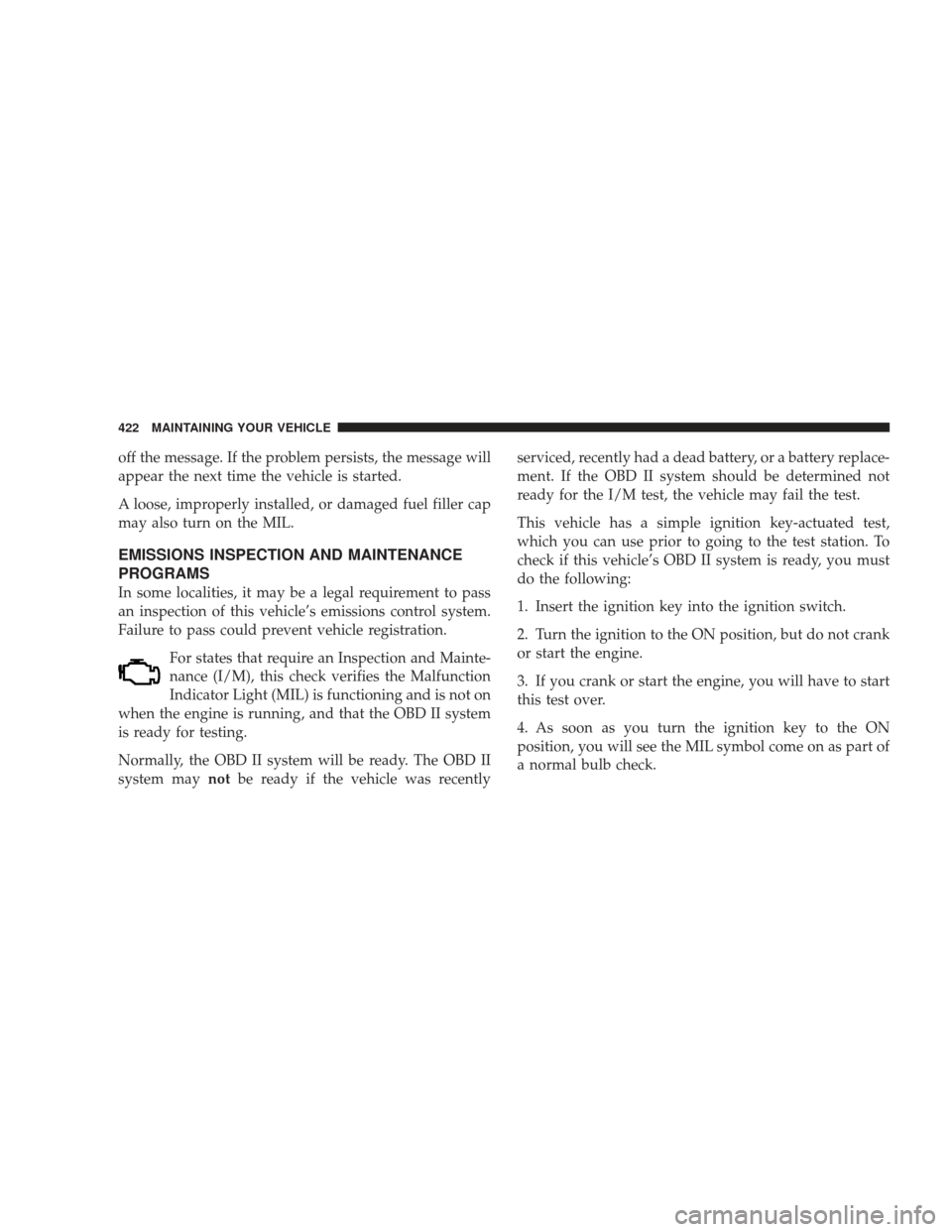
Failure to pass could prevent vehicle registration.For states that require an Inspection and Mainte-
nance (I/M), this check verifies the Malfunction
Indicator Light (MIL) is functioning and is not on
when the engine is running, and that the OBD II system
is ready for testing.
Normally, the OBD II system will be ready. The OBD II
system may notbe ready if the vehicle was recently serviced, recently had a dead battery, or a battery replace-
ment. If the OBD II system should be determined not
ready for the I/M test, the vehicle may fail the test.
This vehicle has a simple ignition key-actuated test,
which you can use prior to going to the test station. To
check if this vehicle’s OBD II system is ready, you must
do the following:
1. Insert the ignition key into the ignition switch.
2. Turn the ignition to the ON position, but do not crank
or start the engine.
3. If you crank or start the engine, you will have to start
this test over.
4. As soon as you turn the ignition key to the ON
position, you will see the MIL symbol come on as part of
a normal bulb check.
422 MAINTAINING YOUR VEHICLE
Page 426 of 523
AUTHORIZED DEALER SERVICE
Your authorized dealer has the qualified service person-
nel, special tools, and equipment to perform all service
operations in an expert manner. Service manuals are
available which include detailed service information for
your vehicle. Refer to these service manuals before
attempting any procedure yourself.
NOTE:Intentional tampering with emissions control
systems can result in civil penalties being assessed
against you.
WARNING!
You can be badly injured working on or around a
motor vehicle. Only do service work for which you
have the knowledge and the proper equipment. If you
have any doubt about your ability to perform a service
job, take your vehicle to a competent mechanic.
MAINTENANCE PROCEDURES
The pages that follow contain the requiredmaintenance
services determined by the engineers who designed your
vehicle.
Besides the maintenance items for which there are fixed
maintenance intervals, there are other items that should
operate satisfactorily without periodic maintenance.
However, if a malfunction of these items does occur, it
could adversely affect the engine or vehicle performance.
These items should be inspected if a malfunction is
observed or suspected.
Engine Oil
Checking Oil Level
To assure proper engine lubrication, the engine oil must
be maintained at the correct level. Check the oil level at
regular intervals, such as every fuel stop.
424 MAINTAINING YOUR VEHICLE
Page 429 of 523

Engine Oil Viscosity (SAE Grade) — 2.4L and 2.7L
Engines
SAE 5W-20 engine oil is recommended for all operating
temperatures. This engine oil improves low temperature
starting and vehicle fuel economy.
The engine oil filler cap also shows the recommended
engine oil viscosity for your engine. For information on
engine oil filler cap location, refer to the “Engine Com-
partment” illustration in this section.
Lubricants that do not have both, the engine oil certifi-
cation mark and the correct SAE viscosity grade number
should not be used.
Engine Oil Viscosity (SAE Grade) — 3.5L Engine
SAE 10W-30 engine oil is preferred for use in 3.5L
Engines for all operating temperatures.The engine oil filler cap also shows the recommended
engine oil viscosity for your engine. For information on
engine oil filler cap location, refer to the “Engine Com-
partment” illustration in this section.
Lubricants that do not have both, the engine oil certifi-
cation mark and the correct SAE viscosity grade number
should not be used.
Synthetic Engine Oils
You may use synthetic engine oils provided the recom-
mended oil quality requirements are met, and the recom-
mended maintenance intervals for oil and filter changes
are followed.
Materials Added to Engine Oil
The manufacturer strongly recommends against the ad-
dition of any additives (other than leak detection dyes) to
the engine oil. Engine oil is an engineered product and its
performance may be impaired by supplemental addi-
tives.
MAINTAINING YOUR VEHICLE 427
7
