Page 386 of 498
1. Remove the spare wheel, jack, and tools from storage.
2. Using the wheel wrench, loosen, but do not remove,
the wheel nuts by turning them counterclockwise one
turn while the wheel is still on the ground.
3. When changing a front wheel, place the jack under the
frame rail behind the wheel. Locate the jack as far
forward as possible on the straight part of the frame
(prior to inboard transition). Operate the jack using the
jack drive tube and the wheel wrench; the tube extension
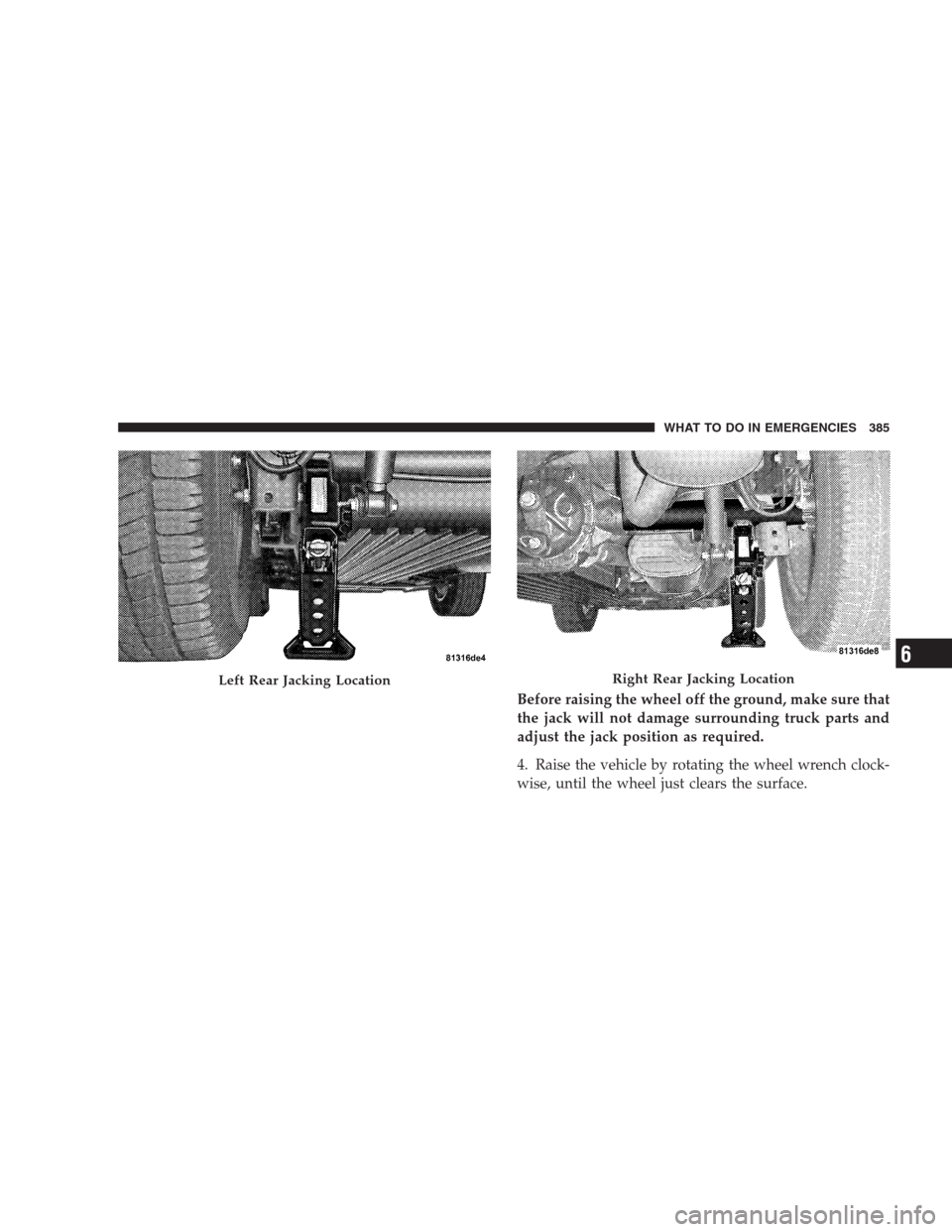
may be used but is not required.When changing a rear wheel, assemble the jack drive
tube to the jack and connect the drive tube to the
extension tube. Place the jack under the axle as close to
the tire as possible with the drive tubes extending to the
rear. Connect the jack tube extension and wheel wrench.
Jack Warning Label
Front Jacking Location
384 WHAT TO DO IN EMERGENCIES
Page 387 of 498
Before raising the wheel off the ground, make sure that
the jack will not damage surrounding truck parts and
adjust the jack position as required.
4. Raise the vehicle by rotating the wheel wrench clock-
wise, until the wheel just clears the surface.
Left Rear Jacking LocationRight Rear Jacking Location
WHAT TO DO IN EMERGENCIES 385
6
Page 388 of 498

WARNING!
Raising the vehicle higher than necessary can make
the vehicle unstable and cause an accident. It could
slip off the jack and hurt someone near it. Raise the
vehicle only enough to remove the tire.
5. Remove the wheel nuts and pull the wheel off. Install
the spare wheel and wheel nuts with the cone shaped end
of the nuts toward the wheel. Lightly tighten the nuts. To
avoid risk of forcing the vehicle off the jack, do not fully
tighten the nuts until the vehicle has been lowered.
NOTE:Do not oil wheel studs. For chrome wheels, do
not substitute with chrome plated wheel nuts.
6. Using the wheel wrench, finish tightening the nuts in
a crisscross pattern. Correct nut tightness is 135 ± 10 ft lbs
(183 ± 14 N·m) dynamic torque. If in doubt about thecorrect tightness, have them checked with a torque
wrench by your authorized dealer or at a service station.
WARNING!
A loose tire or jack thrown forward in a collision or
hard stop could injure someone in the vehicle. Al-
ways stow the jack, tools and the extra tire and wheel
in the places provided.
7. Remove wheel blocks. Do not install chrome or alu-
minum wheel center caps on the spare wheel. This may
result in cap damage.
8. Lower the jack to its fully closed position. Stow the
replaced tire, jack, and tools as previously described.
9. Adjust the tire pressure when possible.
NOTE:Do not oil wheel studs. For chrome wheels, do
not substitute with chrome plated wheel nuts.
386 WHAT TO DO IN EMERGENCIES
Page 389 of 498

WARNING!
Carefully follow these tire changing warnings to
help prevent personal injury or damage to your
vehicle:
•Always park on a firm, level surface as far from
the edge of the roadway as possible before raising
the vehicle.
•Block the wheel diagonally opposite the wheel to
be raised.
•Apply the parking brake firmly before jacking.
•Never start the engine with the vehicle on a jack.
•Do not let anyone sit in the vehicle when it is on a
jack.
•Do not get under the vehicle when it is on a jack.
•Only use the jack in the positions indicated.
(Continued)
WARNING! (Continued)
•If working on or near a roadway, be extremely
careful of motor traffic.
•To assure that spare tires, flat or inflated, are
securely stowed, spares must be stowed with the
valve stem facing the ground.
To Stow The Flat Or Spare
Turn the wheel so that the valve stem is downward. Slide
the wheel retainer through the center of the wheel and
position it properly across the wheel opening.
For convenience in checking the spare tire inflation, stow
with the valve stem toward the rear of the vehicle.
Rotate the winch mechanism until the wheel is drawn
into place against the underside of the vehicle. Continue
to rotate until you feel the winch mechanism slip or click
two times. It cannot be overtightened. Push against the
tire several times to be sure it is firmly in place.
WHAT TO DO IN EMERGENCIES 387
6
Page 392 of 498
WARNING!
Any procedure other than above could result in:
•Personal injury caused by electrolyte squirting out
the battery vent.
•Personal injury or property damage due to battery
explosion.
•Damage to charging system of booster vehicle or
of immobilized vehicle.
FREEING A STUCK VEHICLE
If vehicle becomes stuck in snow, sand, or mud, it can
often be moved by a rocking motion. Move the shift leverrhythmically between FIRST and REVERSE, while apply-
ing slight pressure to the accelerator.
The least amount of accelerator pedal pressure to main-
tain the rocking motion without spinning the wheels or
racing the engine is most effective. Allow the engine to
idle with the shift lever in NEUTRAL for at least one
minute after every five rocking-motion cycles. This will
minimize overheating and reduce the risk of transmis-
sion failure during prolonged efforts to free a stuck
vehicle.
390 WHAT TO DO IN EMERGENCIES
Page 394 of 498
Four-Wheel Drive Vehicles
The manufacturer recommends towing with all wheels
OFFthe ground. Acceptable methods are to tow the
vehicle on a flatbed or with one end of the vehicle raised
and the opposite end on a towing dolly.
Two-Wheel Drive Vehicles
Provided that the transmission is operable, tow with the
transmission in NEUTRAL and the ignition key in the
OFF position, along with the front wheels raised and the
rear wheels on the ground. The speed must not exceed
30 mph (50 km/h), and the distance must not exceed
15 miles (25 km).If the vehicle is to be towed more than 15 miles (25 km)
or faster than 30 mph (50 km/h), it must be towed on a
flatbed, or with the rear wheels raised and the front
wheels on the ground, or with the front end raised and
the rear wheels on a towing dolly.
NOTE:Towing the vehicle with the rear wheels on the
ground at more than 30 mph (50 km/h) or for more than
15 miles (25 km), can cause severe transmission damage.
392 WHAT TO DO IN EMERGENCIES
Page 408 of 498

WARNING! (Continued)
•The air conditioning system contains refrigerant
under high pressure. To avoid risk of personal
injury or damage to the system, adding refrigerant
or any repair requiring lines to be disconnected
should be done by an experienced technician.
NOTE:Use only manufacturer approved A/C System
Sealers, Stop Leak Products, Seal Conditioners, Compres-
sor Oils and Refrigerants.
Refrigerant Recovery and Recycling
R-134a air conditioning refrigerant is a hydrofluoro-
carbon (HFC) that is endorsed by the Environmental
Protection Agency and is an ozone-saving product. How-
ever, the manufacturer recommends that air conditioning
service be performed by authorized dealers or other
service facilities using recovery and recycling equipment.
Drive Shaft Constant Velocity Joints
All 4-wheel drive models are equipped with four con-
stant velocity joints. Periodic lubrication of these joints is
not required. However, the joint boot should be inspected
for external leakage or damage periodically. If external
leakage or damage is evident, the joint boot and grease
should be replaced immediately. Continued operation
could result in failure of the joint due to water and dirt
contamination of the grease. This would require com-
plete replacement of the joint assembly. Refer to the
Service Manual for the detailed replacement procedure.
Body Lubrication
Locks and all body pivot points, including such items as
seat tracks, door hinge pivot points and rollers, liftgate,
tailgate, sliding doors and hood hinges, should be lubri-
cated periodically with a lithium based grease such as
MOPAR�Spray White Lube to assure quiet, easy opera-
tion and to protect against rust and wear. Prior to the
application of any lubricant, the parts concerned should
406 MAINTAINING YOUR VEHICLE
Page 424 of 498

•Avoid using abrasive compounds and power buffing
that may diminish the gloss or thin out the paint
finish.
CAUTION!
•Do not use abrasive or strong cleaning materials
such as steel wool or scouring powder, which will
scratch metal and painted surfaces.
•Use of power washers exceeding 1,200 psi
(8 274 kPa) can result in damage or removal of
paint and decals.
Special Care
•
If you drive on salted or dusty roads or if you drive
near the ocean, hose off the undercarriage at least once
a month.
•It is important that the drain holes in the lower edges
of the doors, rocker panels and liftgate be kept clear
and open.
•If you detect any stone chips or scratches in the paint,
touch them up immediately. The cost of such repairs is
considered the responsibility of the owner.
•If your vehicle is damaged due to an accident or
similar cause which destroys the paint and protective
coating have your vehicle repaired as soon as possible.
The cost of such repairs is considered the responsibil-
ity of the owner.
•If you carry special cargo such as chemicals, fertilizers,
de-icer salt, etc., be sure that such materials are well
packaged and sealed.
•If a lot of driving is done on gravel roads, consider
mud or stone shields behind each wheel.
422 MAINTAINING YOUR VEHICLE