Page 356 of 498

When you do switch fuel types it is recommended that:
•you do not switch when the fuel gauge indicates less
than 1/4 full
•you do not add less than five gallons (19 L) when
refueling
•you operate the vehicle immediately after refueling for
at least five minutes
Observing these precautions will avoid possible hard
starting and/or significant deterioration in drivability
during warm up.
NOTE:When the ambient temperature is above 90°F
(32°C), you may experience hard starting and rough idle
following start up even if the above recommendations are
followed.
Selection Of Engine Oil For Flexible Fuel Vehicles
(E-85) and Gasoline Vehicles
FFV vehicles operated on E-85 require specially formu-
lated engine oils. These special requirements are included
in MOPAR�engine oils, and in equivalent oils meeting
Chrysler Specification MS-6395. The manufacturer only
recommends engine oils that are API Certified and meet
the requirements of Material Standard MS-6395. MS-6395
contains additional requirements, developed during ex-
tensive fleet testing, to provide additional protection to
Chrysler LLC engines. Use MOPAR�or an equivalent oil
meeting the specification MS-6395.
Starting
The characteristics of E-85 fuel make it unsuitable for use
when ambient temperatures fall below 0°F (-18°C). In the
range of 0°F (-18°C) to 32°F (0°C), you may experience an
increase in the time it takes for your engine to start, and
a deterioration in drivability (sags and/or hesitations)
until the engine is fully warmed up.
354 STARTING AND OPERATING
Page 388 of 498

WARNING!
Raising the vehicle higher than necessary can make
the vehicle unstable and cause an accident. It could
slip off the jack and hurt someone near it. Raise the
vehicle only enough to remove the tire.
5. Remove the wheel nuts and pull the wheel off. Install
the spare wheel and wheel nuts with the cone shaped end
of the nuts toward the wheel. Lightly tighten the nuts. To
avoid risk of forcing the vehicle off the jack, do not fully
tighten the nuts until the vehicle has been lowered.
NOTE:Do not oil wheel studs. For chrome wheels, do
not substitute with chrome plated wheel nuts.
6. Using the wheel wrench, finish tightening the nuts in
a crisscross pattern. Correct nut tightness is 135 ± 10 ft lbs
(183 ± 14 N·m) dynamic torque. If in doubt about thecorrect tightness, have them checked with a torque
wrench by your authorized dealer or at a service station.
WARNING!
A loose tire or jack thrown forward in a collision or
hard stop could injure someone in the vehicle. Al-
ways stow the jack, tools and the extra tire and wheel
in the places provided.
7. Remove wheel blocks. Do not install chrome or alu-
minum wheel center caps on the spare wheel. This may
result in cap damage.
8. Lower the jack to its fully closed position. Stow the
replaced tire, jack, and tools as previously described.
9. Adjust the tire pressure when possible.
NOTE:Do not oil wheel studs. For chrome wheels, do
not substitute with chrome plated wheel nuts.
386 WHAT TO DO IN EMERGENCIES
Page 395 of 498
MAINTAINING YOUR VEHICLE
CONTENTS
�Engine Compartment – 3.7L.............. 395
�Engine Compartment – 4.7L.............. 396
�Engine Compartment – 5.7L.............. 397
�Onboard Diagnostic System — OBD II...... 398
▫Loose Fuel Filler Cap Message........... 398
�Emissions Inspection And Maintenance
Programs............................ 399
�Replacement Parts..................... 400
�Dealer Service........................ 400�Maintenance Procedures................. 401
▫Engine Oil......................... 401
▫Engine Oil Filter..................... 403
▫Engine Air Cleaner Filter............... 403
▫Maintenance-Free Battery.............. 404
▫Air Conditioner Maintenance............ 405
▫Drive Shaft Constant Velocity Joints....... 406
▫Body Lubrication.................... 406
▫Windshield Wiper Blades............... 407
7
Page 397 of 498
ENGINE COMPARTMENT – 3.7L
1 — Battery 7 — Washer Fluid Reservoir
2 — Automatic Transmission Dipstick 8 — Engine Coolant Reservoir
3 — Engine Oil Dipstick 9 — Integrated Power Module
4 — Engine Oil Fill 10 — Power Steering Fluid Reservoir
5 — Brake Fluid Reservoir 11 — Coolant Pressure Cap
6 — Power Distribution Center 12 — Air Cleaner FilterMAINTAINING YOUR VEHICLE 3957
Page 398 of 498
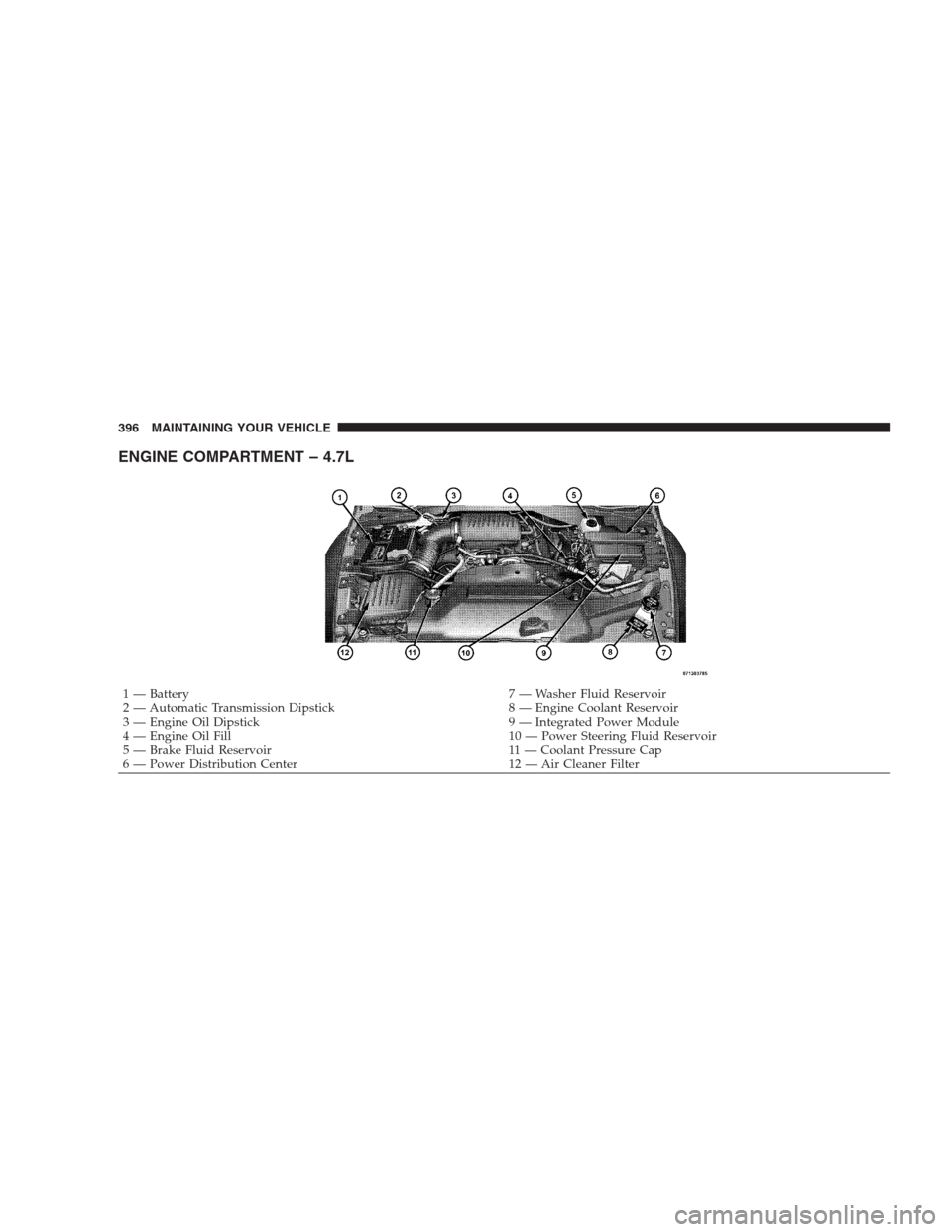
ENGINE COMPARTMENT – 4.7L
1 — Battery 7 — Washer Fluid Reservoir
2 — Automatic Transmission Dipstick 8 — Engine Coolant Reservoir
3 — Engine Oil Dipstick 9 — Integrated Power Module
4 — Engine Oil Fill 10 — Power Steering Fluid Reservoir
5 — Brake Fluid Reservoir 11 — Coolant Pressure Cap
6 — Power Distribution Center 12 — Air Cleaner Filter 396 MAINTAINING YOUR VEHICLE
Page 399 of 498
ENGINE COMPARTMENT – 5.7L
1 — Battery 7 — Washer Fluid Reservoir
2 — Automatic Transmission Dipstick 8 — Engine Coolant Reservoir
3 — Engine Oil Fill 9 — Integrated Power Module
4 — Engine Oil Dipstick 10 — Power Steering Fluid Reservoir
5 — Brake Fluid Reservoir 11 — Coolant Pressure Cap
6 — Power Distribution Center 12 — Air Cleaner FilterMAINTAINING YOUR VEHICLE 3977
Page 403 of 498

your vehicle. Refer to these manuals before attempting
any procedure yourself.
NOTE:Intentional tampering with emissions control
systems can result in civil penalties being assessed
against you.
WARNING!
You can be badly injured working on or around a
motor vehicle. Do only that service work for which
you have the knowledge and the proper equipment.
If you have any doubt about your ability to perform
a service job, take your vehicle to a competent
mechanic.
MAINTENANCE PROCEDURES
The pages that follow contain therequiredmaintenance
services determined by the engineers who designed your
vehicle.Besides the maintenance items for which there are fixed
maintenance intervals, there are other items that should
operate satisfactorily without periodic maintenance.
However, if a malfunction of these items does occur, it
could adversely affect the engine or vehicle performance.
These items should be inspected if a malfunction is
observed or suspected.
Engine Oil
Checking Oil Level
To assure proper lubrication of your vehicle’s engine, the
engine oil must be maintained at the correct level. The
best time to check the engine oil level is about five
minutes after a fully warmed up engine is shut off or
before starting the engine after it has sat overnight.
Checking the oil while the vehicle is on level ground will
improve the accuracy of the oil level readings. Always
maintain the oil level within the SAFE zone on the
dipstick. Adding 1 quart/liter of oil when the reading is
MAINTAINING YOUR VEHICLE 401
7
Page 404 of 498

at the bottom of the SAFE zone will result in a reading at
the top of the SAFE zone on these engines.
CAUTION!
Overfilling or underfilling the crankcase will cause
oil aeration or loss of oil pressure. This could damage
your engine.
Change Engine Oil
Refer to the “Maintenance Schedule” in Section 8 for
proper maintenance intervals.
Engine Oil Selection
For best performance and maximum protection under all
types of operating conditions, the manufacturer only
recommends engine oils that are API certified and meet
the requirements of Chrysler Material Standard MS-6395.
American Petroleum Institute (API) Engine Oil
Identification Symbol
This symbol means that the oil has
been certified by the American
Petroleum Institute (API). The
manufacturer only recommends
API Certified engine oils.
Engine Oil Viscosity (SAE Grade)
SAE 5W-20 engine oil is recommended for all operating
temperatures. This engine oil improves low temperature
starting and vehicle fuel economy.
The engine oil filler cap also shows the recommended
engine oil viscosity for your vehicle. For information on
engine oil filler cap location, refer to “Engine Compart-
ment” in this section.
402 MAINTAINING YOUR VEHICLE