Page 396 of 498

▫Adding Washer Fluid................. 407
▫Exhaust System..................... 408
▫Cooling System..................... 410
▫Brake System....................... 416
▫Automatic Transmission............... 417
▫Transfer Case....................... 419
▫Axles............................. 420
▫Appearance Care And Protection From
Corrosion.......................... 420
�Fuses.............................. 426
▫Interior Fuses....................... 426
▫Underhood Fuses (Power Distribution
Center)........................... 429
▫Underhood Fuses
(Integrated Power Module)............. 432�Vehicle Storage....................... 434
�Replacement Light Bulbs................ 434
�Bulb Replacement..................... 435
▫Headlights/Parking/Turn Signal......... 435
▫Rear Side Marker, Tail Lights, Turn Signals
And Backup Lights — Replacement....... 437
▫License Lights...................... 440
▫Center High-Mounted Stoplight.......... 441
▫Fog Lights......................... 442
�Fluids And Capacities.................. 443
�Fluids, Lubricants And Genuine Parts....... 444
▫Engine............................ 444
▫Chassis........................... 445
394 MAINTAINING YOUR VEHICLE
Page 397 of 498
ENGINE COMPARTMENT – 3.7L
1 — Battery 7 — Washer Fluid Reservoir
2 — Automatic Transmission Dipstick 8 — Engine Coolant Reservoir
3 — Engine Oil Dipstick 9 — Integrated Power Module
4 — Engine Oil Fill 10 — Power Steering Fluid Reservoir
5 — Brake Fluid Reservoir 11 — Coolant Pressure Cap
6 — Power Distribution Center 12 — Air Cleaner FilterMAINTAINING YOUR VEHICLE 3957
Page 398 of 498
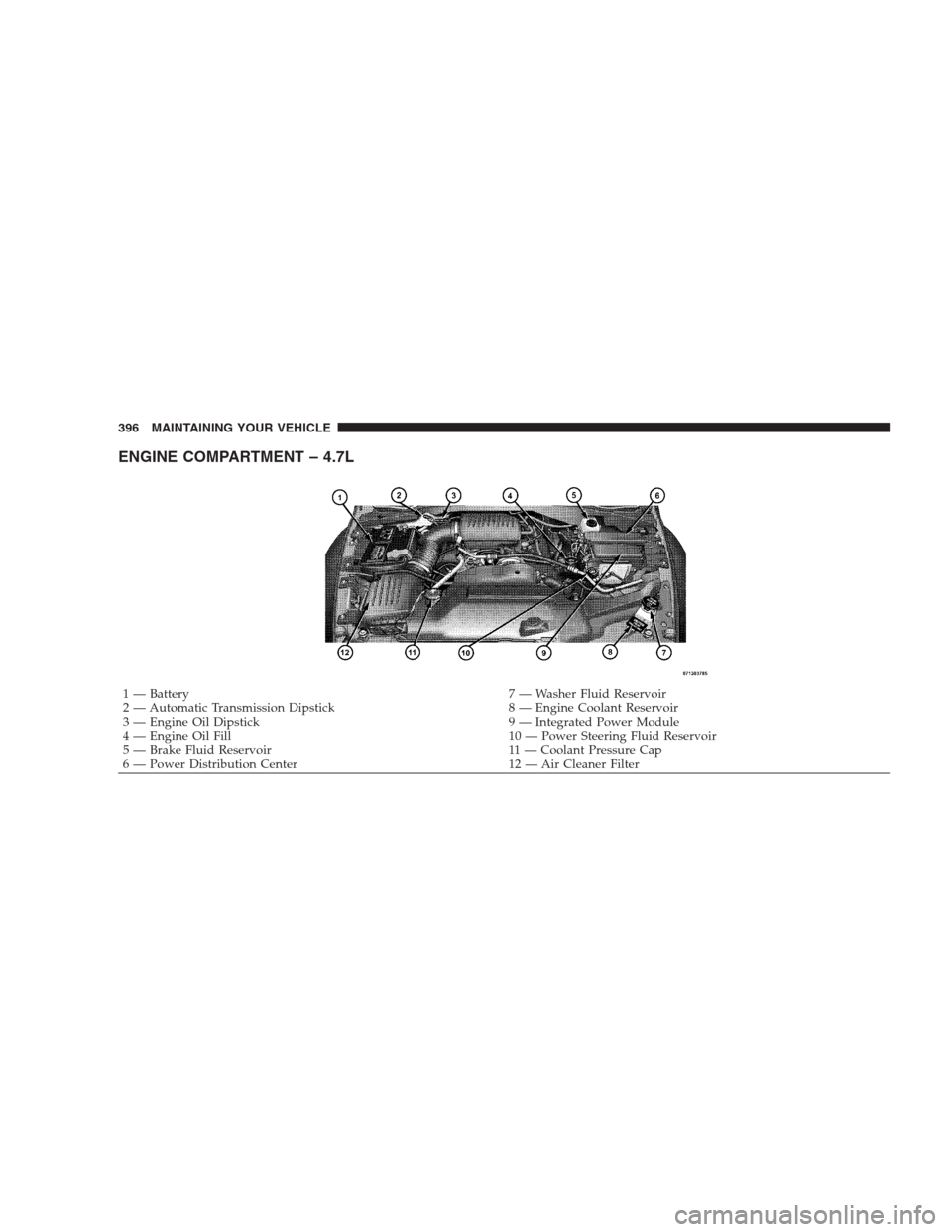
ENGINE COMPARTMENT – 4.7L
1 — Battery 7 — Washer Fluid Reservoir
2 — Automatic Transmission Dipstick 8 — Engine Coolant Reservoir
3 — Engine Oil Dipstick 9 — Integrated Power Module
4 — Engine Oil Fill 10 — Power Steering Fluid Reservoir
5 — Brake Fluid Reservoir 11 — Coolant Pressure Cap
6 — Power Distribution Center 12 — Air Cleaner Filter 396 MAINTAINING YOUR VEHICLE
Page 399 of 498
ENGINE COMPARTMENT – 5.7L
1 — Battery 7 — Washer Fluid Reservoir
2 — Automatic Transmission Dipstick 8 — Engine Coolant Reservoir
3 — Engine Oil Fill 9 — Integrated Power Module
4 — Engine Oil Dipstick 10 — Power Steering Fluid Reservoir
5 — Brake Fluid Reservoir 11 — Coolant Pressure Cap
6 — Power Distribution Center 12 — Air Cleaner FilterMAINTAINING YOUR VEHICLE 3977
Page 419 of 498
CAUTION!
Do not allow a petroleum-base fluid to contaminate
the brake fluid. Seal damage may result.
Automatic Transmission
Fluid Level Check
NOTE:If equipped with a dipstick, use the following
procedure. If your vehicle has a capped dipstick, it is
sealed and should not be tampered with. Your authorized
dealer has the proper tools to ensure that the fluid level
is set properly.
Check the fluid level while the transmission is at normal
operating temperature 180°F (82°C). This occurs after at
least 15 miles (24 km) of driving. At normal operating
temperature the fluid cannot be held comfortably be-
tween the fingertips.To check the automatic transmission fluid level properly,
the following procedure must be used:
1. Operate the engine at idle speed and normal operating
temperature.
2. The vehicle must be on level ground.
3. Fully apply the parking brake and press the brake
pedal.
4. Place the shift lever momentarily in each gear position
ending with the lever in PARK.
5. Remove the dipstick, wipe it clean and reinsert it until
seated.
6. Remove the dipstick again and note the fluid level on
both sides. The fluid level should be between the “HOT”
(upper) reference holes on the dipstick at normal operat-
ing temperature. Verify that solid coating of oil is seen on
both sides of the dipstick. If the fluid is low, add as
MAINTAINING YOUR VEHICLE 417
7
Page 420 of 498

required into the dipstick tube.Do not overfill.After
adding any quantity of oil through the oil fill tube, wait
a minimum of two minutes for the oil to fully drain into
the transmission before rechecking the fluid level.
NOTE:If it is necessary to check the transmissionbelow
the operating temperature, the fluid level should be
between the two “COLD” (lower) holes on the dipstick
with the fluid at approximately 70°F (21°C) (room tem-
perature). If the fluid level is correctly established at
room temperature, it should be between the “HOT”
(upper) reference holes when the transmission reaches
180°F ( 82°C). Remember it is best to check the level at the
normal operating temperature.CAUTION!
Be aware that if the fluid temperature is below 50°F
(10°C) it may not register on the dipstick. Do not add
fluid until the temperature is elevated enough to
produce an accurate reading.
7. Check for leaks. Release parking brake.
To prevent dirt and water from entering the transmission
after checking or replenishing fluid, make certain that the
dipstick cap is properly reseated. It is normal for the
dipstick cap to spring back slightly from its fully seated
position, as long as its seal remains engaged in the
dipstick tube.
418 MAINTAINING YOUR VEHICLE
Page 421 of 498
Selection of Lubricant
It is important that the proper lubricant is used in the
transmission to assure optimum transmission perfor-
mance. Use only the manufacturer ’s recommended trans-
mission fluid. Refer to “Fluids, Lubricants, and Genuine
Parts” in this section for correct fluid type. It is important
that the transmission fluid be maintained at the pre-
scribed level using the recommended fluid. No chemical
flushes should be used in any transmission; only the
approved lubricant may be used.
Special Additives
Automatic Transmission Fluid (ATF) is an engineered
product and its performance may be impaired by supple-
mental additives. Therefore, do not add any fluid addi-
tives to the transmission. The only exception to this
policy is the use of special dyes to aid in detecting fluid
leaks. In addition, avoid using transmission sealers as
they may adversely affect seals.
CAUTION!
Using a transmission fluid other than the manufac-
turer’s recommended fluid may cause deterioration
in transmission shift quality and/or torque converter
shudder. Using a transmission fluid other than the
manufacturer’s recommended fluid will result in
more frequent fluid and filter changes. Refer to
“Fluids, Lubricants, and Genuine Parts” in this sec-
tion for the correct fluid type.
Transfer Case
Inspect the transfer case for fluid leaks. If a fluid leak is
evident the transfer case fluid level may be low. Have the
transfer case serviced immediately.
MAINTAINING YOUR VEHICLE 419
7
Page 447 of 498
Chassis
Component Fluid, Lubricant, or Genuine Part
Automatic Transmission MOPAR�ATF+4 Automatic Transmission Fluid
Transfer Case MOPAR�ATF+4 Automatic Transmission Fluid
Front Axle SAE 75W-90 Multipurpose Type, GL-5 Gear Lubricant or equivalent.
Rear Axle SAE 75W-140 Synthetic Gear Lubricant or equivalent.
Brake Master Cylinder MOPAR�DOT 3 and SAE J1703 should be used or equivalent. If DOT 3
brake fluid is not available, then DOT 4 is acceptable. Use only recom-
mended brake fluids.
Power Steering Reservoir MOPAR�Power Steering Fluid +4, MOPAR�ATF+4 Automatic Transmis-
sion Fluid
MAINTAINING YOUR VEHICLE 445
7