2009 DODGE DURANGO tire type
[x] Cancel search: tire typePage 341 of 498

SNOW TIRES
Snow tires should be of the same size and type construc-
tion as the front tires. Consult the manufacturer of the
snow tire to determine any maximum vehicle speed
requirement associated with the tire. These tires should
always be operated at the vehicle maximum capacity
inflation pressures under any load condition.
While studded tires improve performance on ice, skid
and traction capability on wet or dry surfaces may be
poorer than that of non-studded tires. Some states pro-
hibit studded tires; therefore, local laws should be
checked before using these tire types.
TIRE ROTATION RECOMMENDATIONS
Tires on the front and rear axles of vehicles operate at
different loads and perform different steering, driving,
and braking functions. For these reasons, they wear at
unequal rates and tend to develop irregular wear pat-
terns. These effects can be reduced by timely rotation oftires. The benefits of rotation are especially worthwhile
with aggressive tread designs such as those on all season
type tires. Rotation will increase tread life, help to main-
tain mud, snow and wet traction levels, and contribute to
a smooth, quiet ride.
Tire Rotation
STARTING AND OPERATING 339
5
Page 342 of 498

Follow the recommended tire rotation frequency for your
type of driving found in the “Maintenance Schedules”
section of this manual. More frequent rotation is permis-
sible if desired. The reasons for any rapid or unusual
wear should be corrected prior to rotation being per-
formed.
TIRE PRESSURE MONITOR SYSTEM (TPMS)
The Tire Pressure Monitoring System (TPMS) will warn
the driver of a low tire pressure based on the vehicle
recommended cold placard pressure (the placard is lo-
cated on the driver’s side B-pillar).
The tire pressure will vary with temperature by about
1 psi (6.9 kPa) for every 12°F (6.5°C). This means that
when the outside temperature decreases, the tire pressure
will decrease. Tire pressure should always be set based
on cold inflation tire pressure. This is defined as the tire
pressure after a vehicle has not been driven for more than
three hours - and in outside ambient temperature.Referto the “Tires – General Information” in this section for
information on how to properly inflate the vehicle’s
tires. The tire pressure will also increase as the vehicle is
driven - this is normal and there should be no adjustment
for this increased pressure.
TPMS will warn the driver of a low tire pressure if the tire
pressure falls below the low pressure warning threshold
for any reason, including low temperature effects, or
natural pressure loss through the tire.
The TPMS will continue to warn the driver of low tire
pressure as long as the condition exists, and will not turn
off until the tire pressure is at or above recommended
cold placard pressure. Once the low tire pressure warn-
ing has been illuminated, the tire pressure must be
increased to the recommended cold placard pressure in
order for the TPMS warning light to be turned off. The
system will automatically update and the TPMS warning
light p will extinguish once the updated tire pressures
340 STARTING AND OPERATING
Page 343 of 498

have been received. The vehicle may need to be driven
for up to 20 minutes above 15 mph (25 km/h) to receive
this information.
For example, your vehicle has a recommended cold
(parked for more than three hours) placard pressure of
33 psi (227 kPa). If the ambient temperature is 68°F (20°C)
and the measured tire pressure is 28 psi (193 kPa), a
temperature drop to 20°F (-7°C) will decrease the tire
pressure to approximately 24 psi (165 kPa). This tire
pressure is sufficiently low enough to turn on the TPMS
light. Driving the vehicle may cause the tire pressure to
rise to approximately 28 psi (193 kPa), but the TPMS light
will still be ON. In this situation, the TPMS light will turn
off only after the tires have been inflated to the vehicle’s
recommended cold placard pressure value.CAUTION!
•The TPMS has been optimized for the original
equipment tires and wheels. TPMS pressures have
been established for the tire size equipped on your
vehicle. Undesirable system operation or sensor
damage may result when using replacement
equipment that is not of the same size, type, and/or
style. Aftermarket wheels can cause sensor dam-
age. Do not use aftermarket tire sealants or balance
beads if your vehicle is equipped with a TPMS, as
damage to the sensors may result.
•After inspecting or adjusting the tire pressure
always reinstall the valve stem cap. This will
prevent moisture and dirt from entering the valve
stem, which could damage the tire pressure moni-
toring sensor.
STARTING AND OPERATING 341
5
Page 367 of 498

•The weight of any other type of cargo or equipment
put in or on your vehicle.
•The weight of the driver and all passengers.
NOTE:Remember that everything put into or on the
trailer adds to the load on your vehicle. Also, additional
factory-installed options, or dealer-installed options,
must be considered as part of the total load on your
vehicle. Refer to “Tire and Loading Information Placard”
under “Tire Safety Information” in Section 5.
Towing Requirements
To promote proper break-in of your new vehicle driv-
etrain components the following guidelines are recom-
mended:
CAUTION!
•Avoid towing a trailer for the first 500 miles
(805 km) of vehicle operation. Doing so may dam-
age your vehicle.
•During the first 500 miles (805 km) of trailer
towing, limit your speed to 50 mph (80 km/h).
Perform the maintenance listed in the Maintenance
Schedule. Refer to Section 8 of this manual. When towing
a trailer, never exceed the GAWR or GCWR ratings.
WARNING!
Improper towing can lead to an injury accident.
Follow these guidelines to make your trailer towing
as safe as possible:
(Continued)
STARTING AND OPERATING 365
5
Page 413 of 498

clean by gently spraying water from a garden hose
vertically down the face of the condenser and radiator.
Check the coolant recovery bottle tubing for brittle rub-
ber, cracking, tears, cuts and tightness of the connection
at the bottle and radiator. Inspect the entire system for
leaks.
With the engine at normal operating temperature (but
not running), check the cooling system pressure cap for
proper vacuum sealing by draining a small amount of
engine coolant (antifreeze) from the radiator drain cock.
If the cap is sealing properly, the engine coolant (anti-
freeze) will begin to drain from the coolant recovery
bottle. DO NOT REMOVE THE COOLANT PRESSURE
CAP WHEN THE COOLING SYSTEM IS HOT.Cooling System — Drain, Flush and Refill
If the engine coolant (antifreeze) is dirty or contains a
considerable amount of sediment, clean and flush with a
reliable cooling system cleaner. Follow with a thorough
rinsing to remove all deposits and chemicals. Properly
dispose of the old engine coolant (antifreeze).
Refer to the “Maintenance Schedule” in Section 8 for
proper maintenance intervals.
Selection Of Coolant
Use only the manufacturer’s recommended engine cool-
ant (antifreeze). Refer to “Fluids, Lubricants, and Genu-
ine Parts” in this section for the correct fluid type.
MAINTAINING YOUR VEHICLE 411
7
Page 476 of 498
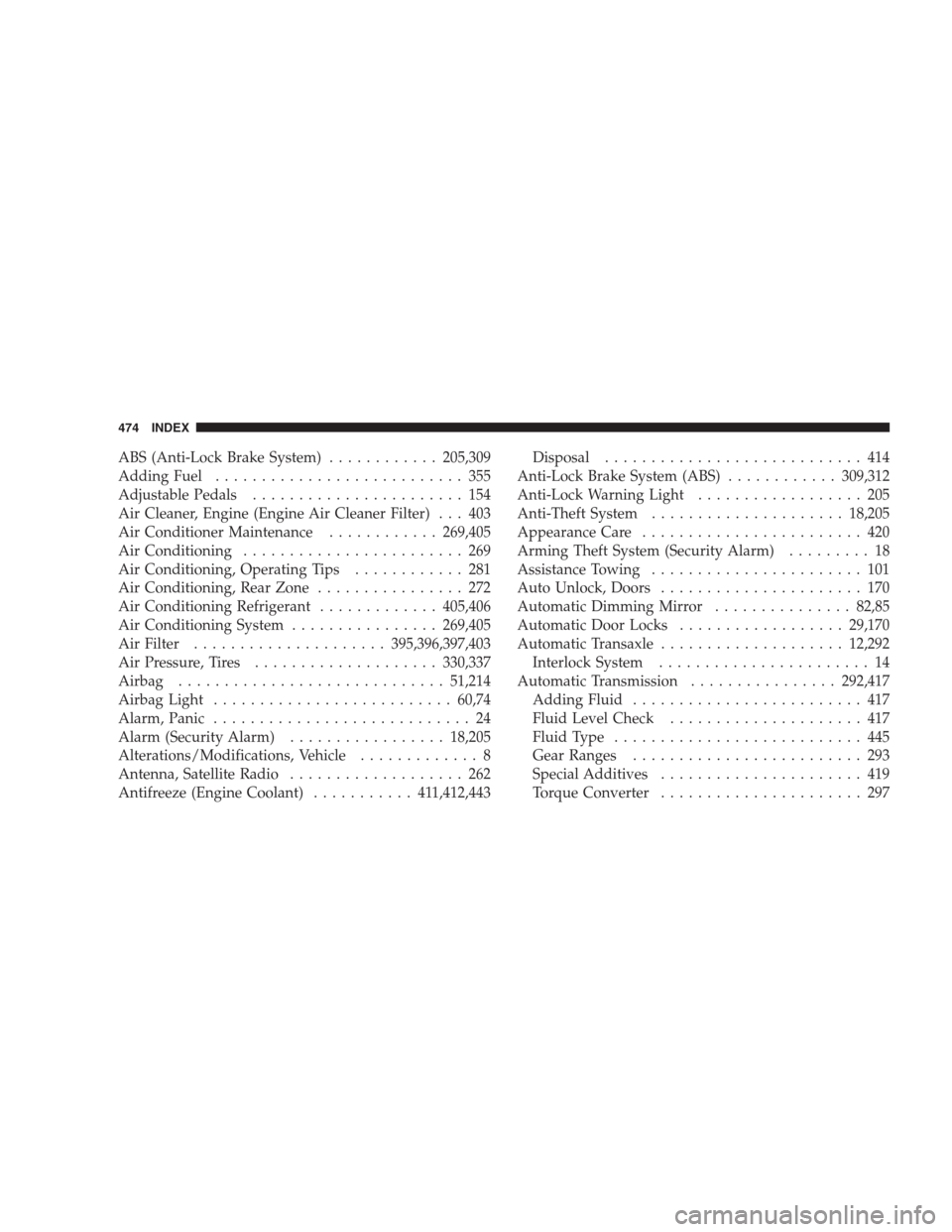
ABS (Anti-Lock Brake System)............205,309
Adding Fuel........................... 355
Adjustable Pedals....................... 154
Air Cleaner, Engine (Engine Air Cleaner Filter) . . . 403
Air Conditioner Maintenance............269,405
Air Conditioning........................ 269
Air Conditioning, Operating Tips............ 281
Air Conditioning, Rear Zone................ 272
Air Conditioning Refrigerant.............405,406
Air Conditioning System................269,405
Air Filter.....................395,396,397,403
Air Pressure, Tires....................330,337
Airbag.............................51,214
Airbag Light..........................60,74
Alarm, Panic............................ 24
Alarm (Security Alarm).................18,205
Alterations/Modifications, Vehicle............. 8
Antenna, Satellite Radio................... 262
Antifreeze (Engine Coolant)........... 411,412,443Disposal............................ 414
Anti-Lock Brake System (ABS)............309,312
Anti-Lock Warning Light.................. 205
Anti-Theft System.....................18,205
Appearance Care........................ 420
Arming Theft System (Security Alarm)......... 18
Assistance Towing....................... 101
Auto Unlock, Doors...................... 170
Automatic Dimming Mirror...............82,85
Automatic Door Locks..................29,170
Automatic Transaxle....................12,292
Interlock System....................... 14
Automatic Transmission................292,417
Adding Fluid......................... 417
Fluid Level Check..................... 417
Fluid Type........................... 445
Gear Ranges......................... 293
Special Additives...................... 419
Torque Converter...................... 297
474 INDEX
Page 488 of 498

Rear Camera........................... 163
Rear Cupholder......................... 190
Rear Liftgate............................ 35
Rear Park Sense System................... 158
Rear Window Defroster................... 194
Rear Window Features.................... 193
Rear Wiper/Washer...................... 193
Rearview Mirrors........................ 82
Reclining Front Seats..................... 121
Recorder, Event Data...................... 60
Recreational Towing...................... 371
Shifting into Transfer Case Neutral (N)....... 372
Shifting out of Transfer Case Neutral (N)..... 374
Reformulated Gasoline.................... 348
Refrigerant............................ 406
Release, Hood.......................... 141
Reminder, Seat Belt....................... 49
Remote Keyless Entry (RKE)................. 20
Remote Sound System (Radio) Controls........ 266Remote Starting System.................... 26
Replacement Keys........................ 16
Replacement Parts....................... 400
Replacement Tires....................... 336
Reporting Safety Defects................... 468
Resetting Oil Change Indicator...........169,207
Restraints, Child.......................62,67
Restraints, Occupant...................... 39
Rocking Vehicle When Stuck................ 390
Roll Over Warning........................ 4
Roof Type Carrier....................... 195
Rotation, Tires.......................... 339
Safety Checks Inside Vehicle................. 74
Safety Checks Outside Vehicle............... 74
Safety Defects, Reporting.................. 468
Safety, Exhaust Gas.....................38,73
Safety Information, Tire................... 320
Safety Tips............................. 72
486 INDEX