Page 313 of 498

CAUTION!
The ABS is subject to possible detrimental effects of
electronic interference caused by improperly in-
stalled aftermarket radios or telephones.
NOTE:During severe braking conditions, a pulsing
sensation may occur and a clicking noise will be heard.
This is normal, indicating that the ABS is functioning.
•Do not “ride” the brakes by resting your foot on the
pedal. This could overheat the brakes and result in
unpredictable braking action, longer stopping dis-
tances, or brake damage.
•When descending mountains or hills, repeated brak-
ing can cause brake fade with loss of braking control.
Avoid repeated heavy braking by downshifting the
transmission or locking out overdrive whenever pos-
sible.
•Engines may idle at higher speeds during warm-up,
which could cause rear wheels to spin and result in
loss of vehicle control. Be especially careful while
driving on slippery roads, in close-quarter maneuver-
ing, parking, or stopping.
•Do not drive too fast for road conditions, especially
when roads are wet or slushy. A wedge of water can
build up between the tire tread and the road. This
hydroplaning action can cause loss of traction, braking
ability, and control.
•After going through deep water or a car wash, brakes
may become wet, resulting in decreased performance
and unpredictable braking action. Dry the brakes by
gentle, intermittent pedal action while driving at very
slow speeds.
STARTING AND OPERATING 311
5
Page 314 of 498

ELECTRONIC BRAKE CONTROL SYSTEM
Your vehicle is equipped with an advanced electronic
brake control system that includes Anti-Lock Brake Sys-
tem (ABS), Traction Control System (TCS), Brake Assist
System (BAS), Electronic Roll Mitigation (ERM), Elec-
tronic Stability Program (ESP) and Trailer Sway Control
(TSC). All six systems work together to enhance vehicle
stability and control in various driving conditions, and
are commonly referred to as ESP.
Anti-Lock Brake System (ABS)
This system aids the driver in maintaining vehicle control
under adverse braking conditions. The system controls
hydraulic brake pressure to prevent wheel lockup and
help avoid skidding on slippery surfaces during braking.
Refer to “Anti-Lock Brake System” in Section 5 of this
manual for more information about ABS.
NOTE:ABS improves steering control of the vehicle
during hard braking maneuvers.
WARNING!
•ABS cannot prevent the natural laws of physics
from acting on the vehicle, nor can it increase
braking or steering efficiency beyond that af-
forded by the condition of the vehicle brakes and
tires or the traction afforded.
•The ABS cannot prevent accidents, including
those resulting from excessive speed in turns,
following another vehicle too closely, or hydro-
planing. Only a safe, attentive, and skillful driver
can prevent accidents.
•The capabilities of an ABS-equipped vehicle must
never be exploited in a reckless or dangerous
manner which could jeopardize the user’s safety
or the safety of others.
312 STARTING AND OPERATING
Page 315 of 498

Traction Control System (TCS)
This system monitors the amount of wheel spin of each of
the driven wheels. If wheel spin is detected, brake
pressure is applied to the slipping wheel(s) and engine
power is reduced to provide enhanced acceleration and
stability. A feature of the TCS system functions similar to
a limited slip differential and controls the wheel spin
across a driven axle. If one wheel on a driven axle is
spinning faster than the other, the system will apply the
brake of the spinning wheel. This will allow more engine
torque to be applied to the wheel that is not spinning.
This feature remains active even if TCS and ESP are in the
“Partial Off” mode. Refer to “ESP (Electronic Stability
Program)” in this Section. This brake pressure modula-
tion transfers drive torque from slipping to non-slipping
wheels to provide optimal forward traction.
Brake Assist System (BAS)
The BAS is designed to optimize the vehicle’s braking
capability during emergency braking maneuvers. The
system detects an emergency braking situation by sens-
ing the rate and amount of brake application and then
applies optimum pressure to the brakes. The system
applies optimum pressure to the brakes in emergency
braking conditions. This can help reduce braking dis-
tances. The BAS complements the ABS. Applying the
brakes very quickly results in the best BAS assistance. To
receive the benefit of the system, you must apply con-
tinuous braking pressure during the stopping sequence.
Do not reduce brake pedal pressure unless braking is no
longer desired.
Once the brake pedal is released, the BAS is deactivated.
STARTING AND OPERATING 313
5
Page 320 of 498

NOTE:To improve the vehicle’s traction when driving
with snow chains, or starting off in deep snow, sand or
gravel, it may be desirable to switch to the “Partial Off”
mode by pressing the ESP OFF switch. Once the situation
requiring ESP to be switched to the “Partial Off” mode is
overcome, turn ESP on by momentarily depressing the
ESP OFF switch. This may be done with the vehicle in
motion.
4WD LOW Range
Partial Off
This is the normal operating mode for ESP in 4WD LOW.
Whenever the vehicle is started in 4WD LOW or the
transfer case (if equipped) is shifted from 4WD LOCK or
NEUTRAL to 4WD LOW, the ESP system will be in this
mode. In 4WD LOW, ESP function is desensitized until
the vehicle reaches a speed of 30 mph (48 km/h). At
30 mph (48 km/h) the normal ESP stability function
returns and the ESP/TCS Indicator Light turns off. Whenthe vehicle speed drops below 25 mph (40 km/h) the ESP
system goes back to “Partial Off.” ESP is desensitized at
low vehicle speeds in 4WD LOW so that it will not
interfere with off road driving but ESP function returns to
provide the stability feature at speeds above 30 mph
(48 km/h). The ABS is in a special Off Road mode that
allows wheels to lock at lower speeds if gravel is detected
to shorten stopping distances.
NOTE:When the vehicle is in 4WD LOW, a feature of
the ESP system remains active whether the ESP is on or
off. This feature functions similar to a limited slip differ-
ential and controls the wheel spin across an axle. If one
wheel on an axle is spinning faster than the other, the
system will apply the brake of the spinning wheel and
allow more engine torque to be applied to the wheel that
is not spinning.
318 STARTING AND OPERATING
Page 323 of 498

NOTE:
•P (Passenger) - Metric tire sizing is based on U.S.
design standards. P-Metric tires have the letter “P”
molded into the sidewall preceding the size designa-
tion. Example: P215/65R15 95H.
•European-Metric tire sizing is based on European
design standards. Tires designed to this standard have
the tire size molded into the sidewall beginning with
the section width. The letter�P�is absent from this tire
size designation. Example: 215/65R15 96H.
•LT (Light Truck) - Metric tire sizing is based on U.S.
design standards. The size designation for LT-Metrictires is the same as for P-Metric tires except for the
letters “LT” that are molded into the sidewall preced-
ing the size designation. Example: LT235/85R16.
•Temporary spare tires are high-pressure compact
spares designed for temporary emergency use only.
Tires designed to this standard have the letter “T”
molded into the sidewall preceding the size designa-
tion. Example: T145/80D18 103M.
•High flotation tire sizing is based on U.S. design
standards and it begins with the tire diameter molded
into the sidewall. Example: 31x10.5 R15 LT.
STARTING AND OPERATING 321
5
Page 325 of 498
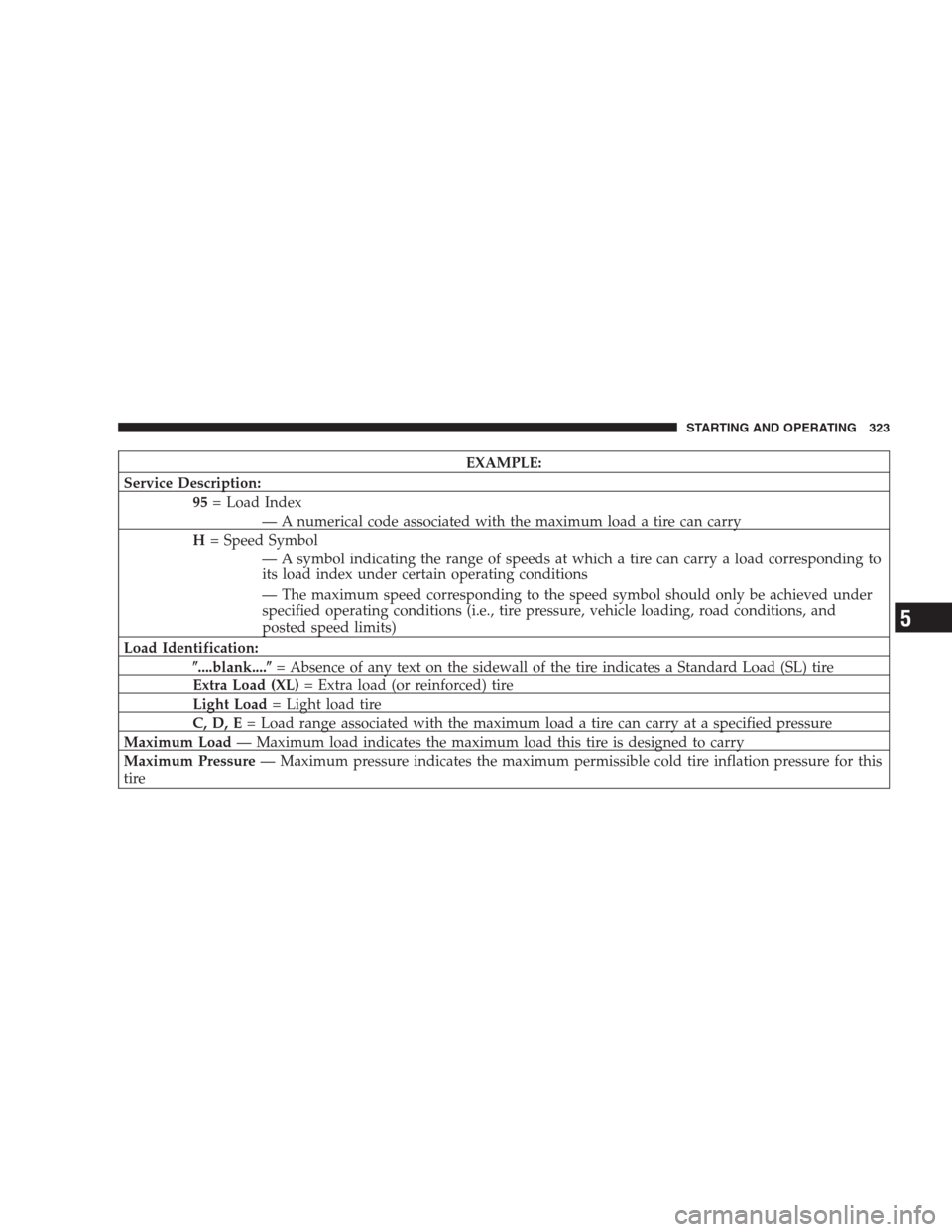
EXAMPLE:
Service Description:
95= Load Index
— A numerical code associated with the maximum load a tire can carry
H= Speed Symbol
— A symbol indicating the range of speeds at which a tire can carry a load corresponding to
its load index under certain operating conditions
— The maximum speed corresponding to the speed symbol should only be achieved under
specified operating conditions (i.e., tire pressure, vehicle loading, road conditions, and
posted speed limits)
Load Identification:
�....blank....�= Absence of any text on the sidewall of the tire indicates a Standard Load (SL) tire
Extra Load (XL)= Extra load (or reinforced) tire
Light Load= Light load tire
C, D, E= Load range associated with the maximum load a tire can carry at a specified pressure
Maximum Load— Maximum load indicates the maximum load this tire is designed to carry
Maximum Pressure— Maximum pressure indicates the maximum permissible cold tire inflation pressure for this
tire
STARTING AND OPERATING 323
5
Page 426 of 498

Interior trim should be cleaned starting with a damp
cloth, a damp cloth with MOPAR�Total Clean, then
MOPAR�Spot & Stain Remover, if absolutely necessary.
Do not use harsh cleaners or Armorall. Use MOPAR�
Total Clean to clean vinyl upholstery.
Leather Seat Care and Cleaning
MOPAR�Total Clean is specifically recommended for
leather upholstery.
Your leather upholstery can be best preserved by regular
cleaning with a damp soft cloth. Small particles of dirt
can act as an abrasive and damage the leather upholstery
and should be removed promptly with a damp cloth.
Stubborn soils can be removed easily with a soft cloth
and MOPAR�Total Clean. Care should be taken to avoid
soaking your leather upholstery with any liquid. Please
do not use polishes, oils, cleaning fluids, solvents, deter-
gents, or ammonia based cleaners to clean your leatherupholstery. Application of a leather conditioner is not
required to maintain the original condition.
WARNING!
Do not use volatile solvents for cleaning purposes.
Many are potentially flammable, and if used in
closed areas they may cause respiratory harm.
Cleaning Headlights
Your vehicle has plastic headlights that are lighter and
less susceptible to stone breakage than glass headlights.
Plastic is not as scratch resistant as glass and therefore
different lens cleaning procedures must be followed.
To minimize the possibility of scratching the lenses and
reducing light output, avoid wiping with a dry cloth. To
remove road dirt, wash with a mild soap solution fol-
lowed by rinsing.
424 MAINTAINING YOUR VEHICLE
Page 430 of 498
Cavity Mini Fuse/Color Description
F13 10 Amp RedIgnition Run
HVAC Module/
Heated Rear
Glass (EBL) Re-
lay
F14 10 Amp RedABS Module Ig-
nition Run
F15 15 Amp BlueBattery Feed
Bluetooth�,
Compass/Trip
Computer
(CMTC), Sentry
Key�Diagnos-
tics
F16 20 Amp YellowReconfigurable
Power OutletsCavity Mini Fuse/Color Description
F17 20 Amp YellowIgnition Run /
Rear Park Assist
/ Second Row
Heated Seats
F18 20 Amp YellowCigar Lighter
Ignition
F19 10 Amp Red Spare Fuse
F20 15 Amp BlueHeating & Air
Conditioning
w/ATC Only
Battery Feed
F21 25 Amp NaturalAmplifier Bat-
tery Feed
428 MAINTAINING YOUR VEHICLE
