Page 301 of 449
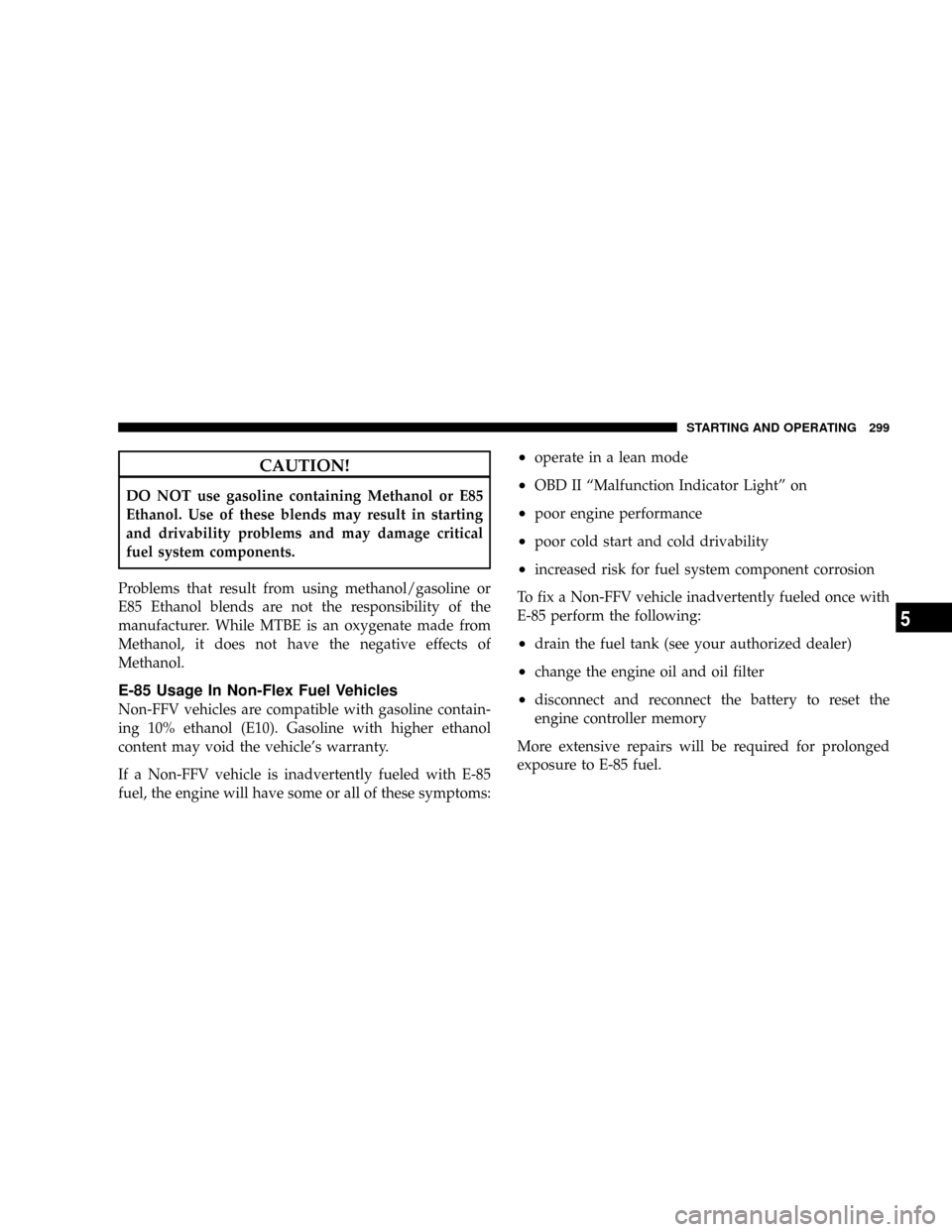
CAUTION!
DO NOT use gasoline containing Methanol or E85
Ethanol. Use of these blends may result in starting
and drivability problems and may damage critical
fuel system components.
Problems that result from using methanol/gasoline or
E85 Ethanol blends are not the responsibility of the
manufacturer. While MTBE is an oxygenate made from
Methanol, it does not have the negative effects of
Methanol.
E-85 Usage In Non-Flex Fuel Vehicles
Non-FFV vehicles are compatible with gasoline contain-
ing 10% ethanol (E10). Gasoline with higher ethanol
content may void the vehicle's warranty.
If a Non-FFV vehicle is inadvertently fueled with E-85
fuel, the engine will have some or all of these symptoms:
²operate in a lean mode
²OBD II ªMalfunction Indicator Lightº on
²poor engine performance
²poor cold start and cold drivability
²increased risk for fuel system component corrosion
To fix a Non-FFV vehicle inadvertently fueled once with
E-85 perform the following:
²drain the fuel tank (see your authorized dealer)
²change the engine oil and oil filter
²disconnect and reconnect the battery to reset the
engine controller memory
More extensive repairs will be required for prolonged
exposure to E-85 fuel.
STARTING AND OPERATING 299
5
Page 303 of 449
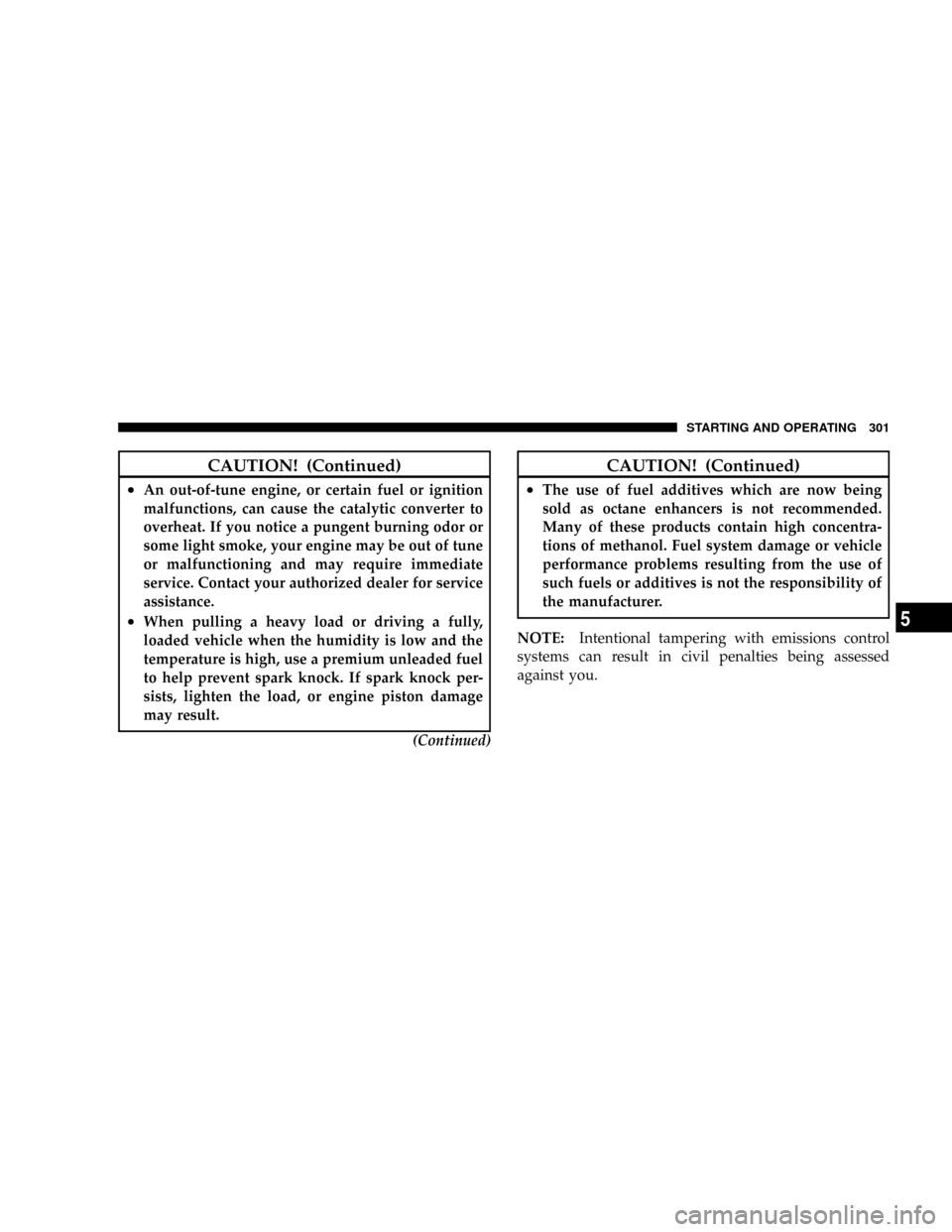
CAUTION! (Continued)
²An out-of-tune engine, or certain fuel or ignition
malfunctions, can cause the catalytic converter to
overheat. If you notice a pungent burning odor or
some light smoke, your engine may be out of tune
or malfunctioning and may require immediate
service. Contact your authorized dealer for service
assistance.
²When pulling a heavy load or driving a fully,
loaded vehicle when the humidity is low and the
temperature is high, use a premium unleaded fuel
to help prevent spark knock. If spark knock per-
sists, lighten the load, or engine piston damage
may result.
(Continued)
CAUTION! (Continued)
²The use of fuel additives which are now being
sold as octane enhancers is not recommended.
Many of these products contain high concentra-
tions of methanol. Fuel system damage or vehicle
performance problems resulting from the use of
such fuels or additives is not the responsibility of
the manufacturer.
NOTE:Intentional tampering with emissions control
systems can result in civil penalties being assessed
against you.
STARTING AND OPERATING 301
5
Page 306 of 449
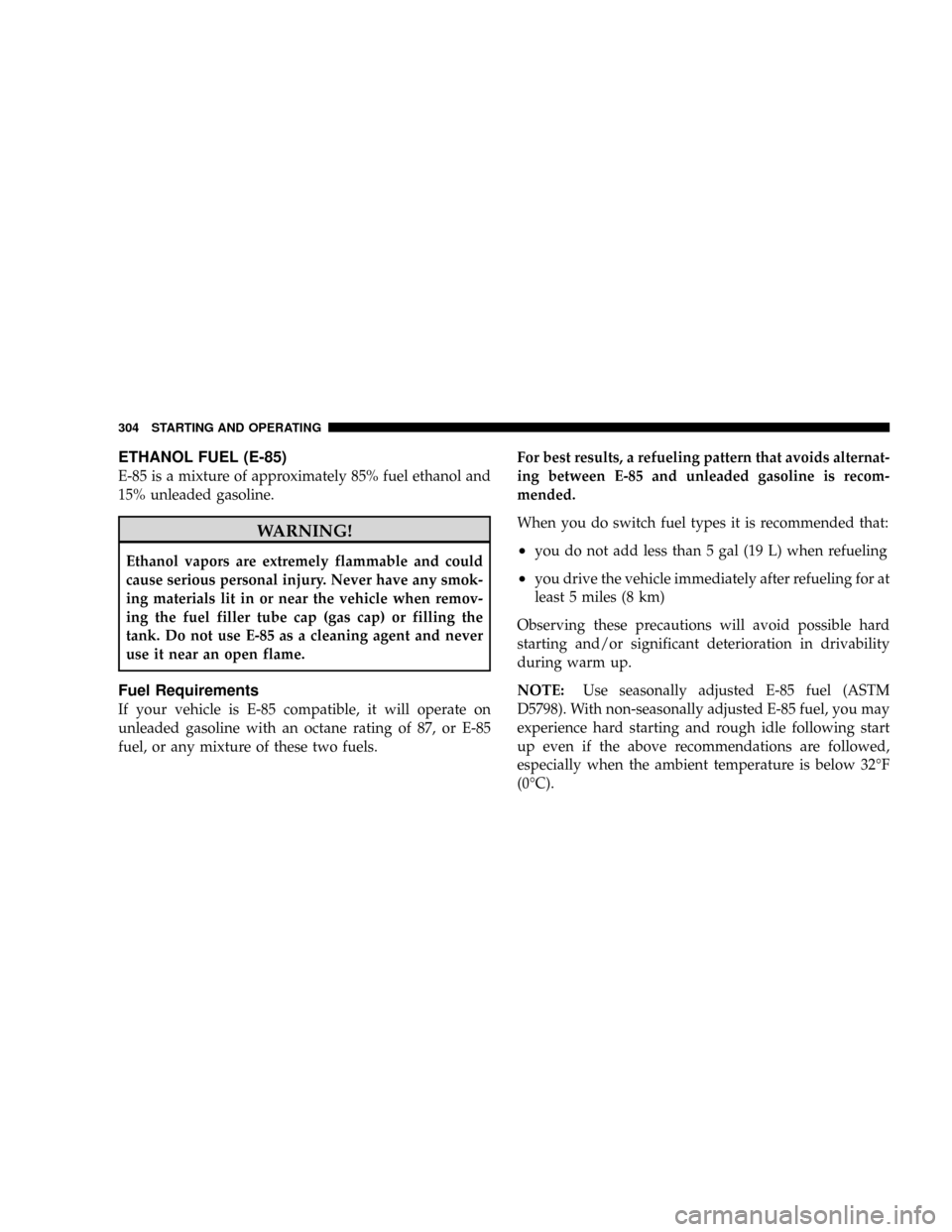
ETHANOL FUEL (E-85)
E-85 is a mixture of approximately 85% fuel ethanol and
15% unleaded gasoline.
WARNING!
Ethanol vapors are extremely flammable and could
cause serious personal injury. Never have any smok-
ing materials lit in or near the vehicle when remov-
ing the fuel filler tube cap (gas cap) or filling the
tank. Do not use E-85 as a cleaning agent and never
use it near an open flame.
Fuel Requirements
If your vehicle is E-85 compatible, it will operate on
unleaded gasoline with an octane rating of 87, or E-85
fuel, or any mixture of these two fuels.For best results, a refueling pattern that avoids alternat-
ing between E-85 and unleaded gasoline is recom-
mended.
When you do switch fuel types it is recommended that:
²you do not add less than 5 gal (19 L) when refueling
²you drive the vehicle immediately after refueling for at
least 5 miles (8 km)
Observing these precautions will avoid possible hard
starting and/or significant deterioration in drivability
during warm up.
NOTE:Use seasonally adjusted E-85 fuel (ASTM
D5798). With non-seasonally adjusted E-85 fuel, you may
experience hard starting and rough idle following start
up even if the above recommendations are followed,
especially when the ambient temperature is below 32ÉF
(0ÉC).
304 STARTING AND OPERATING
Page 330 of 449

NOTE:
²Steps 1 through 5 are requirements that must be met
prior to depressing the NEUTRAL selection button,
and must continue to be met until 1 second elapses
and the shift has been completed. If any of these
requirements (with the exception of 3 - key ON) are
not met prior to depressing the NEUTRAL button or
are no longer met during the 1 second time, then all of
the mode position indicator lights will flash continu-
ously until all requirements are met or until the
NEUTRAL button is released.
²The ignition key must be ON for a shift to take place
and for the position indicator lights to be operable. If
the key is not ON, the shift will not take place and no
position indicator lights will be on or flashing.
²Flashing NEUTRAL position indicator light indicates
that shift requirements have not been met.
WARNING!
You or others could be injured if you leave the
vehicle unattended with the transfer case in the
NEUTRAL position without first fully engaging the
parking brake. The transfer case NEUTRAL position
disengages both the front and rear driveshafts from
the powertrain and will allow the vehicle to move
despite the transmission position. The parking brake
should always be applied when the driver is not in
the vehicle.
328 STARTING AND OPERATING
Page 370 of 449
Please review these recommendations for using Hybrid
Organic Additive Technology (HOAT) engine coolant
(antifreeze). When adding engine coolant (antifreeze):
²The manufacturer recommends using MOPARt
Antifreeze/Coolant 5 Year/100,000 Mile Formula
HOAT (Hybrid Organic Additive Technology)
²Mix a minimum solution of 50% HOAT engine coolant
(antifreeze) and distilled water. Use higher concentra-
tions (not to exceed 70%) if temperatures below -34É F
(-37É C) are anticipated.
²Use only high purity water such as distilled or deion-
ized water when mixing the water/engine coolant
(antifreeze) solution. The use of lower quality water
will reduce the amount of corrosion protection in the
engine cooling system.Please note that it is the owner's responsibility to main-
tain the proper level of protection against freezing ac-
cording to the temperatures occurring in the area where
the vehicle is operated.
NOTE:Mixing engine coolant (antifreeze) types will
decrease the life of the engine coolant (antifreeze) and
will require more frequent engine coolant (antifreeze)
changes.
Cooling System Pressure Cap
The cap must be fully tightened to prevent loss of engine
coolant (antifreeze), and to ensure that the engine coolant
(antifreeze) will return to the radiator from the coolant
recovery bottle.
The cap should be inspected and cleaned if there is any
accumulation of foreign material on the sealing surfaces.
368 MAINTAINING YOUR VEHICLE
Page 380 of 449
Special Care
²
If you drive on salted or dusty roads, or if you drive
near the ocean, hose off the undercarriage at least once
a month.
²It is important that the drain holes in the lower edges
of the doors, rocker panels be kept clear and open.
²If you detect any stone chips or scratches in the paint,
touch them up immediately. The cost of such repairs is
considered the responsibility of the owner.
²If your vehicle is damaged due to an accident or
similar cause, which destroys the paint and protective
coating, have your vehicle repaired as soon as pos-
sible. The cost of such repairs is considered the respon-
sibility of the owner.
²If you carry special cargo such as chemicals, fertilizers,
de-icer salt, etc., be sure that such materials are well
packaged and sealed.
²If a lot of driving is done on gravel roads, consider
mud or stone shields behind each wheel.
²Use MOPARtTouch Up Paint on scratches as soon as
possible. Your authorized dealer has touch up-paint to
match the color of your vehicle.
Wheel and Wheel Trim Care
All wheels and wheel trim, especially aluminum and
chrome-plated wheels, should be cleaned regularly with
a mild soap and water to prevent corrosion. To remove
heavy soil, use MOPARtWheel Cleaner or select a
nonabrasive, non-acidic cleaner. Do not use scouring
pads, steel wool, a bristle brush or metal polishes. Only
MOPARtcleaners are recommended. Do not use oven
cleaner. Avoid automatic car washes that use acidic
solutions or harsh brushes that may damage the wheels'
protective finish.
378 MAINTAINING YOUR VEHICLE
Page 382 of 449
Stubborn soils can be removed easily with a soft cloth
and MOPARtTotal Clean. Care should be taken to avoid
soaking your leather upholstery with any liquid. Please
do not use polishes, oils, cleaning fluids, solvents, deter-
gents, or ammonia-based cleaners to clean your leather
upholstery. Application of a leather conditioner is not
required to maintain the original condition.
WARNING!
Do not use volatile solvents for cleaning purposes.
Many are potentially flammable, and if used in
closed areas they may cause respiratory harm.
Glass Surfaces
All glass surfaces should be cleaned on a regular basis
with any commercial household-type glass cleaner.
Never use an abrasive type cleaner. Use caution when
cleaning inside rear windows equipped with electricdefrosters, or windshields equipped with a windshield
wiper de-icer. Do not use scrapers or other sharp instru-
ments, which may scratch the elements.
When cleaning the rearview mirror, spray cleaner on the
towel or rag that you are using. Do not spray cleaner
directly on the mirror.
Cleaning Plastic Instrument Cluster Lenses
The lenses in front of the instruments in this vehicle are
molded in clear plastic. When cleaning the lenses, care
must be taken to avoid scratching the plastic.
1. Clean with a wet soft rag. A mild soap solution may be
used, but do not use high alcohol content or abrasive
cleaners. If soap is used, wipe clean with a clean damp
rag.
2. Dry with a soft tissue.
380 MAINTAINING YOUR VEHICLE
Page 384 of 449
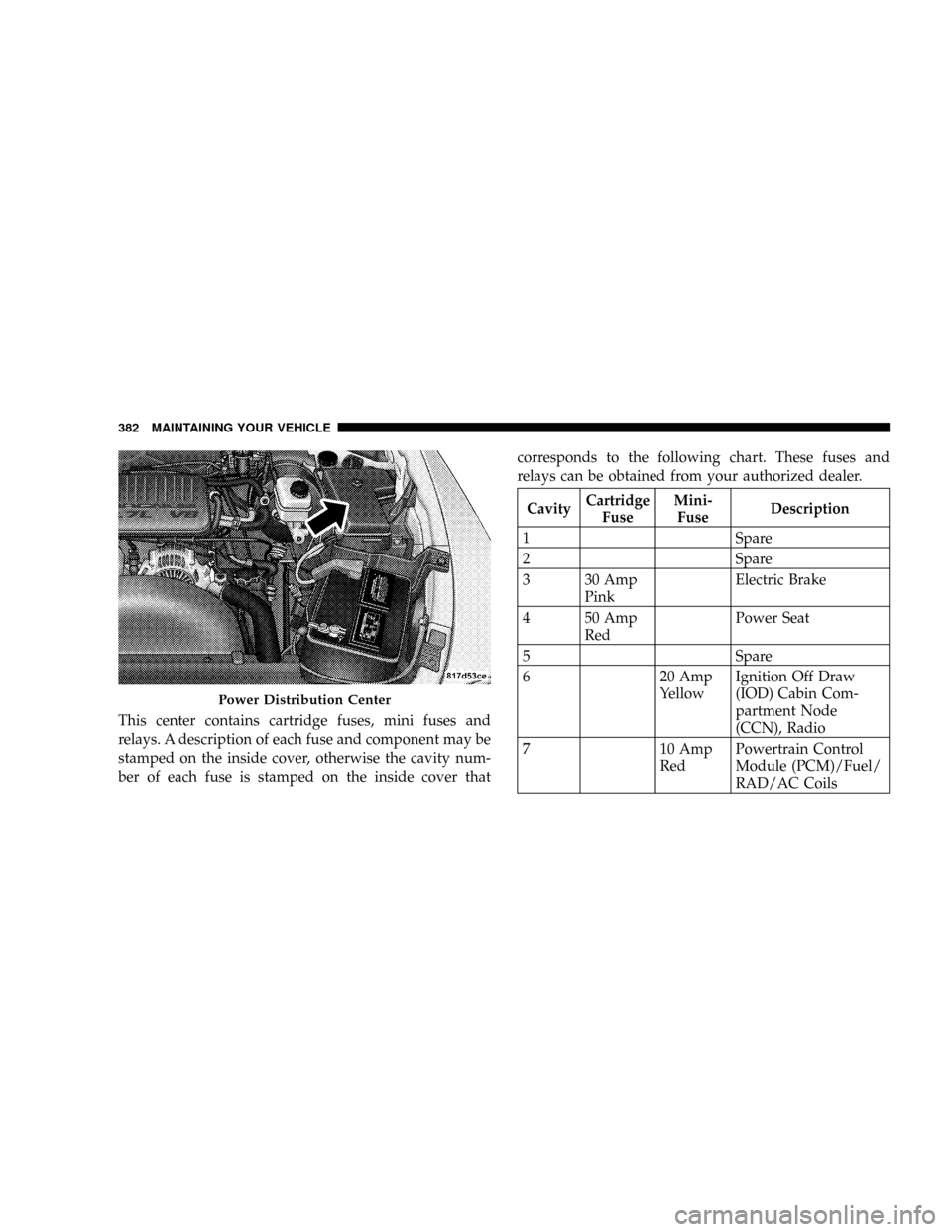
This center contains cartridge fuses, mini fuses and
relays. A description of each fuse and component may be
stamped on the inside cover, otherwise the cavity num-
ber of each fuse is stamped on the inside cover thatcorresponds to the following chart. These fuses and
relays can be obtained from your authorized dealer.
CavityCartridge
FuseMini-
FuseDescription
1 Spare
2 Spare
3 30 Amp
PinkElectric Brake
4 50 Amp
RedPower Seat
5 Spare
6 20 Amp
YellowIgnition Off Draw
(IOD) Cabin Com-
partment Node
(CCN), Radio
7 10 Amp
RedPowertrain Control
Module (PCM)/Fuel/
RAD/AC Coils
Power Distribution Center
382 MAINTAINING YOUR VEHICLE