2009 DODGE DAKOTA child lock
[x] Cancel search: child lockPage 67 of 449
reach. If the buckled seat belt interferes with the child
restraint installation, instead of tucking the seat belt
behind the child restraint, route the seat belt through the
child restraint belt path and then buckle it. This should
stow the seat belt out of the reach of an inquisitive child.
Remind all children in the vehicle that the seat belts are
not toys and should not be played with, and never leave
your child unattended in the vehicle.
WARNING!
Improper installation of a child restraint to the
LATCH anchorages can lead to failure of an infant or
child restraint. The child could be badly injured or
killed. Follow the manufacturer's directions exactly
when installing an infant or child restraint.
Installing Child Restraints Using the Vehicle Seat
Belt
The passenger seat belts are equipped with either cinch-
ing latch plates or automatic locking retractors, which are
designed to keep the lap portion tight around the child
restraint, so that it should not be necessary to use a
locking clip. If the seat belt has a cinching latch plate,
pulling up on the shoulder portion of the lap/shoulder
belt will tighten the belt. The cinching latch plate will
keep the belt tight; however, any seat belt system will
loosen with time, so check the belt occasionally and pull
it tight if necessary. If the seat belt has an automatic
locking retractor, it will have a distinctive label. Pull the
belt from the retractor until there is enough to allow you
to pass through the child restraint and slide the latch
plate into the buckle. Then, pull the belt until it is fully
extended from the retractor. Allow the belt to return to
the retractor, pulling on the excess webbing to tighten the
lap portion about the child restraint. For automatic
THINGS TO KNOW BEFORE STARTING YOUR VEHICLE 65
2
Page 68 of 449
locking retractor seat belts, refer to9Automatic Locking
Mode9in this section. If you have trouble tightening the
lap/shoulder belt on the child restraint because, the
buckle or latch plate is too close to the belt path opening
on the restraint, follow these steps. If the buckle is
webbing-mounted, disconnect the latch plate from the
buckle and twist the short buckle-end belt to shorten it.
Insert the latch plate into the buckle with the release
button facing out. If the belt still can't be tightened, the
buckle is not webbing-mounted, or if by pulling and
pushing on the restraint loosens the belt, you may need
to do something more. Disconnect the latch plate from
the buckle, turn the latch plate around, and insert the
latch plate into the buckle again. If you still can't make
the child restraint secure, try a different seating position
or use the locking clip provided with your child restraint.
To complete the child seat installation, refer to9Child
Restraint Tether Anchor9in this section.Child Restraint Tether Anchor
The Extended Cab model has one routing strap
located behind the passenger side, rear out-
board seating position. The tether anchor itself
is located in the center of vehicle, in between
the two seating positions. The front outboard passenger
seating position is also equipped with a child tether
anchorage, located at the base of the front seatback.
When there is a rear seat delete option, the tether
anchorage located on the cab back panel is designed to be
used for the front seat center seating position. The Crew
Cab model has three anchorages located behind each of
the rear seating positions (rear left, rear center, and rear
right).
66 THINGS TO KNOW BEFORE STARTING YOUR VEHICLE
Page 241 of 449
STARTING PROCEDURES
Before starting your vehicle, adjust your seat, adjust both
inside and outside mirrors, and fasten your seat belts.
WARNING!
Do not leave children or animals inside parked
vehicles in hot weather. Interior heat buildup may
cause serious injury or death.
Manual Transmission
Apply the parking brake, place the shift lever in NEU-
TRAL and depress clutch pedal to the floor before
starting the vehicle. This vehicle is equipped with a
clutch interlocking ignition system. It will not start unless
the clutch is pressed to the floor.
Automatic Transmission
Start the engine with the shift lever in NEUTRAL or
PARK position. Apply the brake before shifting to any
driving range.
NOTE: This vehicle is equipped with a transmission
shift interlocking system. The brake pedal must be
depressed to shift out of PARK.
Tip Start Feature
Turn the ignition switch to START position and release it
as soon as the starter engages. The starter motor will
continue to run, but will automatically disengage itself
when the engine is running. If the engine fails to start, the
starter will disengage automatically in 10 seconds. If this
occurs, turn the ignition switch to the LOCK position,
wait 10 to 15 seconds, then repeat the normal starting
procedure.
STARTING AND OPERATING 239
5
Page 270 of 449
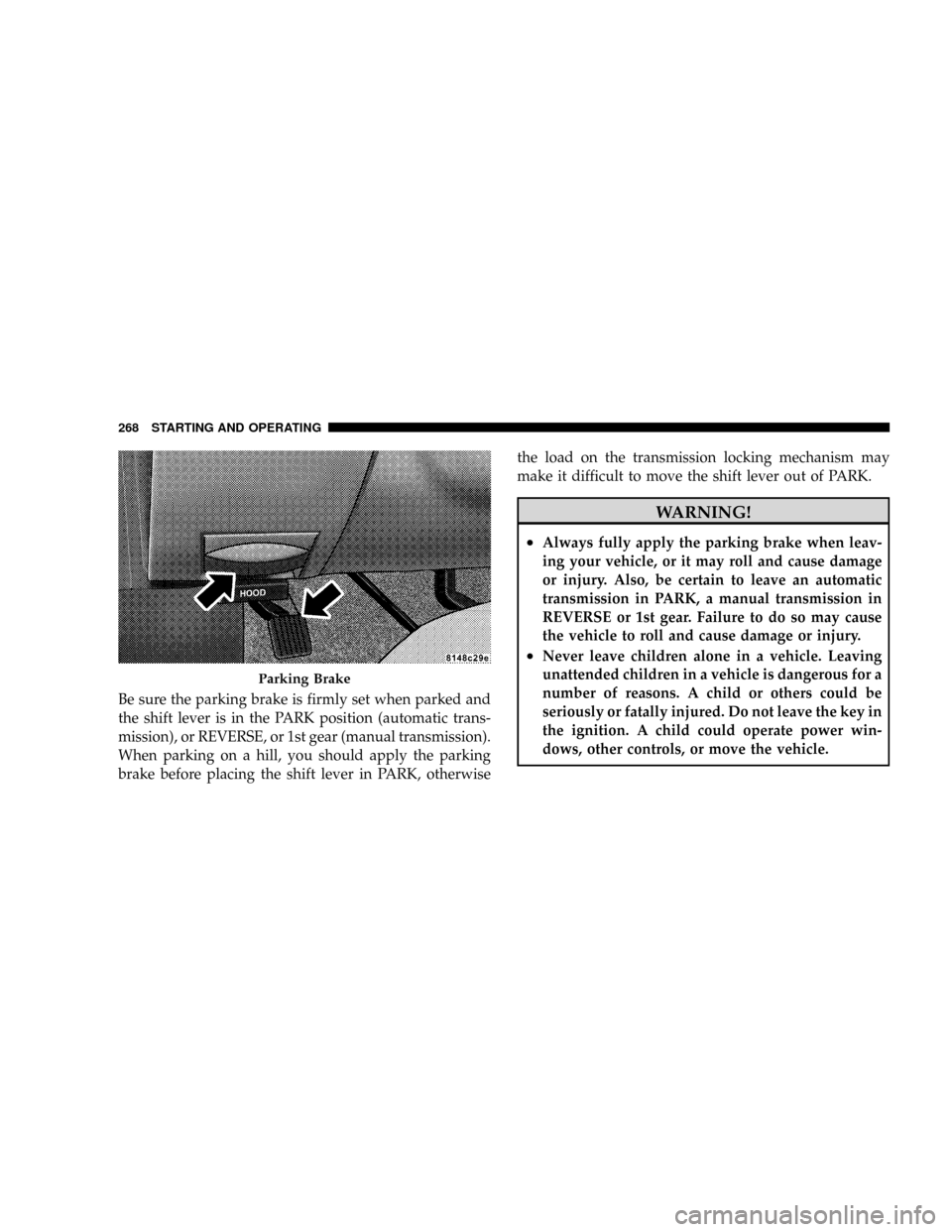
Be sure the parking brake is firmly set when parked and
the shift lever is in the PARK position (automatic trans-
mission), or REVERSE, or 1st gear (manual transmission).
When parking on a hill, you should apply the parking
brake before placing the shift lever in PARK, otherwisethe load on the transmission locking mechanism may
make it difficult to move the shift lever out of PARK.
WARNING!
²Always fully apply the parking brake when leav-
ing your vehicle, or it may roll and cause damage
or injury. Also, be certain to leave an automatic
transmission in PARK, a manual transmission in
REVERSE or 1st gear. Failure to do so may cause
the vehicle to roll and cause damage or injury.
²Never leave children alone in a vehicle. Leaving
unattended children in a vehicle is dangerous for a
number of reasons. A child or others could be
seriously or fatally injured. Do not leave the key in
the ignition. A child could operate power win-
dows, other controls, or move the vehicle.
Parking Brake
268 STARTING AND OPERATING
Page 432 of 449
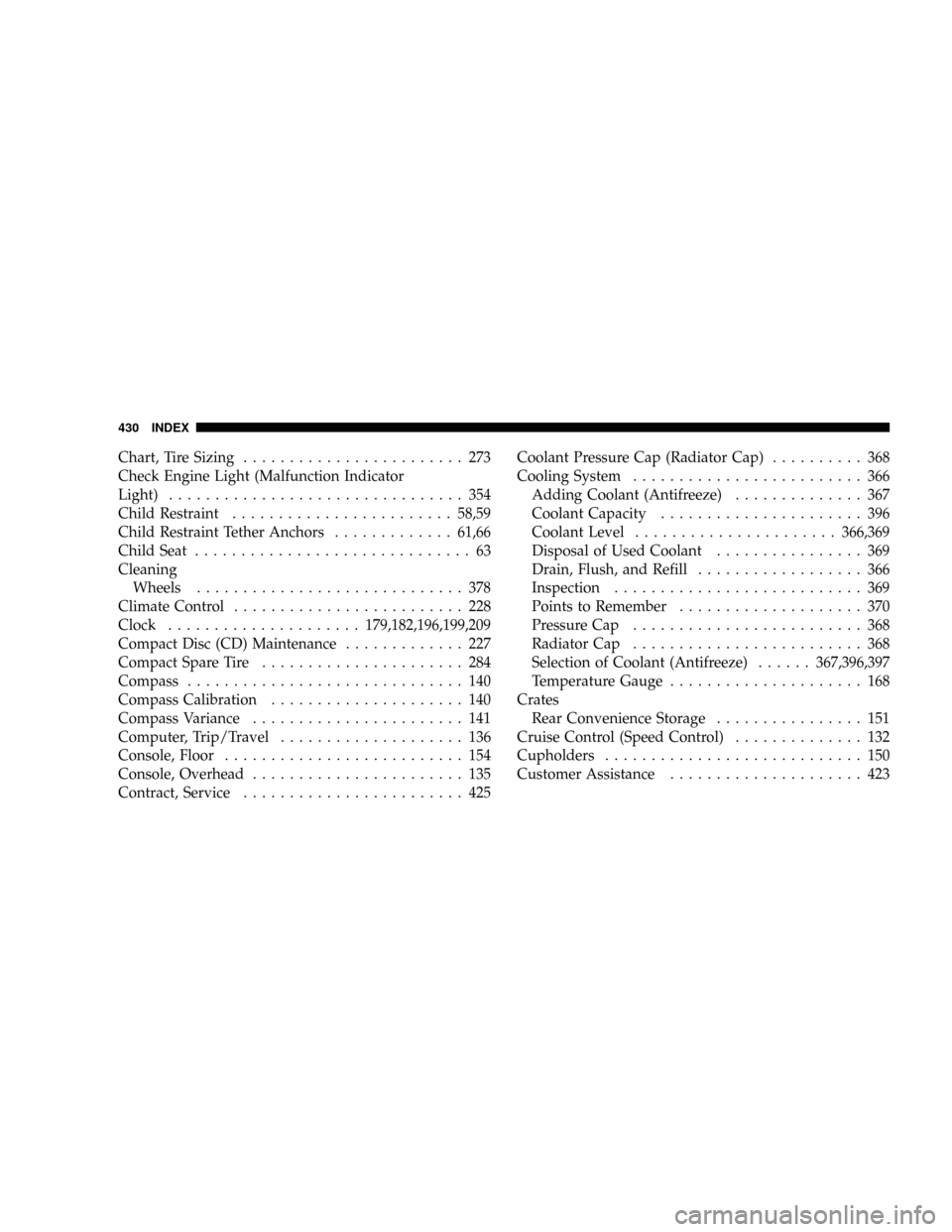
Chart, Tire Sizing........................ 273
Check Engine Light (Malfunction Indicator
Light)................................ 354
Child Restraint........................58,59
Child Restraint Tether Anchors.............61,66
Child Seat.............................. 63
Cleaning
Wheels............................. 378
Climate Control......................... 228
Clock.....................179,182,196,199,209
Compact Disc (CD) Maintenance............. 227
Compact Spare Tire...................... 284
Compass.............................. 140
Compass Calibration..................... 140
Compass Variance....................... 141
Computer, Trip/Travel.................... 136
Console, Floor.......................... 154
Console, Overhead....................... 135
Contract, Service........................ 425Coolant Pressure Cap (Radiator Cap).......... 368
Cooling System......................... 366
Adding Coolant (Antifreeze).............. 367
Coolant Capacity...................... 396
Coolant Level......................366,369
Disposal of Used Coolant................ 369
Drain, Flush, and Refill.................. 366
Inspection........................... 369
Points to Remember.................... 370
Pressure Cap......................... 368
Radiator Cap......................... 368
Selection of Coolant (Antifreeze)......367,396,397
Temperature Gauge..................... 168
Crates
Rear Convenience Storage................ 151
Cruise Control (Speed Control).............. 132
Cupholders............................ 150
Customer Assistance..................... 423
430 INDEX
Page 437 of 449
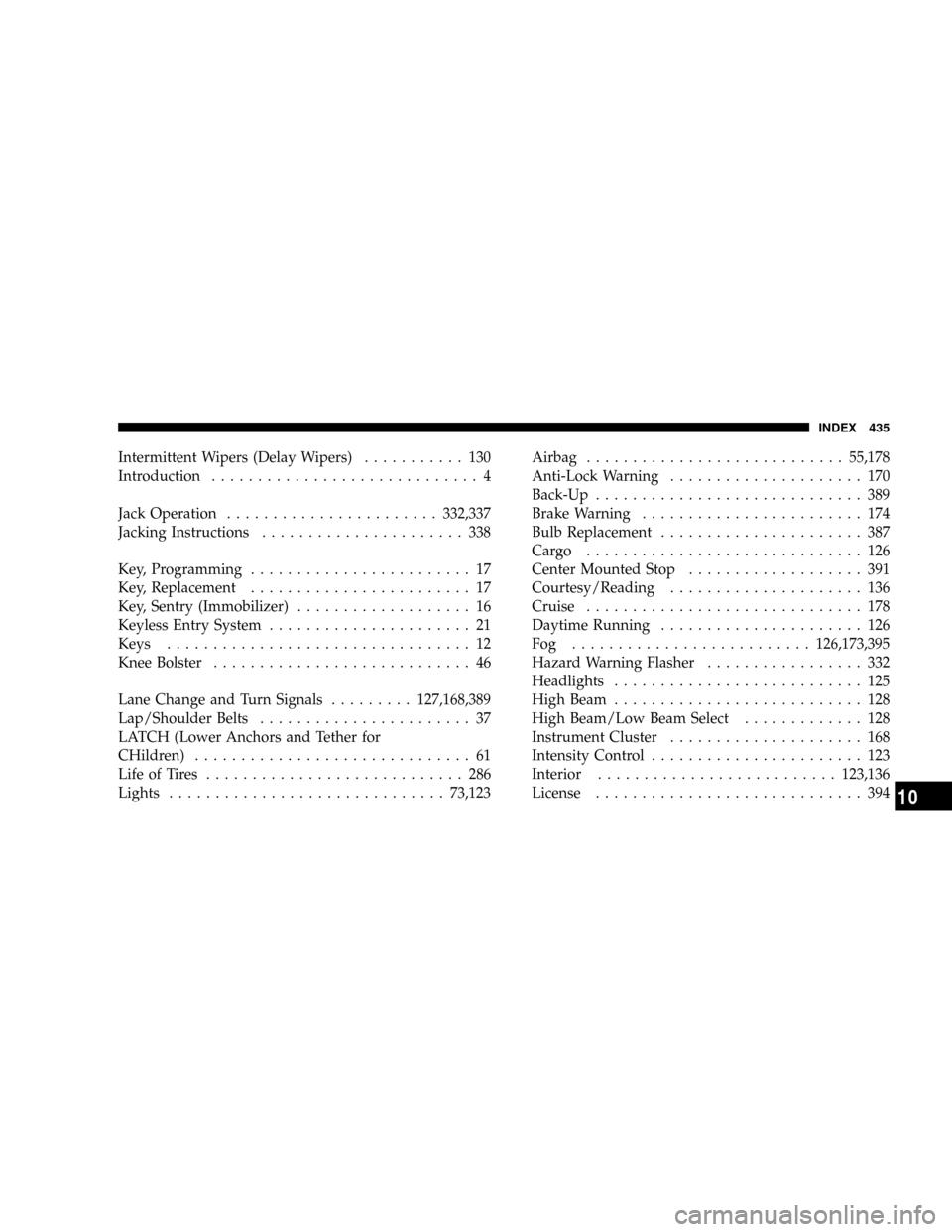
Intermittent Wipers (Delay Wipers)........... 130
Introduction............................. 4
Jack Operation.......................332,337
Jacking Instructions...................... 338
Key, Programming........................ 17
Key, Replacement........................ 17
Key, Sentry (Immobilizer)................... 16
Keyless Entry System...................... 21
Keys................................. 12
Knee Bolster............................ 46
Lane Change and Turn Signals.........127,168,389
Lap/Shoulder Belts....................... 37
LATCH (Lower Anchors and Tether for
CHildren).............................. 61
Life of Tires............................ 286
Lights..............................73,123Airbag............................55,178
Anti-Lock Warning..................... 170
Back-Up............................. 389
Brake Warning........................ 174
Bulb Replacement...................... 387
Cargo .............................. 126
Center Mounted Stop................... 391
Courtesy/Reading..................... 136
Cruise.............................. 178
Daytime Running...................... 126
Fog ..........................126,173,395
Hazard Warning Flasher................. 332
Headlights........................... 125
High Beam........................... 128
High Beam/Low Beam Select............. 128
Instrument Cluster..................... 168
Intensity Control....................... 123
Interior..........................123,136
License............................. 394
INDEX 435
10
Page 438 of 449
Lights On Reminder.................... 126
Low Fuel............................ 168
Malfunction Indicator (Check Engine)........ 175
Passing............................. 128
Seat Belt Reminder..................... 169
Service.............................. 387
Tire Pressure Monitoring (TPMS)........... 176
Turn Signal.....................127,387,389
Voltage............................. 170
Warning (Instrument Cluster Description)..... 168
Limited-Slip Differential................... 262
Loading Vehicle......................... 308
Tires ............................... 276
Locks................................. 29
Auto Unlock.......................... 31
Automatic Door........................ 30
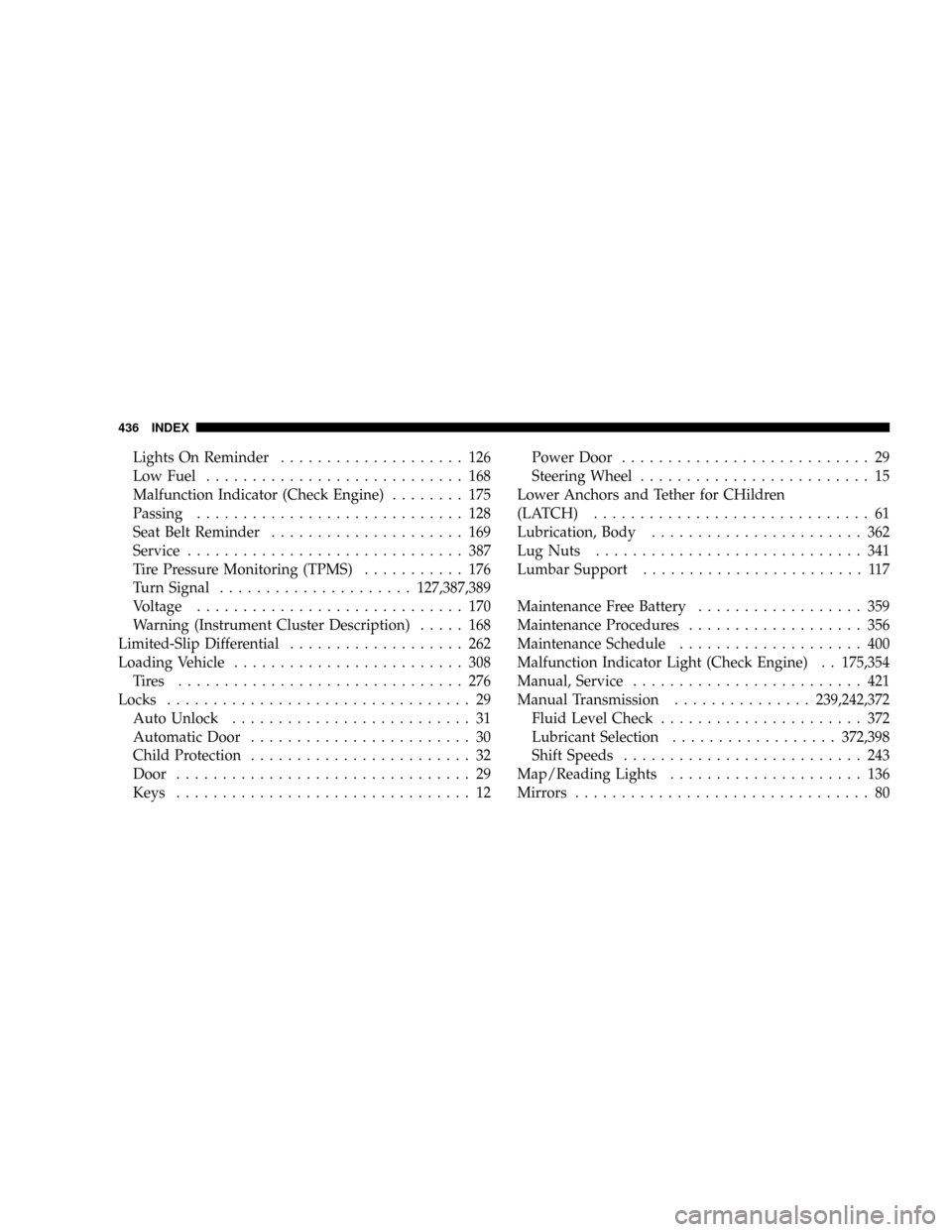
Child Protection........................ 32
Door................................ 29
Keys................................ 12Power Door........................... 29
Steering Wheel......................... 15
Lower Anchors and Tether for CHildren
(LATCH).............................. 61
Lubrication, Body....................... 362
Lug Nuts............................. 341
Lumbar Support........................ 117
Maintenance Free Battery.................. 359
Maintenance Procedures................... 356
Maintenance Schedule.................... 400
Malfunction Indicator Light (Check Engine) . . 175,354
Manual, Service......................... 421
Manual Transmission...............239,242,372
Fluid Level Check...................... 372
Lubricant Selection..................372,398
Shift Speeds.......................... 243
Map/Reading Lights..................... 136
Mirrors................................ 80
436 INDEX
Page 443 of 449

Emergency (Jump Starting)............... 343
Engine Block Heater.................... 241
Engine Fails to Start.................... 240
Remote.............................. 27
Steering
Column Controls...................... 127
Power.............................. 266
Wheel Lock........................... 15
Wheel, Tilt........................... 131
Steering Wheel Mounted Sound System
Controls.............................. 226
Storage, Behind the Seat................... 151
Storage Bin............................ 151
Storage, Vehicle......................... 386
Stuck, Freeing.......................... 346
Supplemental Tire Pressure Information........ 289
Synthetic Engine Oil...................... 358
System, Remote Starting.................... 27Tachometer............................ 171
Tailgate............................... 158
Taillights.............................. 389
Temperature Gauge, Engine Coolant.......... 168
Tether Anchor, Child Restraint............... 61
Tilt Steering Column..................... 131
Tip Start.............................. 239
Tire and Loading Information Placard......276,289
Tire Identification Number (TIN)............. 275
Tire Markings.......................... 272
Tire Safety Information.................... 272
Tires ............................73,280,422
Aging (Life of Tires).................... 286
Air Pressure.......................... 280
Alignment........................... 288
Chains.............................. 289
Changing............................ 332
Compact Spare........................ 284
General Information.................... 280
INDEX 441
10