2009 DODGE CHARGER oil temperature
[x] Cancel search: oil temperaturePage 176 of 484
The gauge pointer will likely indicate a higher tempera-
ture when driving in hot weather, up mountain grades,
or when towing a trailer. It should not be allowed to
exceed the upper limits of the normal operating range.
CAUTION!
Driving with a hot engine cooling system could
damage your vehicle. If the temperature gauge reads
“H,” pull over and stop the vehicle. Idle the vehicle
with the air conditioner turned off until the pointer
drops back into the normal range. If the pointer
remains on the “H,” and you hear a chime, turn the
engine OFF immediately and call for service.
WARNING!
A hot engine cooling system is dangerous. You or
others could be badly burned by steam or boiling
coolant. You may want to call a service center if your
vehicle overheats. If you decide to look under the
hood yourself, refer to Section 7 and follow the
warnings under the Cooling System Pressure Cap
paragraph.
9. Turn Signal Indicators The arrow will flash with the exterior turn signal
when the turn signal lever is operated.
NOTE:
•A continuous chime will sound if the vehicle is driven
more than 1 mile (1.6 km) with either turn signal on.
•Check for an inoperative outside light bulb if either
indicator flashes at a rapid rate.
174 UNDERSTANDING YOUR INSTRUMENT PANEL
Page 277 of 484
WARNING!
Unintended movement of a vehicle could injure
those in and near the vehicle. As with all vehicles,
you should never exit a vehicle while the engine is
running. Before exiting a vehicle, you should always
shift the transmission into PARK, remove the key
from the ignition, and apply the parking brake. Once
the key is removed from the ignition, the transmis-
sion shift lever is locked in the PARK position,
securing the vehicle against unwanted movement.
Furthermore, you should never leave unattended
children inside a vehicle.
Over-Temperature Mode
The transmission electronics constantly monitor the
transmission oil temperature. If the transmission exceeds
normal operating temperature, the transmission will
change the way it shifts to help control the condition.This may result in a slightly different feeling or response
during normal operation in DRIVE position. After the
transmission cools down, it will return to normal
operation.
Brake/Transmission Shift Interlock System
This vehicle is equipped with a Brake Transmission Shift
Interlock System (BTSI) that holds the shift lever in the
PARK position when the ignition switch is in the LOCK
position. To move the shift lever out of the PARK
position, the ignition switch must be turned to the
ON/RUN position, and the brake pedal must be
depressed.
Brake/Transmission Interlock Manual Override
There is an override for the BTSI that allows you to move
the shift lever out of the PARK position if an electrical
system malfunction occurs (i.e., dead battery). To access
the override, remove the rubber tray from the storage bin
STARTING AND OPERATING 275
5
Page 359 of 484
CAUTION!
Driving with a hot cooling system could damage
your vehicle. If the temperature gauge reads “H,”
pull over and stop the vehicle. Idle the vehicle with
the air conditioner turned off until the pointer drops
back into the normal range. If the pointer remains on
the “H,” turn the engine off immediately and call for
service.
WARNING!
A hot engine cooling system is dangerous. You or
others could be badly burned by steam or boiling
coolant. You may want to call a service center if your
vehicle overheats. If you decide to look under the
hood yourself, refer to Section 7 and follow the
warnings under the “Cooling System Pressure Cap”
paragraph.
JACKING AND TIRE CHANGING
WARNING!
•Do not attempt to change a tire on the side of the
vehicle close to moving traffic. Pull far enough off
the road to avoid the danger of being hit when
operating the jack or changing the wheel.
•Getting under a jacked-up vehicle is dangerous.
The vehicle could slip off the jack and fall on you.
You could be crushed. Never get any part of your
body under a vehicle that is on a jack. Never start
or run the engine while the vehicle is on a jack. If
you need to get under a raised vehicle, take it to a
service center where it can be raised on a lift.(Continued)
WHAT TO DO IN EMERGENCIES 357
6
Page 389 of 484
NOTE: Under no circumstances should oil change
intervals exceed 6,000 miles (10 000 km) or six months,
whichever occurs first.
Engine Oil Selection
For best performance and maximum protection under all
types of operating conditions, the manufacturer only
recommends engine oils that are API Certified and meet
the requirements of Chrysler Material Standard MS-6395.
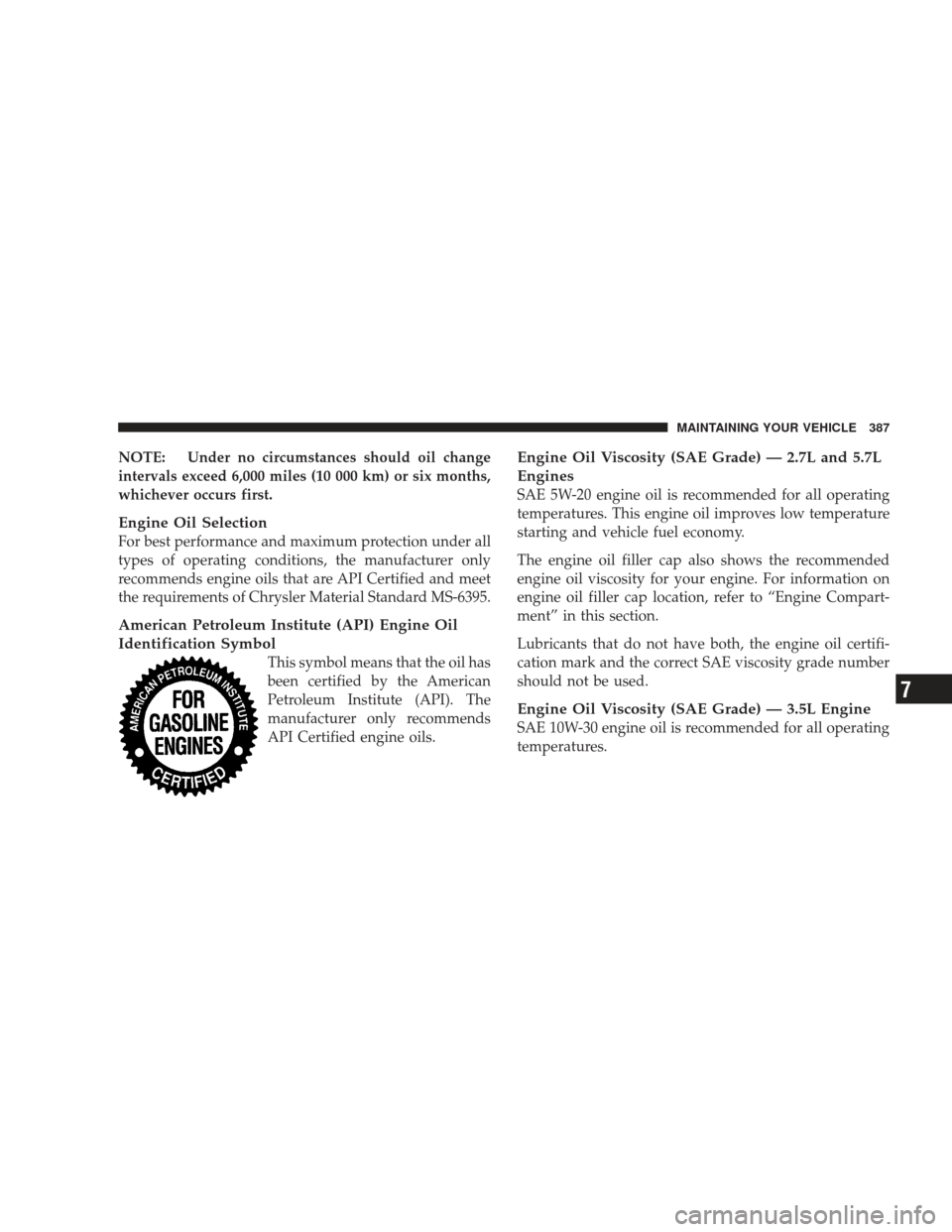
American Petroleum Institute (API) Engine Oil
Identification Symbol
This symbol means that the oil has
been certified by the American
Petroleum Institute (API). The
manufacturer only recommends
API Certified engine oils.
Engine Oil Viscosity (SAE Grade) — 2.7L and 5.7L
Engines
SAE 5W-20 engine oil is recommended for all operating
temperatures. This engine oil improves low temperature
starting and vehicle fuel economy.
The engine oil filler cap also shows the recommended
engine oil viscosity for your engine. For information on
engine oil filler cap location, refer to “Engine Compart-
ment” in this section.
Lubricants that do not have both, the engine oil certifi-
cation mark and the correct SAE viscosity grade number
should not be used.
Engine Oil Viscosity (SAE Grade) — 3.5L Engine
SAE 10W-30 engine oil is recommended for all operating
temperatures.
MAINTAINING YOUR VEHICLE 387
7
Page 396 of 484
To prevent freeze-up of your windshield washer system
in cold weather, select a solution or mixture that meets or
exceeds the temperature range of your climate. This
rating information can be found on most washer fluid
containers.
The fluid reservoir will hold nearly 1 gal (4 L) of washer
fluid when the message “Low Washer Fluid” appears in
the Electronic Vehicle Information Center (EVIC) (if
equipped).
WARNING!
Commercially available windshield washer solvents
are flammable. They could ignite and burn you. Care
must be exercised when filling or working around
the washer solution.
Exhaust System
The best protection against carbon monoxide entry into
the vehicle body is a properly maintained engine exhaust
system.
Whenever a change is noticed in the sound of the exhaust
system, when exhaust fumes can be detected inside the
vehicle, or when the underside or rear of the vehicle is
damaged, have a competent mechanic inspect the com-
plete exhaust system and adjacent body areas for broken,
damaged, deteriorated, or mispositioned parts. Open
seams or loose connections could permit exhaust fumes
to seep into the passenger compartment. In addition,
inspect the exhaust system each time the vehicle is raised
for lubrication or oil change. Replace as required.
394 MAINTAINING YOUR VEHICLE
Page 463 of 484
Auto Up Power Windows.................. 37
Automatic Dimming Mirror ................. 86
Automatic Door Locks ................... 30,31
Automatic Headlights .................... 132
Automatic Oil Change Indicator ..........177,186
Automatic Temperature Control (ATC) ......... 256
Automatic Transaxle Special Additives ...................... 405
Automatic Transmission ...........276,282,404,405
Adding Fluid ...................... 405,430
Autostick ............................ 286
Fluid and Filter Changes ................. 405
Fluid Change ......................... 405
Fluid Level Check ..................... 404
Fluid Type ........................... 430
Gear Ranges ....................... 277,282
Overdrive ........................... 278
Shifting .......................... 276,282
Special Additives ...................... 405 Torque Converter
...................... 280
Automatic Transmission Limp Home Mode . . 281,285
Autostick ............................. 286
Axle Fluid ............................. 430
Axle Lubrication (Axle Fluid) ............... 430
Battery ............................... 389
Emergency Starting ..................... 369
Jump Starting ......................... 369
Keyless Transmitter Replacement (RKE) ....... 25
Location .......................... 370,390
Belts, Seat ............................ 42,79
Body Mechanism Lubrication ............... 392
B-Pillar Location ........................ 306
Brake Assist System ...................... 297
Brake Control System, Electronic ............. 296
Brake Fluid ............................ 430
Brake, Parking .......................... 292
Brake System ........................... 402
INDEX 461
10
Page 467 of 484
Emergency, In Case ofFreeing Vehicle When Stuck ............... 372
Hazard Warning Flasher ................. 356
Jacking ............................. 357
Jump Starting ......................... 369
Overheating .......................... 356
Towing ............................. 374
Emergency Trunk Release ................... 41
Emission Control System Maintenance ......383,432
Engine .......................... 379,380,381
Air Cleaner .......................... 389
Block Heater ......................... 272
Break-In Recommendations ................ 77
Checking Oil Level .................. 385,386
Compartment ................... 379,380,381
Coolant (Antifreeze) ................. 397,429
Cooling ............................. 397
Exhaust Gas Caution .................. 78,336
Fails to Start .......................... 271 Flooded, Starting
...................... 271
Fuel Requirements ..................... 332
Jump Starting ......................... 369
Oil ........................... 385,427,429
Oil Change Interval ...............177,186,386
Oil Filler Cap ......................... 387
Oil Filter ............................ 388
Oil Filter Disposal ..................... 388
Oil Selection ....................... 387,427
Oil Synthetic ......................... 388
Overheating .......................... 356
Temperature Gauge .................... 173
Engine Oil Viscosity ...................... 387
Enhanced Accident Response Feature .......... 63
Ethanol ............................... 333
Event Data Recorder ...................... 65
Exhaust Gas Caution ................78,336,395
Exhaust System ....................... 78,394
Exterior Folding Mirrors ................... 87
INDEX 465
10
Page 472 of 484
Engine Temperature Warning.............. 175
Exterior .............................. 80
Fog ............................. 133,176
Hazard Warning Flasher ................. 356
Headlight Switch ...................... 131
Headlights ........................ 131,422
Headlights On Reminder ................. 133
Headlights On With Wipers ............132,138
High Beam ........................ 135,176
High Beam Indicator .................... 176
High Beam/Low Beam Select ............. 135
Instrument Cluster .................. 131,172
Intensity Control ...................... 136
Interior .......................... 135,145
License ............................. 426
Lights On Reminder .................... 133
Low Fuel ............................ 182
Malfunction Indicator (Check Engine) ........ 183
Map Reading ...................... 135,145Oil Pressure
.......................... 176
Parade Mode (Daytime Brightness) ......... 136
Passing ............................. 135
Reading .......................... 135,145
Seat Belt Reminder ..................... 176
Service ........................... 418,419
Service Engine Soon (Malfunction Indicator) . . . 183
Tire Pressure Monitoring (TPMS) ........180,322
Traction Control ....................... 300
Turn Signal ...................... 80,134,174
Vanity Mirror .......................... 88
Voltage ............................. 173
Warning (Instrument Cluster Description) ..... 172
Load Leveling System .................... 164
Loading Vehicle ...................... 340,341
Capacities ........................... 341
Tires ............................... 306
Locks ................................. 29
Auto Unlock .......................... 31
470 INDEX