Page 244 of 469
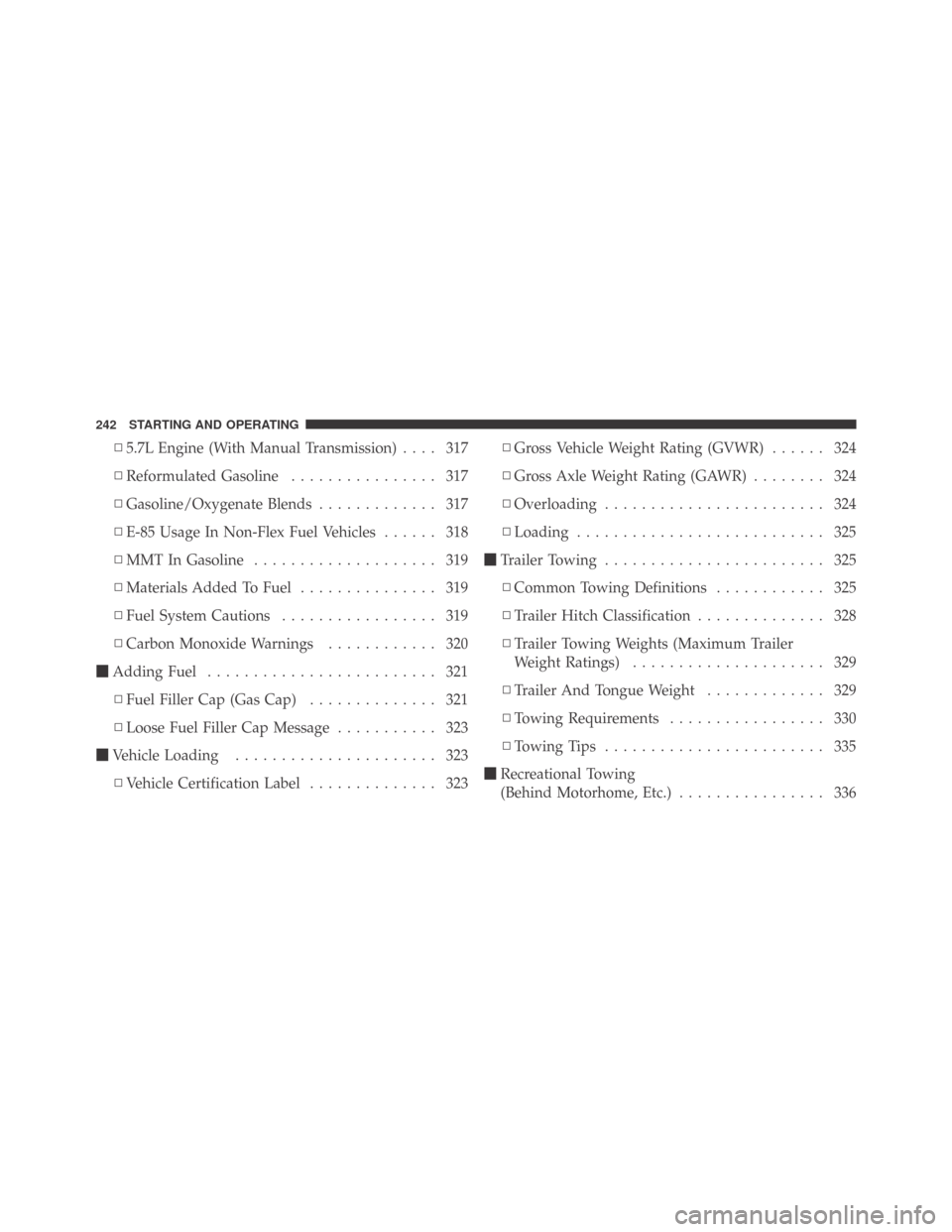
▫5.7L Engine (With Manual Transmission).... 317
▫Reformulated Gasoline................ 317
▫Gasoline/Oxygenate Blends............. 317
▫E-85 Usage In Non-Flex Fuel Vehicles...... 318
▫MMT In Gasoline.................... 319
▫Materials Added To Fuel............... 319
▫Fuel System Cautions................. 319
▫Carbon Monoxide Warnings............ 320
�Adding Fuel......................... 321
▫Fuel Filler Cap (Gas Cap).............. 321
▫Loose Fuel Filler Cap Message........... 323
�Vehicle Loading...................... 323
▫Vehicle Certification Label.............. 323▫Gross Vehicle Weight Rating (GVWR)...... 324
▫Gross Axle Weight Rating (GAWR)........ 324
▫Overloading........................ 324
▫Loading........................... 325
�Trailer Towing........................ 325
▫Common Towing Definitions............ 325
▫Trailer Hitch Classification.............. 328
▫Trailer Towing Weights (Maximum Trailer
Weight Ratings)..................... 329
▫Trailer And Tongue Weight............. 329
▫Towing Requirements................. 330
▫TowingTips ........................ 335
�Recreational Towing
(Behind Motorhome, Etc.)................ 336
242 STARTING AND OPERATING
Page 245 of 469
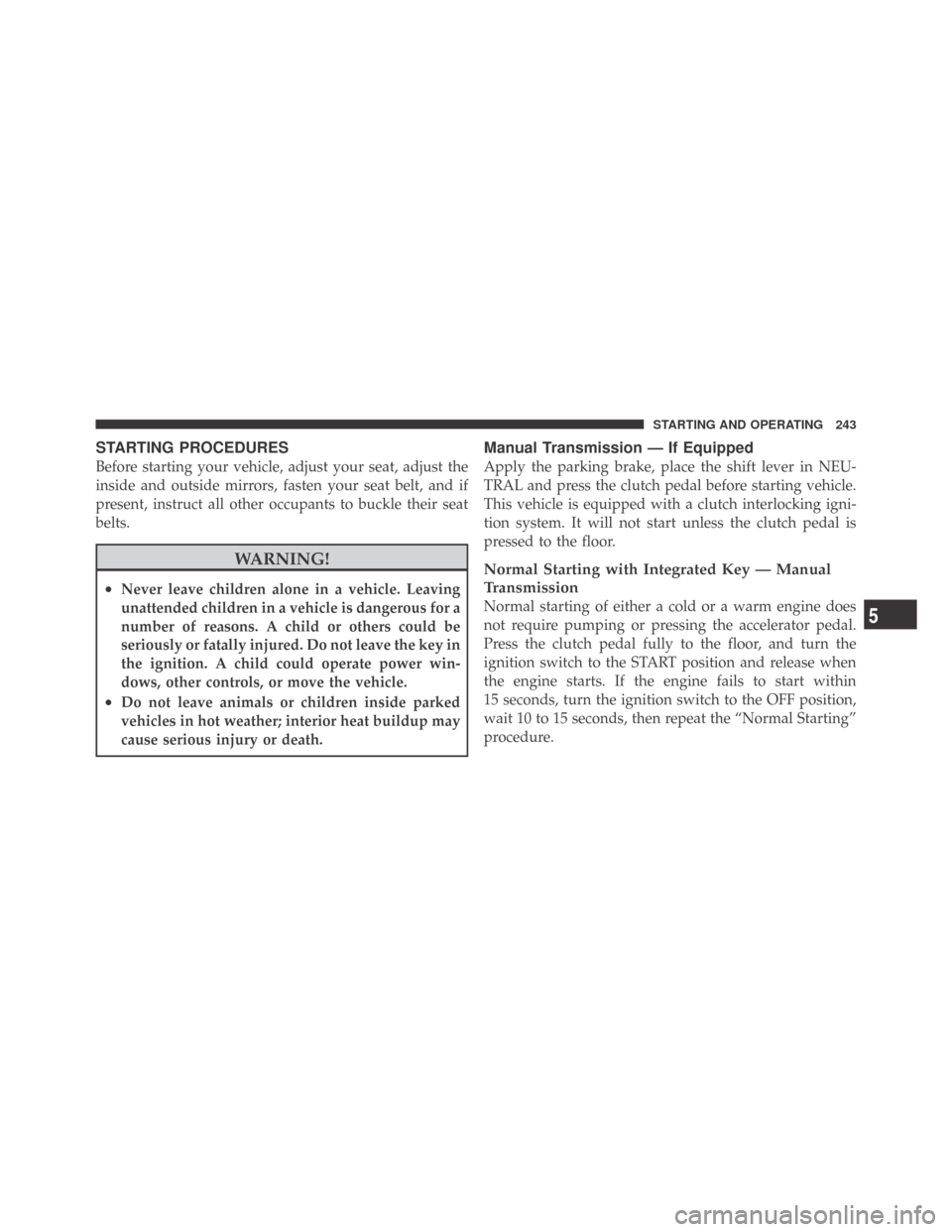
STARTING PROCEDURES
Before starting your vehicle, adjust your seat, adjust the
inside and outside mirrors, fasten your seat belt, and if
present, instruct all other occupants to buckle their seat
belts.
WARNING!
•Never leave children alone in a vehicle. Leaving
unattended children in a vehicle is dangerous for a
number of reasons. A child or others could be
seriously or fatally injured. Do not leave the key in
the ignition. A child could operate power win-
dows, other controls, or move the vehicle.
•Do not leave animals or children inside parked
vehicles in hot weather; interior heat buildup may
cause serious injury or death.
Manual Transmission — If Equipped
Apply the parking brake, place the shift lever in NEU-
TRAL and press the clutch pedal before starting vehicle.
This vehicle is equipped with a clutch interlocking igni-
tion system. It will not start unless the clutch pedal is
pressed to the floor.
Normal Starting with Integrated Key — Manual
Transmission
Normal starting of either a cold or a warm engine does
not require pumping or pressing the accelerator pedal.
Press the clutch pedal fully to the floor, and turn the
ignition switch to the START position and release when
the engine starts. If the engine fails to start within
15 seconds, turn the ignition switch to the OFF position,
wait 10 to 15 seconds, then repeat the “Normal Starting”
procedure.5
STARTING AND OPERATING 243
Page 246 of 469

WARNING!
Do not attempt to push or tow your vehicle to get it
started. Unburned fuel could enter the catalytic con-
verter and once the engine has started, ignite and
damage the converter and vehicle. If the vehicle has
a discharged battery, booster cables may be used to
obtain a start from another vehicle. This type of start
can be dangerous if done improperly, so follow the
procedure carefully. See Section 6 of this manual for
jump-starting instructions.
Automatic Transmission — If Equipped
The shift lever must be in the NEUTRAL or PARK
position before you can start the engine. Apply the brakes
before shifting into any driving gear.
CAUTION!
Damage to the transmission may occur if the follow-
ing precautions are not observed:
•Shift into PARK only after the vehicle has come to
a complete stop.
•Shift into or out of REVERSE only after the
vehicle has come to a complete stop and the engine
is at idle speed.
•Do not shift from REVERSE, PARK, or NEUTRAL
into any forward gear when the engine is above
idle speed.
•Before shifting into any gear, make sure your foot
is firmly on the brake pedal.
Using Fob With Integrated Key (Tip Start)
NOTE:Normal starting of either a cold or a warm
engine is obtained without pumping or pressing the
accelerator pedal.
244 STARTING AND OPERATING
Page 251 of 469

If Engine Fails To Start
WARNING!
•Never pour fuel or other flammable liquids into the
throttle body air inlet opening in an attempt to start
the vehicle. This could result in a flash fire causing
serious personal injury.
•Do not attempt to push or tow your vehicle to get it
started. Vehicles equipped with an automatic trans-
mission cannot be started this way. Unburned fuel
could enter the catalytic converter and once the
engine has started, ignite and damage the converter
and vehicle. If the vehicle has a discharged battery,
booster cables may be used to obtain a start from a
booster battery or the battery in another vehicle. This
type of start can be dangerous if done improperly.
Refer to Section 6 for proper jump-starting proce-
dures and follow them carefully.
Clearing a Flooded Engine (Using ENGINE
START/STOP Button) — Automatic Transmission
Only
If the engine fails to start after you have followed the
“Normal Starting” or “Extreme Cold Weather�proce-
dures, it may be flooded. To clear any excess fuel, press
and hold the brake pedal, push the accelerator pedal all
the way to the floor and hold it, then press and release the
ENGINE START/STOP button once. The starter motor
will engage automatically, run for 10 seconds, and then
disengage. Once this occurs, release the accelerator pedal
and the brake pedal, wait 10 to 15 seconds, then repeat
the “Normal Starting” procedure.
Clearing a Flooded Engine (Using ENGINE
START/STOP Button) — Manual Transmission
Only
If the engine fails to start after you have followed the
“Normal Starting” or “Extreme Cold Weather�proce-
dures, it may be flooded. To clear any excess fuel, press
5
STARTING AND OPERATING 249
Page 253 of 469
WARNING!
Remember to disconnect the cord before driving.
Damage to the 110-115 Volt electrical cord could cause
electrocution.
MANUAL TRANSMISSION — IF EQUIPPED
Six-Speed Manual Transmission
WARNING!
You or others could be injured if you leave the
vehicle unattended without having the parking
brake fully applied. The parking brake should al-
ways be applied when the driver is not in the vehicle,
especially on an incline.
CAUTION!
•Never drive with your foot resting on the clutch
pedal, or try to hold the vehicle on a hill with the
clutch pedal partially engaged, as this will cause
abnormal wear on the clutch. Refer to “Electronic
Brake Control System/Hill Start Assist” in this
section.
•Failure to press the clutch pedal fully to the floor
may cause increased shift efforts, and may result
in damage to the clutch and transmission.
•Do not rest your hand on the shift lever while
driving, as this may result in transmission syn-
chronizer damage.
5
STARTING AND OPERATING 251
Page 256 of 469
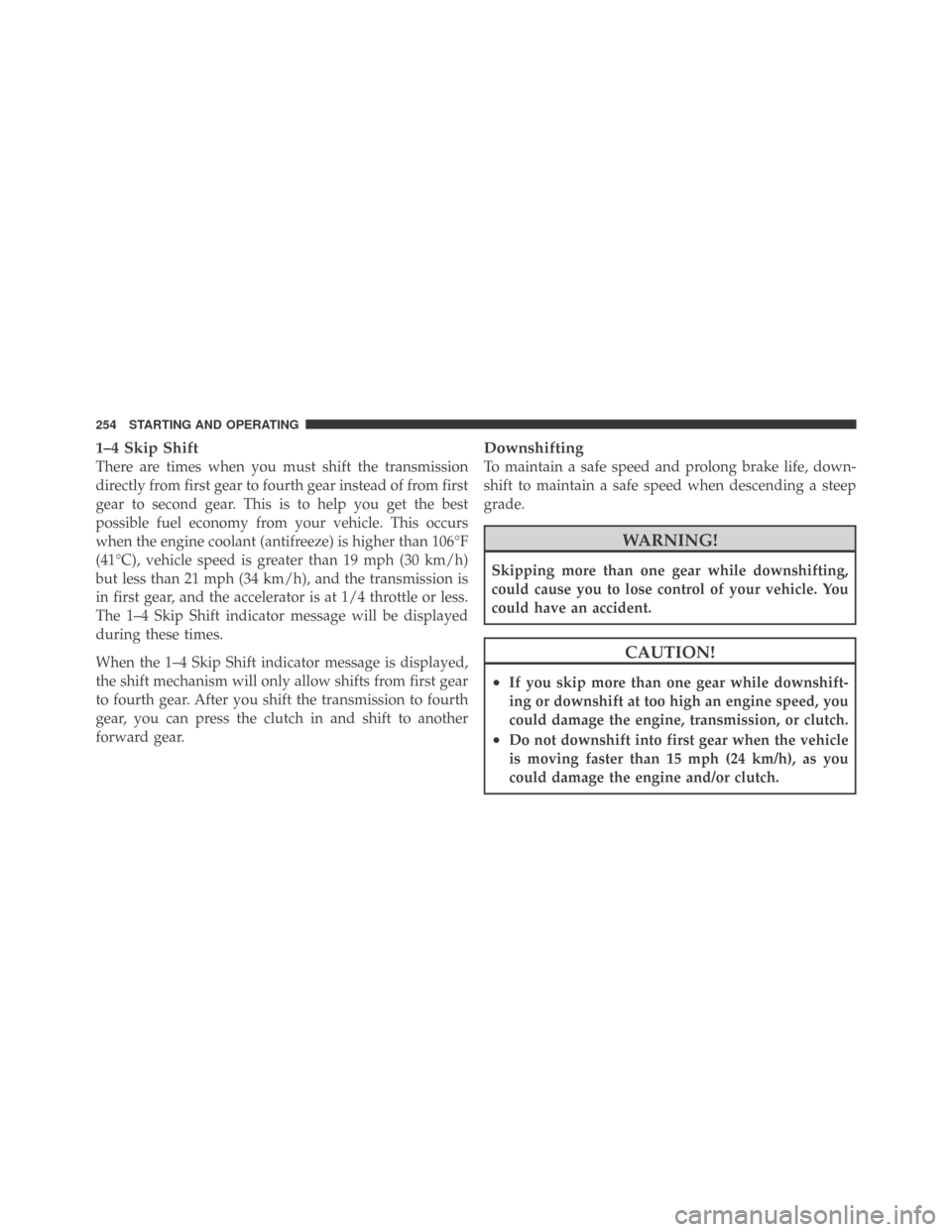
1–4 Skip Shift
There are times when you must shift the transmission
directly from first gear to fourth gear instead of from first
gear to second gear. This is to help you get the best
possible fuel economy from your vehicle. This occurs
when the engine coolant (antifreeze) is higher than 106°F
(41°C), vehicle speed is greater than 19 mph (30 km/h)
but less than 21 mph (34 km/h), and the transmission is
in first gear, and the accelerator is at 1/4 throttle or less.
The 1–4 Skip Shift indicator message will be displayed
during these times.
When the 1–4 Skip Shift indicator message is displayed,
the shift mechanism will only allow shifts from first gear
to fourth gear. After you shift the transmission to fourth
gear, you can press the clutch in and shift to another
forward gear.
Downshifting
To maintain a safe speed and prolong brake life, down-
shift to maintain a safe speed when descending a steep
grade.
WARNING!
Skipping more than one gear while downshifting,
could cause you to lose control of your vehicle. You
could have an accident.
CAUTION!
•If you skip more than one gear while downshift-
ing or downshift at too high an engine speed, you
could damage the engine, transmission, or clutch.
•Do not downshift into first gear when the vehicle
is moving faster than 15 mph (24 km/h), as you
could damage the engine and/or clutch.
254 STARTING AND OPERATING
Page 257 of 469

AUTOMATIC TRANSMISSION — IF EQUIPPED
CAUTION!
Damage to the automatic transmission may occur if
the following precautions are not observed:
•Shift into PARK only after the vehicle has come to
a complete stop.
•Shift into or out of REVERSE only after the
vehicle has come to a complete stop and the engine
is at idle speed.
•Do not shift from REVERSE, PARK, or NEUTRAL
into any forward gear when the engine is above
idle speed.
•Before shifting into any gear, make sure your foot
is firmly on the brake pedal.
WARNING!
It is dangerous to move the shift lever out of PARK or
NEUTRAL if the engine speed is higher than idle
speed. If your foot is not firmly on the brake pedal,
the vehicle could accelerate quickly forward or in
reverse. You could lose control of the vehicle and hit
someone or something. Only shift into gear when the
engine is idling normally and when your right foot is
firmly on the brake pedal.
General Information
The automatic transmission selects individual gears au-
tomatically, dependent upon:
•Altitude
•Vehicle loading
•Driving style
5
STARTING AND OPERATING 255
Page 259 of 469
WARNING!
Unintended movement of a vehicle could injure
those in and near the vehicle. As with all vehicles,
you should never exit a vehicle while the engine is
running. Before exiting a vehicle, you should always
shift the transmission into PARK, remove the key
from the ignition, and apply the parking brake. Once
the key is removed from the ignition, the transmis-
sion shift lever is locked in the PARK position,
securing the vehicle against unwanted movement.
Furthermore, you should never leave unattended
children inside a vehicle.
Over-Temperature Mode
The transmission electronics constantly monitor the
transmission oil temperature. If the transmission exceeds
normal operating temperature, the transmission will
change the way it shifts to help control the condition.This may result in a slightly different feeling or response
during normal operation in DRIVE position. After the
transmission cools down, it will return to normal
operation.
Brake/Transmission Shift Interlock System
This vehicle is equipped with a Brake Transmission Shift
Interlock (BTSI) system that holds the shift lever in the
PARK position when the ignition switch is in the LOCK
position and the engine is not running. To move the shift
lever out of the PARK position, the ignition switch must
be turned to any other ignition position (ACC, ON/
RUN) position, and the brake pedal must be pressed
whether or not the engine is running.
Brake/Transmission Interlock Manual Override
There is an override for the BTSI that allows you to move
the shift lever out of the PARK position if an electrical
system malfunction occurs (i.e., dead battery). To access
5
STARTING AND OPERATING 257