Page 369 of 469
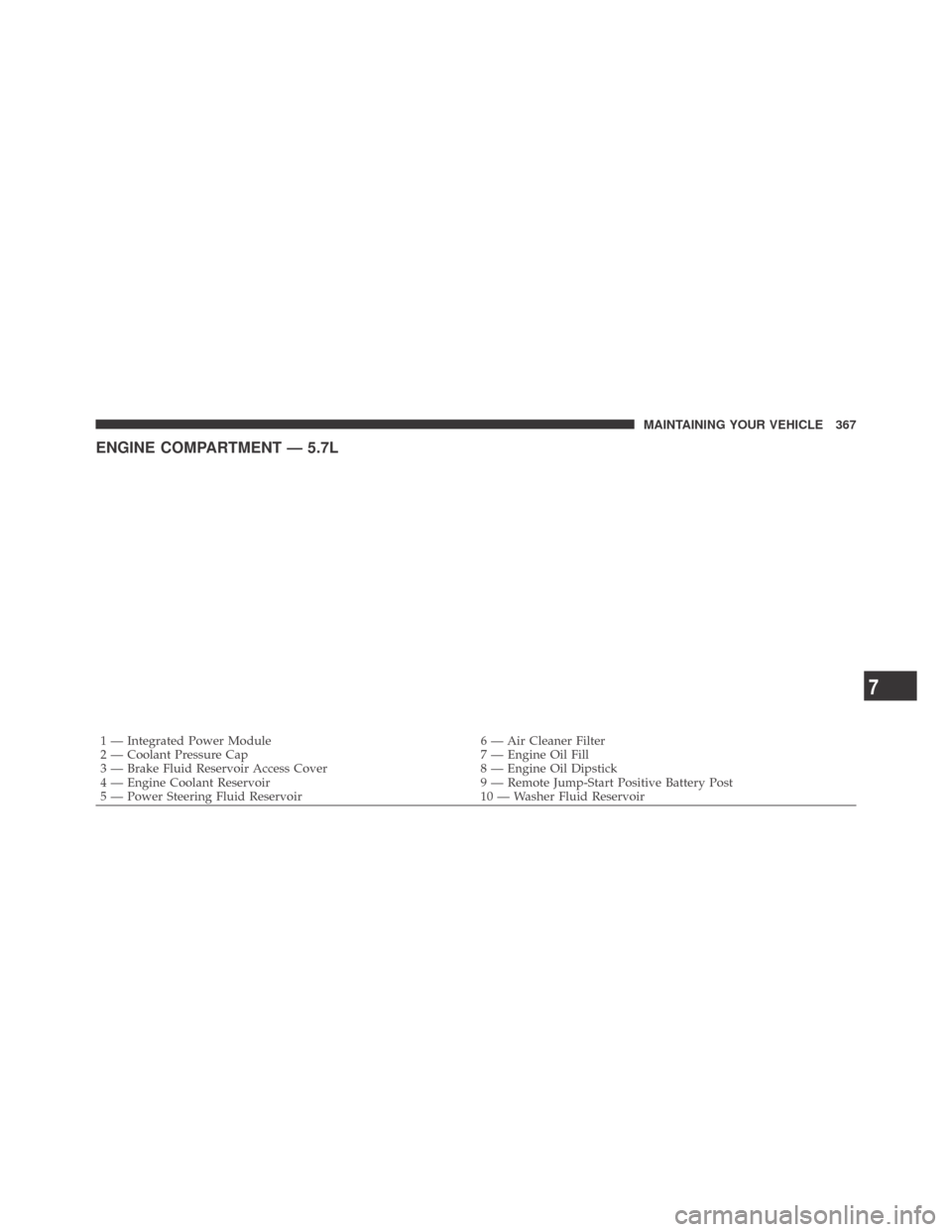
ENGINE COMPARTMENT — 5.7L
1 — Integrated Power Module 6 — Air Cleaner Filter
2 — Coolant Pressure Cap 7 — Engine Oil Fill
3 — Brake Fluid Reservoir Access Cover 8 — Engine Oil Dipstick
4 — Engine Coolant Reservoir 9 — Remote Jump-Start Positive Battery Post
5 — Power Steering Fluid Reservoir 10 — Washer Fluid Reservoir
7
MAINTAINING YOUR VEHICLE 367
Page 391 of 469

•Do not overfill the coolant recovery bottle.
•Check engine coolant (antifreeze) freeze point in the
radiator and in the coolant recovery bottle. If engine
coolant (antifreeze) needs to be added, contents of
coolant recovery bottle must also be protected against
freezing.
•If frequent engine coolant (antifreeze) additions are
required, or if the level in the coolant recovery bottle
does not drop when the engine cools, the cooling
system should be pressure tested for leaks.
•Maintain engine coolant (antifreeze) concentration at
50% HOAT engine coolant (antifreeze) (minimum)
and distilled water for proper corrosion protection of
your engine, which contains aluminum components.
•Make sure that the radiator and coolant recovery
bottle overflow hoses are not kinked or obstructed.
•Keep the front of the radiator clean. If your vehicle is
equipped with air conditioning, keep the front of the
condenser clean.
•Do not change the thermostat for Summer or Winter
operation. If replacement is ever necessary, install
ONLY the correct type thermostat. Other designs may
result in unsatisfactory engine coolant (antifreeze)
performance, poor gas mileage, and increased
emissions.
Brake System
In order to assure brake system performance, all brake
system components should be inspected periodically.
Refer to the “Maintenance Schedule” in Section 8 for the
proper maintenance intervals.
7
MAINTAINING YOUR VEHICLE 389
Page 392 of 469
WARNING!
Riding the brakes can lead to brake failure and
possibly an accident. Driving with your foot resting
or riding on the brake pedal can result in abnormally
high brake temperatures, excessive lining wear, and
possible brake damage. You would not have your full
braking capacity in an emergency.
Master Cylinder - Brake Fluid Level Check
Check the fluid level in the master cylinder immediately
if the brake system warning light indicates system fail-
ure.
Check the fluid level in the master cylinder when per-
forming underhood services.
Clean the top of the master cylinder area before removing
the cap. Add fluid to bring the level up to the “MAX”
mark on the side of the master cylinder reservoir.Overfilling of fluid is not recommended because it may
cause leaking in the system.
Add enough fluid to bring the level up to the require-
ments described on the brake fluid reservoir. With disc
brakes, fluid level can be expected to fall as the brake
pads wear. However, low fluid level may be caused by a
leak and a checkup may be needed.
Use only manufacturer’s recommended brake fluid. Re-
fer to “Fluids, Lubricants, and Genuine Parts” in this
section for the correct fluid type.
390 MAINTAINING YOUR VEHICLE
Page 393 of 469
WARNING!
•Use of a brake fluid that may have a lower initial
boiling point, or is unidentified as to specification,
or which may occur by leaving the top of your
master cylinder reservoir uncovered or the top off
of the brake fluid bottle off, allowing it to absorb
moisture may result in sudden brake failure dur-
ing hard prolonged braking. You could have an
accident.
•Overfilling the brake fluid reservoir can result in
spilling brake fluid on hot engine parts and the
brake fluid catching fire.
(Continued)
WARNING! (Continued)
•Use only brake fluid that has been in a tightly
closed container (both as to bottles and the master
cylinder remaining covered) to avoid contamina-
tion from foreign matter or moisture. Brake fluid,
unlike many other fluids, actually absorbs mois-
ture from the air. This lowers the boiling point of
the fluid and may cause it to boil during hard
braking and create a soft pedal pressure resistance
as the gas compresses. This condition does not
apply adequate pressure to the brakes to function
properly.
•Do not allow petroleum based fluid to contami-
nate the brake fluid, all brake seal components
could be damaged, causing partial or complete
brake failure leading to a crash.7
MAINTAINING YOUR VEHICLE 391
Page 394 of 469
Clutch Hydraulic System — Manual Transmission
(If Equipped)
The clutch hydraulic system is fed by a segregated
volume of fluid within the brake system master cylinder
reservoir. In the event of leakage or wear, use only the
manufacturer’s recommended brake fluid. Refer to “Flu-
ids, Lubricants, and Genuine Parts” in this section for the
correct fluid type.
Manual Transmission — If Equipped
Fluid Level Check
Check the fluid level by removing the fill plug on the left
side of the transmission. The fluid level should be at the
bottom of the fill hole. Add fluid, if necessary, to maintain
the proper level. Refer to “Fluids, Lubricants, and Genu-
ine Parts” in this section for the correct fluid type.
CAUTION!
Using a transmission fluid other than the manufac-
turer’s recommended fluid may cause deterioration
in transmission shift quality and/or damage to the
transmission. Refer to “Fluids, Lubricants, and
Genuine Parts” in this section for the correct fluid
type.
Change Transmission Fluid
If contaminated with water, change the fluid immedi-
ately. See your authorized dealer for service.
Refer to the “Maintenance Schedule” in Section 8 for the
proper maintenance intervals.
392 MAINTAINING YOUR VEHICLE
Page 399 of 469
•Use MOPAR�Touch Up Paint or equivalent on
scratches as soon as possible. Your authorized dealer
has touch up paint to match the color of your vehicle.
Wheel and Wheel Trim Care
All wheels and wheel trim, especially aluminum and
chrome-plated wheels should be cleaned regularly with a
mild soap and water to prevent corrosion. To remove
heavy soil and/or excessive brake dust, use MOPAR�
Wheel Cleaner or equivalent or select a nonabrasive,
non-acidic cleaner. Do not use scouring pads, steel wool,
a bristle brush, or metal polishes. Only MOPAR�or
equivalent is recommended. Do not use oven cleaner.
Avoid automatic car washes that use acidic solutions or
harsh brushes that may damage the wheels’ protective
finish.
Stain Repel Fabric Cleaning Procedure — If
Equipped
Stain Repel seats may be cleaned in the following man-
ner:
•Remove as much of the stain as possible by blotting
with a clean, dry towel.
•Blot any remaining stain with a clean, damp towel.
•For tough stains, apply MOPAR�Total Clean or a mild
soap solution to a clean, damp cloth and remove the
stain. Use a fresh, damp towel to remove soap residue.
•For grease stains, apply MOPAR�Multi-Purpose
Cleaner or equivalent to a clean, damp cloth and
remove the stain. Use a fresh, damp towel to remove
soap residue.
•Do not use any harsh solvents or any other form of
protectants on Stain Repel products.
7
MAINTAINING YOUR VEHICLE 397
Page 404 of 469
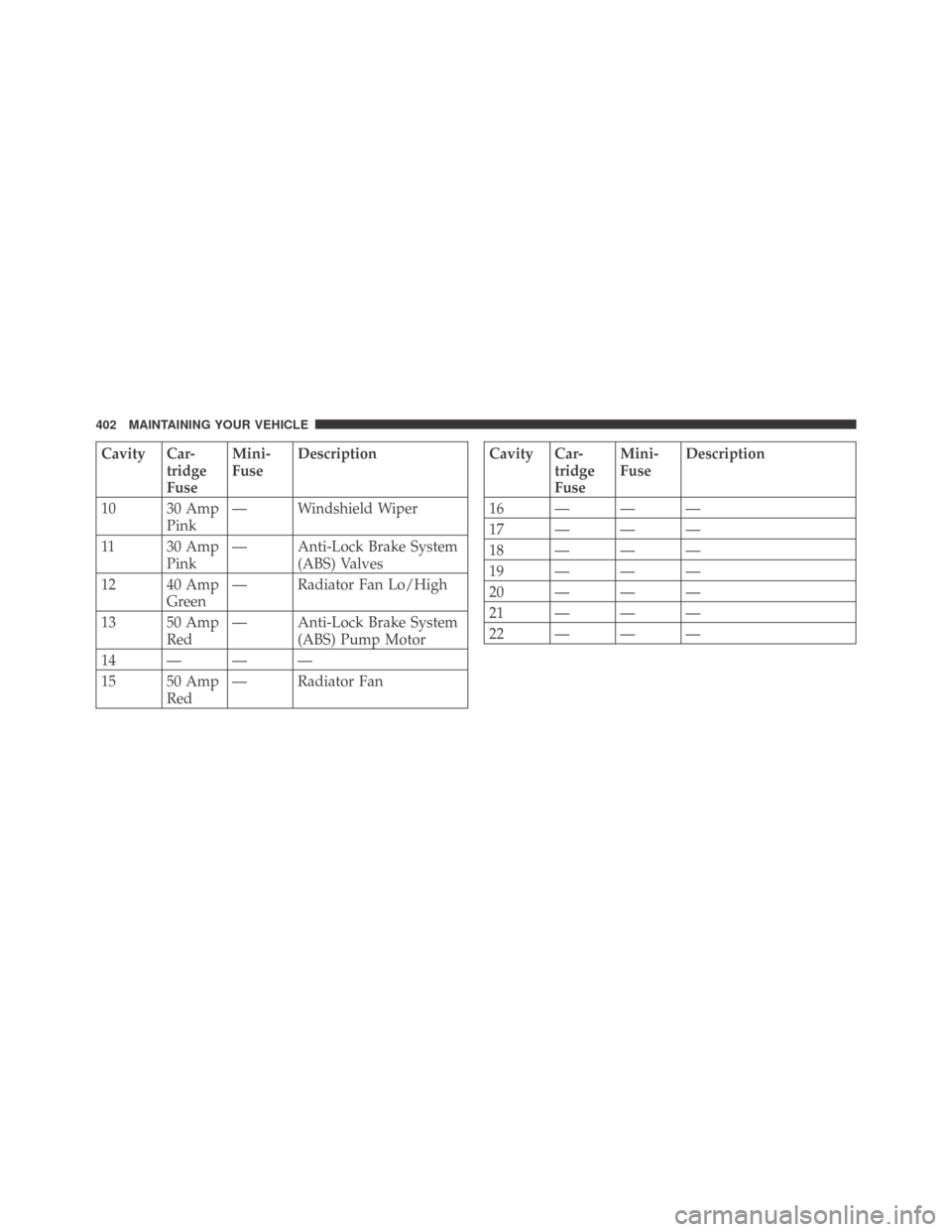
Cavity Car-
tridge
FuseMini-
FuseDescription
10 30 Amp
Pink— Windshield Wiper
11 30 Amp
Pink— Anti-Lock Brake System
(ABS) Valves
12 40 Amp
Green— Radiator Fan Lo/High
13 50 Amp
Red— Anti-Lock Brake System
(ABS) Pump Motor
14———
15 50 Amp
Red— Radiator FanCavity Car-
tridge
FuseMini-
FuseDescription
16———
17———
18———
19———
20———
21———
22———
402 MAINTAINING YOUR VEHICLE
Page 418 of 469
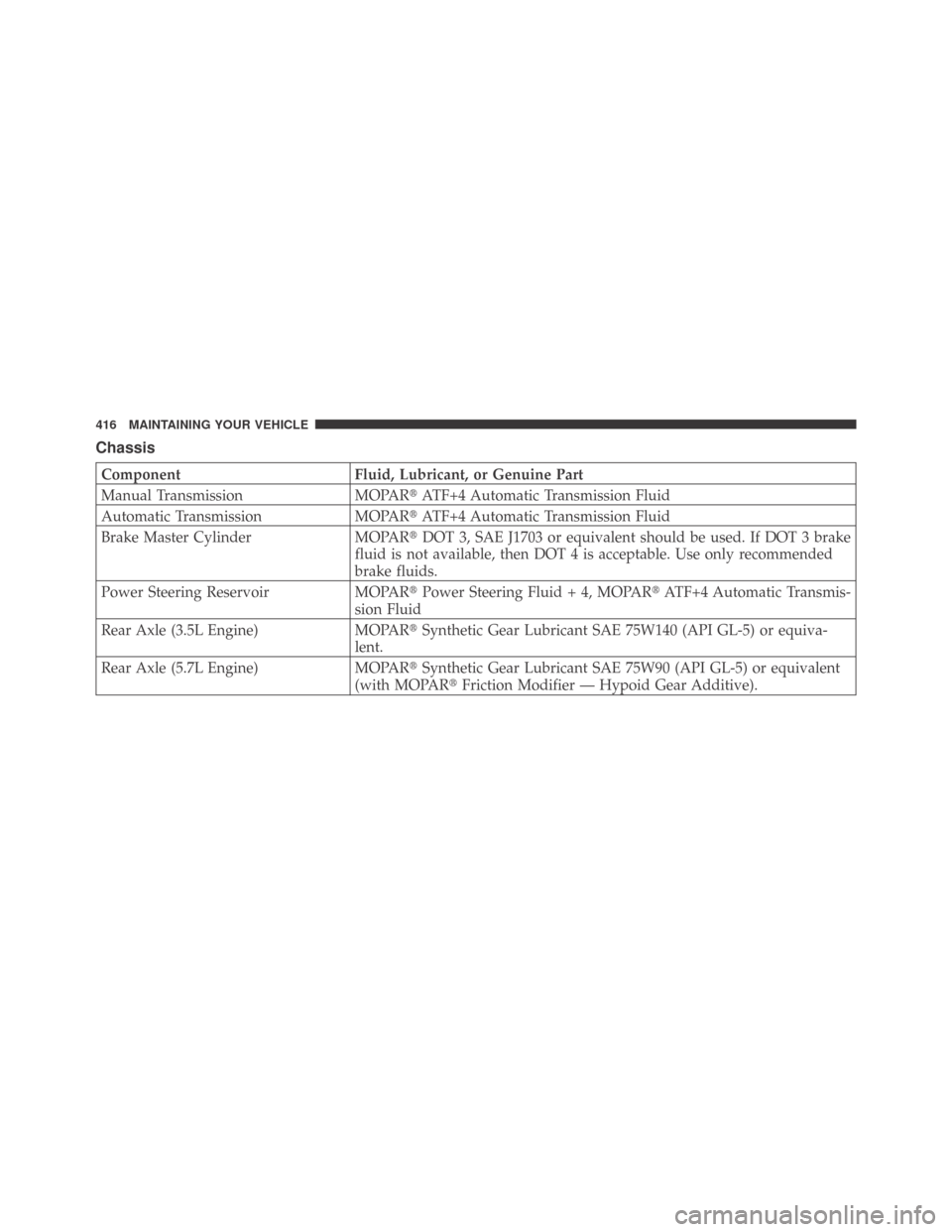
Chassis
Component Fluid, Lubricant, or Genuine Part
Manual Transmission MOPAR�ATF+4 Automatic Transmission Fluid
Automatic Transmission MOPAR�ATF+4 Automatic Transmission Fluid
Brake Master Cylinder MOPAR�DOT 3, SAE J1703 or equivalent should be used. If DOT 3 brake
fluid is not available, then DOT 4 is acceptable. Use only recommended
brake fluids.
Power Steering Reservoir MOPAR�Power Steering Fluid + 4, MOPAR�ATF+4 Automatic Transmis-
sion Fluid
Rear Axle (3.5L Engine) MOPAR�Synthetic Gear Lubricant SAE 75W140 (API GL-5) or equiva-
lent.
Rear Axle (5.7L Engine) MOPAR�Synthetic Gear Lubricant SAE 75W90 (API GL-5) or equivalent
(with MOPAR�Friction Modifier — Hypoid Gear Additive).
416 MAINTAINING YOUR VEHICLE