Page 43 of 469
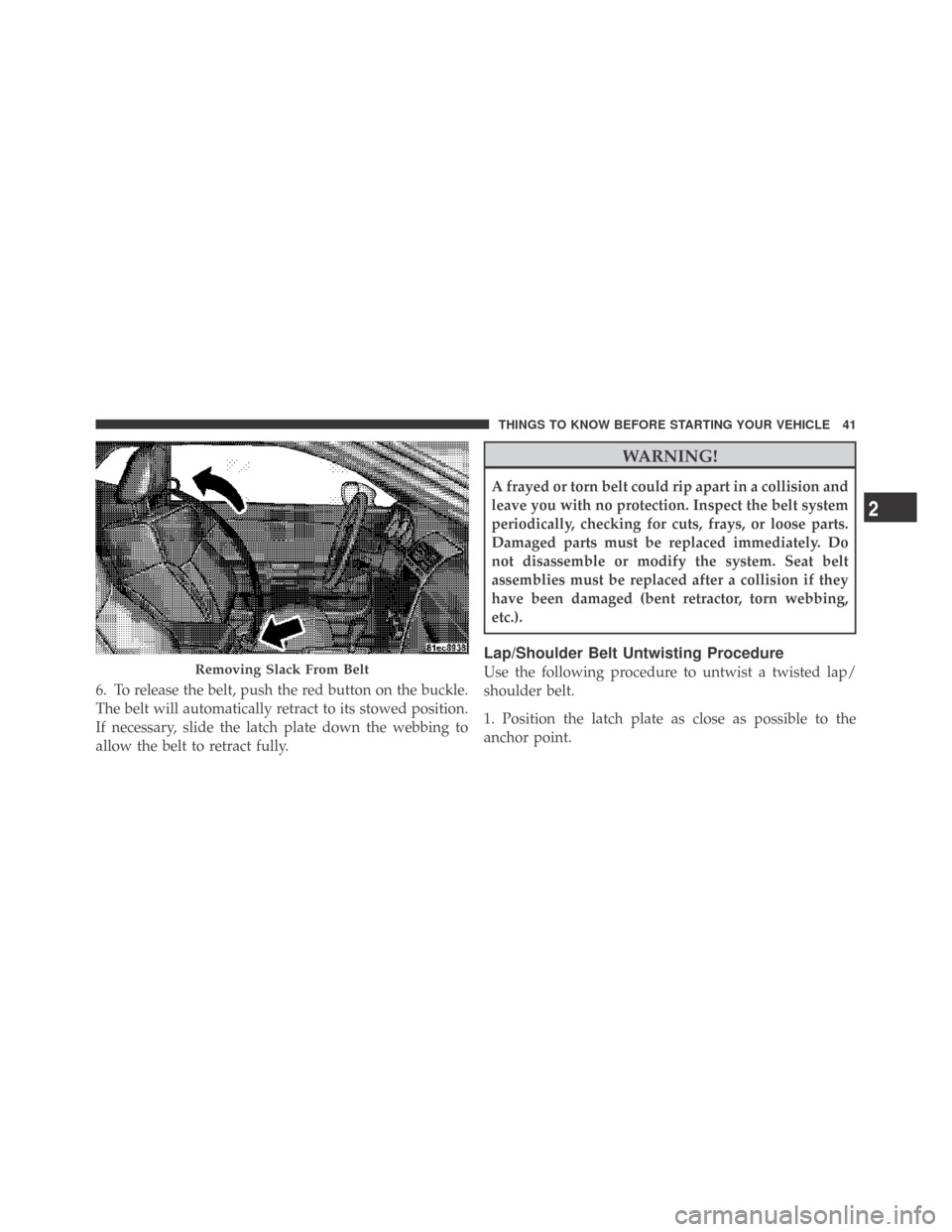
6. To release the belt, push the red button on the buckle.
The belt will automatically retract to its stowed position.
If necessary, slide the latch plate down the webbing to
allow the belt to retract fully.
WARNING!
A frayed or torn belt could rip apart in a collision and
leave you with no protection. Inspect the belt system
periodically, checking for cuts, frays, or loose parts.
Damaged parts must be replaced immediately. Do
not disassemble or modify the system. Seat belt
assemblies must be replaced after a collision if they
have been damaged (bent retractor, torn webbing,
etc.).
Lap/Shoulder Belt Untwisting Procedure
Use the following procedure to untwist a twisted lap/
shoulder belt.
1. Position the latch plate as close as possible to the
anchor point.Removing Slack From Belt
2
THINGS TO KNOW BEFORE STARTING YOUR VEHICLE 41
Page 44 of 469
2. At about 6 to 12 in (15 to 30 cm) above the latch plate,
grasp and twist the belt webbing 180 degrees to create a
fold that begins immediately above the latch plate.
3. Slide the latch plate upward over the folded webbing.
The folded webbing must enter the slot at the top of the
latch plate.
4. Continue to slide the latch plate up until it clears the
folded webbing.
Seat Belt Pretensioners
The seat belts for both front seating positions are
equipped with pretensioning devices that are designed to
remove any slack from the seat belts in the event of a
collision. These devices improve the performance of the
seat belt system by assuring that the belt is tight around
the occupant in a collision. Pretensioners work for all size
occupants, including those in child restraints.NOTE:These devices are not a substitute for proper seat
belt placement by the occupant. The seat belt still must be
worn snug and positioned properly.
The pretensioners are triggered by the Occupant Re-
straint Controller (ORC). (Refer to information on Air-
bags in this section). Like the front airbags, the preten-
sioners are single use items. After a collision that is severe
enough to deploy the airbags and pretensioners, both
must be replaced.Enhanced Seat Belt Use Reminder System
(BeltAlert�)
If the driver’s seat belt has not been buckled within
60 seconds of starting the vehicle and if the vehicle speed
is greater than 5 mph (8 km/h), the Enhanced Seat Belt
Use Reminder System (BeltAlert�) will alert the driver to
buckle the seat belt. The driver should also instruct all
other occupants to buckle their seat belts. Once the
warning is triggered, the BeltAlert�will continue to
42 THINGS TO KNOW BEFORE STARTING YOUR VEHICLE
Page 47 of 469
Seat Belt Extender
If a seat belt is too short even when fully extended your
authorized dealer can provide you with a seat belt
extender. This extender should be used only if the
existing belt is not long enough. When it is not required,
remove the extender and store it.
WARNING!
Using a seat belt extender when not needed can
increase the risk of injury in a collision. Only use
when the seat belt is not long enough when it is worn
low and snug and in the recommended seating posi-
tion. Remove and store the extender when not
needed.
Driver and Front Passenger Supplemental
Restraint System (SRS) - Airbags
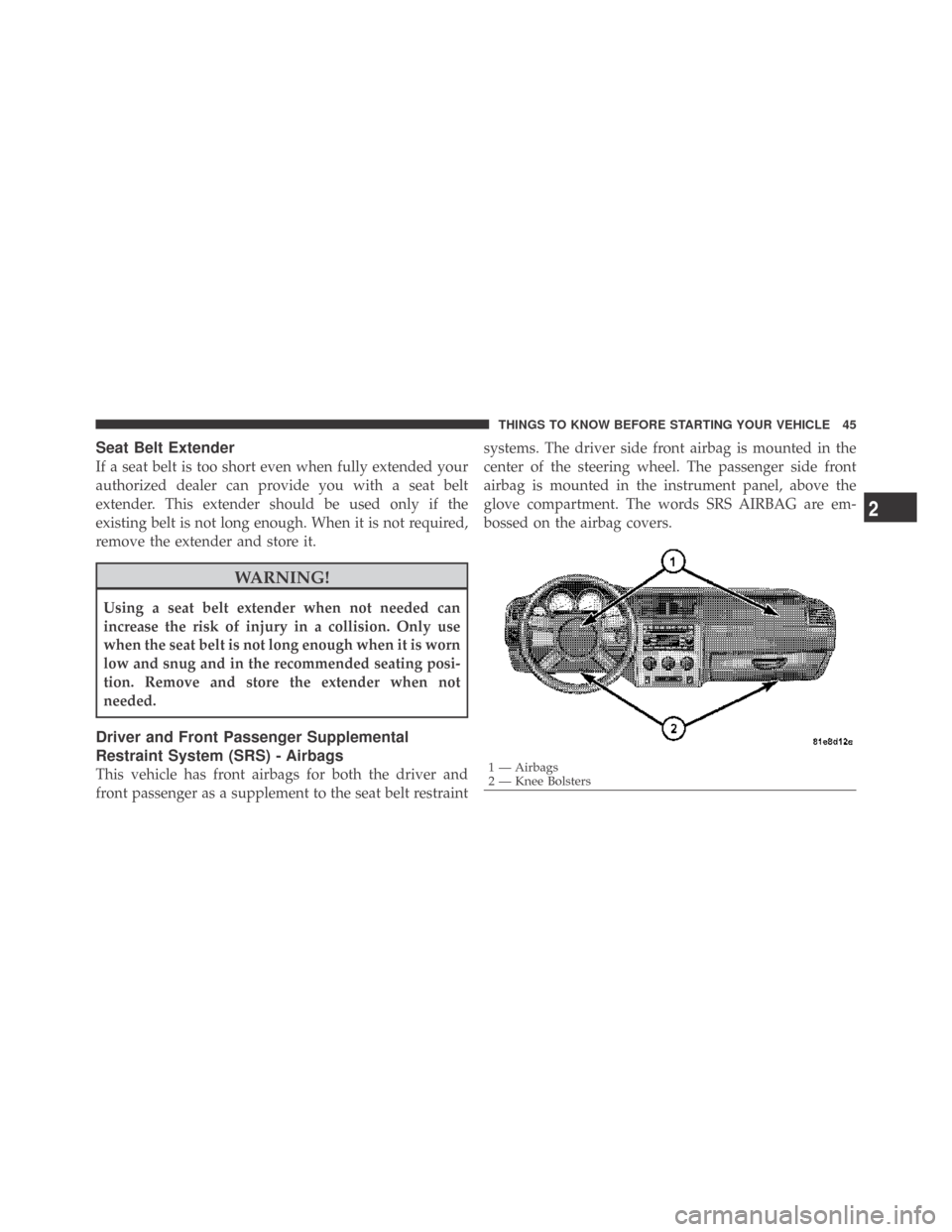
This vehicle has front airbags for both the driver and
front passenger as a supplement to the seat belt restraintsystems. The driver side front airbag is mounted in the
center of the steering wheel. The passenger side front
airbag is mounted in the instrument panel, above the
glove compartment. The words SRS AIRBAG are em-
bossed on the airbag covers.1 — Airbags
2 — Knee Bolsters
2
THINGS TO KNOW BEFORE STARTING YOUR VEHICLE 45
Page 48 of 469
NOTE:The front airbags are certified to the Federal
regulations that allow less forceful deployment.
The front airbags have a multistage inflator design. This
allows the airbag to have different rates of inflation that
are based on collision severity.
WARNING!
•Do not put anything on or around the front airbag
covers or attempt to open them. You may damage the
airbags and you could be injured because the airbags
are no longer functional. These protective covers for
the airbag cushions are designed to open only when
the airbags are inflating.
•Do not drill, cut or tamper with the knee bolster in
any way.
•Do not mount any accessories to the knee bolster
such as alarm lights, stereos, citizens band radios etc.
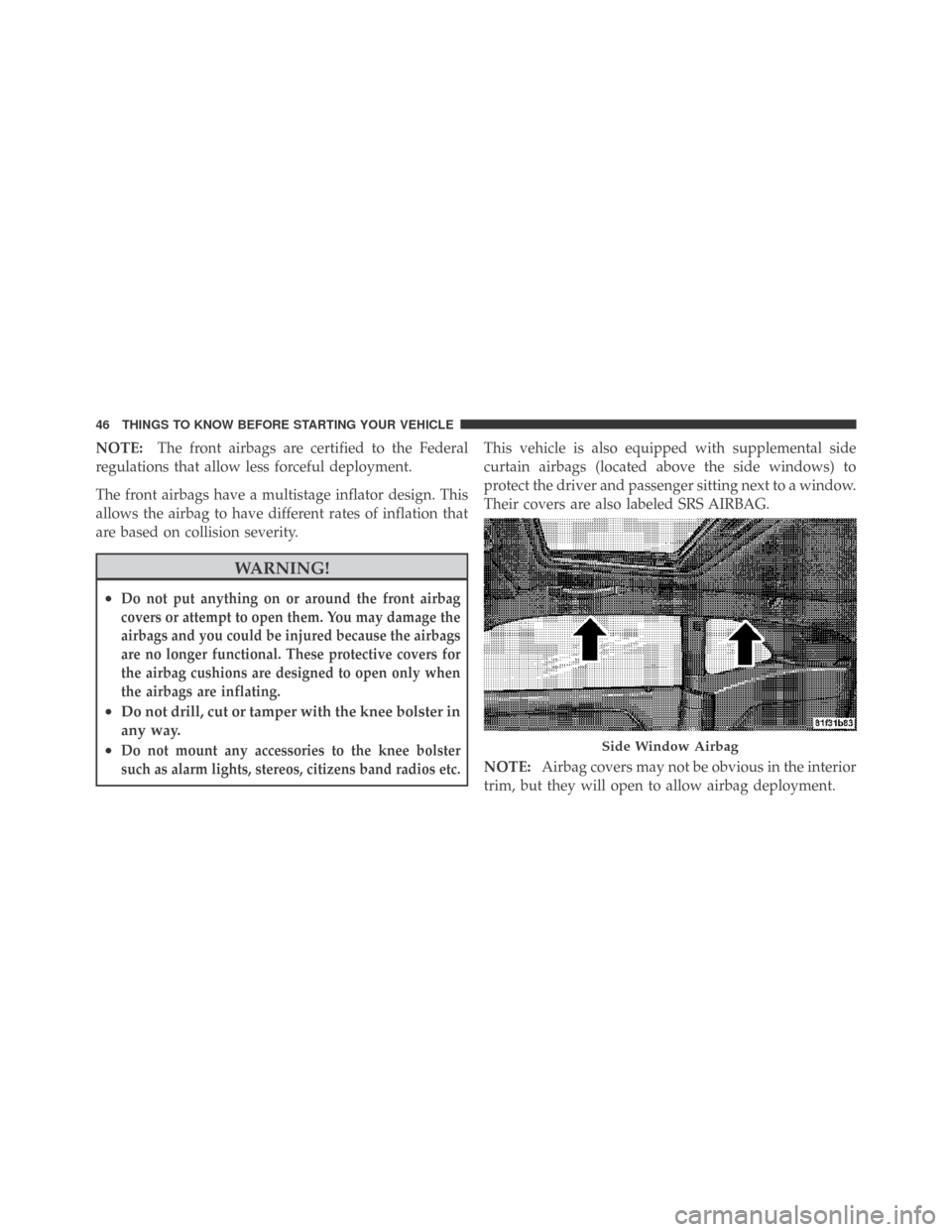
This vehicle is also equipped with supplemental side
curtain airbags (located above the side windows) to
protect the driver and passenger sitting next to a window.
Their covers are also labeled SRS AIRBAG.
NOTE:Airbag covers may not be obvious in the interior
trim, but they will open to allow airbag deployment.
Side Window Airbag
46 THINGS TO KNOW BEFORE STARTING YOUR VEHICLE
Page 49 of 469
WARNING!
•Do not stack luggage or other cargo up high
enough to block the location of the side curtain
airbag. The area where the side curtain airbag is
located should remain free from any obstructions.
•Do not have any accessory items installed which
will alter the roof, including adding a sunroof to
your vehicle. Do not add roof racks that require
permanent attachments (bolts or screws) for instal-
lation on the vehicle roof. Do not drill into the roof
of the vehicle for any reason.
NOTE:Do not use a clothing bar mounted to the coat
hooks in this vehicle. A clothing bar will impede the
proper performance of the curtain airbags.
Along with the seat belts, front airbags work with the
instrument panel knee bolsters to provide improvedprotection for the driver and front passenger. Side curtain
airbags also work with seat belts to improve occupant
protection.
While the seat belts are designed to protect you in many
types of collisions, the front airbags will deploy in
moderate-to-severe frontal collisions. The supplemental
side curtain airbag on the crash side of the vehicle will
also trigger in moderate-to-severe side collisions. How-
ever, even in collisions where the airbags deploy, you
need the seat belts to keep you in the correct position for
the airbags to protect you properly.
Here are some simple steps you can take to minimize
the risk of harm from a deploying airbag:
1. Children 12 years old and younger should ride buck-
led up in the rear seat.
2
THINGS TO KNOW BEFORE STARTING YOUR VEHICLE 47
Page 50 of 469
WARNING!
Infants in rear-facing child restraints should NEVER
ride in the front seat of a vehicle with a passenger
front airbag. An airbag deployment could cause
severe injury or death to infants in that position.
2. Children who are not big enough to wear the vehicle
seat belt properly should be secured in the rear seat in
child restraints or belt-positioning booster seats. (Refer to
information on Child Restraint in this section.)
3. Older children who do not use child restraints or
belt-positioning booster seats should ride properly buck-
led up in the rear seat. Never allow children to slide the
shoulder belt behind them or under their arm.
4. If a child from 1 to 12 years old must ride in the front
passenger seat because the vehicle is crowded, move theseat as far back as possible and use the proper child
restraint. (Refer to information on Child Restraint in this
section.)
5. You should read the instructions provided with your
child restraint to make sure that you are using it properly.
6. All occupants should use their seat belts properly.
7. The driver and front passenger seats should be moved
back as far as practical to allow the airbags time to inflate.
8. Do not lean against the door, as the airbags will inflate
forcefully into the space between you and the door.
9. If the airbag system in this vehicle needs to be
modified to accommodate a disabled person, contact the
Customer Center. Phone numbers are provided in the�If
You Need Customer Assistance�section.
48 THINGS TO KNOW BEFORE STARTING YOUR VEHICLE
Page 51 of 469

WARNING!
•Relying on the airbags alone could lead to more
severe injuries in a collision. The airbags work
with your seat belt to restrain you properly. In
some collisions, the airbags won’t deploy at all.
Always wear your seat belts even though you have
airbags.
•Being too close to the steering wheel or instrument
panel during airbag deployment could cause seri-
ous injury. Airbags need room to inflate. Sit back,
comfortably extending your arms to reach the
steering wheel or instrument panel.
•This vehicle has supplemental side curtain air-
bags, and they need room to inflate. Do not lean
against the door or window. Sit upright in the
center of the seat.
Airbag System Components
The airbag system consists of the following:
•Occupant Restraint Controller (ORC)
•Side Remote Acceleration Sensors
•Side Door Pressure Sensors
•Airbag Warning Light
•Driver Airbag
•Front Passenger Airbag
•Supplemental Side Curtain Airbags above Side Win-
dows
•Steering Wheel and Column
•Instrument Panel
•Interconnecting Wiring
•Seat Belt Reminder Light
2
THINGS TO KNOW BEFORE STARTING YOUR VEHICLE 49
Page 52 of 469

•Knee Impact Bolsters
•Front Acceleration Sensors
•Driver and Front Passenger Seat Belt Pretensioners
How the Airbag System Works
•
TheOccupant Restraint Controller (ORC)determines
if a frontal collision is severe enough to require the
airbags to inflate. The front airbag inflators are de-
signed to provide different rates of airbag inflation
from direction provided by the ORC. The ORC will not
detect rollover.
•The ORC also determines if a side impact is severe
enough to deploy the supplemental side curtain airbag
as required for each type of impact.
•The ORC also monitors the readiness of the electronic
parts of the system whenever the ignition switch is in
the START or ON position. These include all of theitems listed above except the knee bolster, the instru-
ment panel, and the steering wheel and column. If the
key is in the LOCK position, in the ACC position, or
not in the ignition, the airbags are not on and they will
not inflate.
•The ORC also turns on the Airbag Warning
Light in the instrument panel for six to eight
seconds as a self-check when the ignition is
first turned on. After the self-check, the
Airbag Warning Light will turn off. If the ORC detects
a malfunction in any part of the system, it turns on the
Airbag Warning Light either momentarily or continu-
ously. A single chime will sound if the light comes on
again after initial start-up.
50 THINGS TO KNOW BEFORE STARTING YOUR VEHICLE