Page 243 of 469
▫ESP (Electronic Stability Program) — If
Equipped.......................... 284
▫Synchronizing ESP................... 287
▫ESP/BAS Malfunction Indicator Light And
ESP/TCS Indicator Light............... 287
�Tire Safety Information................. 288
▫Tire Markings....................... 288
▫Tire Loading And Tire Pressure.......... 293
�Tires — General Information............. 297
▫Tire Pressure....................... 297
▫Tire Inflation Pressures................ 298
▫Radial Ply Tires..................... 300
▫Compact Spare Tire — If Equipped....... 300
▫TireSpinning ....................... 301▫Tread Wear Indicators................. 302
▫LifeOfTire ........................ 303
▫Replacement Tires.................... 303
�Tire Chains.......................... 304
�Snow Tires.......................... 306
�Tire Rotation Recommendations........... 306
�Tire Pressure Monitor System (TPMS)....... 307
▫Base System........................ 310
▫Premium System — If Equipped......... 312
▫General Information.................. 316
�Fuel Requirements..................... 316
▫3.5L And 5.7L Engines (With Automatic
Transmission)....................... 316
5
STARTING AND OPERATING 241
Page 290 of 469
NOTE:
•The “ESP/TCS Indicator Light” and the “ESP/BAS
Malfunction Indicator Light” will turn on momen-
tarily each time the ignition switch is turned ON.
•Each time the ignition is turned ON, the ESP System
will be ON even if it was turned OFF previously.
•The ESP Control System will make buzzing or clicking
sounds when it is active. This is normal; the sounds
will stop when the ESP becomes inactive following the
maneuver that caused the ESP activation.
TIRE SAFETY INFORMATION
Tire Markings
1 — U.S. DOT Safety Stan-
dards Code (TIN)4 — Maximum Load
2 — Size Designation 5 — Maximum Pressure
3 — Service Description 6 — Treadwear, Traction and
Temperature Grades 288 STARTING AND OPERATING
Page 291 of 469
NOTE:
•P (Passenger) - Metric tire sizing is based on U.S.
design standards. P-Metric tires have the letter “P”
molded into the sidewall preceding the size designa-
tion. Example: P215/65R15 95H.
•European-Metric tire sizing is based on European
design standards. Tires designed to this standard have
the tire size molded into the sidewall beginning with
the section width. The letter�P�is absent from this tire
size designation. Example: 215/65R15 96H.
•Temporary spare tires are high-pressure compact
spares designed for temporary emergency use only.
Tires designed to this standard have the letter “T”
molded into the sidewall preceding the size designa-
tion. Example: T145/80D18 103M.
CAUTION!
Do not use two different size tires on the rear wheels,
as this can result in rear axle damage.
5
STARTING AND OPERATING 289
Page 293 of 469
TIRE SIZING TERMS
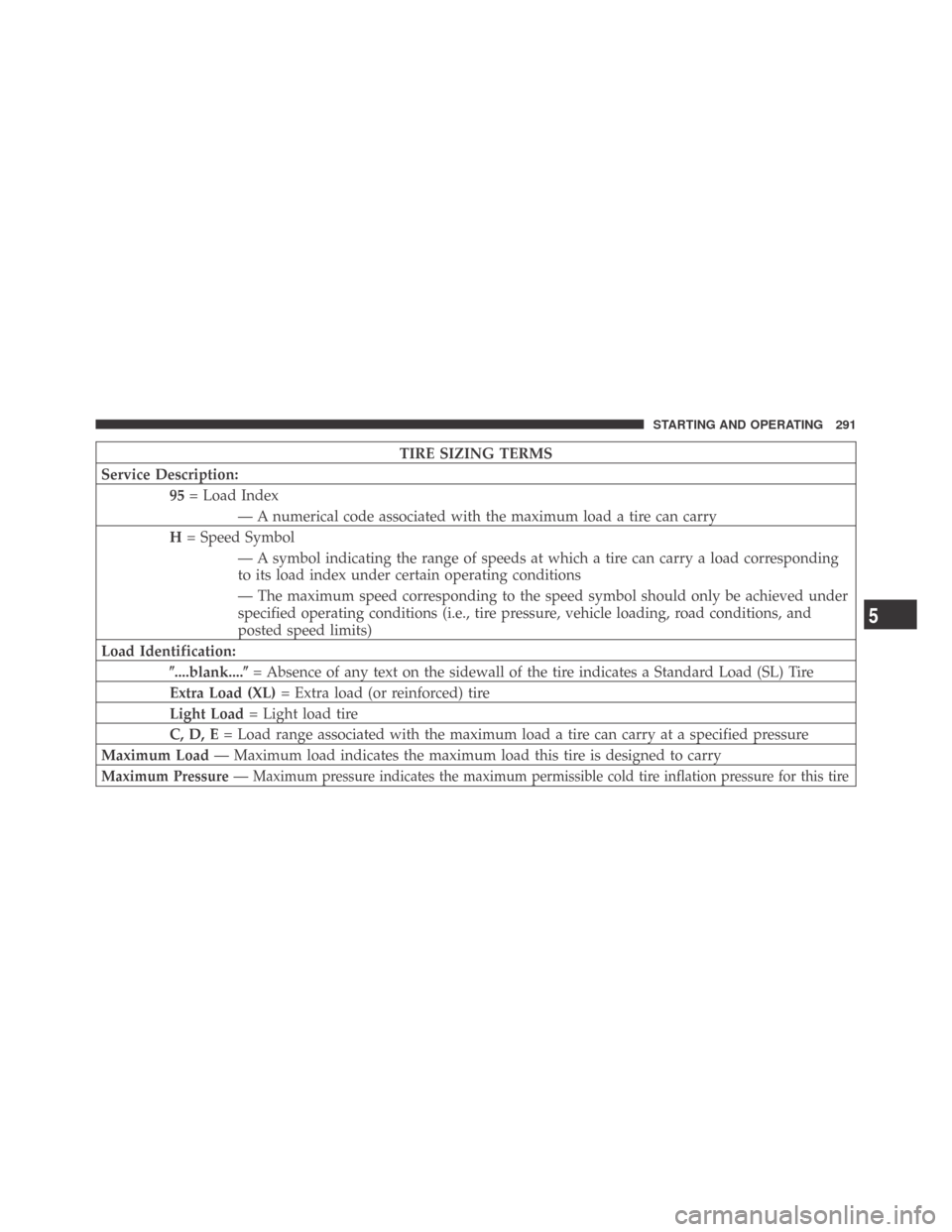
Service Description:
95= Load Index
— A numerical code associated with the maximum load a tire can carry
H= Speed Symbol
— A symbol indicating the range of speeds at which a tire can carry a load corresponding
to its load index under certain operating conditions
— The maximum speed corresponding to the speed symbol should only be achieved under
specified operating conditions (i.e., tire pressure, vehicle loading, road conditions, and
posted speed limits)
Load Identification:
�....blank....�= Absence of any text on the sidewall of the tire indicates a Standard Load (SL) Tire
Extra Load (XL)= Extra load (or reinforced) tire
Light Load= Light load tire
C, D, E= Load range associated with the maximum load a tire can carry at a specified pressure
Maximum Load— Maximum load indicates the maximum load this tire is designed to carry
Maximum Pressure—Maximum pressure indicates the maximum permissible cold tire inflation pressure for this tire
5
STARTING AND OPERATING 291
Page 295 of 469
Tire Loading and Tire Pressure
Tire Placard Location
NOTE:The proper cold tire inflation pressure is listed
on the driver’s side B-Pillar.
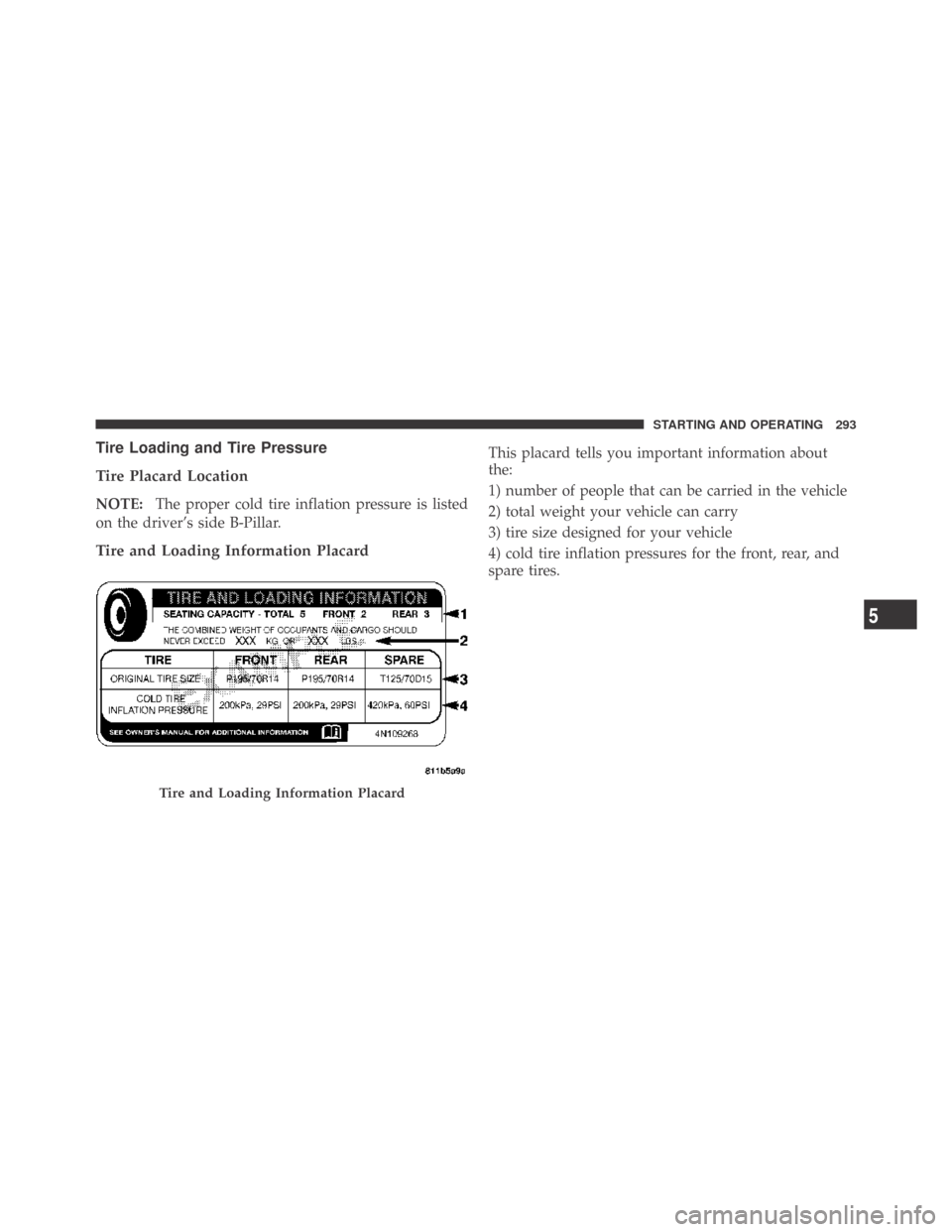
Tire and Loading Information Placard
This placard tells you important information about
the:
1) number of people that can be carried in the vehicle
2) total weight your vehicle can carry
3) tire size designed for your vehicle
4) cold tire inflation pressures for the front, rear, and
spare tires.
Tire and Loading Information Placard
5
STARTING AND OPERATING 293
Page 296 of 469
Loading
The vehicle maximum load on the tire must not exceed
the load carrying capacity of the tire on your vehicle. You
will not exceed the tire’s load carrying capacity if you
adhere to the loading conditions, tire size, and cold tire
inflation pressures specified on the Tire and Loading
Information placard and in the “Vehicle Loading” section
of this manual.
NOTE:Under a maximum loaded vehicle condition,
gross axle weight ratings (GAWRs) for the front and rear
axles must not be exceeded. For further information on
GAWRs, vehicle loading, and trailer towing, refer to
“Vehicle Loading” in this section.
To determine the maximum loading conditions of your
vehicle, locate the statement “The combined weight ofoccupants and cargo should never exceed XXX kg or XXX
lbs.” on the Tire and Loading Information placard. The
combined weight of occupants, cargo/luggage and
trailer tongue weight (if applicable) should never exceed
the weight referenced here.
Steps for Determining Correct Load Limit
1. Locate the statement “The combined weight of occu-
pants and cargo should never exceed XXX kg or XXX lbs”
on your vehicle’s placard.
2. Determine the combined weight of the driver and
passengers that will be riding in your vehicle.
3. Subtract the combined weight of the driver and pas-
sengers from XXX kg or XXX lbs.
294 STARTING AND OPERATING
Page 299 of 469

WARNING!
Overloading of your tires is dangerous. Overloading
can cause tire failure, affect vehicle handling, and
increase your stopping distance. Use tires of the
recommended load capacity for your vehicle. Never
overload them.
TIRES — GENERAL INFORMATION
Tire Pressure
Proper tire inflation pressure is essential to the safe and
satisfactory operation of your vehicle. Three primary
areas are affected by improper tire pressure:
Safety
WARNING!
•Improperly inflated tires are dangerous and can
cause accidents.
•Under-inflation increases tire flexing and can re-
sult in over-heating and tire failure.
•Over-inflation reduces a tire’s ability to cushion
shock. Objects on the road and chuckholes can
cause damage that result in tire failure.
•Unequal tire pressures can cause steering prob-
lems. You could lose control of your vehicle.
•Over-inflated or under-inflated tires can affect
vehicle handling and can fail suddenly, resulting
in loss of vehicle control.
(Continued)
5
STARTING AND OPERATING 297
Page 300 of 469
WARNING! (Continued)
•Unequal tire pressures from one side of the ve-
hicle to the other can cause the vehicle to drift to
the right or left.
•Always drive with each tire inflated to the recom-
mended cold tire inflation pressure.
Economy
Improper inflation pressures can cause uneven wear
patterns to develop across the tire tread. These abnormal
wear patterns will reduce tread life resulting in a need for
earlier tire replacement. Under-inflation also increases
tire rolling resistance and results in higher fuel
consumption.
Ride Comfort and Vehicle Stability
Proper tire inflation contributes to a comfortable ride.
Over-inflation produces a jarring and uncomfortable
ride.
Tire Inflation Pressures
The proper cold tire inflation pressure is listed on the
driver’s side “B” Pillar.
Some vehicles may have supplemental tire pressure
information for vehicle loads that are less than the
maximum loaded vehicle condition. These pressure con-
ditions will be found in the “Supplemental Tire Pressure
Information” section of this manual.
The pressure should be checked and adjusted as well as
inspected for signs of tire wear or visible damage at least
once a month. Use a good quality pocket-type gauge to
check tire pressure. Do not make a visual judgement
when determining proper inflation. Radial tires may look
properly inflated even when they are under-inflated.
298 STARTING AND OPERATING