Page 173 of 469

•Right Front Low Pressure (with a single chime)
•Right Rear Low Pressure (with a single chime)
•Check TPM System (with a single chime)
•ESP Off – Electronic Stability Program is deactivated
•ECO – Fuel Saver Indicator
•Check Gascap
•Key FOB Battery Low
•Service Keyless System
•Wrong Key
•Push Button or Insert Key/Turn To Run (refer to
“Remote Starting System” in Section 2)
•1–4 SKIPSHIFT
•Stereo (If Equipped with Driver-Selectable Surround
Sound [DSS])
•Audio Surround (If Equipped with Driver-Selectable
Surround Sound [DSS])
Engine Oil Change Indicator System
Oil Change Required
Your vehicle is equipped with an engine oil change
indicator system. The “Oil Change Required” message
will flash in the EVIC display for approximately 10 sec-
onds after a single chime has sounded, to indicate the
next scheduled oil change interval. The engine oil change
indicator system is duty cycle based, which means the
engine oil change interval may fluctuate, dependent
upon your personal driving style.
Unless reset, this message will continue to display each
time you turn the ignition switch to the ON/RUN
position. To turn off the message temporarily, press and
release the MENU button. To reset the oil change indica-
tor system (after performing the scheduled maintenance)
refer to the following procedure.
4
UNDERSTANDING YOUR INSTRUMENT PANEL 171
Page 174 of 469
1. Turn the ignition switch to the ON position (Do not
start the engine).
2. Fully depress the accelerator pedal, slowly, three times
within 10 seconds.
3. Turn the ignition switch to the OFF/LOCK position.
NOTE:If the indicator message illuminates when you
start the vehicle, the oil change indicator system did not
reset. If necessary, repeat this procedure.
Trip Functions
Press and release the MENU button until one of the
following Trip Functions displays in the EVIC:
•Average Fuel Economy/Fuel Saver Mode
•Distance To Empty
•Trip A
•Trip B
•Elapsed Time
•Display Units of Measure in
Press the SCROLL button to cycle through all the Trip
Computer functions.
The Trip Functions mode displays the following.
•Average Fuel Economy / Fuel Saver Mode — If
Equipped
Shows the average fuel economy since the last reset. When
the fuel economy is reset, the display will read “RESET” or
show dashes for two seconds. Then, the history informa-
tion will be erased, and the averaging will continue from
the last fuel average reading before the reset.
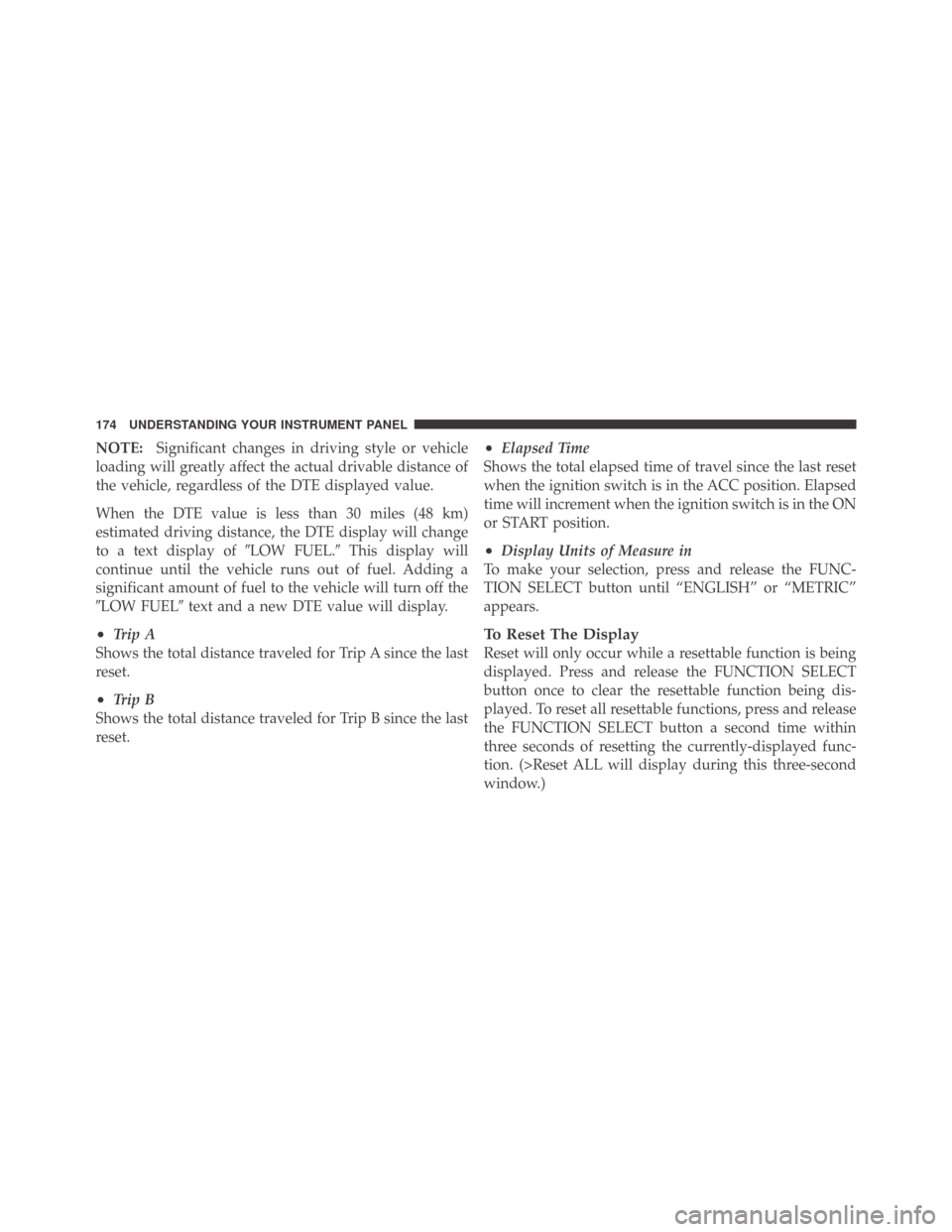
The FUEL SAVER MODE message will display above the
average fuel economy in the EVIC display. This message
will appear whenever MDS (if equipped) allows the
engine to operate on four cylinders, or if you are driving
in a fuel efficient manner.
172 UNDERSTANDING YOUR INSTRUMENT PANEL
Page 175 of 469
This feature allows you to monitor when you are driving
in a fuel efficient manner, and it can be used to modify
driving habits in order to increase fuel economy.
•Distance To Empty (DTE)
Shows the estimated distance that can be traveled with
the fuel remaining in the tank. This estimated distance is
determined by a weighted average of the instantaneous
and average fuel economy, according to the current fuel
tank level. DTE cannot be reset through the FUNCTION
SELECT button.Fuel Saver Mode — On
Fuel Saver Mode — Off
4
UNDERSTANDING YOUR INSTRUMENT PANEL 173
Page 176 of 469
NOTE:Significant changes in driving style or vehicle
loading will greatly affect the actual drivable distance of
the vehicle, regardless of the DTE displayed value.
When the DTE value is less than 30 miles (48 km)
estimated driving distance, the DTE display will change
to a text display of�LOW FUEL.�This display will
continue until the vehicle runs out of fuel. Adding a
significant amount of fuel to the vehicle will turn off the
�LOW FUEL�text and a new DTE value will display.
•Trip A
Shows the total distance traveled for Trip A since the last
reset.
•Trip B
Shows the total distance traveled for Trip B since the last
reset.
•Elapsed Time
Shows the total elapsed time of travel since the last reset
when the ignition switch is in the ACC position. Elapsed
time will increment when the ignition switch is in the ON
or START position.
•Display Units of Measure in
To make your selection, press and release the FUNC-
TION SELECT button until “ENGLISH” or “METRIC”
appears.
To Reset The Display
Reset will only occur while a resettable function is being
displayed. Press and release the FUNCTION SELECT
button once to clear the resettable function being dis-
played. To reset all resettable functions, press and release
the FUNCTION SELECT button a second time within
three seconds of resetting the currently-displayed func-
tion. (>Reset ALL will display during this three-second
window.)
174 UNDERSTANDING YOUR INSTRUMENT PANEL
Page 235 of 469
•Defrost
Air is directed through the windshield and side
window demist outlets. Use this mode with maxi-
mum blower and temperature settings for best wind-
shield and side window defrosting.
NOTE:The air conditioning compressor operates in
Mix, Defrost, and Floor or a blend of these modes, even
if the Air Conditioning Snowflake button is not pressed.
This dehumidifies the air to help dry the windshield. To
improve fuel economy, use these modes only when
necessary.
•Recirculation Control
Use this button to block the flow of outside air
from coming into the passenger compartment.
A light will illuminate when the system is in
recirculation mode. Use the recirculation mode
to provide maximum A/C performance in hot ambient
conditions, or to block outside odors, dust, etc.NOTE:
•Continuous use of the recirculation mode may make
the inside air stuffy and window fogging may occur.
Extended use of this mode is not recommended.
•The use of the recirculation mode in cold or damp
weather may cause windows to fog on the inside,
because of moisture build-up inside the vehicle. Select
the Outside Air position for maximum defogging.
•The A/C will engage automatically to prevent fogging
when the recirculation button is pressed.
•The A/C can be deselected manually without disturb-
ing the mode control selection.
Air Conditioning Control
Use this button to engage the Air Conditioning. A
light will illuminate when the Air Conditioning
System is engaged.
4
UNDERSTANDING YOUR INSTRUMENT PANEL 233
Page 243 of 469
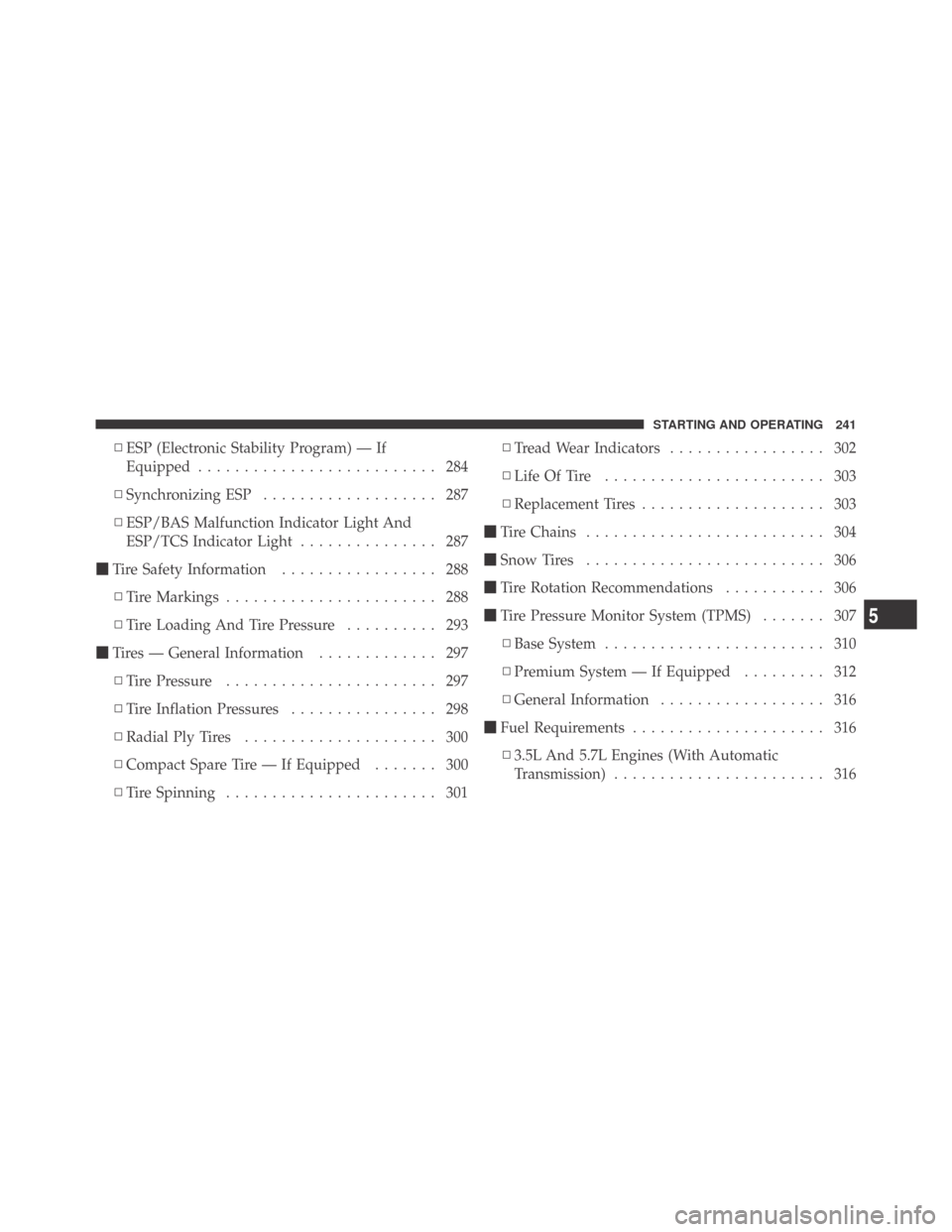
▫ESP (Electronic Stability Program) — If
Equipped.......................... 284
▫Synchronizing ESP................... 287
▫ESP/BAS Malfunction Indicator Light And
ESP/TCS Indicator Light............... 287
�Tire Safety Information................. 288
▫Tire Markings....................... 288
▫Tire Loading And Tire Pressure.......... 293
�Tires — General Information............. 297
▫Tire Pressure....................... 297
▫Tire Inflation Pressures................ 298
▫Radial Ply Tires..................... 300
▫Compact Spare Tire — If Equipped....... 300
▫TireSpinning ....................... 301▫Tread Wear Indicators................. 302
▫LifeOfTire ........................ 303
▫Replacement Tires.................... 303
�Tire Chains.......................... 304
�Snow Tires.......................... 306
�Tire Rotation Recommendations........... 306
�Tire Pressure Monitor System (TPMS)....... 307
▫Base System........................ 310
▫Premium System — If Equipped......... 312
▫General Information.................. 316
�Fuel Requirements..................... 316
▫3.5L And 5.7L Engines (With Automatic
Transmission)....................... 316
5
STARTING AND OPERATING 241
Page 244 of 469
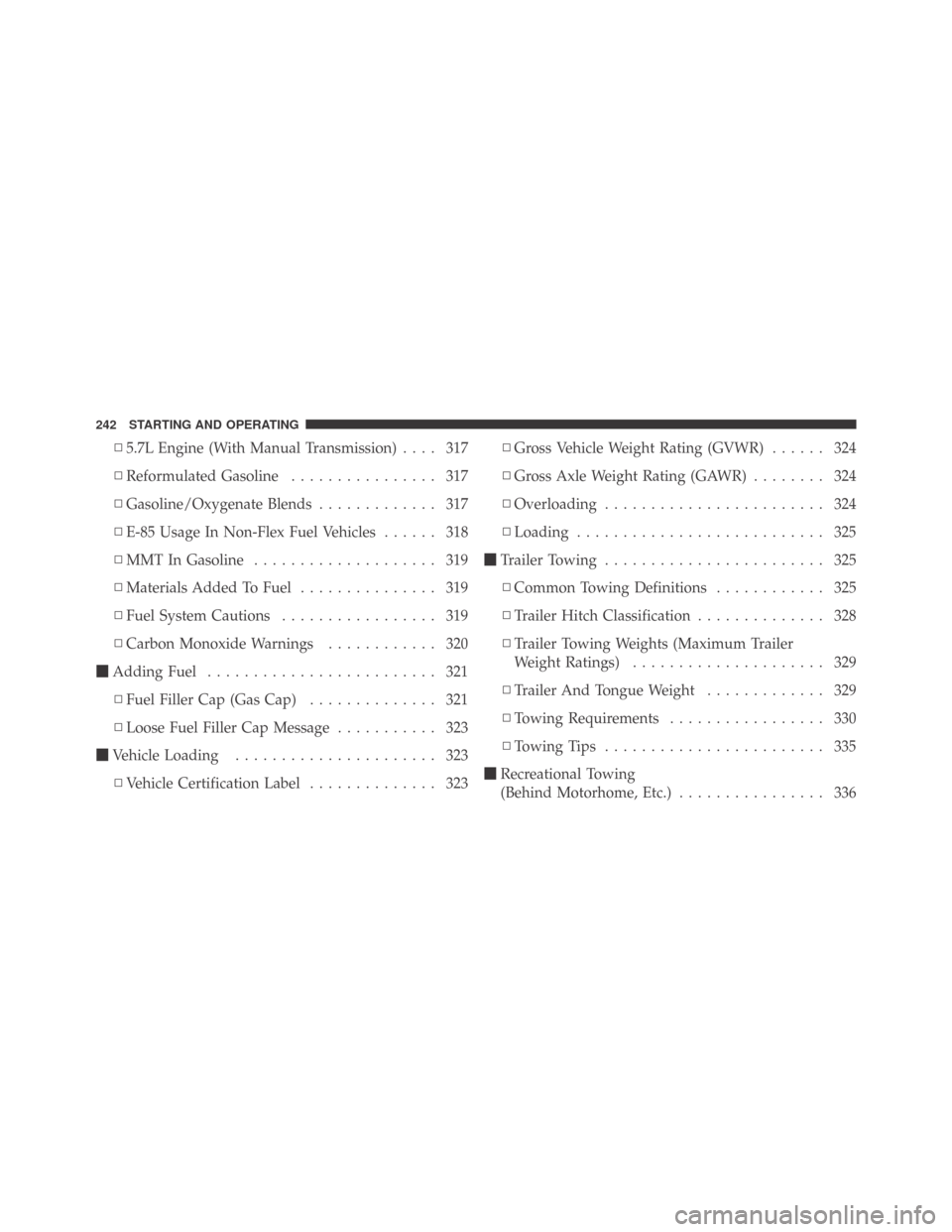
▫5.7L Engine (With Manual Transmission).... 317
▫Reformulated Gasoline................ 317
▫Gasoline/Oxygenate Blends............. 317
▫E-85 Usage In Non-Flex Fuel Vehicles...... 318
▫MMT In Gasoline.................... 319
▫Materials Added To Fuel............... 319
▫Fuel System Cautions................. 319
▫Carbon Monoxide Warnings............ 320
�Adding Fuel......................... 321
▫Fuel Filler Cap (Gas Cap).............. 321
▫Loose Fuel Filler Cap Message........... 323
�Vehicle Loading...................... 323
▫Vehicle Certification Label.............. 323▫Gross Vehicle Weight Rating (GVWR)...... 324
▫Gross Axle Weight Rating (GAWR)........ 324
▫Overloading........................ 324
▫Loading........................... 325
�Trailer Towing........................ 325
▫Common Towing Definitions............ 325
▫Trailer Hitch Classification.............. 328
▫Trailer Towing Weights (Maximum Trailer
Weight Ratings)..................... 329
▫Trailer And Tongue Weight............. 329
▫Towing Requirements................. 330
▫TowingTips ........................ 335
�Recreational Towing
(Behind Motorhome, Etc.)................ 336
242 STARTING AND OPERATING
Page 246 of 469

WARNING!
Do not attempt to push or tow your vehicle to get it
started. Unburned fuel could enter the catalytic con-
verter and once the engine has started, ignite and
damage the converter and vehicle. If the vehicle has
a discharged battery, booster cables may be used to
obtain a start from another vehicle. This type of start
can be dangerous if done improperly, so follow the
procedure carefully. See Section 6 of this manual for
jump-starting instructions.
Automatic Transmission — If Equipped
The shift lever must be in the NEUTRAL or PARK
position before you can start the engine. Apply the brakes
before shifting into any driving gear.
CAUTION!
Damage to the transmission may occur if the follow-
ing precautions are not observed:
•Shift into PARK only after the vehicle has come to
a complete stop.
•Shift into or out of REVERSE only after the
vehicle has come to a complete stop and the engine
is at idle speed.
•Do not shift from REVERSE, PARK, or NEUTRAL
into any forward gear when the engine is above
idle speed.
•Before shifting into any gear, make sure your foot
is firmly on the brake pedal.
Using Fob With Integrated Key (Tip Start)
NOTE:Normal starting of either a cold or a warm
engine is obtained without pumping or pressing the
accelerator pedal.
244 STARTING AND OPERATING