Page 300 of 411

Problems that result from using methanol/gasoline or
E85 Ethanol blends are not the responsibility of the
manufacturer. While MTBE is an oxygenate made from
Methanol, it does not have the negative effects of
Methanol.
E-85 Usage In Non-Flex Fuel Vehicles
Non-FFV vehicles are compatible with gasoline contain-
ing 10% ethanol (E10). Gasoline with higher ethanol
content may void the vehicle’s warranty.
If a Non-FFV vehicle is inadvertently fueled with E-85
fuel, the engine will have some or all of these symptoms:
•operate in a lean mode
•OBD II “Malfunction Indicator Light” on
•poor engine performance
•poor cold start and cold drivability
•increased risk for fuel system component corrosionTo fix a Non-FFV vehicle inadvertently fueled once with
E-85 perform the following:
•drain the fuel tank (see your authorized dealer)
•change the engine oil and oil filter
•disconnect and reconnect the battery to reset the
engine controller memory
More extensive repairs will be required for prolonged
exposure to E-85 fuel.
MMT In Gasoline
MMT is a manganese containing metallic additive that is
blended into some gasoline to increase the octane num-
ber. Gasolines blended with MMT offer no performance
advantage beyond gasolines of the same octane number
without MMT. Gasolines blended with MMT have shown
to reduce spark plug life and reduce emissions system
performance in some vehicles. The manufacturer recom-
mends using gasolines without MMT. Since the MMT
298 STARTING AND OPERATING
Page 310 of 411
WARNING!
A hot engine cooling system is dangerous. You or
others could be badly burned by steam or boiling
coolant. You may want to call a service center if your
vehicle overheats. If you decide to look under the
hood yourself, refer to Section 7, Maintenance, of this
manual. Follow the warnings under the Cooling
System Pressure Cap paragraph.
TIREFIT KIT
Small punctures in the tire tread can be sealed with
TIREFIT. Foreign objects (e.g., screws or nails) should not
be removed from the tire. TIREFIT can be used in outside
temperatures down to approximately -4°F (-20°C).
TIREFIT Storage
The TIREFIT kit is located in the trunk.
TIREFIT Usage Precautions
NOTE:
•Replace the TIREFIT Sealant Bottle prior to the expi-
ration date (printed on the bottle label) to assure
optimum operation of the system.
TIREFIT Location
308 WHAT TO DO IN EMERGENCIES
Page 315 of 411
5. Remove the cap from the valve stem and then screw
the fitting at the end of the Sealant Hose (7) onto the
valve stem.
6. Uncoil the Power Plug and Cable (5) and then insert
the plug into the vehicle’s power outlet.
NOTE:Do not remove foreign objects (e.g., screws or
nails) from the tire.
(C) Injecting TIREFIT Sealant into the deflated
tire:
1. Always start the engine before turning ON the TIRE-
FIT kit.
2. After pressing the Air Pump Power Button
(3), the air pump should start to inflate the tire
and the sealant (white fluid) will flow from the
Sealant Bottle (1) through the Sealant Hose (7)
and into the tire.NOTE:Some sealant may leak out
through the puncture in the tire.3.If the sealant Does Not Flow Through the Clear
Sealant Hose (7):
•Press the Air Pump Power Button (3) to turn OFF
the TIREFIT kit. Disconnect the Clear Sealant Hose
(7) from the valve stem. Make sure the valve stem is
free of debris. Reconnect the Clear Sealant Hose (7)
to the valve stem. Press the Air Pump Power Button
(3) to turn ON the TIREFIT kit.
•Turn the Mode Select knob to the Sealant/Air Mode.
•Connect the Power Plug (5) to a different power
outlet in your vehicle or another vehicle, if available.
Make sure the engine is running before turning ON
the TIREFIT kit.
•The Sealant Bottle (1) may be empty due to previous
use. Call for assistance.
WHAT TO DO IN EMERGENCIES 313
6
Page 325 of 411
MAINTAINING YOUR VEHICLE
CONTENTS
�Engine Compartment — 2.4L Turbo......... 325
�Onboard Diagnostic System — OBD II....... 326
▫Loose Fuel Filler Cap Message........... 326
�Emissions Inspection And Maintenance
Programs............................ 327
�Replacement Parts..................... 328
�Dealer Service........................ 329
�Maintenance Procedures................. 329
▫Engine Oil......................... 329▫Engine Air Cleaner Filter............... 332
▫Maintenance-Free Battery............... 333
▫Air Conditioner Maintenance............ 335
▫Body Lubrication..................... 336
▫Windshield Wiper Blades............... 336
▫Adding Washer Fluid.................. 337
▫Exhaust System...................... 337
▫Cooling System...................... 339
▫Brake System....................... 345
7
Page 327 of 411
ENGINE COMPARTMENT — 2.4L TURBO
1 — Washer Fluid Reservoir 6 — Battery
2 — Power Steering Fluid Reservoir 7 — Air Cleaner Filter
3 — Engine Oil Fill 8 — Coolant Pressure Cap
4 — Brake Fluid Reservoir 9 — Engine Oil Dipstick
5 — Power Distribution Center 10 — Engine Coolant ReservoirMAINTAINING YOUR VEHICLE 3257
Page 331 of 411
DEALER SERVICE
Your authorized dealer has the qualified service person-
nel, special tools, and equipment to perform all service
operations in an expert manner. Service Manuals are
available which include detailed service information for
your vehicle. Refer to these manuals before attempting
any procedure yourself.
NOTE:Intentional tampering with emissions control
systems can result in civil penalties being assessed
against you.
WARNING!
You can be badly injured working on or around a
motor vehicle. Only do service work for which you
have the knowledge and the proper equipment. If
you have any doubt about your ability to perform a
service job, take your vehicle to a competent me-
chanic.
MAINTENANCE PROCEDURES
The pages that follow contain therequiredmaintenance
services determined by the engineers who designed your
vehicle.
Besides the maintenance items for which there are fixed
maintenance intervals, there are other items that should
operate satisfactorily without periodic maintenance.
However, if a malfunction of these items does occur, it
could adversely affect the engine or vehicle performance.
These items should be inspected if a malfunction is
observed or suspected.
Engine Oil
Checking Oil Level
To assure proper engine lubrication, the engine oil must
be maintained at the correct level. Check the oil level at
regular intervals, such as every fuel stop.
MAINTAINING YOUR VEHICLE 329
7
Page 332 of 411
The best time to check the engine oil level is about five
minutes after a fully warmed engine is shut off. Do not
check oil level before starting the engine after it has sat
overnight. Checking engine oil level when the engine is
cold will give you an incorrect reading.
Checking the oil while the vehicle is on level ground and
only when the engine is hot, will improve the accuracy of
the oil level readings. Maintain the oil level between the
range markings on the dipstick. The range markings will
consist of a crosshatch zone that says SAFE or a cross-
hatch zone that says MIN at the low end of the range and
MAX at the high end of the range. Adding 1 qt (1 L) of oil
when the reading is at the low end of the indicated range
will result in the oil level at the full end of the indicator
range.CAUTION!
Do not overfill the engine. Overfilling the engine as
indicated by the range markings, as described above,
on the engine oil dipstick will cause oil aeration,
which can lead to loss of oil pressure and an increase
in oil temperature. This could damage your engine.
Change Engine Oil
Refer to the “Maintenance Schedule” in Section 8 for the
proper maintenance intervals.
Engine Oil Selection
For best performance and maximum protection under all
types of operating conditions, the manufacturer only
recommends full synthetic engine oils that meet require-
ments of Chrysler Material Standard MS-10725.
The manufacturer recommends the use of a full synthetic
engine oil, such as Mobil 1�SAE 0W-40 or equivalent.
330 MAINTAINING YOUR VEHICLE
Page 333 of 411
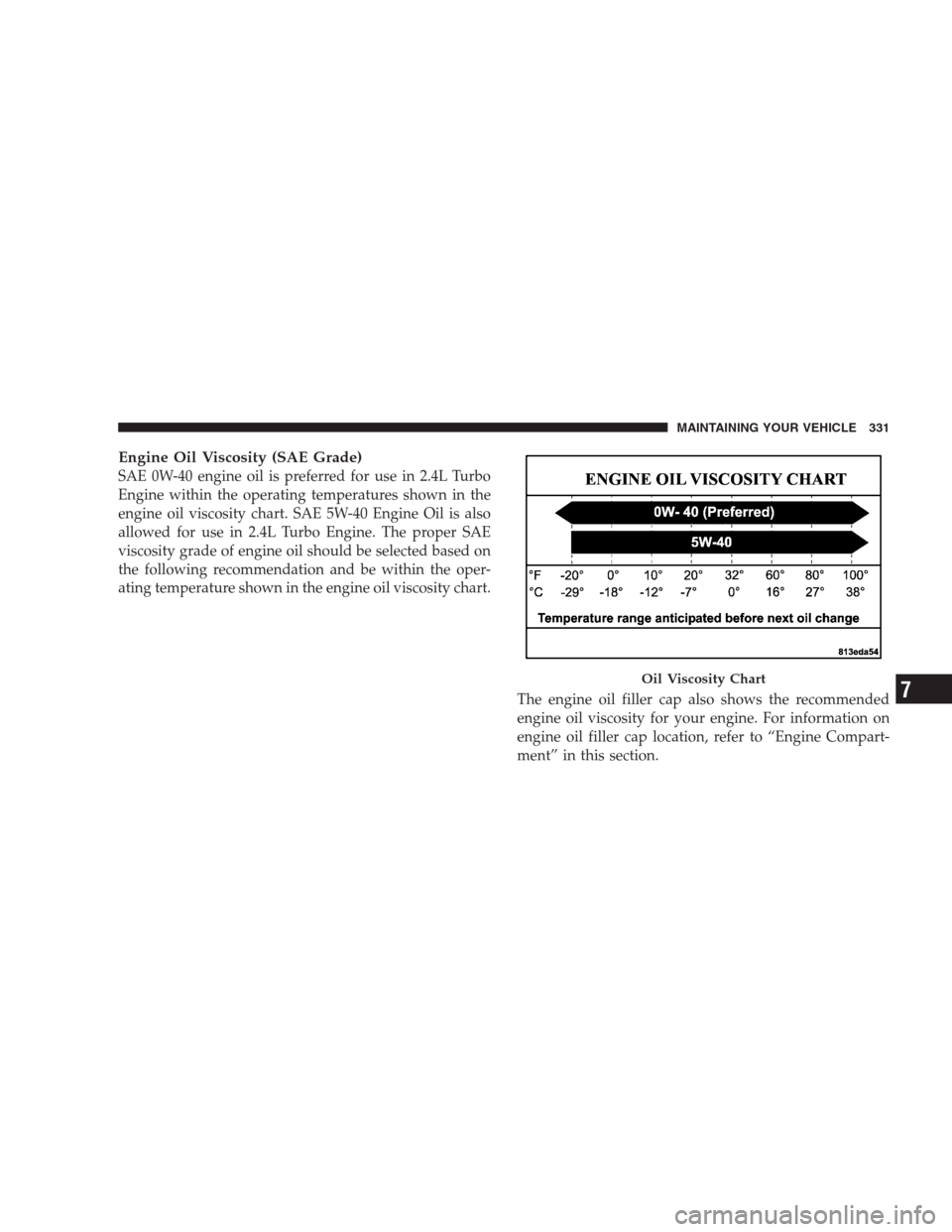
Engine Oil Viscosity (SAE Grade)
SAE 0W-40 engine oil is preferred for use in 2.4L Turbo
Engine within the operating temperatures shown in the
engine oil viscosity chart. SAE 5W-40 Engine Oil is also
allowed for use in 2.4L Turbo Engine. The proper SAE
viscosity grade of engine oil should be selected based on
the following recommendation and be within the oper-
ating temperature shown in the engine oil viscosity chart.
The engine oil filler cap also shows the recommended
engine oil viscosity for your engine. For information on
engine oil filler cap location, refer to “Engine Compart-
ment” in this section.
Oil Viscosity Chart
MAINTAINING YOUR VEHICLE 331
7