2009 DODGE AVENGER child lock
[x] Cancel search: child lockPage 53 of 473

Automatic Locking Mode
In this mode, the shoulder belt is automatically pre-
locked. However, the belt will still retract to remove any
slack in the shoulder belt. The Automatic Locking Mode
is available on all passenger seating positions. Use the
Automatic Locking Mode anytime a child safety seat is
installed in a passenger seating position. Children
12 years old and younger should be properly restrained
in the rear seat whenever possible.
How To Engage The Automatic Locking Mode
1. Buckle the combination lap/shoulder belt.
2. Grasp the shoulder portion and pull downward until
the entire belt is extracted.
3. Allow the belt to retract. As the belt retracts, you will
hear a clicking sound. This indicates the safety belt is
now in the Automatic Locking Mode.
How To Disengage The Automatic Locking Mode
Unbuckle the combination lap/shoulder belt and allow it
to retract completely to disengage the Automatic Locking
Mode and activate the Vehicle Sensitive (Emergency)
Locking mode.
Seat Belts and Pregnant Women
We recommend that pregnant women use the seat belts
throughout their pregnancy. Keeping the mother safe is
the best way to keep the baby safe.
Pregnant women should wear the lap part of the belt
across the thighs and as snug across the hips as possible.
Keep the belt low so that it does not come across the
abdomen. That way the strong bones of the hips will take
the force if there is a collision.
Seat Belt Extender
If a seat belt is too short, even when fully extended and
when the adjustable upper shoulder belt anchorage (if
equipped) is in its lowest position, your authorized
THINGS TO KNOW BEFORE STARTING YOUR VEHICLE 51
2
Page 73 of 473
WARNING! (Continued)
•A rearward facing child restraint should only be
used in a rear seat. A rearward facing child re-
straint in the front seat may be struck by a deploy-
ing passenger airbag which may cause severe or
fatal injury to the infant.
Here are some tips on getting the most out of your
child restraints:
•
Children who are large enough to wear the shoulder
belt comfortably, and whose legs are long enough to
bend over the front of the seat when their back is
against the seatback, should use the lap/shoulder belt
in a rear seat.
•Before buying any restraint system, make sure that it
has a label certifying that it meets all applicable Safety
Standards. We also recommend that you make surethat you can install the child restraint in the vehicle
where you will use it, before you buy it.
•The restraint must be appropriate for your child’s
weight and height. Check the label on the restraint for
weight and height limits.
•Carefully follow the instructions that come with the
restraint. If you install the restraint improperly, it may
not work when you need it.
•All passenger seating positions contain automatic
locking retractors. However, any seat belt system will
loosen with time, so check the belt occasionally and
pull it tight if necessary.
•In the rear seat, you may have trouble tightening the
lap/shoulder belt on the child restraint because the
buckle or latch plate is too close to the belt path
opening on the restraint. Disconnect the latch plate
from the buckle and twist the short buckle end of the
THINGS TO KNOW BEFORE STARTING YOUR VEHICLE 71
2
Page 79 of 473

2. Route the tether strap to provide the most direct path
for the strap between the anchor and the child seat. If
your vehicle is equipped with adjustable rear head
restraints, raise the head restraint, and where possible,
route the tether strap under the head restraint and
between the two posts. If not possible, lower the head
restraint and pass the tether strap around the outboard
side of the head restraint.
3. Attach the tether strap hook (A) of the child restraint
to the anchor (B) and remove slack in the tether strap
according to the child restraint manufacturer’s
instructions.
WARNING!
An incorrectly anchored tether strap could lead to in-
creased head motion and possible injury to the child.
Use only the anchor positions directly behind the child
seat to secure a child restraint top tether strap.
Installing Child Restraints Using the Vehicle Seat
Belt
The passenger seat belts are equipped with Automatic
Locking Retractors (ALRs), which are designed to keep
the lap portion tight around the child restraint.
The seat belt must be in the Automatic Locking Mode in
order to enable a child restraint to be tightly installed.
Refer to “Automatic Locking Mode” in this section for
details. A locking clip should not be necessary once the
automatic locking feature is enabled. Position the shoul-
der and lap belt on the child restraint. The Automatic
Locking Retractor (ALR) is activated by first attaching
the child seat, then pulling all of the webbing out of the
retractor, then allowing the webbing to retract. As the
webbing retracts, you will hear a clicking sound. This
indicates the safety belt is now in the Automatic Locking
Mode. To release, simply unbuckle the seat belt by
depressing the button, and allow the webbing to retract
into the retractor.
THINGS TO KNOW BEFORE STARTING YOUR VEHICLE 77
2
Page 133 of 473
Folding Rear Seat
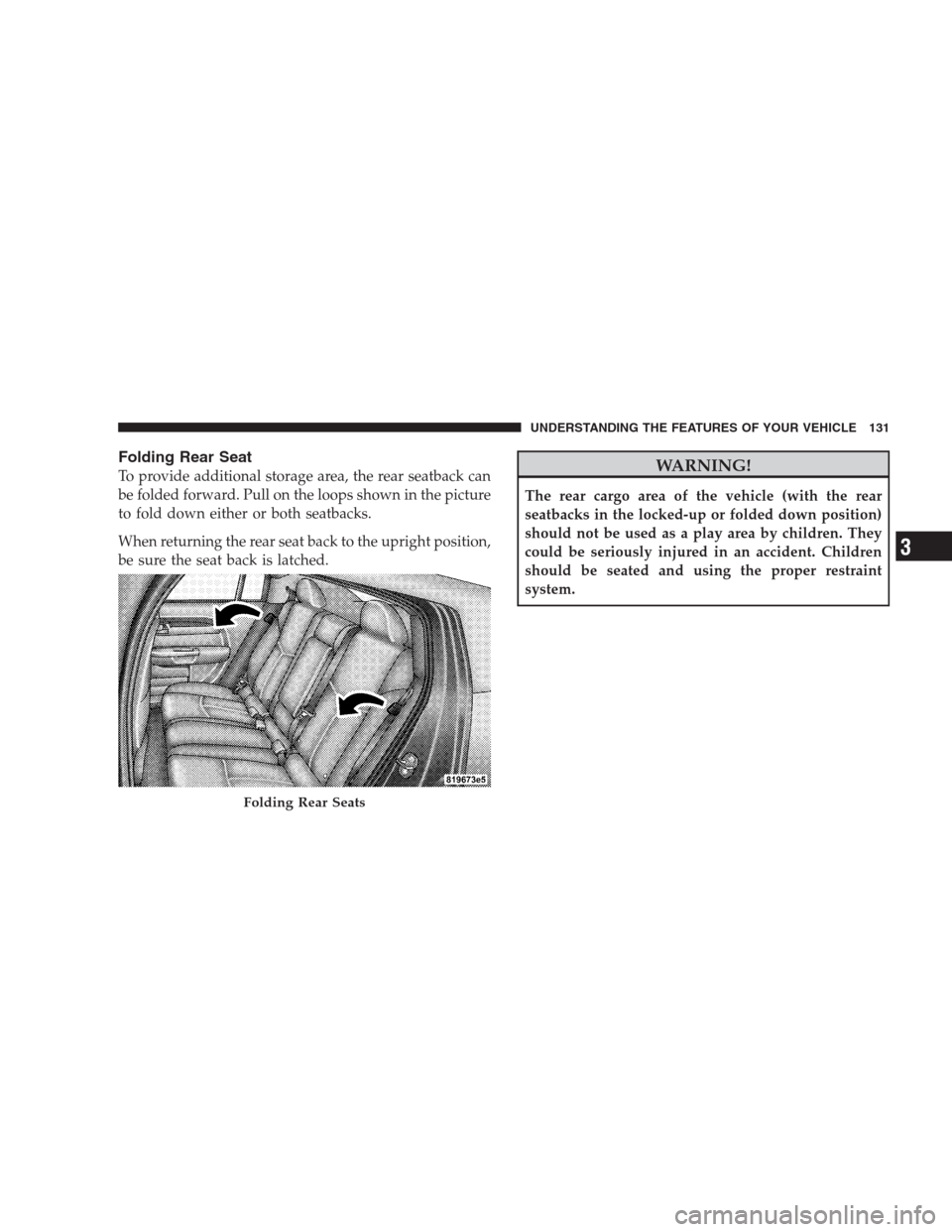
To provide additional storage area, the rear seatback can
be folded forward. Pull on the loops shown in the picture
to fold down either or both seatbacks.
When returning the rear seat back to the upright position,
be sure the seat back is latched.WARNING!
The rear cargo area of the vehicle (with the rear
seatbacks in the locked-up or folded down position)
should not be used as a play area by children. They
could be seriously injured in an accident. Children
should be seated and using the proper restraint
system.
Folding Rear Seats
UNDERSTANDING THE FEATURES OF YOUR VEHICLE 131
3
Page 165 of 473
When the seatback is folded to the upright position, make
sure it is latched by strongly pulling on the top of the
seatback above the seat strap.
WARNING!
•Be certain that the seatback is securely locked into
position. If the seatback in not securely locked
into position, the seat will not provide the proper
stability for child seats and/or passengers. An
improperly latched seat could cause serious injury.
•The cargo area in the rear of the vehicle (with the
rear seatbacks in the locked-up or folded down
position) should not be used as a play area by
children when the vehicle is in motion. They could
be seriously injured in an accident. Children
should be seated and using the proper restraint
system.
(Continued)
WARNING! (Continued)
•To help protect against personal injury, passengers
should not be seated in the rear cargo area. The
rear cargo space is intended for load carrying
purposes only, not for passengers, who should sit
in seats and use seat belts.
•The weight and position of cargo and passengers
can change the vehicle center of gravity and ve-
hicle handling. To avoid loss of control resulting
in personal injury, follow these guidelines for
loading your vehicle:
Always place cargo evenly on the cargo floor. Put heavier
objects as low and as far forward as possible.
Place as much cargo as possible in front of the rear axle.
Too much weight or improperly placed weight over or
behind the rear axle can cause the rear of the vehicle to
sway.
UNDERSTANDING THE FEATURES OF YOUR VEHICLE 163
3
Page 273 of 473
WARNING!
•It is dangerous to move the shift lever out of PARK
or NEUTRAL if the engine speed is higher than
idle speed. If your foot is not firmly on the brake
pedal, the vehicle could accelerate quickly forward
or in reverse. You could lose control of the vehicle
and hit someone or something. Only shift into
gear when the engine is idling normally and when
your right foot is firmly on the brake pedal.
(Continued)
WARNING! (Continued)
•Unintended movement of a vehicle could injure
those in and near the vehicle. As with all vehicles,
you should never exit a vehicle while the engine is
running. Before exiting a vehicle, you should
always shift the vehicle into PARK, remove the
key from the ignition, and apply the parking
brake. Once the key is removed from the ignition,
the shift lever is locked in the PARK position,
securing the vehicle against unwanted movement.
Furthermore, you should never leave children un-
attended inside a vehicle.
Brake/Transaxle Interlock System
This system prevents you from moving the shift lever out
of PARK and into any gear unless the brake pedal is
pressed. This system is active only while the ignition
switch is in the ON position.Always press the brake
pedal first, before moving the shift lever out of PARK.
STARTING AND OPERATING 271
5
Page 454 of 473

Caps, Filler
Fuel................................ 331
Oil (Engine)..................367,368,369,375
Power Steering........................ 282
Radiator (Coolant Pressure)............... 388
Car Washes............................ 395
Carbon Monoxide Warning................. 327
Cargo Area Features...................... 162
Cargo Compartment...................... 162
Cargo Load Floor........................ 162
Cargo (Vehicle Loading)................... 162
Caution, Exhaust Gas...................... 80
Cellular Phone........................91,249
Center High Mounted Stop Light............ 415
Chains, Tire............................ 312
Changing A Flat Tire..................... 350
Chart, Tire Sizing........................ 296
Check Engine Light (Malfunction Indicator
Light)................................ 371Child Restraint....................68,70,74,77
Child Restraint Tether Anchors.............72,74
Child Safety Locks........................ 34
Cigar Lighter........................... 159
Clean Air Gasoline....................... 324
Cleaning
Wheels............................. 397
Windshield Wiper Blades................. 382
Climate Control......................... 250
Clock........................200,214,218,228
Coin Holder........................... 164
Compact Disc (CD) Maintenance............. 249
Compact Spare Tire...................... 306
Compass.............................. 193
Compass Calibration..................... 194
Compass Variance....................... 194
Computer, Trip/Travel..................21,192
Console............................132,164
Console, Floor.......................132,164
452 INDEX
Page 461 of 473

Brake Warning........................ 187
Bulb Replacement...................... 410
Center Mounted Stop................... 415
Daytime Running...................... 137
Electronic Stability Program (ESP) Indicator . . . 291
Engine Temperature Warning.............. 179
Fog ..........................137,183,412
Headlight Switch...................... 135
Headlights........................... 135
Headlights On With Wipers............... 142
High Beam Indicator.................... 187
Illuminated Entry....................... 21
Instrument Cluster..................... 135
Interior............................. 134
License............................. 415
Lights On Reminder.................... 137
Low Fuel............................ 178
Malfunction Indicator (Check Engine)........ 186
Map Reading......................... 134Oil Pressure.......................... 179
Passing............................. 137
Seat Belt Reminder..................... 179
Security Alarm (Theft Alarm).............. 19
Theft Alarm (Security Alarm).............. 178
Tire Pressure Monitoring (TPMS)........184,314
Traction Control....................... 291
Turn Signal.....................138,183,413
Voltage............................. 178
Warning (Instrument Cluster Description)..... 177
Loading Vehicle......................334,336
Capacities........................... 336
Tires ............................... 299
Locks
Auto Unlock.......................... 33
Child Protection........................ 34
Door................................ 31
Power Door........................... 32
Low Tire Pressure System.................. 314
INDEX 459
10