Page 350 of 473

HAZARD WARNING FLASHER
The Hazard Warning flasher switch is located on the
instrument panel, below the radio.
Press the switch to turn on the Hazard
Warning flashers. When the Hazard
Warning flasher switch is activated, all
directional turn signals will flash on
and off to warn oncoming traffic of an
emergency. Press the switch a second
time to turn off flashers.
This is an emergency warning system and should not be
used when the vehicle is in motion. Use it when your
vehicle is disabled and is creating a safety hazard for
other motorists.
If it is necessary to leave the vehicle to go for service, the
Hazard Warning flasher will continue to operate with the
ignition key removed and the vehicle locked.NOTE:With extended use, the Hazard Warning flasher
may wear down your battery.
IF YOUR ENGINE OVERHEATS
In any of the following situations, you can reduce the
potential for overheating by taking the appropriate ac-
tion.
•On the highways — Slow down.
•In city traffic — While stopped, put transaxle in
NEUTRAL, but do not increase engine idle speed.
If the pointer rises to theH(red) mark, the instrument
cluster will sound a chime. Pull over and stop the vehicle
with the engine at idle, when safe. Turn off the air
conditioning and wait until the pointer drops back into
the normal range. If the pointer remains on the H (red)
mark for more than a minute, turn the engine off imme-
diately and call for service.
348 WHAT TO DO IN EMERGENCIES
Page 354 of 473
WARNING!
Do not attempt to change a tire on the side of the
vehicle close to moving traffic. Pull far enough off
the road to avoid the danger of being hit when
operating the jack or changing the wheel.
2. Set the parking brake.
3. Place the shift lever into PARK (automatic transaxle)
or REVERSE (manual transaxle).
4. Turn OFF the ignition.
5. Turn on the Hazard Warning flasher.6. Block both the front and rear of the
wheel diagonally opposite the jacking
position. For example, if changing the
right front tire, block the left rear
wheel.
NOTE:Passengers should not remain in the vehicle
while the vehicle is being jacked.
Jacking Instructions
WARNING!
Carefully follow these tire changing warnings to
help prevent personal injury or damage to your
vehicle:
(Continued)
352 WHAT TO DO IN EMERGENCIES
Page 360 of 473

JUMP-STARTING PROCEDURE
The battery is stored between the left front headlight
assembly and the left front wheel splash shield. Access is
through the splash shield.
Jump-starting remote battery terminals are located under
the hood.
WARNING!
•Take care to avoid the radiator cooling fan when-
ever the hood is raised. It can start anytime the
ignition switch is on. You can be hurt by the fan.
(Continued)
WARNING! (Continued)
•Do not attempt to push or tow your vehicle to get
it started. Vehicles equipped with an automatic
transaxle cannot be started this way. Unburned
fuel could enter the catalytic converter and once
the engine has started, ignite and damage the
converter and vehicle. If the vehicle has a dis-
charged battery, booster cables may be used to
obtain a start from another vehicle. This type of
start can be dangerous if done improperly, so
follow this procedure carefully.
•Do not use a booster battery or any other booster
source with an output that exceeds 12-Volts.
1. Wear eye protection and remove any metal jewelry
such as watchbands or bracelets that might make an
inadvertent electrical contact.
358 WHAT TO DO IN EMERGENCIES
Page 361 of 473
2. When boosting from a battery in another vehicle, park
that vehicle within booster cable reach, but without
allowing the vehicles to touch. Set the parking brake,
place the automatic transaxle in PARK and turn ignition
to LOCK for both vehicles.
WARNING!
Do not permit vehicles to touch each other as this
could establish a ground connection and personal
injury could result.
3. Turn off the heater, radio, and all unnecessary electri-
cal loads.
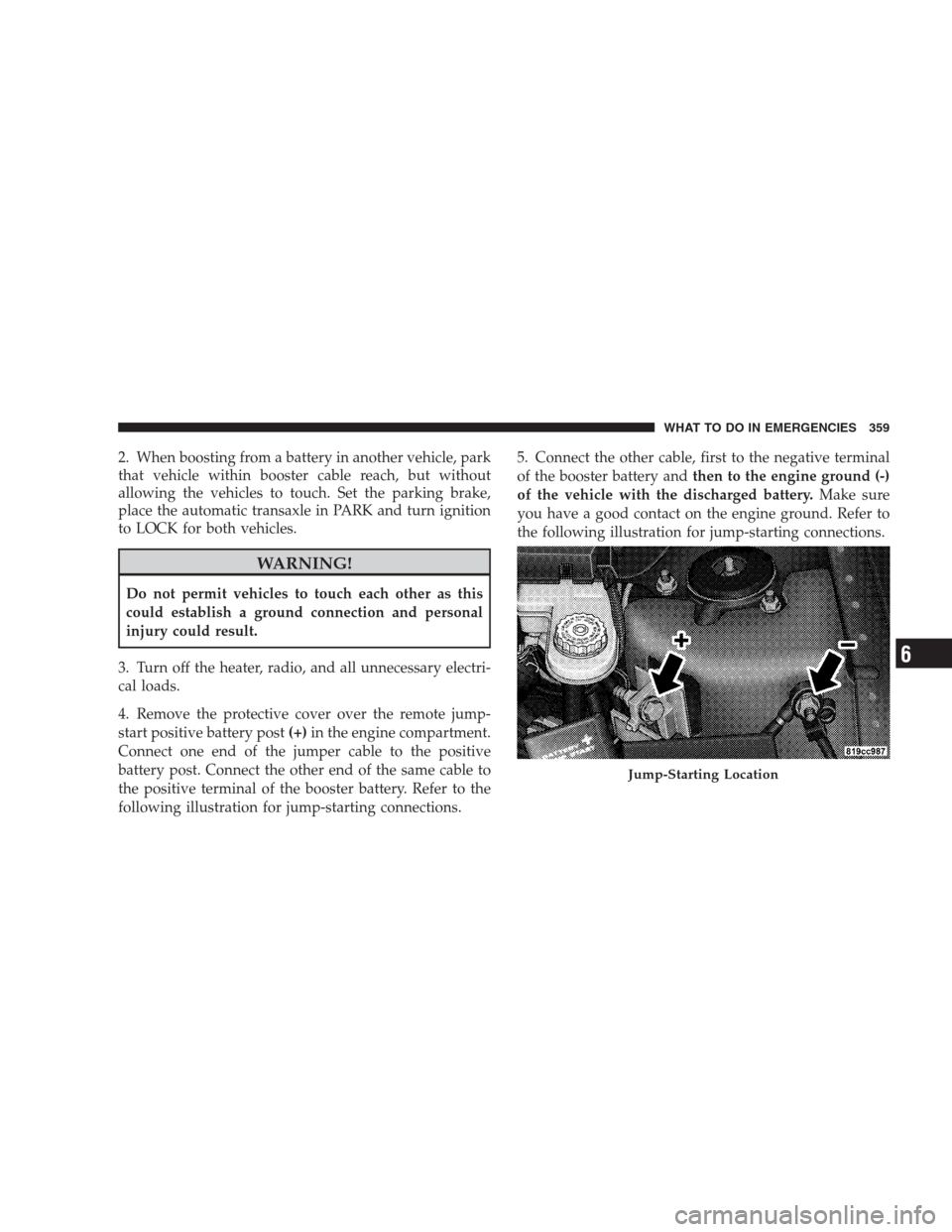
4. Remove the protective cover over the remote jump-
start positive battery post(+)in the engine compartment.
Connect one end of the jumper cable to the positive
battery post. Connect the other end of the same cable to
the positive terminal of the booster battery. Refer to the
following illustration for jump-starting connections.5. Connect the other cable, first to the negative terminal
of the booster battery andthen to the engine ground (-)
of the vehicle with the discharged battery.Make sure
you have a good contact on the engine ground. Refer to
the following illustration for jump-starting connections.
Jump-Starting Location
WHAT TO DO IN EMERGENCIES 359
6
Page 362 of 473

6. If the vehicle is equipped with Sentry Key�Immobi-
lizer, turn the ignition switch to the ON position for three
seconds before moving the ignition switch to the START
position.
7. Start the engine in the vehicle that has the booster
battery, let the engine idle a few minutes, and then start
the engine in the vehicle with the discharged battery.
8. When removing the jumper cables, reverse the se-
quence exactly. Be careful of the moving belts and fan.
9. Reinstall the protective cover over the remote jump-
start positive battery post.WARNING!
During cold weather when temperatures are below
freezing point, electrolyte in a discharged battery
may freeze. Do not attempt jump-starting because
the battery could rupture or explode. The battery
temperature must be brought up above the freezing
point before attempting a jump-start.
NOTE:Refer to “Maintenance Procedures” in Section 7
of this manual for information on accessing the battery
for service or replacement.
WARNING!
Any procedure other than above could result in:
•Personal injury caused by electrolyte squirting out
the battery vent;
(Continued)
360 WHAT TO DO IN EMERGENCIES
Page 364 of 473
CAUTION!
Racing the engine or spinning the wheels too fast
may lead to transaxle overheating and failure. It can
also damage the tires. Do not spin the wheels above
30 mph (48 km/h). Do not spin the wheels continu-
ously for more than 30 seconds.
TOWING A DISABLED VEHICLE
Towing With The Ignition Key
Front Wheel Drive
Your vehicle may be towed (with all four wheels flat on
the ground), under the following conditions: The shift
lever must be in NEUTRAL, the distance to be traveled
must not exceed 15 miles (25 km), and the towing speed
must not exceed 25 mph (40 km/h). Exceeding these
towing limits may cause a transaxle failure. If the trans-
axle is not operative, or if the vehicle is to be towed morethan 15 miles (25 km), the vehicle must be transported
either with a flat bed truck or with the front wheels off
the ground.
CAUTION!
•If the vehicle being towed requires steering, the
ignition switch must be in the ON position, not in
the LOCK or ACC position.
•Do not attempt to tow this vehicle from the front
with sling type towing equipment. Damage to the
front fascia will result.
•Do not push or tow this vehicle with another
vehicle as damage to the bumper fascia and trans-
axle may result.
If you must use the accessories (wipers, defrosters, etc.)
while being towed, the key must be in the ON position,
not the ACC position. Make certain the transaxle remains
in NEUTRAL.
362 WHAT TO DO IN EMERGENCIES
Page 365 of 473

Towing Without The Ignition Key
Special care must be taken when the vehicle is towed
with the ignition in the LOCK position. Flatbed towing is
the preferred towing method. However, if a flatbed
towing vehicle is not available, a wheel lift towing
vehicle may be used. Rear towing is not recommended
with the front wheels on the ground, as transaxle damage
can result. If rear towing is the only alternative, a front
end dolly must be used. Proper towing equipment is
necessary to prevent damage to the vehicle.
Towing This Vehicle Behind Another Vehicle
Flat towing with all four wheels on the ground of
vehicles equipped with an automatic transmission, is
only permitted within the limitations described in this
section.
Towing This Vehicle Behind Another Vehicle With
A Tow Dolly
Rear towing is not recommended with the front wheels
on the ground, as transaxle damage can result. If rear
towing is the only alternative, a front end dolly must be
used. Proper towing equipment is necessary to prevent
damage to the vehicle.
Towing Without Power — Override Transaxle
Interlock System
Special care must be taken when the vehicle is towed
with the ignition in the LOCK position. A dolly should be
used under the front wheels if the rear wheels are raised.
Proper towing equipment is necessary to prevent dam-
age to the vehicle.
WHAT TO DO IN EMERGENCIES 363
6
Page 366 of 473
Battery power is required to release the brake/transaxle
interlock system. There is an override system that allows
you to shift out of PARK in case of loss of power. To
activate the override system:
•Firmly apply the parking brake.
•Insert the ignition key and rotate it to the ON position.
•Remove the cupholder liner.
•Insert a key, screwdriver, or similar object into the
front hole then push and hold the manual override
release lever forward.
•While holding the release lever forward, move the
shift lever from PARK to NEUTRAL.
•Release the override.
364 WHAT TO DO IN EMERGENCIES

