Page 383 of 481

TOWING A DISABLED VEHICLE
Proper towing or lifting equipment is required to prevent
damage to your vehicle. Use of safety chains is recom-
mended.Attach towing device to main structural mem-
bers of the vehicle Ð not to bumpers or associated
brackets. State and local laws, applying to vehicles
under tow, must be observed.
Four-Wheel Drive Vehicles
The manufacturer recommends towing with all wheels
OFFthe ground. Acceptable methods are to tow the
vehicle on a flatbed or with one end of the vehicle raised
and the opposite end on a towing dolly.
Two-Wheel Drive Vehicles
Provided that the transmission is operable, tow with the
transmission in NEUTRAL and the ignition key in the
OFF position, along with the front wheels raised and therear wheels on the ground. The speed must not exceed 30
mph (50 km/h), and the distance must not exceed 15
miles (25 km).
If the vehicle is to be towed more than 15 miles (25 km)
or faster than 30 mph (50 km/h), it must be towed on a
flatbed, or with the rear wheels raised and the front
wheels on the ground, or with the front end raised and
the rear wheels on a towing dolly.
NOTE:Towing the vehicle with the rear wheels on the
ground at more than 30 mph (50 km/h) or for more than
15 miles (25 km), can cause severe transmission damage.
WHAT TO DO IN EMERGENCIES 381
6
Page 397 of 481

include cleaning of the condenser fins and a performance
test. Drive belt tension should also be checked at this
time.
WARNING!
²Use only refrigerants and compressor lubricants
approved by the manufacturer for your air condi-
tioning system. Some unapproved refrigerants are
flammable and can explode, injuring you. Other
unapproved refrigerants or lubricants can cause
the system to fail, requiring costly repairs. Refer to
Section 3 of the Warranty Information book for
further warranty information.
²The air conditioning system contains refrigerant
under high pressure. To avoid risk of personal
injury or damage to the system, adding refrigerant
or any repair requiring lines to be disconnected
should be done by an experienced technician.NOTE:Use only manufacturer approved A/C System
Sealers, Stop Leak Products, Seal Conditioners, Compres-
sor Oils and Refrigerants.
Refrigerant Recovery and Recycling
R-134a air conditioning refrigerant is a hydrofluoro-
carbon (HFC) that is endorsed by the Environmental
Protection Agency and is an ozone-saving product. How-
ever, the manufacturer recommends that air conditioning
service be performed by authorized dealers or other
service facilities using recovery and recycling equipment.
Drive Shaft Constant Velocity Joints
All 4-wheel drive models are equipped with four con-
stant velocity joints. Periodic lubrication of these joints is
not required. However, the joint boot should be inspected
for external leakage or damage periodically. If external
leakage or damage is evident, the joint boot and grease
should be replaced immediately. Continued operation
could result in failure of the joint due to water and dirt
MAINTAINING YOUR VEHICLE 395
7
Page 414 of 481

²If you carry special cargo such as chemicals, fertilizers,
de-icer salt, etc., be sure that such materials are well
packaged and sealed.
²If a lot of driving is done on gravel roads, consider
mud or stone shields behind each wheel.
²Use MOPARtTouch Up Paint on scratches as soon as
possible. Your authorized dealer has touch up paint to
match the color of your vehicle.
Wheel and Wheel Trim Care
All wheels and wheel trim, especially aluminum and
chrome plated wheels, should be cleaned regularly with
a mild soap and water to prevent corrosion. To remove
heavy soil, use MOPARtWheel Cleaner or select a
nonabrasive, non-acidic cleaner. Do not use scouring
pads, steel wool, a bristle brush or metal polishes. Only
MOPARtcleaners are recommended. Do not use ovencleaner. Avoid automatic car washes that use acidic
solutions or harsh brushes that may damage the wheels'
protective finish.
YES EssentialstFabric Cleaning Procedure ± If
Equipped
YES Essentialstseats may be cleaned in the following
manner:
²Remove as much of the stain as possible by blotting
with a clean, dry towel.
²Blot any remaining stain with a clean, damp towel.
²For tough stains, apply MOPARtTotal Clean or a mild
soap solution to a clean, damp cloth and remove stain.
Use a fresh, damp towel to remove soap residue.
²For grease stains, apply MOPARtMulti-Purpose
Cleaner to a clean, damp cloth and remove stain. Use
a fresh, damp towel to remove soap residue.
412 MAINTAINING YOUR VEHICLE
Page 426 of 481
BULB REPLACEMENT
Headlights/Parking/Turn Signal
1. Remove the two bolts attaching the headlight to the
upper fender reinforcement (hood must be opened to
access bolts).2. Remove one nut that attaches the headlight to the
inner fender panel. Access to the nut is possible by
opening the fender panel access door which is located in
the wheel liner.
3. Grasp the headlight and pull firmly to disengage the
headlight from the fender panel.
424 MAINTAINING YOUR VEHICLE
Page 431 of 481
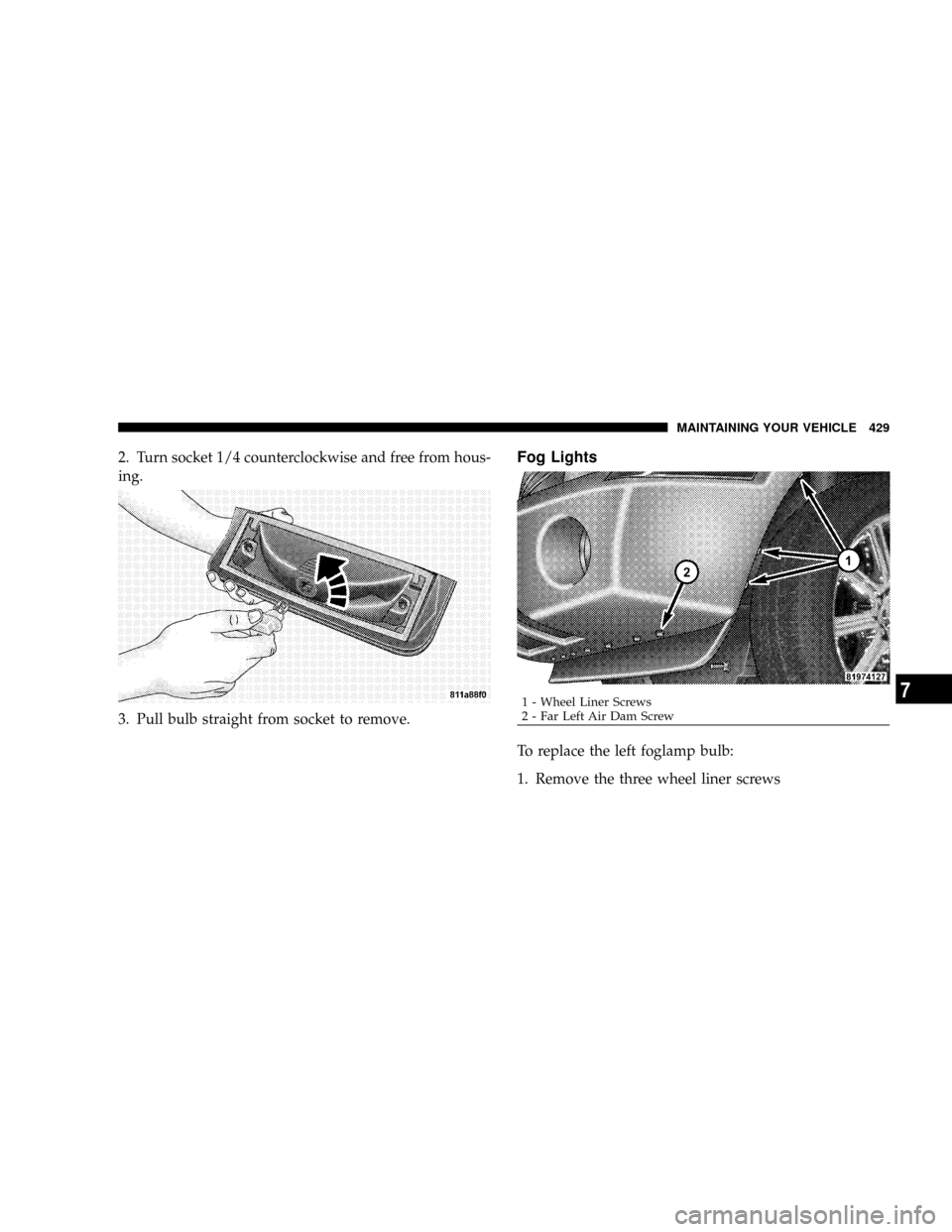
2. Turn socket 1/4 counterclockwise and free from hous-
ing.
3. Pull bulb straight from socket to remove.Fog Lights
To replace the left foglamp bulb:
1. Remove the three wheel liner screws
1 - Wheel Liner Screws
2 - Far Left Air Dam ScrewMAINTAINING YOUR VEHICLE 4297
Page 460 of 481
Temperature Grades
The temperature grades are A (the highest), B, and C,
representing the tire's resistance to the generation of heat
and its ability to dissipate heat, when tested under
controlled conditions on a specified indoor laboratory
test wheel. Sustained high temperature can cause the
material of the tire to degenerate and reduce tire life, and
excessive temperature can lead to sudden tire failure. The
grade C corresponds to a level of performance, which all
passenger car tires must meet under the Federal Motor
Vehicle Safety Standard No. 109. Grades B and A repre-
sent higher levels of performance on the laboratory test
wheel, than the minimum required by law.WARNING!
The temperature grade for this tire is established for
a tire that is properly inflated and not overloaded.
Excessive speed, under-inflation, or excessive load-
ing, either separately or in combination, can cause
heat buildup and possible tire failure.
458 IF YOU NEED CONSUMER ASSISTANCE
Page 464 of 481

Cargo Organizer........................ 193
Cargo (Vehicle Loading)................... 346
Cellular Phone........................88,254
Center High Mounted Stop Light............ 428
Certification Label....................... 346
Charging.............................. 377
Chart, Tire Sizing........................ 309
Check Engine Light (Malfunction Indicator Light). . 388
Child Restraint........................65,66
Child Restraint Tether Anchors.............68,73
Child Seat.............................. 70
Circuit Breakers......................... 415
Cleaning
Wheels............................. 412
Climate Control......................... 255
Climate Control, Rear Zone..............259,265
Clock........................216,218,221,231
Compact Disc (CD) Maintenance............. 253
Compact Spare Tire...................... 319Compass Calibration..................... 174
Compass Variance....................... 174
Connector
UCI ................................ 241
Universal Consumer Interface (UCI)......... 241
Console, Floor.......................189,192
Console, Overhead....................165,166
Contract, Service........................ 453
Coolant Pressure Cap (Radiator Cap)....385,386,402
Cooling System......................... 400
Adding Coolant (Antifreeze).............. 401
Coolant Capacity...................... 431
Coolant Level......................400,403
Disposal of Used Coolant................ 403
Drain, Flush, and Refill.................. 400
Inspection........................... 403
Points to Remember.................... 404
Pressure Cap......................... 402
Radiator Cap......................... 402
462 INDEX
Page 467 of 481

Filters
Air Cleaner.......................... 393
Engine Oil........................392,432
Engine Oil Disposal.................... 392
Flashers
Hazard Warning....................... 368
Turn Signal.....................148,204,425
Flat Tire Stowage.....................370,377
Flexible Fuel Vehicles
Cruising Range........................ 343
Engine Oil........................... 343
Fuel Requirements..................340,342
Replacement Parts..................... 343
Starting............................. 343
Flooded Engine Starting................... 276
Floor Console.......................189,192
Fluid, Brake.........................405,433
Fluid Capacities......................... 431Fluid Level Checks
Automatic Transmission................. 406
Brake............................... 405
Engine Oil........................... 390
Power Steering........................ 294
Transfer Case......................... 408
Fluids, Lubricants and Genuine Parts.......... 432
Fog Lights..........................147,429
Folding Rear Seat.....................127,131
Four Wheel Drive....................... 284
Operation........................... 284
Four-Way Hazard Flasher.................. 368
Freeing A Stuck Vehicle................... 379
Front Axle (Differential)................... 409
Fuel................................. 335
Filler Cap (Gas Cap).................344,345
Gauge.............................. 204
Octane Rating......................335,432
Requirements......................335,431
INDEX 465
10