2009 CHRYSLER ASPEN ECU
[x] Cancel search: ECUPage 26 of 481

²For vehicles not equipped with the EVIC, perform the
following procedure:
1. Press and hold the UNLOCK button on the transmit-
ter.
2. After holding the UNLOCK button for four seconds,
also press the LOCK button within six seconds.
3. Release both buttons at the same time.
4. Test the flash lights with LOCK feature while outside
of the vehicle, by pressing the LOCK button on the
transmitter with the ignition in the OFF position and the
key removed.
NOTE:Pressing the LOCK button on the key fob while
you are inside the vehicle will activate the security alarm.
Opening a door with the security alarm activated will
cause the alarm to sound. Press the UNLOCK button to
deactivate the security alarm.5. If the desired programming was not achieved or to
reactivate this feature, repeat the above steps.
Using the Panic Alarm
To activate the PANIC mode, while the ignition is OFF,
press and release the PANIC button on the transmitter
once. When the PANIC mode is activated, the interior
lights will illuminate, the head lights and parking lights
will flash and the horn will sound.
To cancel the PANIC mode, press and release the PANIC
button on the transmitter a second time. PANIC mode
will automatically cancel after three minutes or if the
vehicle is started or exceeds 15 mph (24 km/h). During
the PANIC mode, the door locks and Remote Keyless
Entry system will function normally. PANIC mode will
not disarm the security alarm system on vehicles so
equipped.
24 THINGS TO KNOW BEFORE STARTING YOUR VEHICLE
Page 31 of 481

To enter the vehicle while the engine is running during a
remote start, you must first unlock the vehicle using the
UNLOCK button on the (RKE) transmitter. Then, prior to
the end of the 15-minute cycle, insert the key into the
ignition switch and turn the switch to the ON position,
otherwise the engine will cancel remote start and auto-
matically turn off.
Remote start will also cancel if any of the following occur:
²If the engine stalls or RPM exceeds 2500
²Any engine warning lamps come on
²The hood is opened
²The hazard switch is pressed
²The transmission is moved out of PARKThe vehicle can be started remotely up to a maximum of
two times. The vehicle is also allowed a maximum of one
failed start, where the remote start sequence was initiated
but the engine stopped cranking without starting. After
either of these conditions, or if the Security Alarm System
is alarming or if the PANIC button was pressed, the
vehicle must be reset by inserting a valid key into the
ignition and moving it to the RUN position, then back to
LOCK.
THINGS TO KNOW BEFORE STARTING YOUR VEHICLE 29
2
Page 32 of 481

DOOR LOCKS
Manual Door Locks
All the doors can be ªmanuallyº locked from the inside
by pushing down the door lock plunger, located at the
rear of the door. Both front doors may be opened from the
inside with the door lock plunger in the down or locked
position.
WARNING!
²For personal security and safety in the event of an
accident, lock the vehicle doors when you drive as
well as when you park and leave the vehicle.
²Never leave unattended children alone in a ve-
hicle. Leaving children in a vehicle is dangerous
for a number of reasons. A child or others could be
seriously or fatally injured. Don't leave the keys in
the ignition. A child could operate power win-
dows, other controls, or move the vehicle.
Power Door Locks
A power door lock switch is on each front door trim
panel. Use this switch to lock or unlock the doors.
If you press the power door lock switch while the key is
in the ignition and any front door is open, the power
Power Door Lock Switch
30 THINGS TO KNOW BEFORE STARTING YOUR VEHICLE
Page 67 of 481

Child Restraint
Everyone in your vehicle needs to be buckled up all the
time - babies and children, too. Every state in the United
States and all Canadian provinces require that small
children ride in proper restraint systems. This is the law,
and you can be prosecuted for ignoring it. Children 12
years and under should ride properly buckled up in a
rear seat, if available. According to crash statistics, chil-
dren are safer when properly restrained in the rear seats
rather than in the front.
There are different sizes and types of restraints for
children from newborn size to the child almost large
enough for an adult seat belt. Always check the child seat
Owner's Manual to ensure you have the right seat for
your child. Use the restraint that is correct for your child.
Infants and Small Children
²
This vehicle is not capable of accommodating the
installation of a car bed used for carrying newbornbabies at the right front passenger seat position. If a car
bed must be used to transport a newborn baby, the car
bed must be installed in the second seating row only.
²Safety experts recommend that children ride
rearward-facing in the vehicle until they are at least
one year old and weigh at least 20 lbs (9 kg). Two types
of child restraints can be used rearward facing: infant
carriers and9convertible9child seats.
²The infant carrier is only used rearward-facing in the
vehicle. It is recommended for children who weigh up
to about 20 lbs (9 kg).9Convertible9child seats can be
used either rearward-facing or forward-facing in the
vehicle. Convertible child seats often have a higher
weight limit in the rearward-facing direction than
infant carriers do, so they can be used rearward-facing
by children who weigh more than 20 lbs (9 kg) but are
less than one year old. Both types of child restraints are
held in the vehicle by the lap/shoulder belt or the
THINGS TO KNOW BEFORE STARTING YOUR VEHICLE 65
2
Page 70 of 481

²Buckle the child into the restraint exactly as the
manufacturer's instructions tell you.
²When your child restraint is not in use, secure it in the
vehicle with the seat belt or remove it from the vehicle.
Do not leave it loose in the vehicle. In a sudden stop or
collision, it could strike the occupants or seatbacks and
cause serious personal injury.
LATCH - Child Seat Anchorage System (Lower
Anchors and Tether for CHildren)
Your vehicle's second row seat is equipped with the child
restraint anchorage system called LATCH. The LATCH
system provides for the installation of the child restraint
without using the vehicle's seat belts, instead securing
the child restraint using lower anchorages and upper
tether straps from the child restraint to the vehicle
structure. LATCH-compatible child restraint systems are
now available. However, because the lower anchorages
are to be introduced over a period of years, child restraintsystems having attachments for those anchorages will
continue to also have features for installation using the
vehicle's seat belts. Child restraints having tether straps
and hooks for connection to the top tether anchorages
have been available for some time. For some older child
restraints, many child restraint manufacturers offer
add-on tether strap kits or retro-fit kits. You are urged to
take advantage of all the available attachments provided
with your child restraint in any vehicle.
All three second row seating positions have lower an-
chorages that are capable of accommodating LATCH-
compatible child seats having flexible, webbing-mounted
lower attachments. Child seats with fixed lower attach-
ments must be installed in the outboard positions only.
Regardless of the specific type of lower attachment,
NEVERinstall LATCH-compatible child seats such that
two seats share a common lower anchorage. If you are
installing LATCH-compatible child restraints in adjacent
rear seating positions, you can use the LATCH anchors or
68 THINGS TO KNOW BEFORE STARTING YOUR VEHICLE
Page 74 of 481

the lap portion around the child restraint. Any seat belt
system will loosen with time, so check the belt occasion-
ally, and pull it tight if necessary.Child Restraints in Third Row Seating (If
Equipped)
For vehicles equipped with third row split bench (60/40)
seating, the tether strap anchorage is located on the
seatback behind the center seating position. The hooks in
the rear floor areNOTdesigned to withstand the forces
that may occur during a crash.
WARNING!
An incorrectly anchored tether strap could lead to
increased head motion and possible injury to the
child. Use only the anchor positions directly behind
the child seat to secure a child restraint top tether
strap. Children and infants are safer when properly
restrained in a child restraint system secured in a rear
seating position.
Second Row Seat Tether Anchors
72 THINGS TO KNOW BEFORE STARTING YOUR VEHICLE
Page 76 of 481

3. Attach the tether strap hook of the child restraint to
the tether anchor located on the seatback and remove the
slack in the tether strap according to the manufacturer 's
instructions.
WARNING!
An incorrectly anchored tether strap could lead to
seat failure and injury to the child. In a collision, the
seat could come loose and allow the child to crash
into the inside of the vehicle or other passengers, or
even be thrown from the vehicle. Use only the anchor
positions directly behind the child seat to secure a
child restraint top tether strap. For instructions, refer
to ªChild Restraint Tether Anchorº in this section.
See your authorized dealer for help if necessary.
Transporting Pets
Airbags deploying in the front seat could harm your pet.
An unrestrained pet will be thrown about and possiblyinjured, or injure a passenger during panic braking or in
a collision. Pets should be restrained in the rear seat in
pet harnesses or pet carriers that are secured by seat belts.
ENGINE BREAK-IN RECOMMENDATIONS
A long break-in period is not required for the engine in
your vehicle.
Drive moderately during the first 300 miles (500 km).
After the initial 60 miles (100 km), speeds up to 50 or 55
mph (80 or 90 km/h) are desirable.
While cruising, brief full-throttle acceleration within the
limits of local traffic laws, contributes to a good break-in.
Wide-open throttle acceleration in low gear can be detri-
mental and should be avoided.
The engine oil installed in the engine at the factory is a
high-quality energy conserving type lubricant. Oil
changes should be consistent with anticipated climate
conditions under which vehicle operations will occur.
74 THINGS TO KNOW BEFORE STARTING YOUR VEHICLE
Page 84 of 481
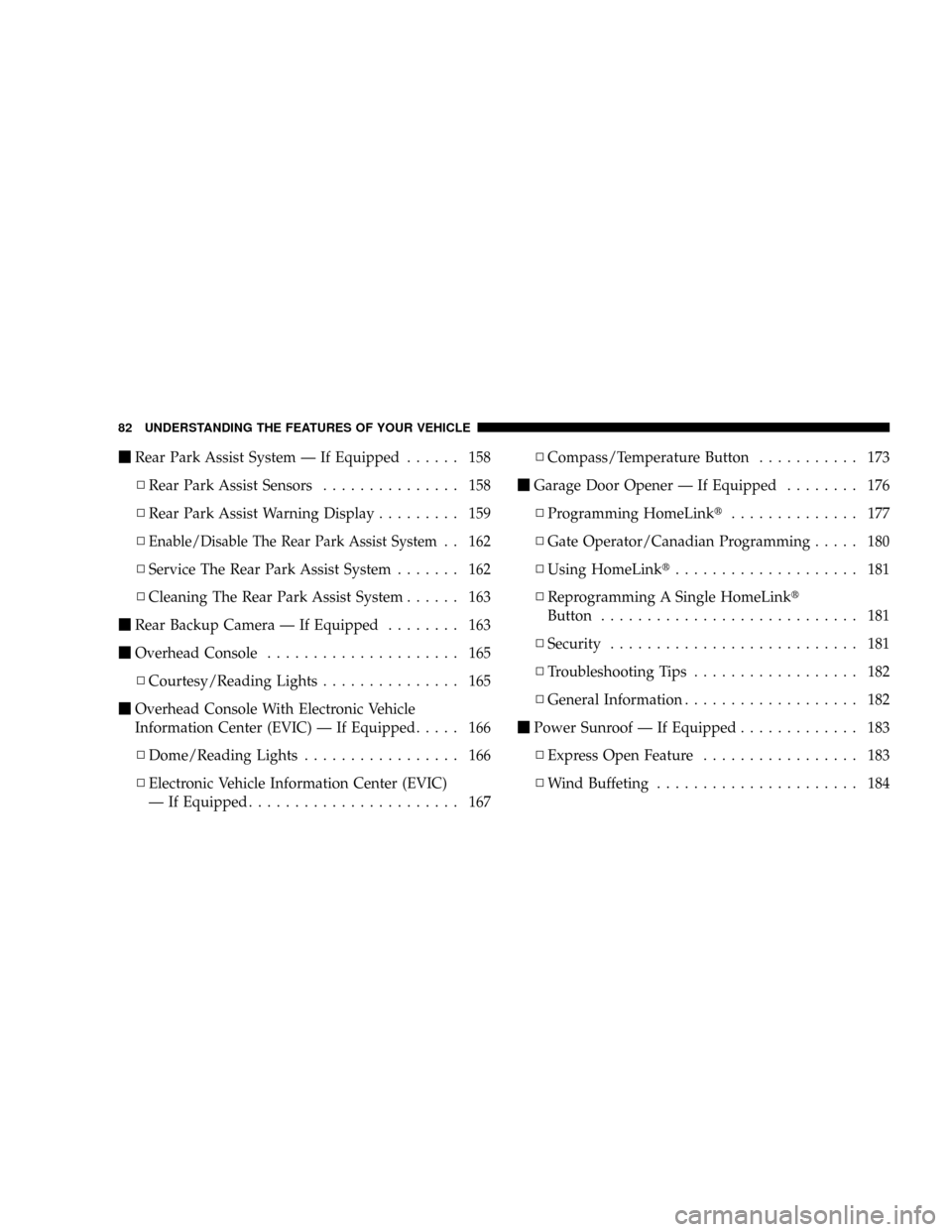
mRear Park Assist System Ð If Equipped...... 158
NRear Park Assist Sensors............... 158
NRear Park Assist Warning Display......... 159
N
Enable/Disable The Rear Park Assist System. . 162
NService The Rear Park Assist System....... 162
NCleaning The Rear Park Assist System...... 163
mRear Backup Camera Ð If Equipped........ 163
mOverhead Console..................... 165
NCourtesy/Reading Lights............... 165
mOverhead Console With Electronic Vehicle
Information Center (EVIC) Ð If Equipped..... 166
NDome/Reading Lights................. 166
NElectronic Vehicle Information Center (EVIC)
Ð If Equipped....................... 167NCompass/Temperature Button........... 173
mGarage Door Opener Ð If Equipped........ 176
NProgramming HomeLinkt.............. 177
NGate Operator/Canadian Programming..... 180
NUsing HomeLinkt.................... 181
NReprogramming A Single HomeLinkt
Button............................ 181
NSecurity........................... 181
NTroubleshooting Tips.................. 182
NGeneral Information................... 182
mPower Sunroof Ð If Equipped............. 183
NExpress Open Feature................. 183
NWind Buffeting...................... 184
82 UNDERSTANDING THE FEATURES OF YOUR VEHICLE