Page 398 of 493
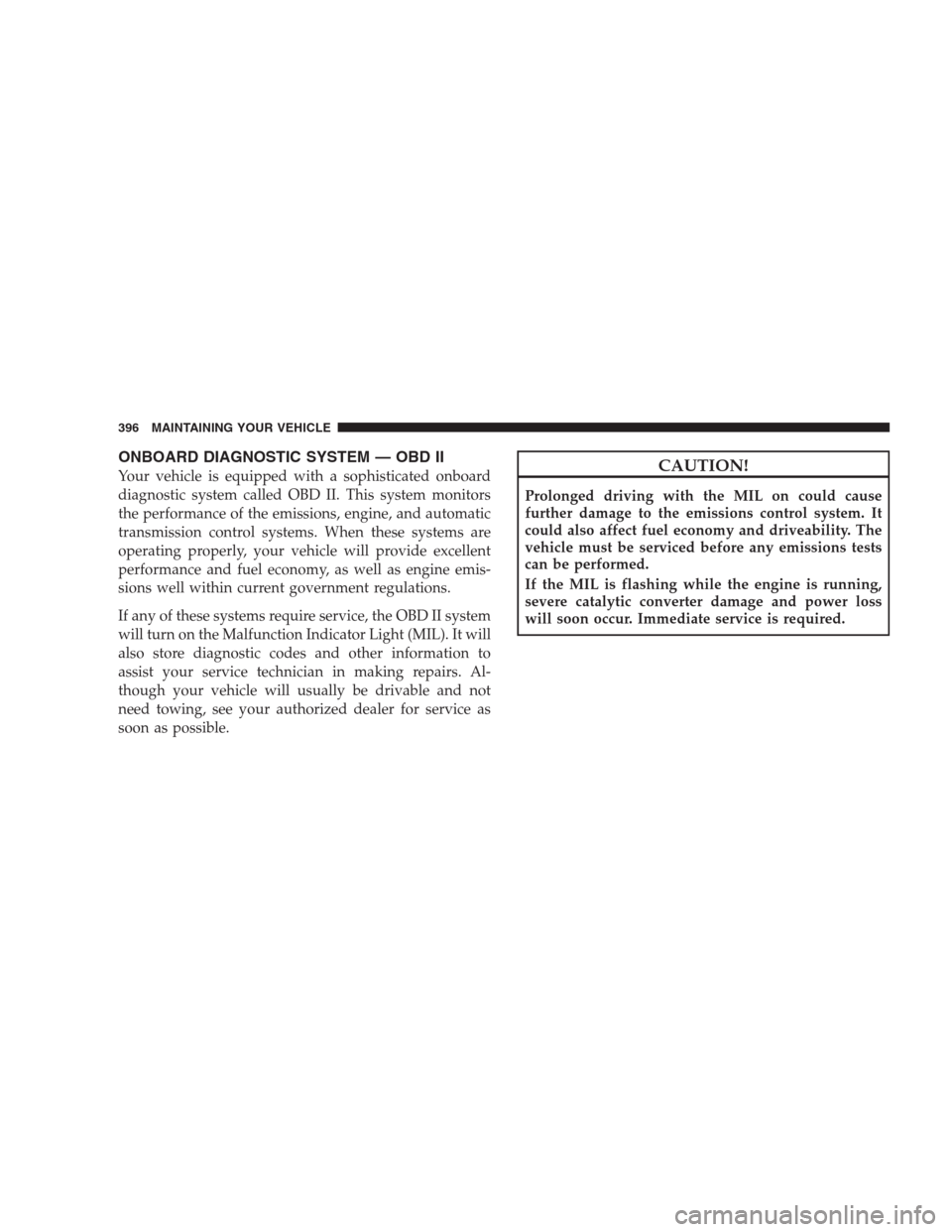
ONBOARD DIAGNOSTIC SYSTEM — OBD II
Your vehicle is equipped with a sophisticated onboard
diagnostic system called OBD II. This system monitors
the performance of the emissions, engine, and automatic
transmission control systems. When these systems are
operating properly, your vehicle will provide excellent
performance and fuel economy, as well as engine emis-
sions well within current government regulations.
If any of these systems require service, the OBD II system
will turn on the Malfunction Indicator Light (MIL). It will
also store diagnostic codes and other information to
assist your service technician in making repairs. Al-
though your vehicle will usually be drivable and not
need towing, see your authorized dealer for service as
soon as possible.CAUTION!
Prolonged driving with the MIL on could cause
further damage to the emissions control system. It
could also affect fuel economy and driveability. The
vehicle must be serviced before any emissions tests
can be performed.
If the MIL is flashing while the engine is running,
severe catalytic converter damage and power loss
will soon occur. Immediate service is required.
396 MAINTAINING YOUR VEHICLE
Page 399 of 493
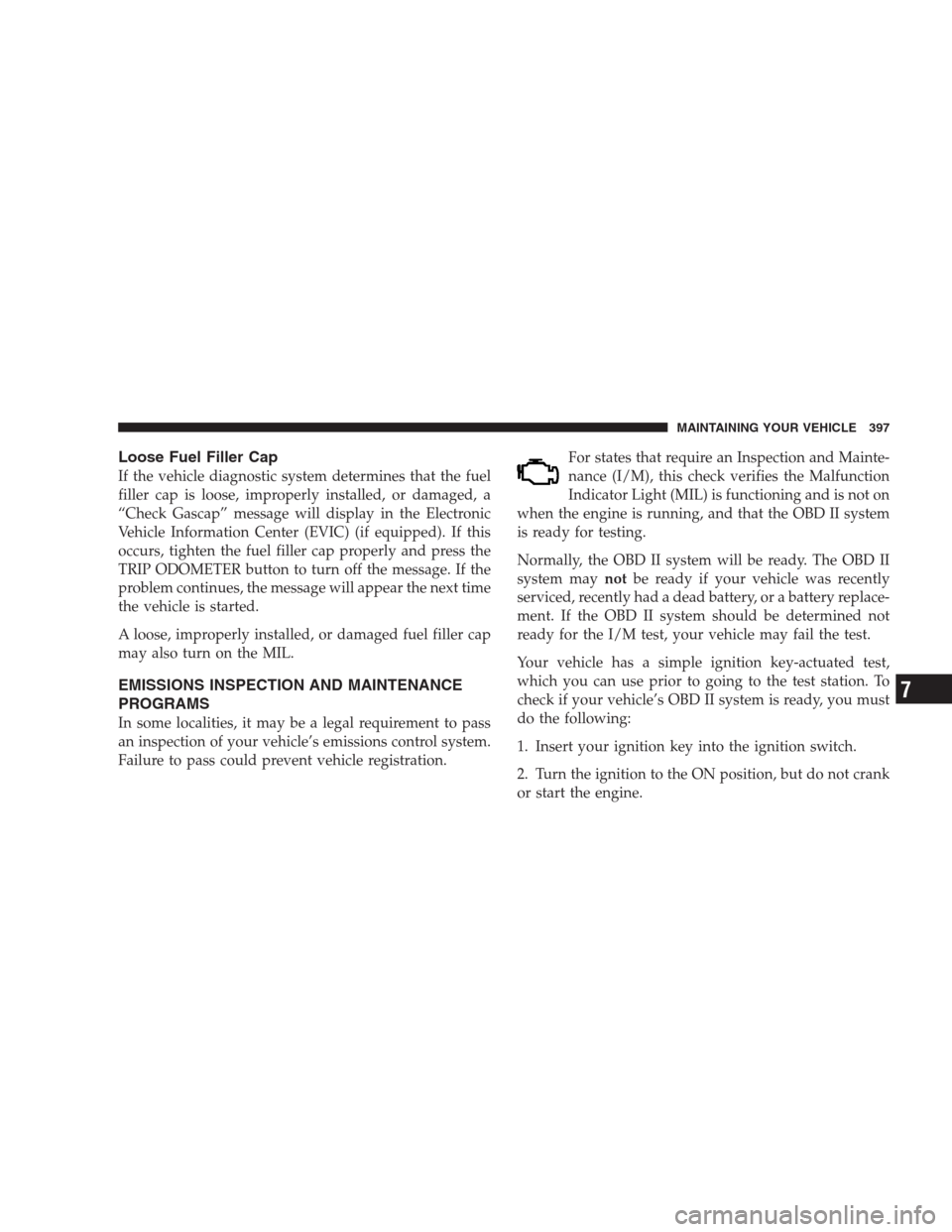
Loose Fuel Filler Cap
If the vehicle diagnostic system determines that the fuel
filler cap is loose, improperly installed, or damaged, a
“Check Gascap” message will display in the Electronic
Vehicle Information Center (EVIC) (if equipped). If this
occurs, tighten the fuel filler cap properly and press the
TRIP ODOMETER button to turn off the message. If the
problem continues, the message will appear the next time
the vehicle is started.
A loose, improperly installed, or damaged fuel filler cap
may also turn on the MIL.
EMISSIONS INSPECTION AND MAINTENANCE
PROGRAMS
In some localities, it may be a legal requirement to pass
an inspection of your vehicle’s emissions control system.
Failure to pass could prevent vehicle registration.For states that require an Inspection and Mainte-
nance (I/M), this check verifies the Malfunction
Indicator Light (MIL) is functioning and is not on
when the engine is running, and that the OBD II system
is ready for testing.
Normally, the OBD II system will be ready. The OBD II
system maynotbe ready if your vehicle was recently
serviced, recently had a dead battery, or a battery replace-
ment. If the OBD II system should be determined not
ready for the I/M test, your vehicle may fail the test.
Your vehicle has a simple ignition key-actuated test,
which you can use prior to going to the test station. To
check if your vehicle’s OBD II system is ready, you must
do the following:
1. Insert your ignition key into the ignition switch.
2. Turn the ignition to the ON position, but do not crank
or start the engine.
MAINTAINING YOUR VEHICLE 397
7
Page 402 of 493
could adversely affect the engine or vehicle performance.
These items should be inspected if a malfunction is
observed or suspected.
Engine Oil
Checking Oil Level
To assure proper engine lubrication, the engine oil must
be maintained at the correct level. Check the oil level at
regular intervals, such as every fuel stop.
The best time to check the engine oil level is about five
minutes after a fully warmed engine is shut off or before
starting the engine after it has sat overnight.
Checking the oil while the vehicle is on level ground will
improve the accuracy of the oil level readings. Maintain
the oil level in the “SAFE” range. Adding 1.0 qt (1.0 l) of
oil when the reading is at the bottom of the “SAFE” range
will result in an oil level at the top of the “SAFE” range
on these engines.
CAUTION!
Overfilling or underfilling will cause oil aeration or
loss of oil pressure. This could damage your engine.
Change Engine Oil
Refer to the “Maintenance Schedule” in Section 8 for
proper maintenance intervals.
NOTE: Under no circumstances should oil change
intervals exceed 6,000 miles (10 000 km) or six months,
whichever occurs first.
Engine Oil Selection
For best performance and maximum protection under all
types of operating conditions, the manufacturer only
recommends full synthetic engine oils that meet the
American Petroleum Institute (API) categories of SM or
SM/CF, and meet the requirements of Chrysler Material
Standard MS-10725.
400 MAINTAINING YOUR VEHICLE
Page 411 of 493
damaged, deteriorated, or mispositioned parts. Open
seams or loose connections could permit exhaust fumes
to seep into the passenger compartment. In addition,
inspect the exhaust system each time the vehicle is raised
for lubrication or oil change. Replace as required.
WARNING!
Exhaust gases can injure or kill. They contain carbon
monoxide (CO), which is colorless and odorless.
Breathing it can make you unconscious and can
eventually poison you. To avoid breathing CO, refer
to “Exhaust Gas” under “Safety Tips” in Section 2.
The catalytic converter requires the use of unleaded fuel
only. Leaded gasoline will destroy the effectiveness of the
catalyst as an emissions control device.Under normal operating conditions, the catalytic con-
verter will not require maintenance. However, it is im-
portant to keep the engine properly tuned to assure
proper catalyst operation and prevent possible catalyst
damage.
CAUTION!
Damage to the catalytic converter can result if your
vehicle is not kept in proper operating condition. In
the event of engine malfunction, particularly involv-
ing engine misfire or other apparent loss of perfor-
mance, have your vehicle serviced promptly. Contin-
ued operation of your vehicle with a severe
malfunction could cause the converter to overheat,
resulting in possible damage to the converter and the
vehicle.
NOTE:Intentional tampering with emissions control
systems can result in civil penalties being assessed
against you.
MAINTAINING YOUR VEHICLE 409
7
Page 430 of 493
CAUTION!
•When installing the power distribution center
cover, it is important to ensure the cover is prop-
erly positioned and fully latched. Failure to do so
may allow water to get into the power distribution
center and possibly result in an electrical system
failure.
•When replacing a blown fuse, it is important to
use only a fuse having the correct amperage rating.
The use of a fuse with a rating other than indicated
may result in a dangerous electrical system over-
load. If a properly rated fuse continues to blow, it
indicates a problem in the circuit that must be
corrected.
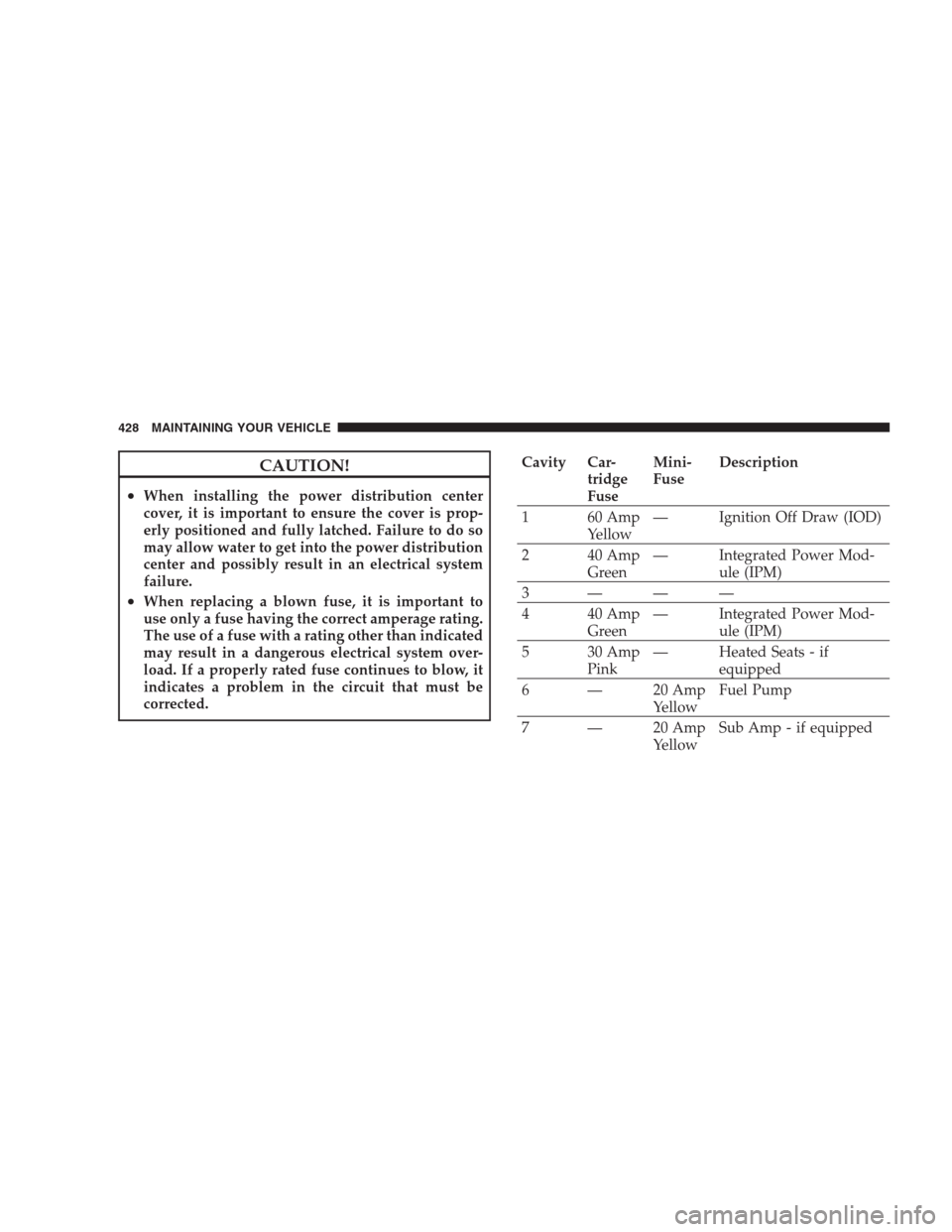
Cavity Car-
tridge
FuseMini-
FuseDescription
1 60 Amp
Yellow— Ignition Off Draw (IOD)
2 40 Amp
Green— Integrated Power Mod-
ule (IPM)
3———
4 40 Amp
Green— Integrated Power Mod-
ule (IPM)
5 30 Amp
Pink— Heated Seats - if
equipped
6 — 20 Amp
YellowFuel Pump
7 — 20 Amp
YellowSub Amp - if equipped
428 MAINTAINING YOUR VEHICLE
Page 440 of 493
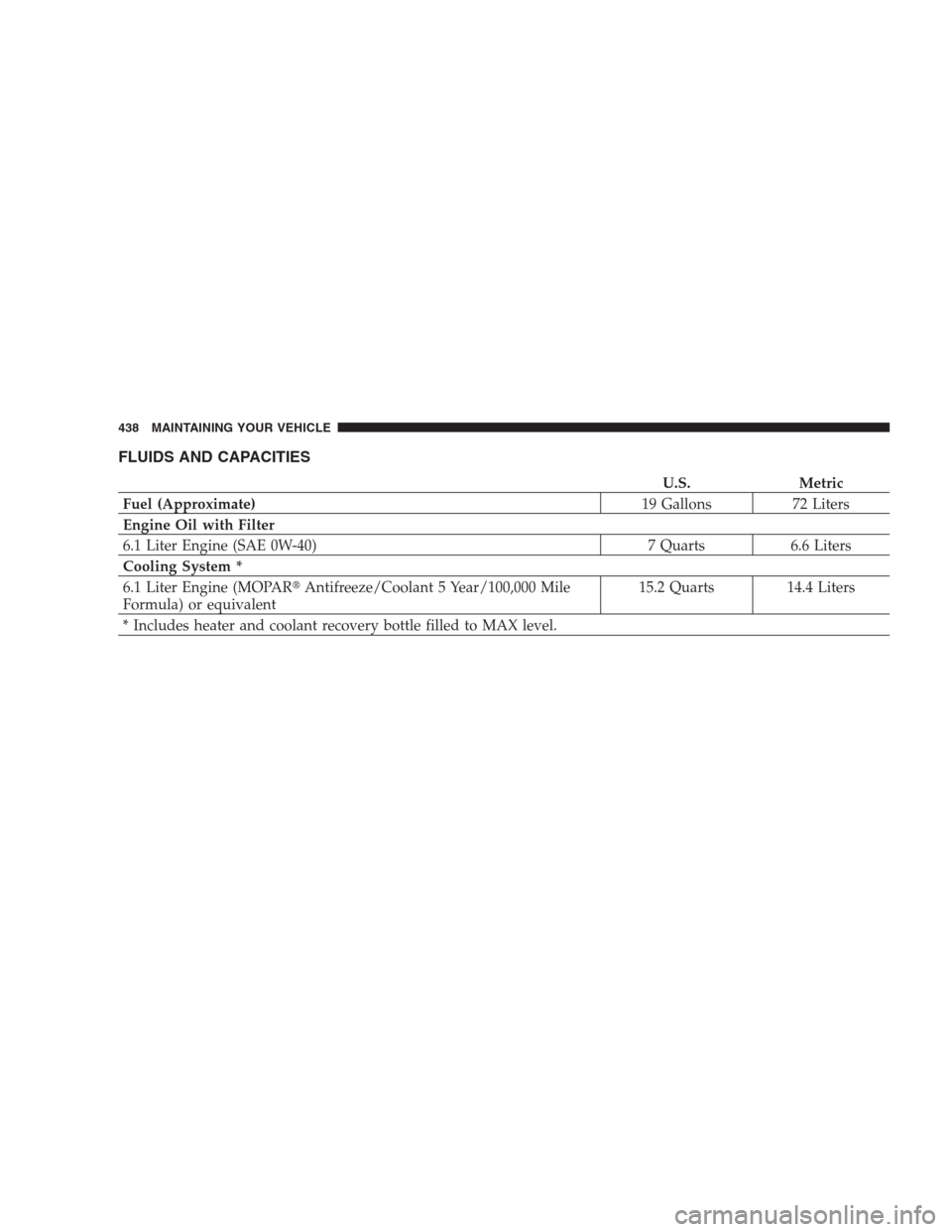
FLUIDS AND CAPACITIES
U.S. Metric
Fuel (Approximate)19 Gallons 72 Liters
Engine Oil with Filter
6.1 Liter Engine (SAE 0W-40) 7 Quarts 6.6 Liters
Cooling System *
6.1 Liter Engine (MOPAR�Antifreeze/Coolant 5 Year/100,000 Mile
Formula) or equivalent15.2 Quarts 14.4 Liters
* Includes heater and coolant recovery bottle filled to MAX level.
438 MAINTAINING YOUR VEHICLE
Page 441 of 493
FLUIDS, LUBRICANTS, AND GENUINE PARTS
Engine
Component Fluid, Lubricant, or Genuine Part
Engine Coolant MOPAR�Antifreeze/Coolant 5 Year/100,000 Mile Formula HOAT (Hybrid
Organic Additive Technology) or equivalent
Engine Oil (6.1L Engine) For best performance and maximum protection under all types of operating
conditions, the manufacturer only recommends full synthetic engine oils that
meet the American Petroleum Institute (API) categories of SM or SM/CF, and
meet the requirements of Chrysler Material Standard MS-10725. The manu-
facturer recommends the use of a full synthetic engine oil, such as Mobil 1�
SAE 0W-40 or equivalent. For additional information, refer to the “Engine Oil
Selection” and “Engine Oil Viscosity (SAE Grade)” in the “Maintenance Pro-
cedures” section of this manual.
Oil Filter (6.1L Engine) MOPAR�Engine Oil Filter (P/N 04884899AB) or equivalent
Spark Plugs (6.1L Engine) PLZTR5A-13 (Gap 0.050 in [1.27 mm])
Fuel Selection (6.1L Engine) Premium Unleaded 91 Octane Only or higher
MAINTAINING YOUR VEHICLE 439
7
Page 445 of 493

Based on engine operation conditions, the oil change
indicator message will illuminate. This means that ser-
vice is required for your vehicle. Have your vehicle
serviced as soon as possible, within the next 500 miles
(805 km).
NOTE:
•The oil change indicator message will not monitor the
time since the last oil change. Change your vehicle’s
oil if it has been six months since your last oil change,
even if the oil change indicator message is NOT
illuminated.
•Change your engine oil more often if you drive your
vehicle off-road for an extended period of time.
•Under no circumstances should oil change intervals
exceed 6,000 miles (10,000 km) or six months, which-
ever comes first.Your authorized dealer will reset the oil change indicator
message after completing the scheduled oil change. If a
scheduled oil change is performed by someone other
than your authorized dealer, the message can be reset by
referring to the steps described under “Oil Change
Required” under “Electronic Vehicle Information Center
(EVIC)” in Section 4 or under “Odometer/Trip Odom-
eter” under “Instrument Cluster Descriptions” in Sec-
tion 4.
At Each Stop for Fuel
•Check the engine oil level. Refer to “Engine Oil” under
“Maintenance Procedures” in Section 7.
•Check the windshield washer solvent and add if
required.
MAINTENANCE SCHEDULES 443
8
M
A
I
N
T
E
N
A
N
C
E
S
C
H
E
D
U
L
E
S