Page 64 of 493

However, if you haven’t healed significantly within a
few days or if you have any blistering, see your doctor
immediately.
•As the airbags deflate, you may see some smoke-like
particles. The particles are a normal by-product of the
process that generates the nontoxic gas used for airbag
inflation. These airborne particles may irritate the skin,
eyes, nose, or throat. If you have skin or eye irritation,
rinse the area with cool water. For nose or throat
irritation, move to fresh air. If the irritation continues,
see your doctor. If these particles settle on your
clothing, follow the garment manufacturer’s instruc-
tions for cleaning.
•It is not advisable to drive your vehicle after the
airbags have been deployed. If you are involved in
another collision, the airbags will not be in place to
protect you.
WARNING!
Deployed airbags can’t protect you in another colli-
sion. Have the airbags replaced by an authorized
dealer as soon as possible.
Enhanced Accident Response System
In the event of an impact that causes airbag deployment,
with the vehicle stopped, and the vehicle communication
network intact, and the power intact, the Enhanced
Accident Response System performs the following func-
tions:
•Cuts off fuel to the engine.
•Flashes hazard lights.
•Turns on the interior lights, which remain on as long as
the battery has power or until the ignition key is
removed.
•Unlocks the doors automatically.
62 THINGS TO KNOW BEFORE STARTING YOUR VEHICLE
Page 65 of 493
NOTE:The interior lights can only be deactivated if the
key is removed from the ignition switch or the vehicle is
driven.
Maintaining Your Airbag System
WARNING!
•Modifications to any part of the airbag system
could cause it to fail when you need it. You could
be injured because the airbags are not there to
protect you. Do not modify the components or
wiring, including adding any kind of badges or
stickers to the steering wheel hub trim cover or the
upper passenger side of the instrument panel. Do
not modify the front bumper, vehicle body struc-
ture, or frame.
•You need proper knee impact protection in a
collision. Do not mount or locate any aftermarket
equipment on or behind the knee impact bolster.
(Continued)
WARNING! (Continued)
•It is dangerous to try to repair any part of the
airbag system yourself. Be sure to tell anyone who
works on your vehicle that it has airbags.
NOTE:
Perchlorate Material — special handling may
apply. See www.dtsc.ca.gov/hazardouswaste/perchlorate.
Airbag Warning Light
You will want to have the airbags ready to
inflate for your protection in an impact. While
the airbag system is designed to be mainte-
nance free, if any of the following occurs, have
an authorized dealer service the system promptly:
•The Airbag Warning Light does not come on or flickers
during the six to eight seconds when the ignition
switch is first turned ON.
THINGS TO KNOW BEFORE STARTING YOUR VEHICLE 63
2
Page 80 of 493

Defroster
Check operation by selecting the defrost mode and place
the blower control on high speed. You should be able to
feel the air directed against the windshield. See your
authorized dealer for service if your defroster is
inoperable.
Periodic Safety Checks You Should Make Outside
The Vehicle
Tires
Examine tires for excessive tread wear and uneven wear
patterns. Check for stones, nails, glass, or other objects
lodged in the tread. Inspect the tread and sidewall for
cuts and cracks. Check the wheel nuts for tightness.
Check the tires (including spare) for proper pressure.
Lights
Have someone observe the operation of exterior lights
while you work the controls. Check turn signal and high
beam indicator lights on the instrument panel.
Door Latches
Check for positive closing, latching, and locking.
Fluid Leaks
Check area under vehicle after overnight parking for fuel,
engine coolant, oil, or other fluid leaks. Also, if gasoline
fumes are detected or if fuel, power steering fluid, or
brake fluid leaks are suspected, the cause should be
located and corrected immediately.
78 THINGS TO KNOW BEFORE STARTING YOUR VEHICLE
Page 82 of 493
�Voice Recognition System (VR) —
If Equipped.......................... 116
▫Voice Recognition System (VR) Operation . . . 116
▫Commands........................ 118
▫Voice Training...................... 121
�Seats.............................. 122
▫Power Seats........................ 122
▫Power Reclining Seats................. 123
▫Lumbar Support..................... 124
▫Head Restraints..................... 125
▫Heated Seats....................... 126
▫Folding Rear Seat.................... 127
�Driver Memory Seat — If Equipped........ 128▫Programming The Memory Feature....... 129
▫Linking And Unlinking The Remote Keyless
Entry (RKE) Transmitter To The Memory
Feature........................... 130
▫Memory Position Recall................ 131
▫Easy Entry/Exit Seat (Available With
Memory Seat Only)................... 131
�To Open And Close The Hood............ 132
�Lights............................. 134
▫Headlight Switch.................... 134
▫Automatic Headlights................. 135
▫Headlights On With Wipers............. 135
▫SmartBeams — If Equipped............. 135
▫Headlight Time Delay................. 137
80 UNDERSTANDING THE FEATURES OF YOUR VEHICLE
Page 83 of 493
▫Daytime Running Lights — If Equipped.... 137
▫Lights-On Reminder.................. 137
▫Fog Lights......................... 138
▫Multifunction Lever.................. 138
▫Overhead Console Map/Reading Lights.... 140
▫Interior Lights...................... 140
�Windshield Wipers And Washers.......... 142
▫Intermittent Wiper System.............. 142
▫Mist Feature........................ 143
▫Windshield Washers.................. 143
▫Headlights On With Wipers............. 143
▫Rain Sensing Wipers.................. 144�Power Tilt/Telescoping Steering Column —
If Equipped.......................... 146
�Adjustable Pedals..................... 147
�Electronic Speed Control................ 148
▫To Activate......................... 149
▫To Set At A Desired Speed.............. 150
▫To Deactivate....................... 150
▫To Resume Speed.................... 150
▫To Vary The Speed Setting.............. 150
▫To Accelerate For Passing.............. 151
�Adaptive Cruise Control (ACC) —
If Equipped.......................... 152
▫Adaptive Cruise Control (ACC) Operation . . 155
▫Activating Adaptive Cruise Control (ACC) . . 155
UNDERSTANDING THE FEATURES OF YOUR VEHICLE 81
3
Page 84 of 493
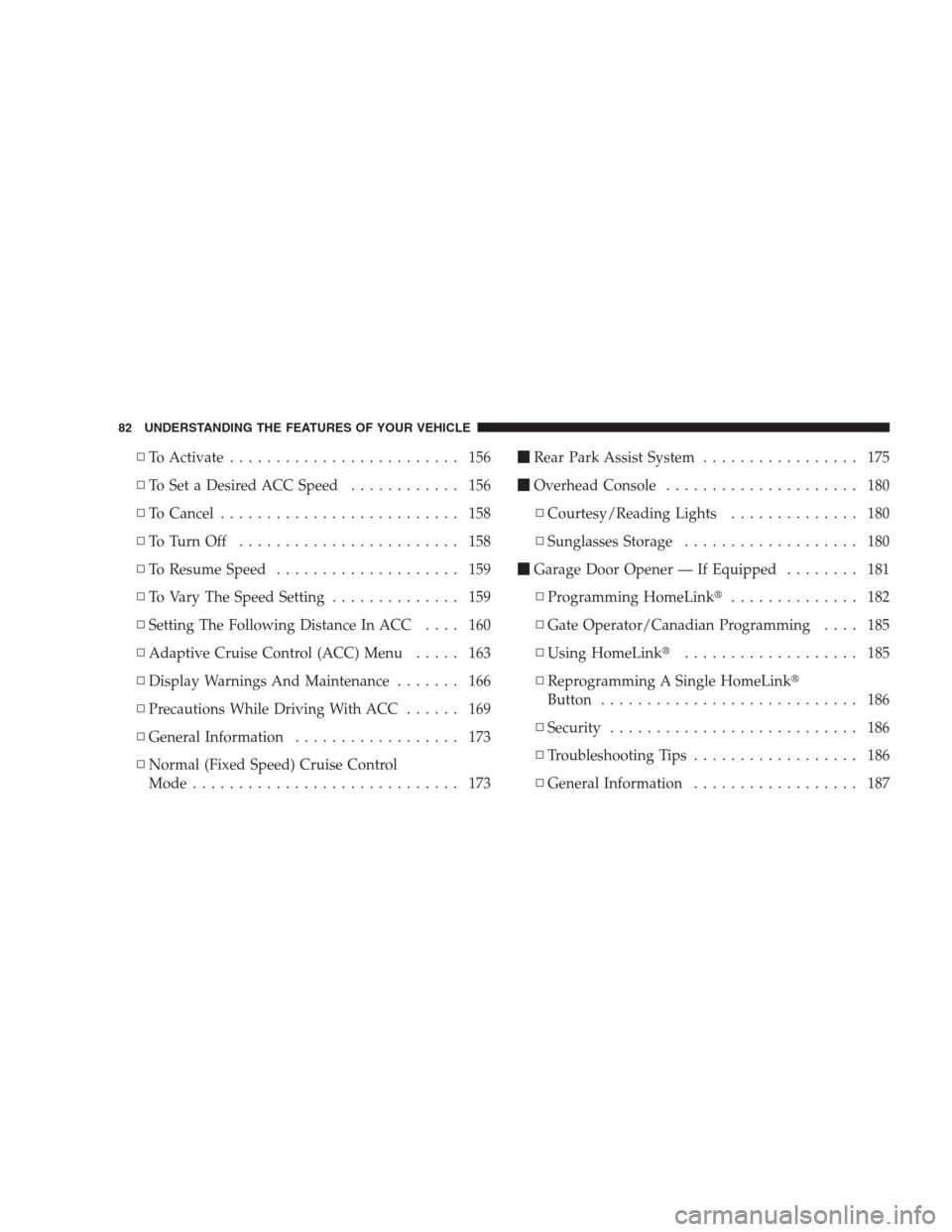
▫To Activate......................... 156
▫To Set a Desired ACC Speed............ 156
▫To Cancel.......................... 158
▫ToTurnOff ........................ 158
▫To Resume Speed.................... 159
▫To Vary The Speed Setting.............. 159
▫Setting The Following Distance In ACC.... 160
▫Adaptive Cruise Control (ACC) Menu..... 163
▫Display Warnings And Maintenance....... 166
▫Precautions While Driving With ACC...... 169
▫General Information.................. 173
▫Normal (Fixed Speed) Cruise Control
Mode............................. 173�Rear Park Assist System................. 175
�Overhead Console..................... 180
▫Courtesy/Reading Lights.............. 180
▫Sunglasses Storage................... 180
�Garage Door Opener — If Equipped........ 181
▫Programming HomeLink�.............. 182
▫Gate Operator/Canadian Programming.... 185
▫Using HomeLink�................... 185
▫Reprogramming A Single HomeLink�
Button............................ 186
▫Security........................... 186
▫Troubleshooting Tips.................. 186
▫General Information.................. 187
82 UNDERSTANDING THE FEATURES OF YOUR VEHICLE
Page 136 of 493
To prevent possible damage, do not slam the hood to
close it. Lower the hood, until it is open approximately
6 in (15 cm), and then drop it. This should secure both
latches. Never drive your vehicle unless the hood is fully
closed, with both latches engaged.
WARNING!
If the hood is not fully latched, it could fly up when
the vehicle is moving and block your forward vision.
You could have a collision. Be sure all hood latches
are fully latched before driving.
LIGHTS
Headlight Switch
The headlight switch is located on the left side of
the instrument panel. This switch controls theoperation of the headlights, parking lights, instrument
panel lights, instrument panel light dimming, interior
lights, and fog lights.Headlight Switch
134 UNDERSTANDING THE FEATURES OF YOUR VEHICLE
Page 137 of 493

Rotate the headlight switch clockwise to the first detent
for parking light and instrument panel light operation.
Turn it to the second detent for headlight, parking light,
and instrument panel light operation.
Automatic Headlights
This system automatically turns the headlights on or off
according to ambient light levels. To turn the system on,
rotate the headlight switch counterclockwise to the
AUTO (A) position. When the system is on, the headlight
time delay feature is also on. This means the headlights
will stay on for up to 90 seconds after you turn the
ignition switch OFF. To turn the automatic system off,
move the headlight switch out of the AUTO (A) position.
NOTE:The engine must be running before the head-
lights will come on in the automatic mode.
Headlights On with Wipers
When this feature is active, the headlights will turn on
approximately 10 seconds after the wipers are turned on
if the headlight switch is placed in the AUTO position. In
addition, the headlights will turn off when the wipers are
turned off if they were turned on by this feature.
The Headlights On with Wipers feature can be enabled or
disabled. Refer to ”Headlights On with Wipers,” under
“Personal Settings (Customer-Programmable Features)”
under “Electronic Vehicle Information Center (EVIC)” in
Section 4.
SmartBeams — If Equipped
The SmartBeam system provides increased forward light-
ing at night by automating high beam control through
the use of a digital camera mounted on the inside
rearview mirror. This camera detects vehicle specific light
and automatically switches from high beams to low
beams until the approaching vehicle is out of view.
UNDERSTANDING THE FEATURES OF YOUR VEHICLE 135
3