Page 380 of 493
HAZARD WARNING FLASHER
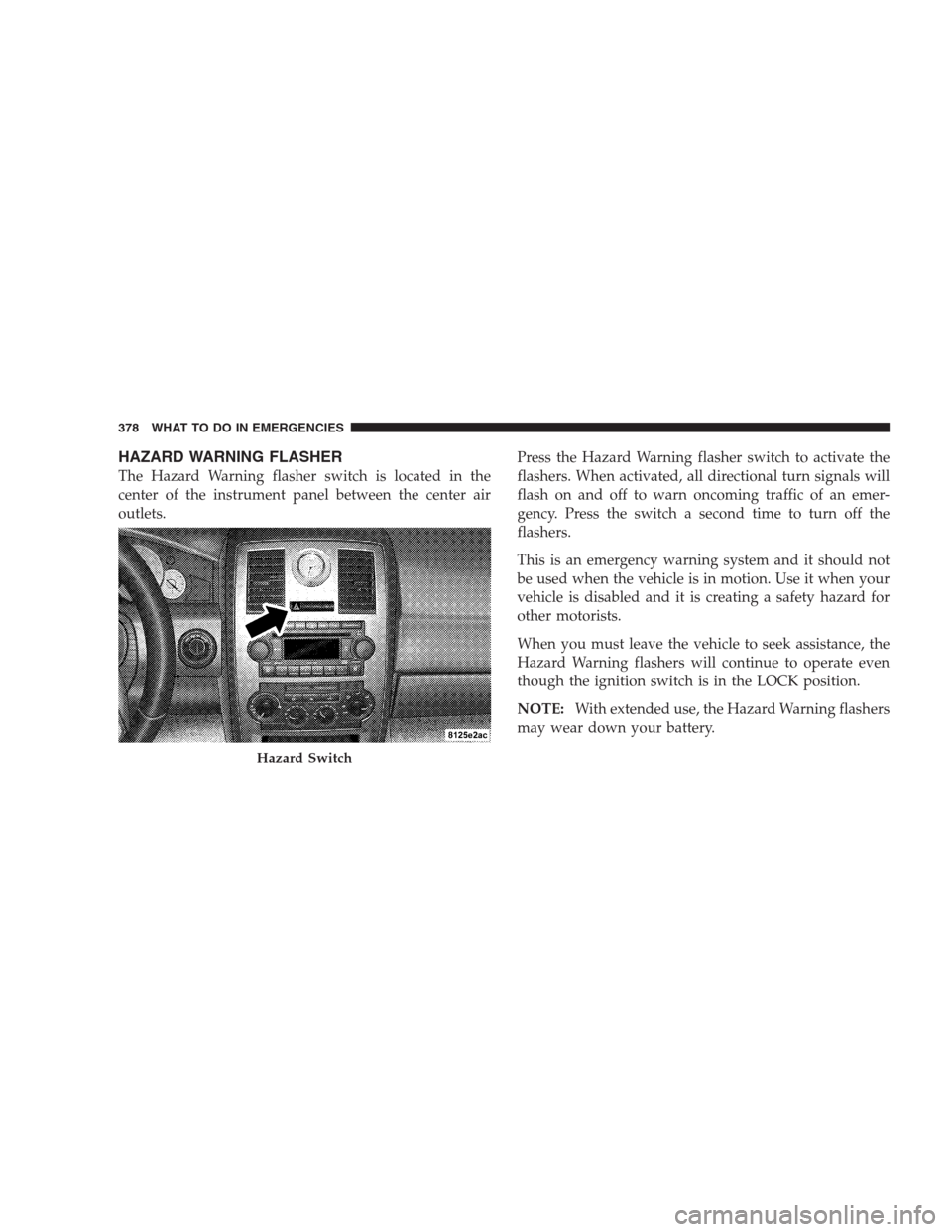
The Hazard Warning flasher switch is located in the
center of the instrument panel between the center air
outlets.Press the Hazard Warning flasher switch to activate the
flashers. When activated, all directional turn signals will
flash on and off to warn oncoming traffic of an emer-
gency. Press the switch a second time to turn off the
flashers.
This is an emergency warning system and it should not
be used when the vehicle is in motion. Use it when your
vehicle is disabled and it is creating a safety hazard for
other motorists.
When you must leave the vehicle to seek assistance, the
Hazard Warning flashers will continue to operate even
though the ignition switch is in the LOCK position.
NOTE:With extended use, the Hazard Warning flashers
may wear down your battery.
Hazard Switch
378 WHAT TO DO IN EMERGENCIES
Page 381 of 493
IF YOUR ENGINE OVERHEATS
In any of the following situations, you can reduce the
potential for overheating by taking the appropriate ac-
tion.
•On the highways — slow down.
•In city traffic — while stopped, put transmission in
NEUTRAL, but do not increase engine idle speed.
NOTE:There are steps that you can take to slow down
an impending overheat condition. If your air conditioner
is on, turn it off. The air conditioning system adds heat to
the engine cooling system and turning off the A/C
removes this heat. You can also turn the temperature
control to maximum heat, the mode control to floor, and
the fan control to high. This allows the heater core to act
as a supplement to the radiator and aids in removing heat
from the engine cooling system.
CAUTION!
Driving with a hot cooling system could damage
your vehicle. If the temperature gauge reads 240°F
(116°C) or greater pull over and stop the vehicle. Idle
the vehicle with the air conditioner turned off until
the pointer drops back into the normal range 200–
230°F (93–110°C). If the pointer remains at 240°F
(116°C) or greater and you hear a chime, turn the
engine off immediately and call for service.
WARNING!
A hot engine cooling system is dangerous. You or
others could be badly burned by steam or boiling
coolant. You may want to call a service center if your
vehicle overheats. If you decide to look under the
hood yourself, refer to Section 7 and follow the
warnings under the “Cooling System Pressure Cap”
paragraph.
WHAT TO DO IN EMERGENCIES 379
6
Page 383 of 493
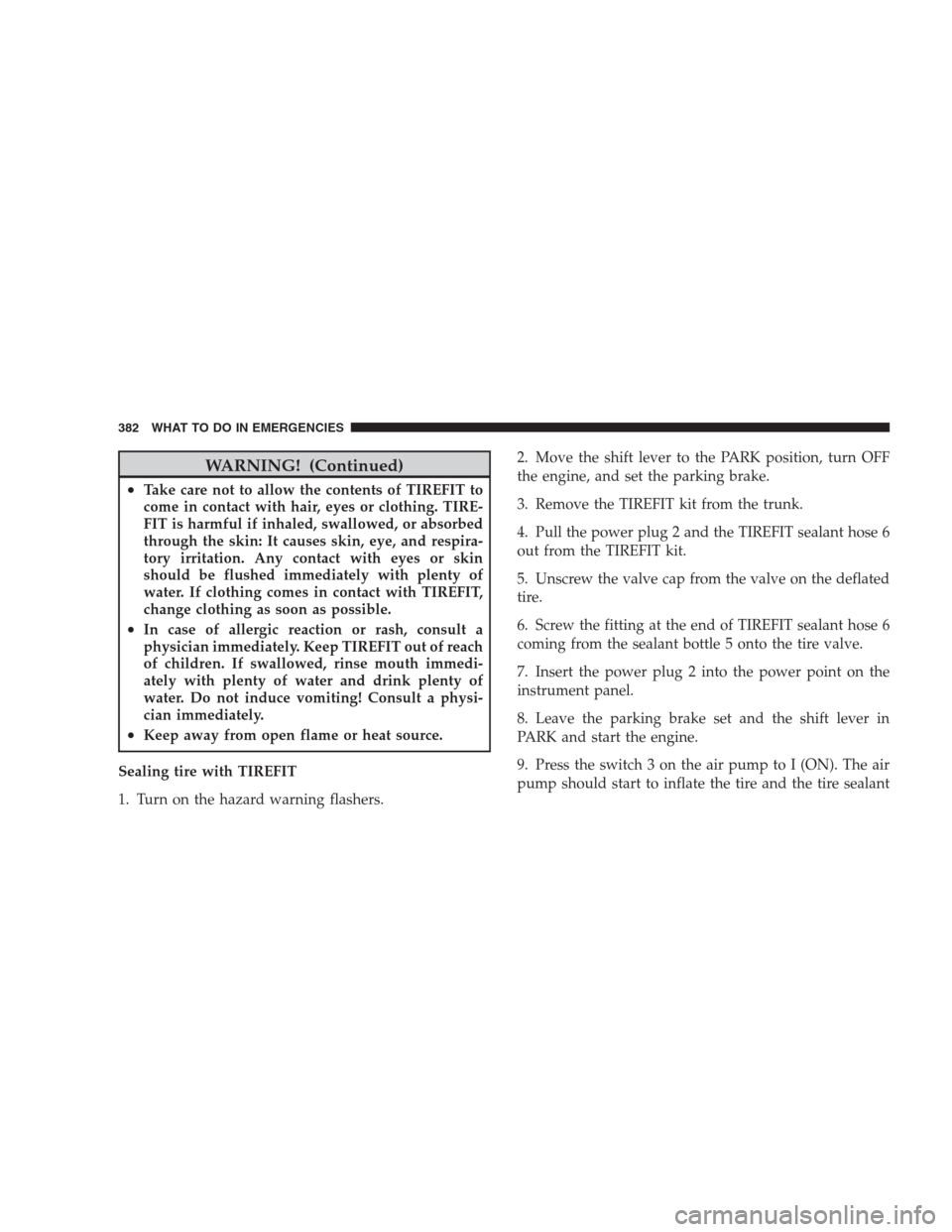
1. Air pump hose
2. Power plug and cable
3. AIR PUMP switch
4. Pressure gauge5. TIREFIT sealant bottle
6. TIREFIT sealant hose
WARNING!
•Do not attempt to repair a tire on the side of the
vehicle close to traffic. Pull far enough off the road
to avoid the danger of being hit when operating
the jack or repairing a tire.
•Cuts or punctures larger than approximately
0.16 in (4 mm), tire damage caused by driving with
extremely low tire pressure or on a flat tire, or a
damaged wheel can pose a hazard while driving.
TIREFIT should not be used in such circum-
stances. Do not drive the vehicle under such cir-
cumstances. Contact your nearest authorized
dealer for assistance.
(Continued)
Tirefit Kit
WHAT TO DO IN EMERGENCIES 381
6
Page 384 of 493
WARNING! (Continued)
•Take care not to allow the contents of TIREFIT to
come in contact with hair, eyes or clothing. TIRE-
FIT is harmful if inhaled, swallowed, or absorbed
through the skin: It causes skin, eye, and respira-
tory irritation. Any contact with eyes or skin
should be flushed immediately with plenty of
water. If clothing comes in contact with TIREFIT,
change clothing as soon as possible.
•In case of allergic reaction or rash, consult a
physician immediately. Keep TIREFIT out of reach
of children. If swallowed, rinse mouth immedi-
ately with plenty of water and drink plenty of
water. Do not induce vomiting! Consult a physi-
cian immediately.
•Keep away from open flame or heat source.
Sealing tire with TIREFIT
1. Turn on the hazard warning flashers.2. Move the shift lever to the PARK position, turn OFF
the engine, and set the parking brake.
3. Remove the TIREFIT kit from the trunk.
4. Pull the power plug 2 and the TIREFIT sealant hose 6
out from the TIREFIT kit.
5. Unscrew the valve cap from the valve on the deflated
tire.
6. Screw the fitting at the end of TIREFIT sealant hose 6
coming from the sealant bottle 5 onto the tire valve.
7. Insert the power plug 2 into the power point on the
instrument panel.
8. Leave the parking brake set and the shift lever in
PARK and start the engine.
9. Press the switch 3 on the air pump to I (ON). The air
pump should start to inflate the tire and the tire sealant
382 WHAT TO DO IN EMERGENCIES
Page 385 of 493
(white fluid) will flow from the sealant bottle 5 through
the TIREFIT sealant hose 6 and into the tire.
10. Allow the air pump to run for five minutes and then
read the pressure gauge 4. If the tire inflates to 26 psi
(1.8 bar) or greater, proceed to Step 19 of this procedure.
If not, proceed to the following step.
11. Press the AIR PUMP switch 3 to 0 (OFF). Then,
disconnect the TIREFIT system from the tire and place it
back in the vehicle.
12. Release the parking brake and drive the vehicle back
and forth approximately 30 ft (9.1 m) to distribute the
sealant more evenly within the tire.
13. Turn on the hazard warning flashers.
14. Move the shift lever to the PARK position, turn OFF
the engine, and set the parking brake.15. Disconnect the air pump hose 1 from the underside
of the sealant bottle 5 by flipping the hose valve open.
16. Connect the air pump hose valve to the tire valve and
flip the hose valve closed.
17. Leave the parking brake set and the shift lever in
PARK and start the engine.
18. Press the switch 3 on the air pump to I (ON). The air
pump should inflate the tire to at least 26 psi (1.8 bar)
within five minutes. If the tire inflates to this level,
proceed to the following step.NOTE:If a tire pressure of
26 psi (1.8 bar) is not obtained within five minutes, the
tire is too badly damaged. Do not attempt to drive the
vehicle further. Call for assistance.
19. With a tire pressure of no less than 26 psi (1.8 bar)
press the AIR PUMP switch 3 to 0 (OFF) and turn off the
engine. Then, disconnect the TIREFIT system from the
tire and place it back in the vehicle.
WHAT TO DO IN EMERGENCIES 383
6
Page 386 of 493
20. Release the parking brake and drive the vehicle for
approximately 10 minutes to ensure optimum distribu-
tion of the tire sealant within the tire.
21. Turn on the hazard warning flashers.
22. Move the shift lever to the PARK position, turn OFF
the engine, and set the parking brake.
23. Disconnect the air pump hose 1 from the underside
of the sealant bottle 5 by flipping the hose valve open.
24. Connect the air pump hose valve to the tire valve and
flip the hose valve closed.
25. Check the pressure in the tire by reading the pressure
gauge 4. If the pressure is 19 psi (1.3 bar) or greater,
proceed to the following step.NOTE:If the pressure is
less than 19 psi (1.3 bar), the tire is too badly damaged.
Do not attempt to drive the vehicle further. Call for
assistance.26. Leave the parking brake set and the shift lever in
PARK and start the engine.
27. Inflate the tire to the pressure indicated on the tire
pressure label on the driver-side latch pillar by pressing
the switch 3 on the air pump to I (ON) and watching the
pressure gauge. When the tire pressure is set to the
pressure indicated on the tire pressure label, press the
AIR PUMP switch 3 to 0 (OFF) and turn off the engine.
28. Disconnect the TIREFIT system from the tire and
reinstall the valve cap.
29. Place the sealant kit back in the trunk of the vehicle.
Replace the sealant bottle at your nearest authorized
MOPAR�parts dealership.
30. Have the tire inspected at the earliest opportunity at
an authorized dealer or tire service center.
384 WHAT TO DO IN EMERGENCIES
Page 387 of 493
NOTE:
•If a pressure of at least 19 psi (1.3 bar) cannot be
maintained in the tire, the tire is too badly damaged.
Do not attempt to drive the vehicle further. Call for
assistance.
•Do not operate the electric air pump for more than
eight minutes to avoid overheating. The air pump may
be used again once it has cooled down.
•Replace the TIREFIT sealant bottle 5 once every four
years to assure optimum operation of the system.
•If TIREFIT is liquid, clean water and a damp cloth will
remove the material from the vehicle or tire and wheel
components. Once TIREFIT sealing material has dried,
it can easily be peeled off and properly discarded.
•Do not exceed 55 mph (90 km/h) until the tire has
been inspected.
JUMP-STARTING PROCEDURES
WARNING!
•Take care to avoid the radiator cooling fan when-
ever the hood is raised. It can start anytime the
ignition switch is ON. You can be hurt by the fan.
•Do not attempt to push or tow your vehicle to get
it started. Vehicles equipped with an automatic
transmission cannot be started this way. Unburned
fuel could enter the catalytic converter and once
the engine has started, ignite and damage the
converter and vehicle. If the vehicle has a dis-
charged battery, booster cables may be used to
obtain a start from another vehicle. This type of
start can be dangerous if done improperly, so
follow this procedure carefully.
(Continued)
WHAT TO DO IN EMERGENCIES 385
6
Page 388 of 493
WARNING! (Continued)
•Battery fluid is a corrosive acid solution; do not
allow battery fluid to contact eyes, skin, or cloth-
ing. Don’t lean over battery when attaching
clamps or allow the clamps to touch each other. If
acid splashes in eyes or on skin, flush contami-
nated area immediately with large quantities of
water.
•A battery generates hydrogen gas, which is flam-
mable and explosive. Keep flame or spark away
from the vent holes.
•Do not use a booster battery or any other booster
source with an output that exceeds 12-Volts.
•The battery in this vehicle has a vent hose that
should not be disconnected and should only be
replaced with a battery of the same type (vented).NOTE:The battery is stored under an access cover in
the trunk. Remote battery terminals are located in the
engine compartment for jump-starting.
1. Wear eye protection and remove any metal jewelry
such as watchbands or bracelets that might make an
inadvertent electrical contact.
2. When boost is provided by a battery in another
vehicle, park that vehicle within booster cable reach, but
do not allow the vehicles to touch one another.
WARNING!
Do not permit vehicles to touch each other as this
could establish a ground connection and personal
injury could result.
3. Set the parking brake, place the automatic transmis-
sion in PARK, and turn the ignition switch to the LOCK
position on both vehicles.
386 WHAT TO DO IN EMERGENCIES